Every Rolex Release in 2026: New Models and Prices
All 58 new references from Watches and Wonders 2026, from the Rolesium Daytona to centennial Oyster Perpetual editions — with every retail price.

- 58 new references spanning seven model families, priced from $6,750 to $98,100
- The centennial theme celebrates 100 years since the Oyster case patent of 1926
- Headline piece: the Rolesium Daytona (ref. 126502), $57,800 — the first Daytona in steel and platinum
- The Yacht-Master II returns with a redesigned case and new Cal. 4162 movement
- Secondary market: GMT Pepsi up 19%, Lady-Datejust up 36% over the past 12 months
The Centennial Story: Why 2026 Is Different
Every year at Watches and Wonders, Rolex occupies the largest booth on the floor, and every year the crowd arrives expecting a revolution. Most years they leave with a palette swap. 2026 was not most years. One hundred years ago, in 1926, Hans Wilsdorf patented the Oyster case — the hermetically sealed wristwatch housing that transformed timekeeping from a parlour curiosity into something you could wear across an ocean, down a mine shaft, or through a world war. That patent is the single most consequential invention in the history of wristwatches, and Rolex treated its centennial accordingly.
Fifty-eight new references rolled out across seven model families. The price band stretched from $6,750 for the entry-level Oyster Perpetual 36 to $98,100 for a diamond-paved Day-Date 36 in white gold. Between those poles sat a roster that rewarded long-time collectors, caught the attention of newcomers, and — crucially — gave authorized dealers fresh inventory at a time when waitlists have begun to loosen.
The centennial thread ran through almost every release. The Oyster Perpetual received a mosaic “Jubilee Motif” dial spelling “Rolex” in more than ten hues. A new Yellow Rolesor variant stamped “100” into the crown. And the flagship announcement — the Rolesium Daytona — used a white grand feu enamel dial that nodded directly to the earliest Oyster aesthetics.
For buyers, the practical question is always the same: what does this mean for prices? We will get to the secondary-market data later in this guide. First, here is every significant release, model by model, with retail pricing confirmed at the time of the Geneva show.
The Headline Release: Rolesium Daytona
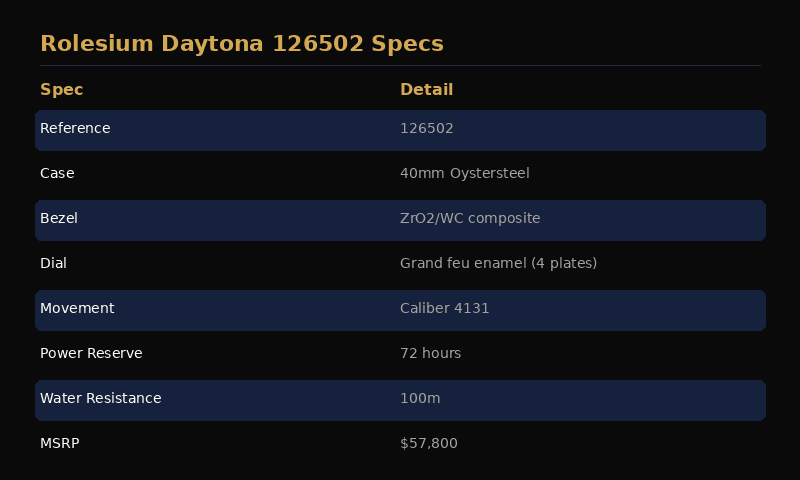
“Rolesium” is Rolex’s proprietary name for its steel-and-platinum combination. Until now, the treatment had appeared on the Yacht-Master and a handful of Datejust references. The Cosmograph Daytona had never received it. Ref. 126502 changes that, and the result is arguably the most technically interesting Daytona since the ceramic bezel arrived in 2016.
The case is Oystersteel. The bezel is 950 platinum — but this is not the polished platinum ring of the Yacht-Master. Rolex developed a new zirconia-and-tungsten-carbide ceramic insert specifically for this reference, bonded to the platinum substrate. The surface has a matte, almost granular texture that photographs closer to titanium than to the bright silver you would expect from platinum. Under direct light, a subtle blue-grey undertone appears. It is unlike any bezel Rolex has produced.
The dial is white grand feu enamel, assembled from four separate ceramic plates fired at roughly 800 °C. Enamel dials are notoriously difficult to produce at scale because bubbles, cracks and colour variations during firing mean rejection rates above 50 percent. Rolex’s solution — sectioning the dial into four independent plates — lets them fire smaller surfaces with tighter temperature control, then assemble the quadrants with near-invisible seams. The result is a pure, glassy white that does not yellow over decades the way lacquer can.
Inside sits calibre 4131, the same column-wheel chronograph movement found in the current Daytona range. It runs at 28,800 vph with a 72-hour power reserve and carries Rolex’s Superlative Chronometer certification (−2/+2 seconds per day after casing). The 126502 is not a new-movement launch; it is a new material and dial execution on proven mechanicals.
Retail price: $57,800. That positions it above the steel Daytona ($15,100) and below the white-gold Daytona ($32,600 retail, but over $40,000 on the secondary market). Demand forecasting is always speculative, but the combination of a first-ever material pairing, a centennial launch, and a production process with high rejection rates suggests the 126502 will carry a significant waitlist. If you are interested, registering with your authorized dealer early matters.
For a deeper look at the Daytona range and how the Rolesium fits alongside existing references, see our Rolex Daytona Buyer’s Guide.
The Oyster Perpetual Centennial Editions
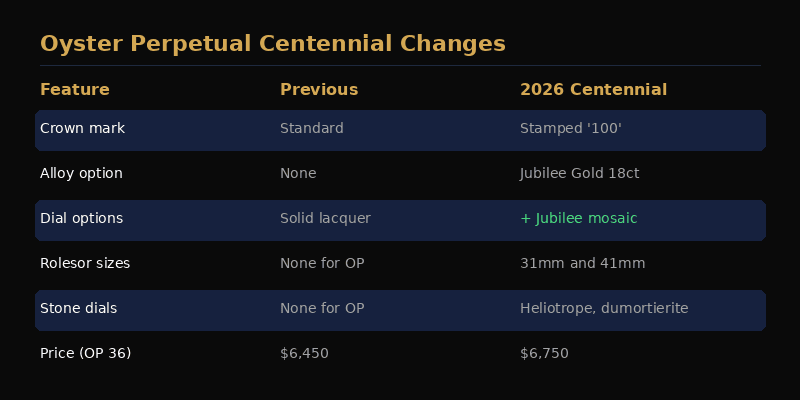
If the Rolesium Daytona was the show-stopper, the Oyster Perpetual centennial editions were the crowd-pleasers. Rolex treated the OP — its most accessible collection — to three distinct updates: the Jubilee Motif dial, a new Yellow Rolesor variant, and two precious-metal references that push the traditionally entry-level model into unexpected territory.
Jubilee Motif Dial
Available across three sizes — 31 mm (ref. 277200), 36 mm (ref. 126000), and 41 mm (ref. 134300) — the Jubilee Motif dial is a mosaic pattern that spells “Rolex” in more than ten colours. The effect is playful by Rolex standards, closer to the candy-coloured OP dials that drove a frenzy in 2020 than to the staid indices of the traditional range. At arm’s length, the dial reads as an abstract geometric pattern; up close, the lettering resolves. The OP 36 starts at $6,750 and the OP 41 at $7,050.
Yellow Rolesor (Steel and 18k Gold)
Rolex has never offered the Oyster Perpetual in Rolesor — until now. Ref. 134303 (41 mm, $9,650) and ref. 277203 (31 mm, $7,700) pair an Oystersteel case with an 18-karat yellow gold fluted bezel. The crown is stamped “100” as a centennial mark, a detail subtle enough that most people will never notice it. For buyers who want something between a steel OP and a full-gold Datejust, this fills a gap that has existed since the collection launched.
Precious-Metal Oyster Perpetuals
Two references push the OP into territory traditionally reserved for the Datejust and Day-Date. The OP 28 in 18-karat yellow gold (ref. 276208, $30,000) features green heliotrope stone markers — a brand first for the Oyster Perpetual. The OP 34 in Everose gold (ref. 124205, $38,100) carries a dumortierite stone dial, the blue-violet mineral creating an effect reminiscent of lapis lazuli but with more variation in tone.
These are not volume pieces. They are centennial gestures — a way for Rolex to demonstrate that the Oyster case, the invention being celebrated, is versatile enough to hold precious stones and precious metals without losing the robust, tool-watch identity that made it famous. For a broader overview of the collection, read our Rolex Oyster Perpetual Price Guide.
Yacht-Master II Returns
The Yacht-Master II has always occupied an awkward position in the Rolex catalogue. Its regatta countdown complication is genuinely useful for competitive sailors and genuinely confusing for everyone else. The previous generation — big, angular, and topped with a blue Cerachrom bezel — divided opinion sharply. Rolex’s response in 2026 is a from-the-ground-up redesign.
The case remains 44 mm but has been completely reworked. Lug-to-lug length is shorter, making the watch wear smaller on the wrist despite the identical diameter. Water resistance increases to 100 metres, up from the previous model’s somewhat puzzling 100-metre rating that had been reduced from earlier versions. The bezel is now bidirectional, with a cleaner countdown scale that simplifies the regatta-start programming.
Inside is the new calibre 4162, replacing the 4161. Rolex has not published granular details on the changes, but the movement carries their latest Chronergy escapement and a 72-hour power reserve, up from the previous 70 hours. The regatta countdown mechanism remains mechanical — not digital — and is still programmable from one to ten minutes.
Two variants launched: ref. 126680 in Oystersteel at $20,300 and ref. 126688 in 18-karat yellow gold at $57,800. Both come on Oyster bracelets. The steel version is competitively priced against the Omega Seamaster Planet Ocean Chronograph ($9,100) and well below the Blancpain Fifty Fathoms Chronograph ($18,700), though neither of those offers a regatta countdown.
Whether the redesign changes the Yacht-Master II’s fortunes on the secondary market remains to be seen. Previous references have traded below retail — rare for a steel sport Rolex — because demand never matched the more universally appealing Submariner or GMT-Master II. The shorter case proportions and cleaner dial may help, but this is still a niche complication.
Check Any Watch Price in Seconds
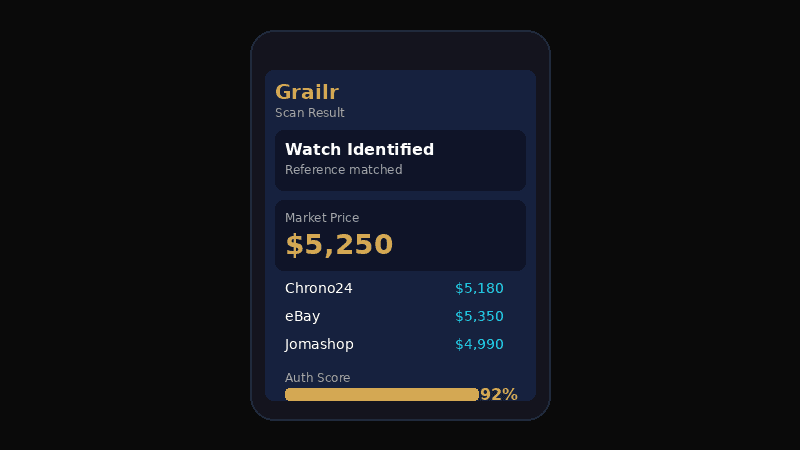
Grailr scans your watch photo and pulls live pricing from Chrono24, eBay, and Jomashop.
- AI identifies brand, model & reference number
- Live market prices from 3+ sources
- Authentication confidence score
Datejust and Day-Date Updates
Where the Oyster Perpetual and Daytona took the centennial headlines, the Datejust and Day-Date received more targeted updates — new dial colours, new materials, and in the Day-Date’s case, an entirely new gold alloy.
Datejust Green Ombré Dial
Green has been Rolex’s colour story for three years running, and the 2026 Datejust doubles down. Ref. 126200 (36 mm, $8,150) and ref. 126300 (41 mm, $8,950) receive a green lacquer dial with a sunburst gradient that deepens from a pale sage at the centre to a rich forest green at the chapter ring. The effect is similar to the green Submariner dial but on a dressier canvas, with applied hour markers rather than lume plots.
Both come on Jubilee bracelets in Oystersteel. At these price points they sit comfortably in the Datejust’s traditional sweet spot: accessible enough for a first Rolex, refined enough to wear with a suit. For a full breakdown of the Datejust range, see our Rolex Datejust Buying Guide.
Day-Date 40 “Jubilee Gold”
The Day-Date 40 (ref. 228235) arrives in a new 18-karat alloy Rolex calls “Jubilee Gold.” It is a warm champagne tone with grey and pink undertones — somewhere between yellow gold and Everose, and distinct from both. Rolex developed the alloy in-house at their foundry in Plan-les-Ouates, and it is exclusive to centennial references. The dial is pale green aventurine with baguette diamond hour markers. Retail is $62,700.
Off-Catalogue Day-Date 36 Models
Seven Day-Date 36 references were released outside the standard catalogue, each with a natural stone dial: meteorite, aventurine, lapis lazuli, tiger’s eye, malachite, onyx, and chrysoprase. Prices range from $62,705 to $76,600, and availability is limited to select Rolex boutiques. These are collectors’ pieces, not volume production, and they are likely to appreciate on the secondary market simply because so few will be made.
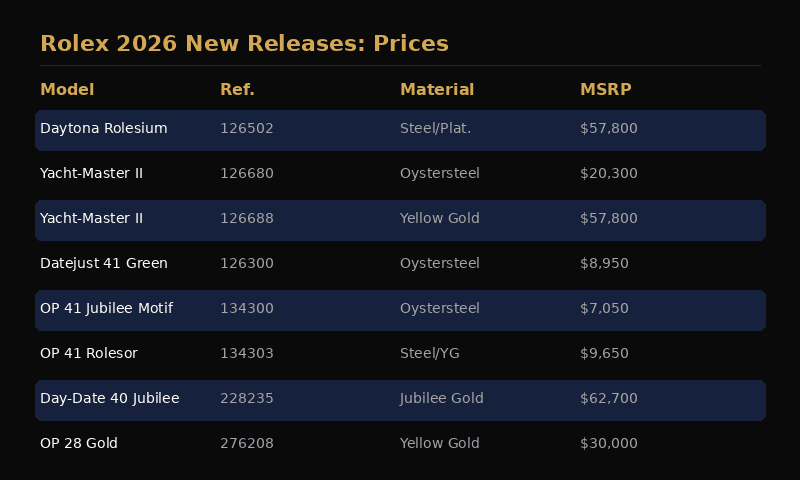
| Model | Reference | Size | Material | Retail Price |
|---|---|---|---|---|
| Daytona Rolesium | 126502 | 40 mm | Steel & Platinum | $57,800 |
| Yacht-Master II | 126680 | 44 mm | Oystersteel | $20,300 |
| Yacht-Master II | 126688 | 44 mm | 18k Yellow Gold | $57,800 |
| OP Jubilee Motif | 126000 | 36 mm | Oystersteel | $6,750 |
| OP Jubilee Motif | 134300 | 41 mm | Oystersteel | $7,050 |
| OP Yellow Rolesor | 134303 | 41 mm | Steel & 18k Gold | $9,650 |
| Datejust Green | 126200 | 36 mm | Oystersteel | $8,150 |
| Datejust Green | 126300 | 41 mm | Oystersteel | $8,950 |
| Day-Date 40 Jubilee Gold | 228235 | 40 mm | 18k Jubilee Gold | $62,700 |
| OP 28 Yellow Gold | 276208 | 28 mm | 18k Yellow Gold | $30,000 |
| OP 34 Everose Gold | 124205 | 34 mm | 18k Everose Gold | $38,100 |
Not included in the table: seven off-catalogue Day-Date 36 models with natural stone dials ($62,705–$76,600) and the diamond-paved Day-Date 36 at the top of the range ($98,100). For any of these, Grailr’s identification tool can confirm reference numbers from a photograph — useful when dealer listings are vague about which stone dial variant they are offering.
What Happened to Prices After the Announcements
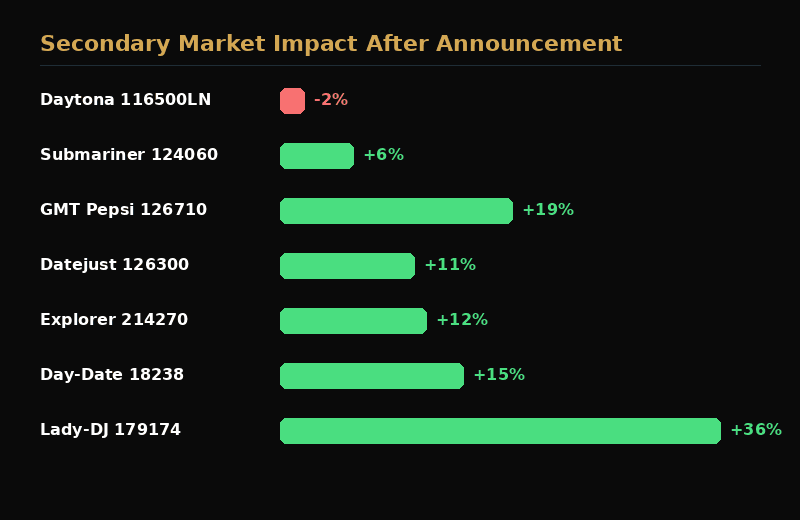
New releases always send ripples through the secondary market. Discontinued models can spike in value overnight if collectors perceive them as the “last of their kind.” Current-production references can soften if a new variant steals attention. And sometimes the market barely reacts at all. Here is what actually happened to key Rolex references over the 12 months surrounding the 2026 announcements.
| Reference | Model | 12-Month Change | Context |
|---|---|---|---|
| 116500LN | Daytona (discontinued) | −2% | Softening as collectors shift focus to the Rolesium |
| 124060 | Submariner | +6% | Steady demand; no 2026 update keeps supply tight |
| 126710BLRO | GMT-Master II “Pepsi” | +19% | Strongest performer; no update expected until 2027+ |
| 126300 | Datejust 41 | +11% | Green ombré launch boosted existing dial variants |
| 214270 | Explorer | +12% | Discontinued reference; steady collector demand |
| 18238 | Day-Date “President” | +15% | Jubilee Gold alloy renews interest in vintage gold DD |
| 179174 | Lady-Datejust | +36% | Women’s Rolex market continues multi-year rally |
The standout is the Lady-Datejust 179174 at +36 percent. Women’s Rolex references have been the strongest-performing segment of the secondary market for two consecutive years. Supply is constrained because many Lady-Datejust and Lady-Date models were produced in smaller numbers than their men’s counterparts, and a growing cohort of women collectors is entering the market.
The GMT-Master II “Pepsi” at +19 percent benefits from the absence of a 2026 update. When Rolex leaves a popular sport model unchanged, secondary-market buyers treat existing references as safe holds — there is no risk of a new version making yours look dated. Read our GMT-Master II Guide for the full reference breakdown.
The mild softening of the discontinued Daytona 116500LN (−2 percent) is worth watching. It may simply be a temporary dip as attention shifts to the Rolesium, or it may signal the beginning of a longer correction now that the current-generation 126500 has established itself. Either way, if you are tracking a specific reference, Grailr’s appraisal tool can pull current secondary-market comparables in seconds.
What These Releases Mean for Buyers
The 2026 releases break neatly into three buying categories, each with a different strategic consideration.
Entry-Level Buyers: The Best Time in Years
If you are buying your first Rolex, the Oyster Perpetual 36 at $6,750 or the Datejust 36 at $8,150 are strong starting points. The OP’s Jubilee Motif dial gives you a talking point that most Rolex owners cannot match — it is genuinely unusual for the brand — and the Datejust green ombré delivers more visual impact than the standard silver or blue dials at the same price. Waitlists for steel Datejust and OP models have shortened meaningfully through 2025 and into 2026, and some authorized dealers have these on the shelf.
Mid-Range Collectors: Watch the Yacht-Master II
The redesigned Yacht-Master II at $20,300 is the most interesting value proposition in the 2026 lineup for buyers who already own a Submariner or GMT and want something different. Previous Yacht-Master II references have traded below retail on the secondary market, meaning you may be able to pick one up at or near list price without a waitlist. If the redesign is well received and production is limited, early buyers could see modest appreciation. If reception is lukewarm, you will at least have bought at retail rather than paying a grey-market premium.
High-End Collectors: The Rolesium Is the Play
At $57,800, the Rolesium Daytona is expensive by any standard, but its combination of a first-ever material pairing, limited production driven by enamel-dial rejection rates, and centennial timing makes it the most likely candidate for significant secondary-market premiums. The Day-Date 40 Jubilee Gold at $62,700 is the other high-end piece worth considering, especially if you value a new precious-metal alloy that may not appear outside centennial references. Both require a strong relationship with your authorized dealer.
Across all price tiers, one principle holds: know what you are paying before you commit. Whether you are buying from an authorized dealer, a grey-market seller, or a private party, scanning the watch with Grailr gives you an identification confidence score and live market comparables from Chrono24, eBay, and Jomashop. It takes less than a minute, and it can save you from overpaying by thousands.
Frequently Asked Questions
How many new Rolex watches were released at Watches and Wonders 2026?
Rolex unveiled 58 new references across seven collections. Prices range from $6,750 for the Oyster Perpetual 36 with Jubilee Motif dial to $98,100 for a diamond-paved Day-Date 36 in white gold. The centennial theme celebrated 100 years since the Oyster case patent of 1926.
What is the Rolex Rolesium Daytona and how much does it cost?
The Rolesium Daytona (ref. 126502) is the first Cosmograph Daytona in Rolex’s steel-and-platinum ‘Rolesium’ combination. It features a white grand feu enamel dial made from four ceramic plates fired at 800 °C and a new zirconia/tungsten-carbide bezel insert. Retail price is $57,800.
What is the cheapest new Rolex in 2026?
The most affordable new 2026 Rolex is the Oyster Perpetual 36 with the Jubilee Motif dial (ref. 126000) at $6,750. The OP 41 with the same dial starts at $7,050, and the OP 31 at an undisclosed but lower price point. These are steel watches on Oyster bracelets.
Did Rolex update the Submariner or GMT-Master II in 2026?
No. The Submariner and GMT-Master II were unchanged in the 2026 cycle. The GMT-Master II ‘Pepsi’ (126710BLRO) has risen 19% on the secondary market over the past 12 months, partly because the absence of an update signals stability in current references.
Are Rolex prices going up or down after Watches and Wonders 2026?
It depends on the model. The GMT-Master II ‘Pepsi’ is up 19%, the Lady-Datejust 179174 is up 36%, and the Datejust 126300 is up 11% over the past 12 months. The discontinued Daytona 116500LN has softened by 2%. Use Grailr’s appraisal tool to check current prices for any specific reference.
What is Jubilee Gold?
Jubilee Gold is a new 18-karat gold alloy developed by Rolex for centennial references. It has a warm champagne tone with grey and pink undertones, distinct from both yellow gold and Everose gold. It debuts on the Day-Date 40 (ref. 228235) at $62,700.
Related Articles
The Bottom Line
Rolex’s centennial year delivered more than a coat of commemorative paint. The Rolesium Daytona introduces a genuinely new material-and-dial combination to the brand’s most coveted chronograph. The Oyster Perpetual centennial editions give entry-level buyers a reason to visit their dealer. And the Yacht-Master II redesign takes a divisive model and makes a serious case for its existence.
For buyers, the takeaway is practical: the secondary market favours models that were not updated (GMT-Master II, Submariner), while new releases create short-term uncertainty that can become a buying opportunity. Whether you are tracking a specific reference or browsing the new lineup, scan it with Grailr to verify what you are looking at and what it is actually worth.
Spotted a 2026 Release?
Scan any listing or dealer photo to verify the reference number, check live pricing across Chrono24, eBay and Jomashop, and get an identification confidence score.
Scan a Watch NowSources and price context
- Rolex Official Collection — current model configurations and retail pricing.
- Watches and Wonders Geneva — the annual salon where these references were announced.
Retail prices shown are manufacturer-suggested retail at the time of the Geneva announcement and may vary by region. Secondary-market percentages are indicative 12-month changes based on completed sales data, not live quotes or guaranteed returns. Compare the exact reference, condition and sale date before relying on any figure.