Seiko Astron GPS Solar Guide: Every Model Compared
Price context: this guide includes indicative prices from its original publication period. They have not all been refreshed to current quotes. Use the linked primary sources for specifications and policies, and verify prices independently.
Key Takeaways
- The Seiko Astron was the world’s first GPS Solar watch when it launched in 2012, inheriting the name of the 1969 Quartz Astron
- The 5X caliber family is the world’s smallest GPS solar movement — three-second time zone changes, perpetual calendar to 2100
- Current models range from $2,400–$3,200, all in titanium with 100m water resistance and solar charging
- The 2026 5X63 chronograph caliber adds a 24-hour chronograph to the GPS Solar platform for the first time
- GPS syncs twice daily for atomic-level accuracy — zero maintenance, no battery replacement
What Is Seiko Astron GPS Solar?
The Seiko Astron GPS Solar is one of the most technologically ambitious watch lines in production. Launched on 7 September 2012 — exactly 43 years after Seiko’s original Quartz Astron became the world’s first quartz wristwatch on Christmas Day 1969 — the modern Astron became the world’s first watch to receive GPS signals and convert them to precise timekeeping.
The heritage is intentional. The 1969 Quartz Astron (reference 35SQ) redefined watchmaking by proving a battery-powered quartz oscillator could keep better time than the finest Swiss mechanical chronometers. That single watch triggered the “Quartz Crisis” that nearly wiped out Switzerland’s mechanical watch industry. Four decades later, Seiko used the same name to signal another inflection point: a watch that sets itself from space and runs on light.
GPS Solar technology works in three layers. First, a high-sensitivity antenna in the case receives signals from the GPS satellite network — 24 satellites orbiting at roughly 20,200 km above the earth, each carrying an atomic clock accurate to billionths of a second. The watch triangulates its position from at least three satellites, determines the local time zone, and sets itself accordingly. Second, a solar cell beneath the dial converts any light — sunlight, office fluorescents, LED bulbs — into electrical energy stored in a rechargeable lithium-ion cell. Third, a perpetual calendar programmed to 2100 automatically adjusts for varying month lengths, leap years, and the GPS leap-second offset.
The practical result is a watch you never set. Cross a time zone and it corrects itself within three seconds. Fly from London to Tokyo and back — the watch tracks every zone change without you touching the crown. Step outside once a day and the GPS antenna does the rest. The solar cell keeps it running for roughly six months on a full charge in complete darkness, or up to two years in power-save mode. For frequent travellers, the Astron is arguably the most useful complication in all of modern watchmaking.
The engineering behind the antenna is worth understanding. Seiko uses a ring antenna integrated into the case mid-section rather than a separate patch antenna, which is how they kept the 5X cases under 14mm thick. The antenna picks up the L1 frequency (1575.42 MHz) transmitted by all GPS satellites. When the watch initiates a sync — either on its automatic schedule or when you press the crown button while outdoors — it connects to a minimum of three satellites, triangulates its position, and reads the atomic clock signal embedded in the satellite’s transmission. The entire process takes roughly six seconds. By contrast, the earlier 8X caliber needed up to 30 seconds for the same operation, and its case was noticeably thicker to accommodate a larger antenna.
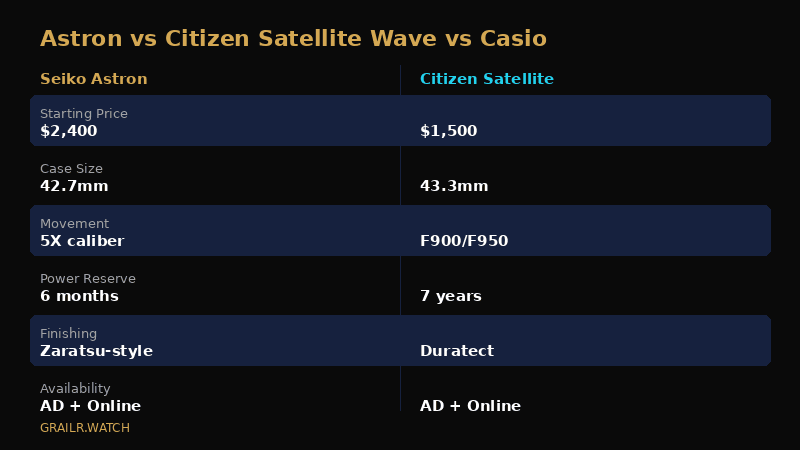
Seiko positions the Astron between its mainstream Prospex and Presage lines and the Grand Seiko brand. At $2,400–$3,200, the Astron is priced above every non-Grand-Seiko watch in Seiko’s catalogue and competes on technology rather than horological tradition. This is a deliberate choice: where Grand Seiko sells craftsmanship, hand-finishing, and the Spring Drive, the Astron sells innovation, convenience, and the promise that you will never need to set your watch again.
Caliber Guide: 5X53, 5X83 & 5X63
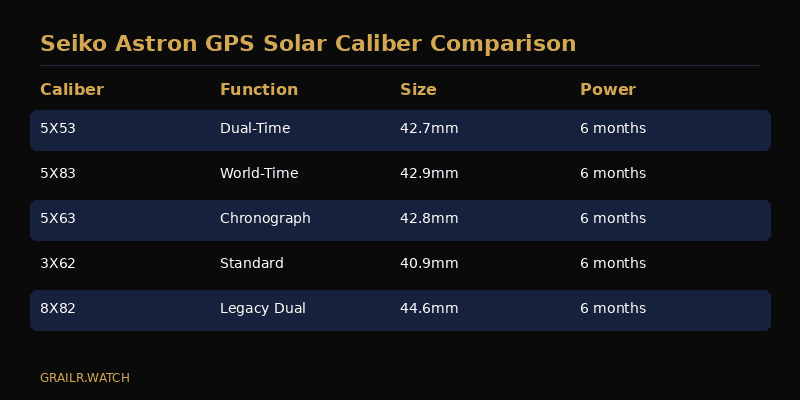
Seiko introduced the Caliber 5X series in 2018 as a wholesale redesign of the Astron GPS Solar platform. The previous 8X calibers were good watches, but they were thick, power-hungry, and slow to acquire satellites. The 5X generation solved all three problems at once, producing what Seiko correctly calls the world’s smallest GPS solar movement. Every 5X caliber shares the same core: GPS satellite reception, solar charging, perpetual calendar to 2100, and a high-precision quartz oscillator that maintains accuracy between syncs.
Caliber 5X53 — Dual-Time
The foundation caliber. The 5X53 displays two time zones simultaneously — the main dial shows local time, while a sub-dial at 6 o’clock shows a second zone you set via the crown. GPS reception is automatic (twice daily) or manual with a single button press. The perpetual calendar handles dates, months, and leap years through 2100 with no adjustment needed. At 42.7mm and 13.3mm thick, it wears like a conventional sports watch despite the satellite technology inside. Power reserve sits at six months on a full charge, with two years in power-save mode. This is the caliber for travellers who move between two cities regularly — a commuter between London and New York, or a consultant splitting time between Singapore and Sydney.
Caliber 5X83 — World-Time
The 5X83 adds a full world-time complication to the 5X platform. A disc beneath the dial displays all 39 standard time zones, and pressing the crown changes the home zone with a three-second animation that sweeps the hour hand, minute hand, and world-time disc to their new positions simultaneously. The city ring on the bezel or dial edge lets you read any zone at a glance. This caliber targets the genuine global traveller — someone who needs to check Tokyo, London, and Dubai in the same meeting. The case dimensions match the 5X53 at 42.7mm, and the power reserve is identical.
Caliber 5X63 — Chronograph (2026)
The newest member of the 5X family, launched in 2026. The 5X63 integrates a 24-hour chronograph into the GPS Solar platform for the first time, adding elapsed-time measurement without sacrificing satellite timekeeping or the perpetual calendar. Two chronograph sub-dials track minutes and hours up to 24 hours, and the central seconds hand doubles as the chronograph seconds counter when activated. The case grows slightly to accommodate the additional mechanism, but remains under 14mm thick. This caliber is aimed at buyers who want both GPS timekeeping and a functional stopwatch — and who would rather have one watch doing both than two watches on a shelf.
| Specification | 5X53 | 5X83 | 5X63 |
|---|---|---|---|
| Function | Dual-Time | World-Time | Chronograph |
| Year introduced | 2018 | 2018 | 2026 |
| Case diameter | 42.7 mm | 42.7 mm | 43.5 mm |
| GPS time zones | 2 zones | 39 zones | 2 zones |
| Chronograph | No | No | 24-hour |
| Perpetual calendar | To 2100 | To 2100 | To 2100 |
| Power reserve | 6 months | 6 months | 6 months |
| Zone change speed | 3 seconds | 3 seconds | 3 seconds |
Current Models & 2026 Pricing
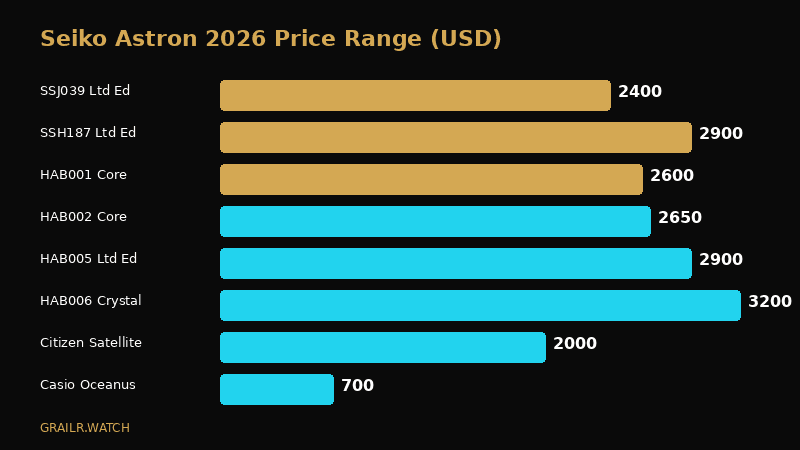
The 2026 Astron lineup spans from accessible titanium sport models to limited-edition releases that attract collectors. All current production Astrons use titanium cases with Seiko’s proprietary super-hard coating, 100m water resistance (suitable for swimming and recreational water activities, not dive-rated), sapphire crystals with anti-reflective coating, and the 5X caliber family described above. Prices sit between $2,400 and $3,200 at authorized dealers, placing the Astron above Seiko’s Presage and Prospex lines but below Grand Seiko.
The SSJ039 is the standout limited edition for 2026: a 1,500-piece production run in titanium with a deep green dial inspired by the Northern Lights. At $2,400 it sits at the entry point of the range but carries genuine collectibility thanks to its restricted numbers. The SSH187 offers a more restrained aesthetic — a black dial with rose-gold accents on a titanium bracelet, priced at $2,700. For buyers who want the new chronograph caliber, the HAB001–006 series launched with the 5X63 in six dial variants, ranging from $2,800 to $2,900.
Every Astron comes with Seiko’s global warranty and the brand’s proprietary Dia-Shield and super-hard coating on the titanium case and bracelet. The coating serves the same purpose as Citizen’s Duratect — hardening the titanium surface to resist everyday scratches — and holds up well over years of daily wear. The sapphire crystals are double-sided anti-reflective, meaning legibility in bright sunlight is excellent. For a closer look at how the Astron’s technology compares to similar solar-powered watches, our Citizen Eco-Drive guide covers the Satellite Wave GPS that competes directly at this price point.
| Model | Caliber | Case / Dial | Price | Notes |
|---|---|---|---|---|
| SSJ039 | 5X53 | Titanium / Green | $2,400 | Limited 1,500 pcs |
| SSH187 | 5X53 | Titanium / Black | $2,700 | Rose-gold accents |
| HAB001 | 5X63 | Titanium / Blue | $2,800 | New chrono caliber |
| HAB003 | 5X63 | Titanium / Silver | $2,800 | New chrono caliber |
| HAB005 | 5X63 | Titanium / Black | $2,900 | DLC-coated case |
| SSJ series | 5X83 | Titanium / Various | $2,500–$3,200 | World-time models |
Check Any Watch Price in Seconds
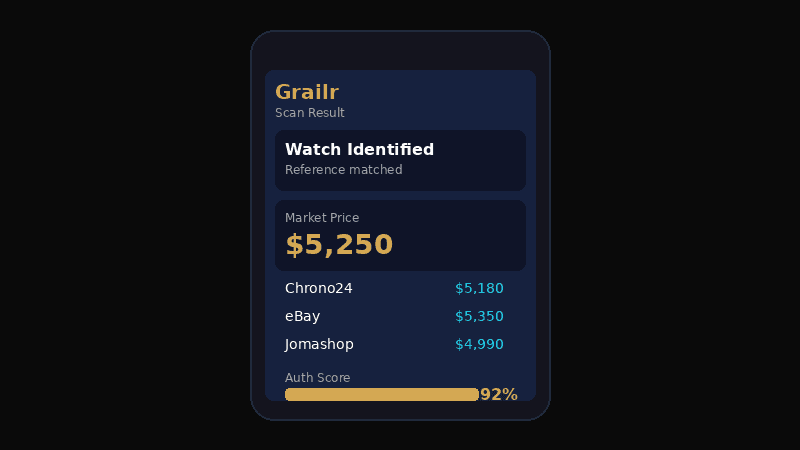
Grailr uses a photo to suggest a watch identity and an indicative price estimate, with active eBay listings where available. Check the exact reference and condition independently; a photo scan cannot authenticate a watch.
- Grailr suggests brand, model & reference
- Active eBay listings where available
- Identification confidence, not authentication
Seiko Astron vs Competitors
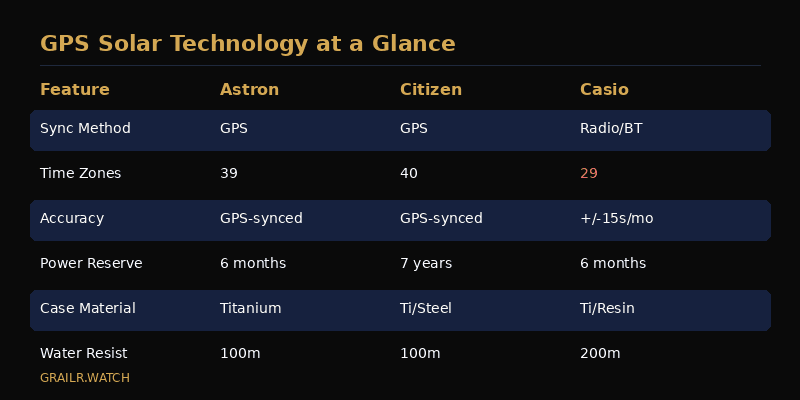
The Astron occupies a narrow competitive space. Only a handful of watches combine GPS satellite timekeeping with solar power, and each takes a different approach to the same engineering problem.
Citizen Satellite Wave GPS — $1,500–$2,500
Citizen’s direct competitor uses the same fundamental technology — GPS satellite reception with solar charging — in their Super Titanium cases with Duratect coating. The CC4004-58E ($1,100) is their flagship GPS model, though the higher-end Satellite Wave models push toward $2,500. Citizen’s Super Titanium finishing has improved dramatically in recent years, and the brand’s approach to surface hardening is arguably more proven than Seiko’s. The Astron commands its premium through movement refinement (the 5X is thinner and acquires satellites faster) and dial finishing that more closely approaches luxury-watch standards. For buyers choosing between the two, the decision often comes down to whether the dial finishing and case proportions justify the $500–$1,000 premium.
Casio Oceanus — $400–$800
Casio’s Oceanus line uses Multi-Band 6 radio-controlled timekeeping rather than GPS. Radio signals cover less of the earth’s surface (you need to be within range of one of six broadcasting stations), but acquisition is faster and uses less power. The Oceanus OCW-T200 series offers solar charging, sapphire crystal, titanium construction, and atomic timekeeping for under $800 — roughly a third of the Astron’s price. The trade-off is coverage: GPS works anywhere with sky visibility, radio does not. If you rarely leave the coverage zones of the US, Europe, Japan, or China, the Oceanus delivers similar time-setting convenience for far less money. The finishing gap between Oceanus and Astron is significant, however — the Astron looks and feels like a substantially more refined watch.
Casio G-Shock GPW-2000 — $600–$900
The G-Shock Gravitymaster GPW-2000 combines GPS timekeeping with Multi-Band 6 radio reception and Bluetooth smartphone connectivity — three time-setting methods in one package. It adds G-Shock’s legendary shock resistance and 200m water resistance. The price is roughly a quarter of the Astron’s. The catch is aesthetics: the GPW-2000 is a large, overtly sporty resin-and-metal watch that belongs with casual or outdoor wear. The Astron, in contrast, works with a suit as easily as it does with a weekend outfit. They solve the same technical problem for entirely different audiences.
Buying Advice: AD, Grey Market & Titanium Care
Buying a Seiko Astron well means understanding where to buy, what you’re paying for, and how to keep the titanium looking sharp over years of daily wear.
Authorized Dealer vs Grey Market
Seiko authorized dealers (ADs) sell Astrons at full retail with the manufacturer’s global warranty. Grey-market sellers — shops that import watches through unofficial channels — typically discount Astrons by 15–25%, bringing a $2,700 model down to $2,000–$2,300. The trade-off is warranty: grey-market watches carry the seller’s own warranty, not Seiko’s. For a GPS Solar watch with no mechanical movement to service, the warranty matters less than it does for a Swiss automatic, since the 5X caliber has few wear points and no regular service interval. Still, if the rechargeable cell fails or the GPS antenna develops a fault, an AD purchase guarantees Seiko will handle the repair. For a deeper comparison, our grey market vs authorized dealer guide covers the full picture.
Titanium Care
Seiko’s super-hard coating protects the titanium from most scratches, but it is not invincible. Avoid contact with abrasive surfaces — concrete, rough stone, unfinished metal — that can damage even hardened titanium. For cleaning, warm water with a mild soap and a soft brush is all you need; avoid ultrasonic cleaners, which can damage the GPS antenna’s shielding over time. The bracelet clasp and link connections are the most vulnerable areas for cosmetic wear; a microfibre cloth after sweaty days helps prevent buildup in the joints.
Strap Options
Most Astrons ship on titanium bracelets, but Seiko also offers crocodile-pattern leather and silicone strap variants on select references. The titanium bracelet is the better long-term choice for daily wear — it’s lighter, more durable, and maintains a consistent look over years. Leather wears faster, particularly in humid climates, and needs replacement every 12–18 months with regular use. Aftermarket silicone straps from brands like Barton or Crafter Blue fit the Astron’s lug spacing and offer a comfortable, sweat-friendly alternative for summer or sport use. If you value quality watch straps, budget $40–$80 for a good aftermarket option.
What to Check Before You Buy
Regardless of where you purchase, inspect three things on any Astron. First, confirm GPS reception by taking the watch outdoors and initiating a manual sync — the seconds hand should sweep to the 12 o’clock position, pause while acquiring satellites, then return to running time when the sync completes. A watch that cannot acquire a signal outdoors may have an antenna fault. Second, check the power reserve indicator, usually a sub-dial at 9 o’clock or a small gauge — it should respond to light exposure within a few minutes near a window. Third, inspect the titanium bracelet or case for any deep scratches that penetrate through Seiko’s hard coating into the bare titanium beneath, which indicates impact damage rather than normal surface wear.
Resale & Value Retention
The secondary market for Seiko Astron GPS Solar watches is more active than most buyers expect. On platforms like eBay, Chrono24, and WatchRecon, used Astrons in good condition typically sell for 40–55% of their original retail price, which is strong for a non-mechanical watch and significantly better than most quartz-based competitors in the same price bracket.
Limited editions hold value best. The SSJ039 (1,500 pieces, $2,400 retail) has already demonstrated secondary-market demand above retail in regions where it sold out at authorized dealers. Previous limited runs like the Novak Djokovic and Honda Jet collaborations followed the same pattern — strong initial demand, limited supply, and steady resale values once the production run ended. Standard-production models follow a more conventional depreciation curve, losing 20–30% on first resale and stabilising at roughly half of retail within two to three years.
The total cost of ownership argument is where the Astron’s economics become genuinely compelling. A $2,700 Astron requires zero servicing over its lifetime — no battery swaps, no movement service, no regulation adjustments. Compare that to a Swiss automatic in the same price range (an Omega Aqua Terra or a Tudor Black Bay, for example), which needs a $500–$800 service every five to eight years. Over 20 years, the Swiss watch accumulates $1,500–$3,000 in servicing costs on top of its purchase price. The Astron accumulates nothing. That difference doesn’t make the Astron a better watch in absolute terms, but it does make it a more predictable financial commitment.
One factor working in the Astron’s favour long-term is its position in Seiko’s heritage narrative. The “Astron” name is one of the most historically significant in all of watchmaking — on the same level as Speedmaster or Submariner in terms of what it represents for the industry. As the original 1969 Quartz Astron becomes an increasingly valuable collector’s item (examples in good condition now trade above $10,000), the modern GPS Solar line benefits from a halo effect that lifts its perceived significance. Whether that translates into meaningful value appreciation for current production models remains to be seen, but the name alone gives the Astron a cultural weight that no Citizen or Casio GPS watch can claim.
Frequently Asked Questions
How does the Seiko Astron GPS Solar watch work?
The Astron connects to the GPS satellite network to determine your exact position and sets the correct time zone automatically. A solar cell beneath the dial converts any light into electrical energy stored in a rechargeable cell, so the watch never needs a battery replacement. It syncs with satellites twice daily for atomic-level accuracy anywhere on earth with a view of the sky.
What is the difference between the 5X53 and 5X63 Astron calibers?
The 5X53 is a dual-time caliber that shows two time zones simultaneously and is the thinnest GPS solar movement Seiko has produced. The 5X63, launched in 2026, adds a 24-hour chronograph function to the GPS solar platform while maintaining the same satellite timekeeping and perpetual calendar. The 5X83 sits between them, adding a full world-time complication with a city-name bezel.
Is the Seiko Astron worth $2,400?
The Astron occupies a unique niche. No Swiss watch under $5,000 offers GPS satellite timekeeping, solar charging, perpetual calendar, and titanium construction in one package. Compared to Citizen’s Satellite Wave GPS ($1,500–$2,500), the Astron commands a premium for its finishing and movement refinement. If you travel frequently or value zero-maintenance accuracy, the Astron delivers genuine technological value that mechanical watches at this price cannot match.
How long does the Astron GPS Solar battery last?
On a full charge, the Astron runs for approximately six months without any light exposure. In power-save mode, it can last up to two years. Under normal wear with regular light exposure, the rechargeable cell stays topped up indefinitely and is designed to last the lifetime of the watch. A full charge from empty takes about six hours in direct sunlight or longer under indoor lighting.
Does the Seiko Astron hold its value?
The Astron retains roughly 40–55% of its retail price on the secondary market, which is strong for a non-mechanical watch. Limited editions like the SSJ039 hold value particularly well due to restricted production numbers. The zero maintenance costs also mean total ownership cost is lower than comparably priced mechanical watches that need servicing every five to eight years.
Can the Seiko Astron GPS Solar work indoors?
The solar charging works from any light source, including indoor lighting, so the watch runs continuously under normal conditions. However, GPS time synchronisation requires a clear view of the sky. The watch stores its last successful sync and maintains accuracy through its high-precision quartz oscillator between syncs. Most wearers find it syncs successfully during outdoor portions of their daily routine.
Related Articles
The Bottom Line
The Seiko Astron GPS Solar is the most technologically advanced solar watch you can buy. It inherits a name that changed the industry twice — once with quartz in 1969, once with GPS in 2012 — and the 2026 lineup, led by the new 5X63 chronograph caliber, continues to push what a non-mechanical watch can do.
At $2,400–$3,200, it asks more than Citizen’s Satellite Wave or Casio’s Oceanus, and it justifies that premium through superior movement refinement, dial finishing, and titanium case quality. The perpetual calendar, automatic GPS time-zone correction, and solar charging mean you will never set the time, change a battery, or book a service appointment. For travellers, technologists, and anyone who values precision without maintenance, the Astron is in a class of its own.
It won’t give you the horological romance of a mechanical movement or the investment-grade appreciation of a Rolex or Patek Philippe. What it will give you is a watch that is functionally perfect, every day, for decades, powered by nothing but light and satellites. That proposition has been compelling since 2012. With the 5X63, it just got better.
Curious What Your Watch Is Worth?
Whether it’s a Seiko Astron, a vintage Citizen, or a Swiss luxury piece — snap a photo and Grailr will identify a likely model and provide an indicative price estimate, with active eBay listings where available for comparison.
Appraise Your WatchSources and price context
- Seiko Astron GPS Solar Technology — Confirms GPS satellite reception, 5X caliber specifications, solar charging details and perpetual calendar range.
- Hodinkee: Introducing the Seiko Astron GPS Solar 5X Caliber — Independent editorial review of the 5X caliber platform, movement dimensions, and satellite acquisition improvements.
These primary sources support the specific history, specification or policy points noted above. Prices and resale percentages elsewhere in this guide are indicative editorial figures, not a verified transaction dataset or guaranteed returns. Confirm the exact reference, region, condition and current quote before buying; asking prices are not completed-sale prices.