Identification guide
Seiko Serial Number Lookup: Month Codes and Dating Guide
Learn to read Seiko serial month codes, separate case and calibre numbers, narrow the possible decade and check the evidence before buying a used watch.
By Grailr Watch Intelligence · · 12 min read
What a Seiko serial lookup can tell you
For many Seiko watches using a traditional six-character serial pattern, the first character indicates a year ending and the second a month. That is a starting point, not a complete production date. The decade needs additional evidence, and other numbering formats need their own research. A plausible result does not prove the watch is original or establish its value.
This guide explains how to collect the right markings, read the commonly used month code and narrow a possible date without pretending every Seiko follows one universal rule. It is a research guide, not access to Seiko's private records. If your real question is whether a used watch is worth buying, you will also need the reference, condition, known work and seller terms.
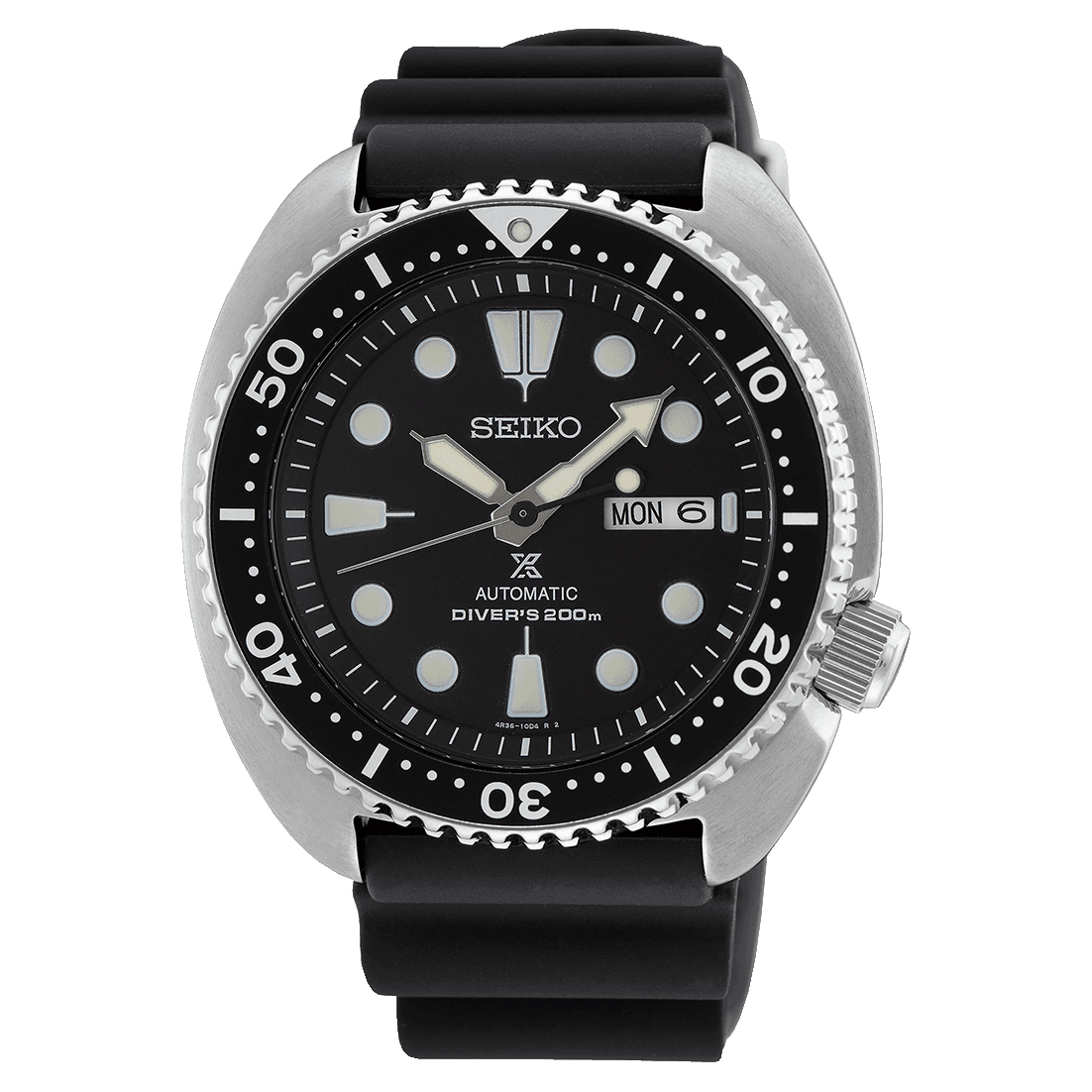
The photograph above shows a Seiko Turtle SRPE93 using Seiko's SRPE93K1 product image. It helps identify the type of watch being discussed; it does not show an individual serial or prove a production date. The fictional serial used below is not assigned to this pictured watch. Keeping those two things separate prevents a product photograph from becoming invented evidence.
Find the caseback information before searching
Seiko's official instruction finder directs owners to the calibre code on the caseback when selecting a manual. Photograph the whole back clearly, then take closer views of any difficult markings. Use soft light and change the angle to reduce reflections. Do not polish engraving or scratch dirt away with a metal tool just to improve a photograph.
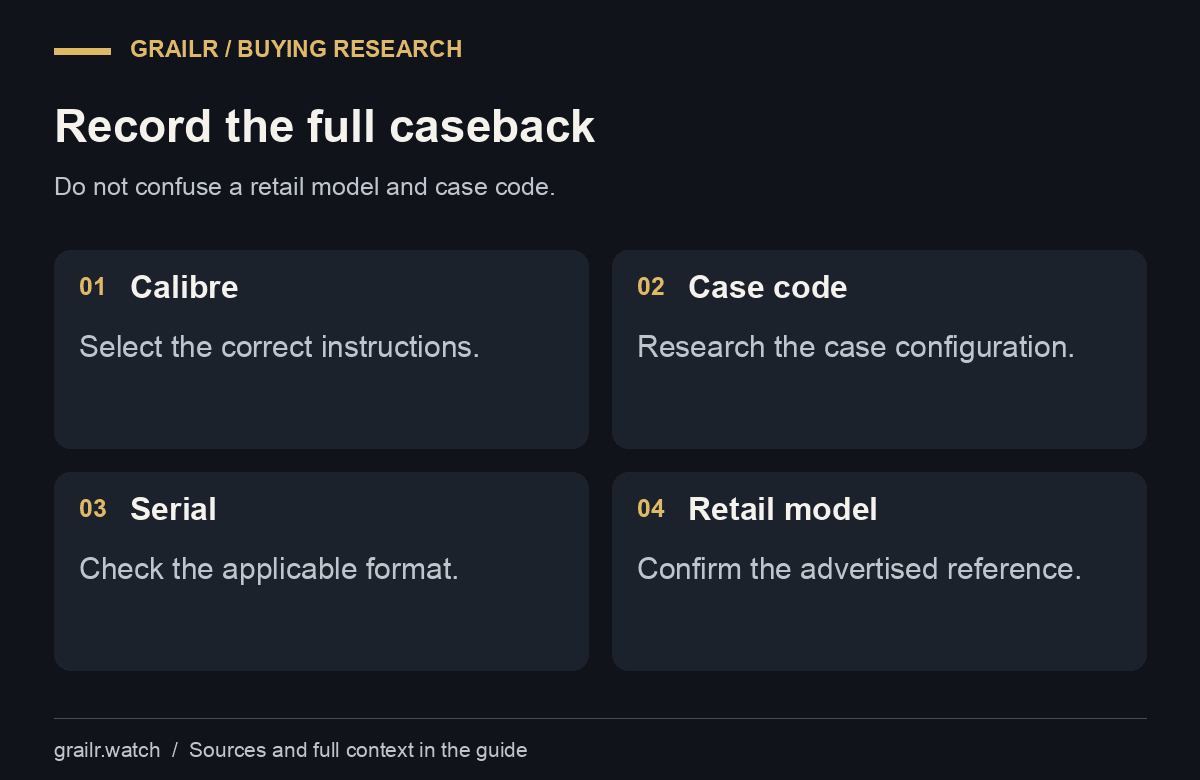
Record the movement-and-case code separately from the serial. In the commonly encountered format, the hyphenated code combines a calibre designation and case code. The retail model name used in a shop or advertisement can be different. Preserve every character rather than assuming a partial match identifies the exact watch. A familiar collection nickname is useful for conversation, but it is not a substitute for the markings.
| Detail | Where your evidence comes from | What to use it for |
|---|---|---|
| Calibre code | Caseback and appropriate manufacturer documentation | Find the correct operating instructions |
| Case code | Complete caseback marking | Research the case and reference combination |
| Serial | Clear photograph of the individual marking | Evaluate an applicable dating pattern |
| Retail model | Reliable product record, tag or sale documents | Identify the advertised configuration |
| Purchase date | Invoice or dated ownership record | Establish when it was sold, not automatically made |
If the numbers disagree with the listing, ask for clarification before deciding which description to trust. A seller may have copied a similar model's specifications or confused a retail number with the case code. Our reference-number guide helps organize that comparison. Do not open a watch simply because an online discussion asks for a movement photo; use an appropriate watchmaker if an internal inspection is necessary.
Seiko month codes and a worked example
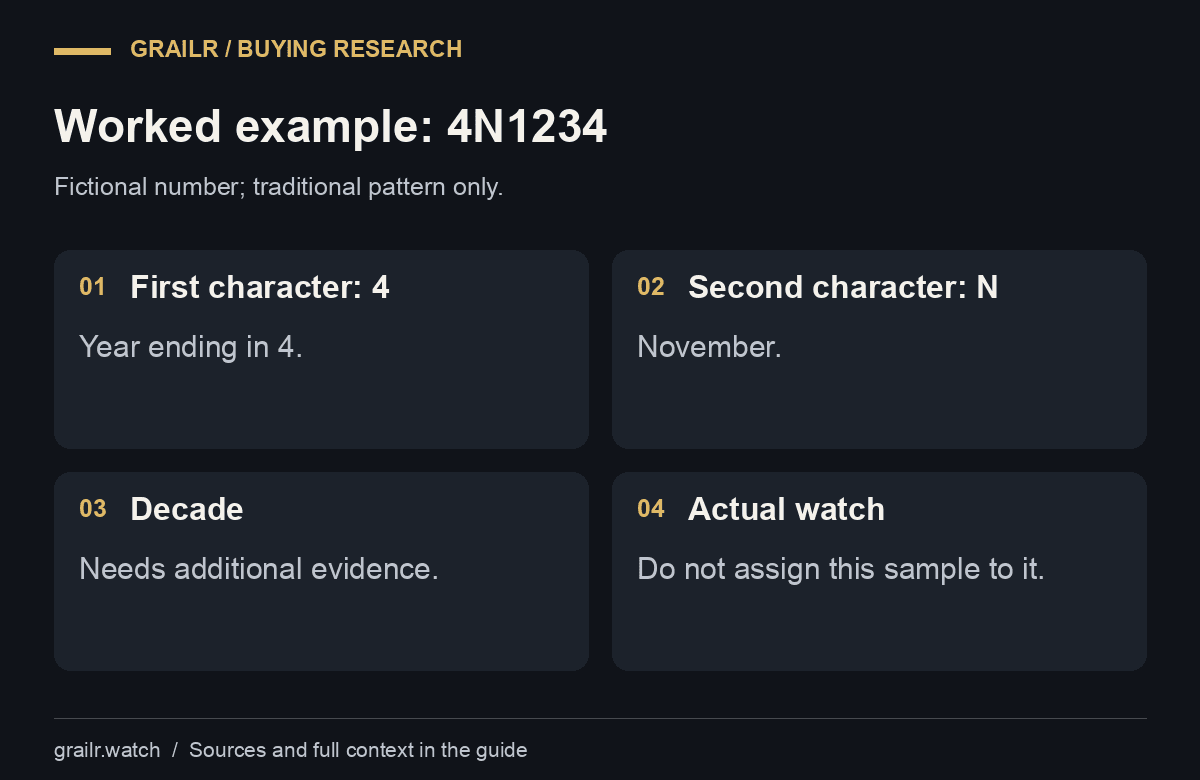
The independent WatchSleuth Date Finder documents the traditional decoding convention and combines it with movement-year records. In that method, a first character of 4 means a year ending in 4; it does not choose between decades. The second character uses the month mapping below. Treat this as an attributed collector method whose applicability still needs checking for the watch.
| Second character | Month |
|---|---|
| 1 | January |
| 2 | February |
| 3 | March |
| 4 | April |
| 5 | May |
| 6 | June |
| 7 | July |
| 8 | August |
| 9 | September |
| 0 | October |
| N | November |
| D | December |
Take 4N1234, a fictional teaching example. Under that convention it suggests November in a year ending in 4. It does not decide whether the candidate is 1994, 2004, 2014 or 2024. Those years are illustrations of the ambiguity, not claims that a particular reference existed in all four. Do not assign this sample number to a real watch or use it as a substitute for the actual engraving.
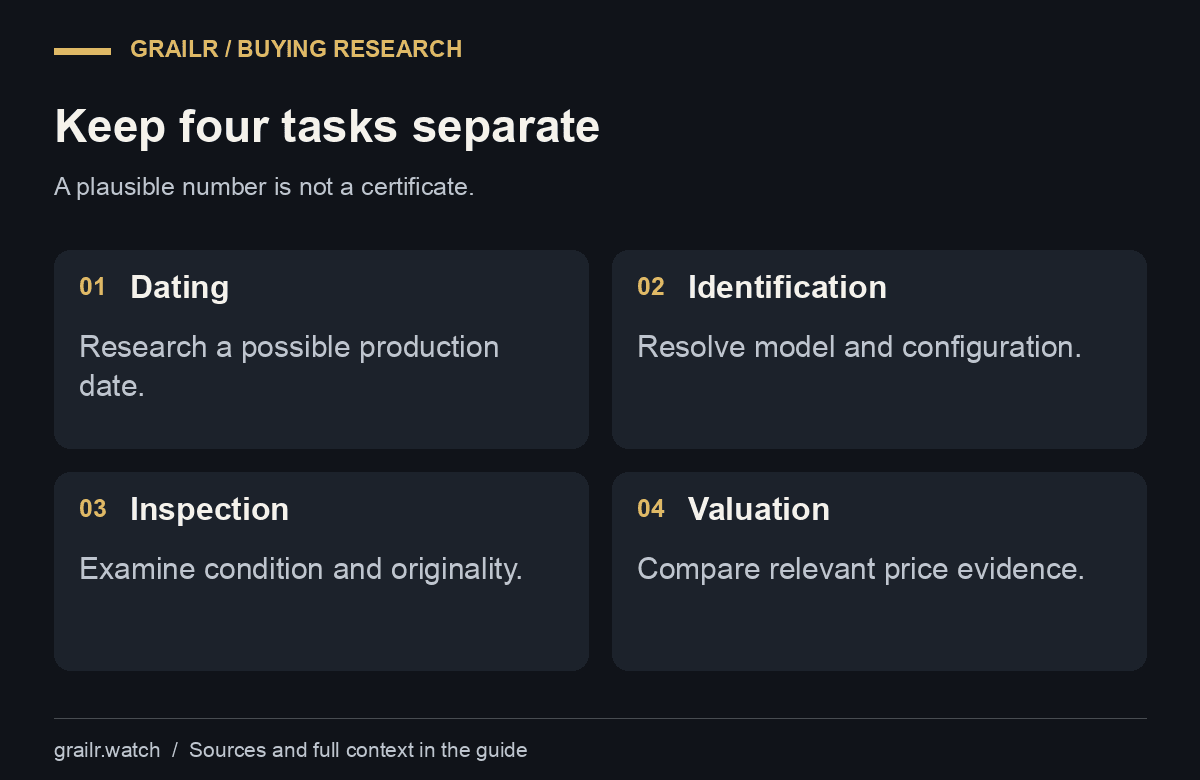
The correct next question is what independently supports the decade. A matching final digit is a weak filter on its own. If you have to assume the model's history, the meaning of the number and the originality of the caseback to get the desired answer, the result should remain provisional. A useful research note makes those assumptions visible rather than hiding them behind a single date.
Narrow the decade with independent evidence
Build a short evidence file around the exact watch. Look for a dated manufacturer catalogue, an identifiable original receipt, a reliable reference record or a documented professional assessment. A claim repeated across marketplace advertisements is not the same as an independent source. Save the source and explain what it establishes: introduction of a design, existence of a reference at a date, or ownership of a particular example.
An invoice establishes a sale date, subject to checking that it belongs to the watch. It does not necessarily establish how recently the watch was manufactured. A dated catalogue establishes that a model was offered in that publication, not that every similar-looking watch was made that year. Distinguishing those claims makes your final conclusion more useful even when the answer remains a range.
The author of the Retro Seiko decoder also explains why multiple dates can result from incomplete records or a movement spanning decades. When using a movement database, inspect its assumptions and whether it covers the exact revision. An unknown end date is not evidence of uninterrupted production. Avoid treating the latest decade a calculator displays as the recommended answer. Record several candidates if necessary and explain which additional evidence would distinguish them. If none is available, “date unresolved” is an honest and actionable result.
For the pictured watch family, our Seiko Turtle guide separates named references and their specifications. The Seiko 5 Sports guide provides another family starting point. Use those guides to understand the proposed identification, then seek evidence for the individual watch rather than borrowing the article's publication date or a product-image upload date.
Recognize when the usual pattern does not apply
The Retro Seiko developer specifically excludes 2019-and-later Seiko 5 Sports from its dating method. Treat that as a stated limitation of the tool, not a manufacturer-issued dating certificate for other models. A code that does not fit the documented pattern should remain unresolved. Do not remove characters, rearrange digits or swap a letter for a number simply to make a calculator accept it. Photograph it again and compare the marking with instructions or reliable reference evidence for that particular watch. Other formats and ambiguous engraving require research rather than a forced answer.
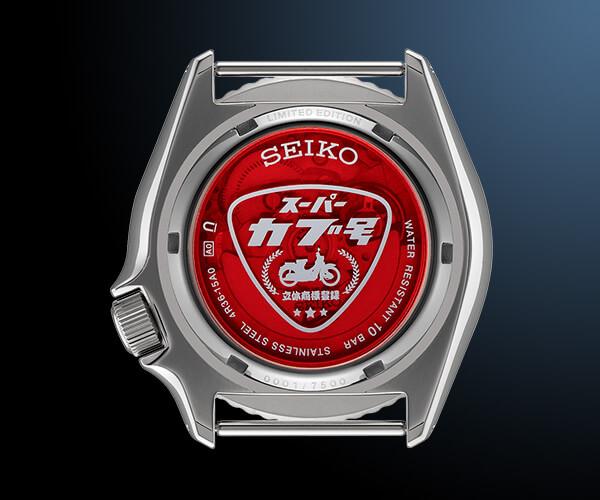
An edition number is also a different kind of information. Seiko's Super Cub collaboration page describes numbered pieces within an edition. A fraction-like edition marking should not be fed into a production-date formula just because it contains digits. Ask what each inscription represents and keep the answer attached to the actual source.
Replacement cases, casebacks, dials or movements create additional questions. A readable number on one component does not by itself establish that every other component began life with it. This does not mean every repaired watch is undesirable. It means the seller should explain what is known, what was changed and what is uncertain so you can decide whether the watch suits your priorities.
A matching serial is not an authenticity check
A serial lookup evaluates information about a marking; it does not inspect the complete physical watch. A number that produces a plausible date cannot answer whether a dial has been replaced, a case refinished or a movement modified. Nor does it establish who owns the watch or whether the person offering it has the right to sell it. Those questions require different evidence.
Avoid treating a seller's screenshot from a dating tool as a certificate. Ask for the actual photographs and the source used to interpret them. If originality is important to the price, agree on an appropriate inspection and clear return terms before the transaction. A well-documented repair can be acceptable to one buyer and unsuitable to another; disclosure is what lets both make informed decisions.
For a custom or modified Seiko, start with a written description of the base watch and changed parts. Ask whether replacement components are manufacturer parts, aftermarket parts or of unknown origin. The phrase “Seiko movement” does not describe the entire assembled watch. A custom build should be evaluated on its disclosed specification and execution, not assumed to have the identity and resale history of a factory reference.
Ask the seller questions that change the decision
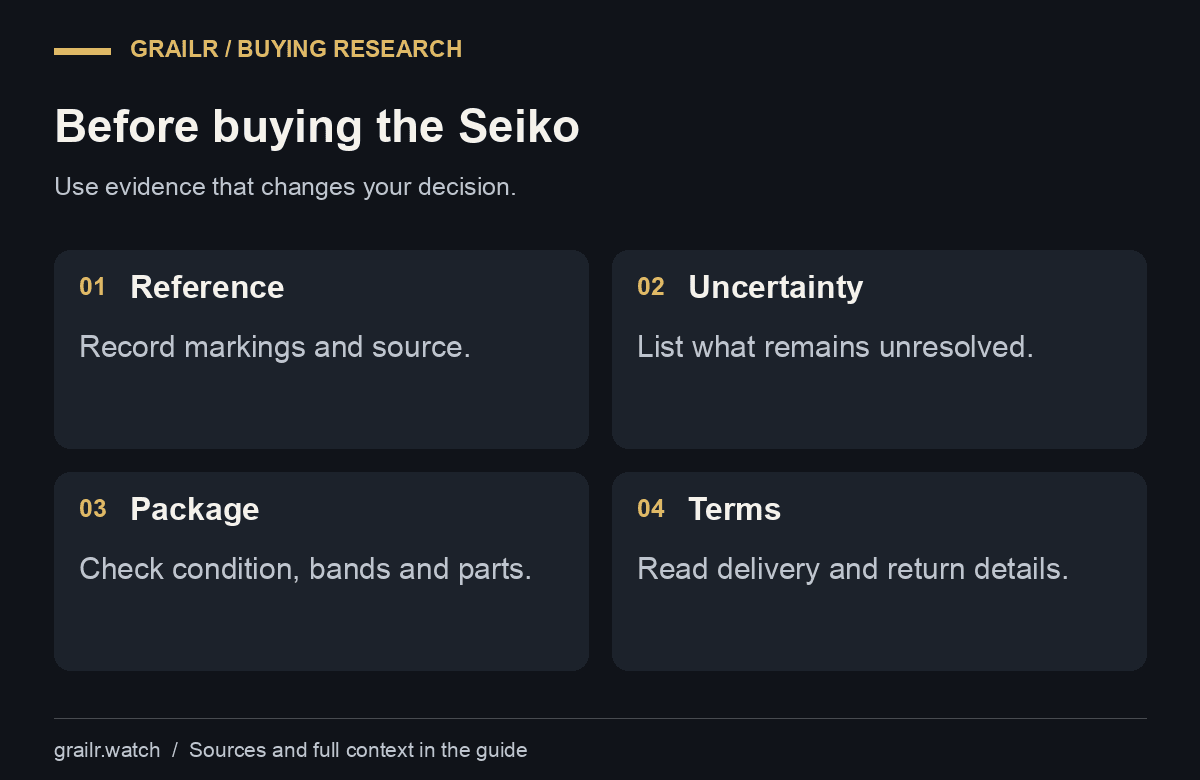
A useful first message is: “Could you send a clear photograph of the complete caseback and confirm the retail reference? What evidence supports the stated year, and are any parts known to have been replaced?” Follow up on the answers rather than sending a generic interrogation. If the seller does not know, ask them to label that uncertainty instead of encouraging a guess.
For condition, request clear views of the dial, crystal, case edges, crown and supplied band. Ask what functions have been checked and whether there are known faults. A watch described as running may still need work; a photograph of its hands in one position does not demonstrate reliable timekeeping. Seek a dated service record if recent maintenance is a material part of the offer.
Check the package as carefully as the watch head. Confirm bracelet length, spare links, clasp, straps and documents. Missing sizing parts can make an apparently inexpensive watch impractical. For water use, seek a suitable recent test and professional advice for the individual watch; an original specification is not evidence of its present sealing condition. Keep those questions separate from the age calculation.
Turn the research into a price comparison
After identifying the likely reference, compare similar examples in a similar condition category. Keep new manufacturer prices, seller asking prices and documented completed transactions separate. Record what each offer includes and its location, currency and date. A low figure from a different market may not include the costs or return options that matter to you.
Make a simple budget with the purchase price, delivery and known immediate work. Use an actual quotation for a missing bracelet component or required repair where possible. If an item remains unknown, mark it as unknown rather than assigning an optimistic zero. Decide your maximum acceptable total before being distracted by a desirable dial colour or an attractive story about the production year.
Our guide to assessing a used-watch price explains that comparison in more detail. Grailr technology adds a photo-led starting point: a suggested identification, indicative value context and questions to investigate. See the public identification examples before choosing a plan. A Grailr report does not decode a hidden serial, consult Seiko's private records or authenticate the physical watch; it helps you organize the buying research around what the photograph can show.
Frequently asked questions
Can a Seiko serial give me the exact manufacture date?
A result depends on the numbering pattern and the evidence for the particular watch. Do not force an unsupported format into a calculator. Keep unresolved assumptions in your notes and seek model-specific records if the date matters to a purchase.
Why does a Seiko calculator show more than one year?
The method can leave several candidate decades, especially when movement records are incomplete or span a long period. Read the tool author’s assumptions. A sale receipt, catalogue or professional observation may help; do not simply select the newest result.
Is the retail model number always engraved on the caseback?
Do not expect the shop reference and caseback code to be identical. Record the markings exactly and compare them with reliable product documentation. Seiko’s official manual finder uses the calibre code, which is useful for selecting the correct instructions.
Can I use a limited-edition number as a date code?
Do not assume so. The official Super Cub example on this page numbers pieces within an edition. Establish what an inscription represents before attempting a calculation. A sequence within an edition answers a different question from an individual production date.
Does a matching date mean a modified Seiko is original?
No. Ask what base watch and components were used, and which parts were replaced. A custom build should be described and priced on its disclosed specification. A plausible caseback number does not establish the originality of the assembled watch.
Can Grailr check the value of my Seiko from a photo?
Grailr technology can suggest the watch and provide indicative value context. Confirm the reference and compare condition, included parts and sale terms before acting on an asking price. A photo report does not certify originality or consult Seiko’s private serial records.
Sources and research method
This is a desk-researched identification guide, not an official manufacturer database or a physical inspection. Sources were checked on 20 November 2026. Historical dates retain their original context; collector dating methods are attributed and qualified. Worked serial examples are fictional. Product photographs are credited and do not establish the date, condition or originality of an individual watch.