What “Swiss Made” Legally Means on a Watch
The Swissness ordinance, the 60 % cost threshold, the movement supply chain — and what the famous dial inscription does and does not guarantee about quality.
- “Swiss Made” requires a Swiss movement, at least 60 % of manufacturing costs in Switzerland, and Swiss casing-up and final inspection
- Up to 40 % of component value can come from outside Switzerland — dials, hands and cases are commonly sourced from Asia
- The label is an origin standard, not a quality or accuracy certification — look for COSC or METAS testing separately
- Most mid-range Swiss watch brands use ETA or Sellita base movements; only a handful of houses manufacture entirely in-house
The Legal Definition of “Swiss Made”
Two words on the dial — Swiss Made — carry more legal weight than most buyers realise. Since 1 January 2017, the revised “Swissness” ordinance has governed exactly when a manufacturer may print them. The law replaced a much looser framework that had been in place since 1971 and was widely criticised for setting the bar too low.
Under the current rules, a Swiss Made wrist watch must satisfy three conditions simultaneously. First, its movement must be Swiss: at least 60 % of the movement’s component value must originate in Switzerland, and the movement must be both assembled and subjected to final inspection on Swiss soil. Second, at least 60 % of the total manufacturing costs of the finished watch — movement, case, dial, hands, crystal, strap or bracelet, plus assembly labour — must be incurred in Switzerland. Third, the casing-up (placing the movement inside the case) and the final inspection must take place in Switzerland.
“Manufacturing costs” is the key phrase. The ordinance counts the cost of raw materials, components, assembly, testing, quality control and certification. It does not count the cost of marketing, distribution, packaging or duties. That distinction matters because it determines which expenses a brand can shift between Swiss and foreign facilities to reach — or appear to reach — the 60 % threshold.
The pre-2017 regime required only that the movement be Swiss and that final inspection happen in Switzerland. There was no cost threshold for the finished watch at all. A brand could source its case from China, its dial from Japan and its strap from Thailand, install a Swiss movement, run a final check in Biel, and legally stamp “Swiss Made” on the dial. The 2017 reform was a direct response to that gap, pushed through by the Federation of the Swiss Watch Industry (FH) and supported by major Swiss watch brands that wanted the label to mean something more substantial.
Enforcement sits with the FH, which monitors the market, investigates complaints and can pursue civil litigation under Swiss unfair-competition law. Criminal prosecution for fraudulent use of the label is also possible under the Swiss Trade Mark Protection Act. In practice, the FH sends cease-and-desist letters far more often than it litigates, but high-profile actions against non-compliant brands have established clear precedent.
What Swiss Made Does Not Guarantee
The label opens doors in showrooms and adds perceived value on the wrist, but it carries several blind spots that buyers should understand before treating it as a seal of quality.
It does not mean all-Swiss components. The 60 % cost rule explicitly allows up to 40 % of manufacturing value to originate outside Switzerland. In practice this means dials stamped in China, hands cut in Japan, crystals pressed in Thailand and straps stitched in Italy can all appear inside a watch legally bearing the Swiss Made inscription. The label tells you where the majority of value concentrates — not where every part was born.
It does not guarantee quality, accuracy or water resistance. Swiss Made is a geographic-origin standard, not a performance certification. A $300 Swiss Made quartz watch and a $30,000 Swiss Made tourbillon both clear the same legal threshold. Neither the Swissness ordinance nor the FH imposes minimum tolerances for timekeeping, power reserve, water resistance or finishing. Those assurances come from separate, voluntary certifications — COSC for chronometer-grade accuracy, METAS for Omega’s Master Chronometer standard, and the Poincon de Geneve for Geneva-origin finishing.
It does not mean in-house movement. Many well-known Swiss made watch brands use calibres supplied by ETA (a Swatch Group subsidiary) or Sellita. When a brand prints its own calibre name on the rotor, it may be a cosmetically modified version of a mass-produced base movement rather than a proprietary design. This is neither fraudulent nor unusual — the Tissot PRX Powermatic 80, for example, uses an ETA-derived calibre and is a perfectly solid Swiss Made watch — but it does mean “Swiss Made” and “in-house movement” are two different claims.
It does not mean hand-assembled. The ordinance requires Swiss assembly but says nothing about whether that assembly is done by hand, by machine, or by some combination. High-volume Swiss timepiece brands use automated lines for placing components, with human inspection at checkpoints. The romantic image of a single watchmaker building every watch at a bench applies to a small number of ultra-high-end ateliers, not to Swiss Made watches as a category.
The Movement Supply Chain
Understanding who actually makes the movement inside a Swiss Made watch explains more about what you are paying for than the dial inscription ever will. The Swiss movement ecosystem is dominated by three suppliers, a handful of genuine manufacture houses, and hundreds of brands that fall somewhere in between.
ETA SA is the elephant in the room. A subsidiary of the Swatch Group, ETA supplies mechanical and quartz calibres to hundreds of watch brands around the world. Its ETA 2824-2 (three-hand automatic) and ETA 7750 (chronograph) are among the most widely used movements in history. When the Swatch Group announced plans to restrict ETA supply to outside brands — a process that began around 2010 and tightened gradually — it sent shockwaves through the industry and created a market opening for competitors.
Sellita stepped into that gap. Based in La Chaux-de-Fonds, Sellita reverse-engineered ETA’s popular calibres and now produces near-identical alternatives: the SW200-1 mirrors the ETA 2824-2, the SW500 matches the ETA 7750, and so on. Many brands that formerly used ETA now use Sellita interchangeably, and some use whichever supplier offers better lead times on a given production run. Ronda, meanwhile, dominates the Swiss quartz segment, supplying affordable calibres to entry-level Swiss made watches from Victorinox, Wenger and others.
Some brands buy these base movements and add proprietary modules, custom rotors or decorative finishing before assigning their own calibre number. This is common and legitimate — Oris, for instance, builds its Calibre 400 on an architecture developed with partners but manufactured to its own specifications. The practice only becomes misleading when a brand implies from-scratch design where none exists.
At the other end of the spectrum sit the true manufacture houses — brands that design, produce and assemble their own movements from the ground up. Rolex makes every calibre in-house. Patek Philippe does the same and adds the Geneva Seal to each movement. Audemars Piguet, Jaeger-LeCoultre and Vacheron Constantin all maintain their own movement production. Tudor moved to in-house calibres with the MT5xxx series, and Omega now manufactures its co-axial movements internally — a point our Seamaster buying guide covers in detail.
The takeaway is simple: two watches can both say “Swiss Made” on the dial while having fundamentally different origins under the case back. One may contain a movement designed, machined and assembled entirely within a single manufacture; the other may house a mass-produced calibre shared with dozens of competing brands. Both are legal. Neither is lying. But the buyer who knows the difference is in a far better position to judge fair pricing.
Swiss Made Tiers by Price
Not all Swiss made watches occupy the same world. The label appears on $250 field watches and $250,000 grand complications alike. The table below breaks down four broad price bands, the representative brands in each, and what you can typically expect in terms of movement sourcing. Use it as a map, not a verdict — there are standout watches at every tier, and price alone does not determine whether a watch is worth owning.
| Price Tier | Example Brands | Movement Source | Typical Calibre | What You Get |
|---|---|---|---|---|
| Entry ($200–$1,000) | Tissot, Hamilton, Certina, Mido | ETA / Sellita base | ETA 2824-2, Powermatic 80 | Reliable Swiss automatic or quartz, solid build, sapphire crystal on most |
| Mid ($1,000–$5,000) | Oris, Longines, TAG Heuer | Modified ETA / Sellita or proprietary | Oris Cal. 400, Longines L888 | Enhanced power reserve, better finishing, brand-specific modifications |
| Luxury ($5,000–$20,000) | Tudor, Omega | In-house | Tudor MT5xxx, Omega Co-Axial 8xxx | Proprietary calibres, COSC or METAS certified, higher-grade finishing |
| Ultra-luxury ($20,000+) | Rolex, Patek Philippe, AP, Vacheron | Fully in-house | Rolex 32xx, Patek 26-330, AP 4302 | Manufacture movements, Geneva Seal or equivalent, hand finishing, multi-year warranty |
The entry tier is where the Swiss Made label arguably works hardest for the buyer. A $400 Tissot with an ETA movement and sapphire crystal offers genuine Swiss watchmaking at a price that competes with Japanese automatics from Seiko and Orient. The difference is not always in the hardware — it is in the after-sale ecosystem: Swiss Made brands tend to have broader service networks and longer parts availability than their Asian counterparts.
At the luxury and ultra-luxury tiers the calculus shifts. You are paying for proprietary movement development, hand finishing and brand heritage as much as for the Swiss Made inscription. A Patek Philippe Nautilus and a Tissot PRX both say “Swiss Made” on the dial; the price gap between them reflects everything the label does not measure.
Check Any Watch Price in Seconds
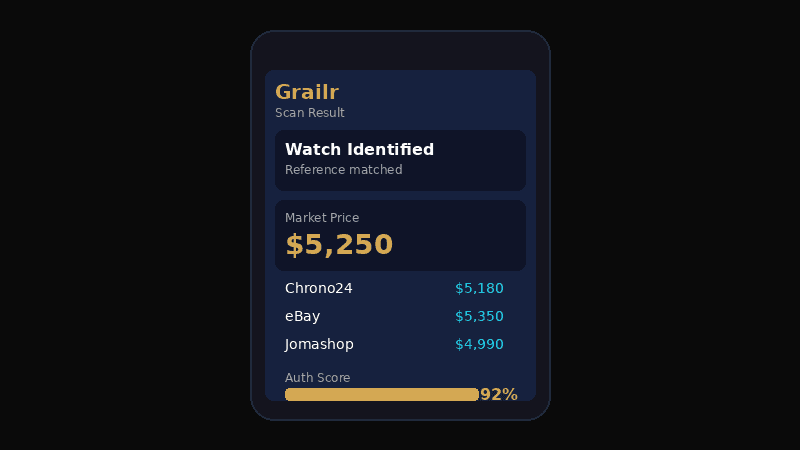
Grailr scans your watch photo and pulls live pricing from Chrono24, eBay, and Jomashop.
- AI identifies brand, model & reference number
- Live market prices from 3+ sources
- Authentication confidence score
Criticisms and Loopholes
The 2017 Swissness reform was a genuine improvement over the old regime, but it did not silence the critics. The 60 % cost rule — the centrepiece of the new framework — contains structural blind spots that allow brands to qualify with more foreign content than the label implies.
Cost inflation through finishing. The ordinance counts manufacturing costs, not component origin. A brand can import a rough case blank from China at low cost, then perform expensive hand polishing, PVD coating or satin brushing in Switzerland. The finishing labour is Swiss, so it counts toward the 60 % threshold — even though the underlying metal was milled abroad. The result is a mathematically Swiss case that was physically shaped on a foreign CNC machine. This is legal, common and exactly the kind of accounting the label’s critics highlight.
Dials and hands from Asia. Dial manufacturing is notoriously cost-effective in China and Japan, where large-scale producers offer quality at a fraction of the Swiss price. Many mid-range Swiss made watch brands source dials from these suppliers, and the Swissness ordinance permits it as long as total foreign costs stay below 40 %. The same applies to hands, crystals and crown components. A buyer looking at a Swiss Made dial is not necessarily looking at Swiss manufacturing.
The 60 % threshold is not 80 %. When the reform was debated, some industry voices — including several major manufacture houses — argued for a higher threshold, 80 % or even 100 %. The compromise settled at 60 %, which was a politically achievable number but left room for brands that depend heavily on foreign supply chains. Critics argue this makes Swiss Made a “majority Swiss” label rather than a “Swiss” label.
None of this means the label is worthless. It provides a meaningful legal floor — the majority of a Swiss Made watch’s manufacturing value does originate in Switzerland, the movement is Swiss, and the final assembly and inspection are Swiss. But it is a floor, not a ceiling. Buyers who want to know exactly what they are getting need to look beyond the two words on the dial and into the brand’s disclosed sourcing, certifications and manufacturing claims.
How to Verify What You’re Buying
The Swiss Made label gets you through the front door. These additional checks tell you what is actually inside the house.
Identify the movement calibre. Every reputable brand publishes the calibre number for each reference. Search it. If the number traces back to an ETA or Sellita base, that is not a negative — but it does tell you the movement is shared with other brands and priced accordingly. If the brand claims an in-house calibre, verify that the architecture is original rather than a cosmetically renamed version of a supplier movement.
Look for COSC or METAS certification. Swiss Made says where the watch was built. COSC chronometer certification says it was individually tested for accuracy over 15 days at −4/+6 seconds per day. METAS Master Chronometer certification (used by Omega) goes further, testing magnetic resistance to 15,000 gauss, water resistance, power reserve and accuracy on the wrist at 0/+5 seconds per day. Either mark is a stronger quality signal than Swiss Made alone.
Check for the Hallmark of Geneva. The Poincon de Geneve (Geneva Seal) is a voluntary certification that requires the movement to be manufactured, assembled, adjusted and cased in the Canton of Geneva. It also imposes aesthetic finishing standards — bevelled edges, polished screw heads, Geneva stripes — that Swiss Made does not require. Currently carried by Vacheron Constantin, Roger Dubuis and Chopard’s L.U.C. line, among others. It is a significantly higher bar than Swiss Made.
Ask whether the brand discloses its movement supplier. Transparency correlates with confidence. Brands that volunteer their supplier relationship — “we use an ETA 2892 base with our proprietary module” — are giving you the information you need to make a fair comparison. Brands that obscure the source behind a house calibre name and provide no further detail are not necessarily dishonest, but they are making your research harder on purpose.
Use Grailr to cross-reference. Upload a photo to Grailr’s identification tool to pull the brand, model and reference number. From there you can research the specific calibre, check indicative pricing and see how the watch sits within its brand’s lineup. For a deeper look at authenticity indicators, the authentication check provides a confidence score based on visible details — though it is not a substitute for a hands-on inspection by a qualified watchmaker.
Swiss Made vs Other Origin Labels
Swiss Made is the most commercially powerful origin label in watchmaking, but it is not the only one. Several other designations carry their own legal requirements and quality implications. The following table compares the major labels side by side so you can see exactly what each one promises — and where the gaps are.
| Label | Movement Rule | Cost Rule | Assembly Rule | Quality Guarantee |
|---|---|---|---|---|
| Swiss Made | Swiss (60 % value, Swiss assembled and inspected) | 60 % of total mfg costs in Switzerland | Casing-up and final inspection in Switzerland | None — origin only |
| Swiss Movement | Swiss (same 60 % rule) | No watch-level cost rule | Movement only — case and assembly anywhere | None |
| Swiss Parts | Contains Swiss-origin components | No threshold | No requirement | None |
| Made in Germany / Glashutte | 50 % of movement value added in Germany (stricter for “Glashutte”) | 50 % of total value added in Germany | Assembly in Germany | None formally, but brands self-impose high standards |
| Made in Japan | Japanese movement (no formal % rule) | No formal threshold | Assembly in Japan | None formally; Grand Seiko applies internal standards exceeding COSC |
German watchmaking has its own heritage centred on Glashutte, a town in Saxony where A. Lange & Sohne, Glashutte Original, Nomos and Moritz Grossmann all operate. German watches tend to emphasise transparency — exhibition case backs are the norm — and the finishing traditions differ from Swiss conventions: three-quarter plates, Glashutte ribbing (a variant of perlage) and blued steel screws are characteristic German signatures. The “Glashutte” designation requires that at least 50 % of value be added in that town specifically, making it tighter geographically than Swiss Made.
Japanese watchmaking is the other major force. Grand Seiko, Citizen (and its subsidiary Bulova) and Casio all produce watches with movements designed and manufactured in Japan. Grand Seiko’s Spring Drive technology has no Swiss equivalent, and its hand-finished Hi-Beat calibres match or surpass Swiss rivals in accuracy and decoration. The automatic-vs-quartz debate often underestimates the Japanese contribution: Seiko invented the quartz wristwatch in 1969 and continues to push both mechanical and electronic frontiers.
Frequently Asked Questions
Does Swiss Made mean every component is made in Switzerland?
No. The Swissness ordinance requires that at least 60% of manufacturing costs are incurred in Switzerland and that the movement is Swiss, but up to 40% of component value can come from outside Switzerland. Dials, hands, and case parts are commonly sourced from Asia.
Is a Swiss Made watch always better than a Japanese or German watch?
Not necessarily. Swiss Made is an origin label, not a quality certification. A Grand Seiko from Japan or a Glashutte Original from Germany can match or exceed Swiss competitors in finishing and accuracy. The label tells you where the value concentrates, not how good the watch is.
What is the cheapest Swiss Made watch worth buying?
Tissot, Hamilton, and Certina offer well-regarded Swiss Made watches from roughly $250 to $600. The Tissot PRX and Hamilton Khaki Field are popular starting points with ETA or Powermatic movements and solid build quality at their price.
Does Swiss Made guarantee chronometer-grade accuracy?
No. Swiss Made sets geographic and cost thresholds, not accuracy standards. For tested accuracy, look for COSC chronometer certification or METAS Master Chronometer certification. These are separate programmes with their own testing protocols.
What is the difference between Swiss Made and Swiss Movement?
Swiss Made requires a Swiss movement plus at least 60% of total manufacturing costs in Switzerland and Swiss casing-up and final inspection. Swiss Movement means only the movement meets the Swiss criteria — the case, dial, and assembly can happen anywhere. Swiss Made is the stricter label.
Can a watch brand lose its Swiss Made status?
Yes. The Federation of the Swiss Watch Industry monitors use of the label and can bring legal action against brands that use it fraudulently. Brands must continuously meet the Swissness ordinance thresholds to print the label on their dials.
Related Articles
The Bottom Line
“Swiss Made” is a legal origin standard with real teeth — a Swiss movement, 60 % of costs on Swiss soil, Swiss final assembly and inspection. It is not a quality guarantee, not a promise of in-house manufacturing and not proof that every component was made in the Jura mountains. Treat it as a starting point, not a verdict.
The smartest buyers pair the Swiss Made label with their own research: identifying the movement calibre, checking for COSC or METAS certification, and understanding where the brand sits in the supply chain. A $400 Tissot with an ETA movement and a $40,000 Patek Philippe with a hand-finished manufacture calibre both wear the same two words on their dials. Knowing what separates them is the difference between buying a label and buying a watch.
Want to Know Exactly What You’re Looking At?
Upload a photo and Grailr will suggest the brand, model and reference number, with indicative pricing from live market sources. Check the result against the seller’s documentation and an independent inspection — a photo scan is a starting point, not proof of authenticity.
Try Grailr Free