Thinnest Watch in the World: Every Record Holder
From a 1.65 mm sliver of titanium to everyday dress watches under 6 mm — every record holder ranked by thickness with real specs and prices.
Price context: this guide includes indicative prices from its original publication period. They have not all been refreshed to current quotes. Use the linked primary sources for specifications and policies, and verify prices independently.

- The Konstantin Chaykin ThinKing Mystery (1.65 mm) and Bulgari Octo Finissimo Ultra COSC (1.70 mm) are the two thinnest mechanical watches ever made
- Record-level thinness starts above $400,000 and sacrifices water resistance, shock protection and everyday wearability
- The Bulgari Octo Finissimo Automatic (5.15 mm, ~$12,700) is the thinnest watch most collectors can wear daily
- Budget ultra-thin options exist: the Tissot Tradition 5.5 starts at roughly $375 and measures 5.5 mm
The Current Record Holders
The race to build the thinnest watch in the world has produced engineering that borders on the absurd. At the very top sit two watches thinner than a credit card: the Konstantin Chaykin ThinKing Mystery at 1.65 mm and the Bulgari Octo Finissimo Ultra COSC at 1.70 mm. Both are limited editions that cost more than most houses. Neither is meant for daily wear — they exist to prove a point.
The Chaykin ThinKing Mystery, introduced as a concept in 2024 and shown in production form at Watches & Wonders 2026, uses a mystery-dial layout where the hands appear to float above the caseback with no visible movement. The edition is limited to 12 pieces. Independent watchmaker Konstantin Chaykin, best known for his Joker series, built the entire movement from scratch in Moscow.
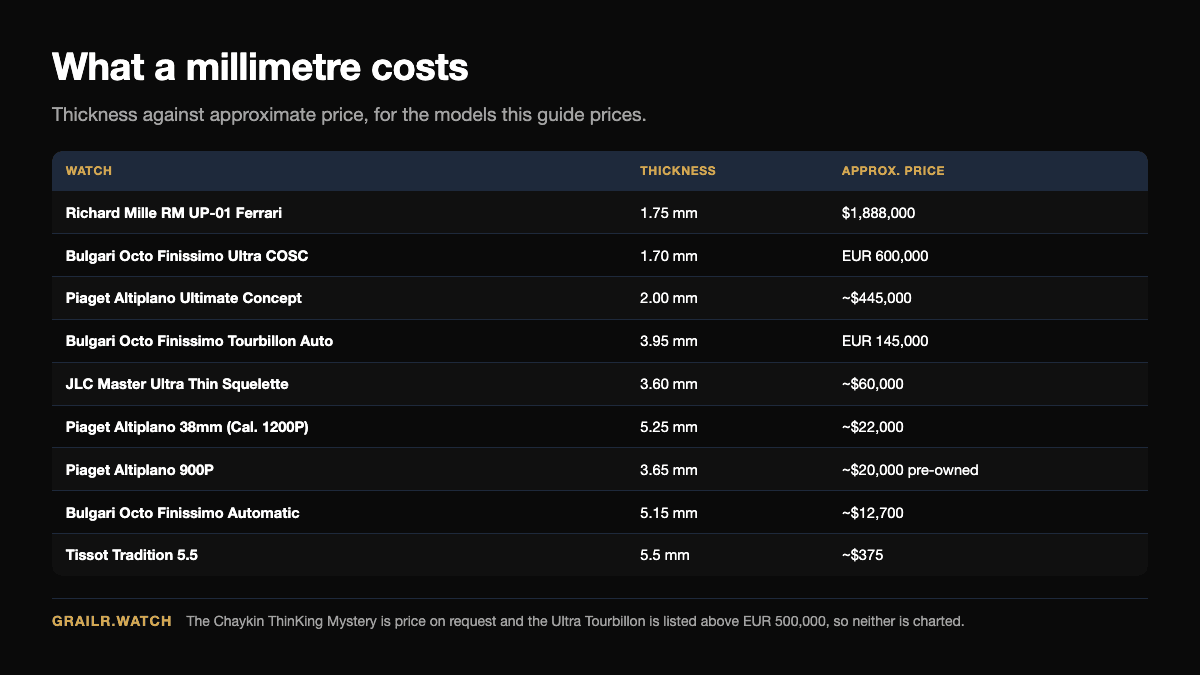
Bulgari’s answer is the Octo Finissimo Ultra COSC, which first appeared in 2022 at 1.80 mm and was refined to 1.70 mm by 2024. What makes it remarkable beyond the thinness is the COSC chronometer certification — the watch runs within −4/+6 seconds per day at a thickness where most movements would not keep time at all. The movement and caseback are a single integrated plate; the barrel drum doubles as the caseback surface. It retails for approximately €600,000.
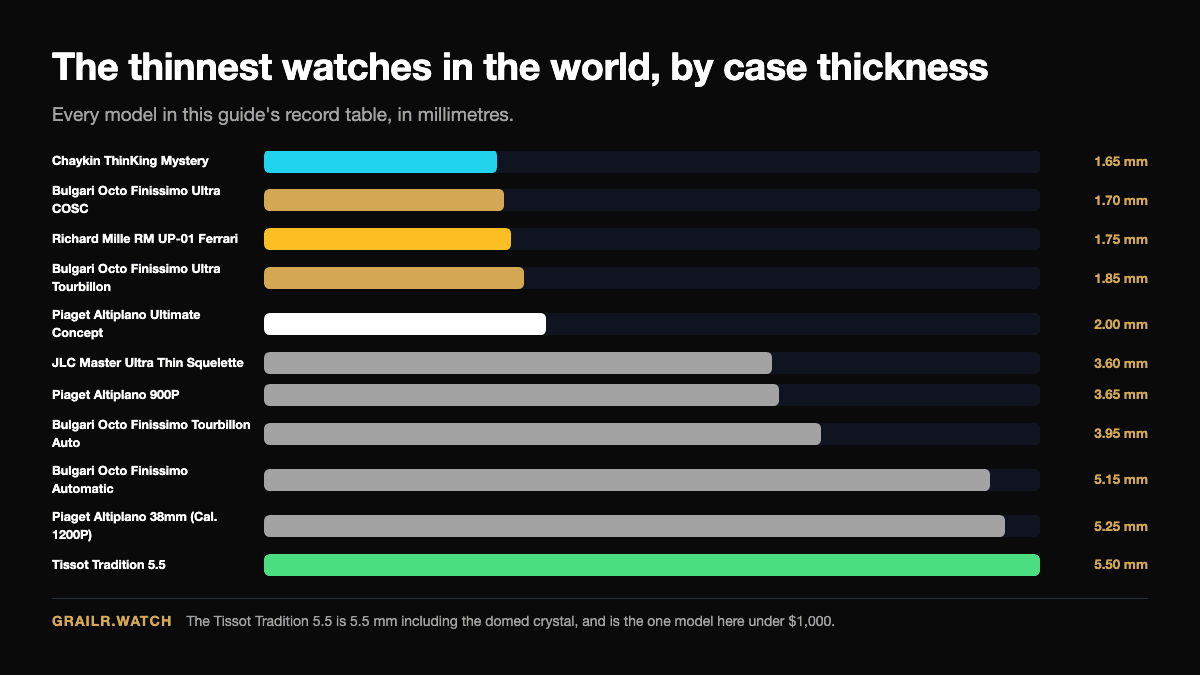
Sandwiched between them sits the Richard Mille RM UP-01 Ferrari at 1.75 mm. A collaboration with Ferrari launched in 2022, it was the first watch to break the 2 mm barrier. Its baseplate is grade-5 titanium, and the movement uses a novel anchor escapement designed to function at near-zero clearances. Only 150 were produced at a reported $1.888 million each. For a broader look at brands pushing this boundary, see our guide to ultra-thin watchmaking.
Every Ultra-Thin Record Ranked
The table below ranks every significant ultra-thin watch by total case thickness. Note that some brands measure from caseback to crystal, while others include the crown or gasket, so a direct comparison at tenths of a millimetre can be misleading. Still, the hierarchy is clear: Chaykin and Bulgari are in a class of their own below 2 mm.
| Watch | Thickness | Year | Movement | Approx. Price |
|---|---|---|---|---|
| Chaykin ThinKing Mystery | 1.65 mm | 2026 | In-house manual | Price on request |
| Bulgari Octo Finissimo Ultra COSC | 1.70 mm | 2024 | BVL Calibre 180 | €600,000 |
| Richard Mille RM UP-01 Ferrari | 1.75 mm | 2022 | RMUP-01 | $1,888,000 |
| Bulgari Octo Finissimo Ultra Tourbillon | 1.85 mm | 2025 | BVL Calibre 180T | €500,000+ |
| Piaget Altiplano Ultimate Concept | 2.00 mm | 2018 | 900P-UC | ~$445,000 |
| JLC Master Ultra Thin Squelette | 3.60 mm | 2015 | Cal. 849ASQ | ~$60,000 |
| Piaget Altiplano 900P | 3.65 mm | 2014 | Cal. 900P | ~$20,000 (pre-owned) |
| Bulgari Octo Finissimo Tourbillon Auto | 3.95 mm | 2020 | BVL 288 | €145,000 |
| Piaget Altiplano 38mm (Cal. 1200P) | 5.25 mm | 2010 | Cal. 1200P | ~$22,000 |
| Bulgari Octo Finissimo Automatic | 5.15 mm | 2017 | BVL 138 | ~$12,700 |
How Watchmakers Achieve Extreme Thinness
Building a watch below 2 mm thick is not simply a matter of making parts thinner. The traditional architecture of a mechanical watch — baseplate, bridges, mainspring barrel, gear train, balance wheel, dial, hands, case, crystal — stacks to roughly 8–12 mm in a standard timepiece. Getting to 1.70 mm means rethinking nearly every layer.
Integrated case-movement construction. In the Bulgari Ultra, the caseback is the movement baseplate. There is no separate case into which a movement is dropped; the movement is the case. Piaget pioneered a similar approach with the Altiplano Ultimate Concept in 2018, where the case middle serves as the mainplate. This eliminates an entire layer of material.
Peripheral or micro-rotor winding. A conventional central rotor adds 2–3 mm of height. Bulgari’s Octo Finissimo Automatic uses a peripheral rotor that orbits the movement’s edge instead of sitting on top. Piaget’s 1200P uses a micro-rotor recessed into the baseplate. Both approaches recover critical vertical space.
Novel escapements. The balance wheel and lever escapement are the tallest single components in most movements. Richard Mille’s RM UP-01 uses a flat anchor escapement specifically designed for minimal height. Bulgari moved the balance to the dial side and made it visible through the crystal. Chaykin’s ThinKing eliminates visible hands entirely.
Exotic materials. Titanium, cobalt alloys and carbon composites replace steel to reduce thickness without losing structural rigidity. The RM UP-01 uses grade-5 titanium for both the baseplate and the case, and its crown is a flat pusher on the side edge to avoid adding depth. The Piaget Ultimate Concept uses a cobalt-based alloy case that is simultaneously the mainplate.
What Thinness Actually Costs You
Ultra-thin watches look spectacular on the wrist, but the pursuit of record-breaking thinness involves real compromises that matter for anyone considering a purchase. Understanding these trade-offs is as important as knowing the thickness figures.
| Trade-off | Record Holders (<2 mm) | Practical Ultra-Thin (3–6 mm) | Standard Watch (8–14 mm) |
|---|---|---|---|
| Water resistance | 30 m or none | 30–50 m | 100–300 m |
| Shock resistance | Minimal | Moderate | ISO 1413 rated |
| Power reserve | ~40–50 h | 40–65 h | 48–80 h |
| Service complexity | Manufacturer only | Specialist required | Any qualified watchmaker |
| Wearability | Display / occasional | Office / dress | All-day, every day |
| Complications | Time only | Date or moonphase | Chrono, GMT, calendar |
Water resistance is the clearest casualty. A standard Oyster case uses thick gaskets and a screw-down crown — features that add millimetres. The Bulgari Ultra uses a flat pressure-fit caseback with no screw-down crown at all, leaving it rated to just 30 metres on paper and barely splash-proof in practice. The Piaget Ultimate Concept is not even rated for water contact.
Service is another consideration. When the movement is the case, a simple service becomes an engineering project. Bulgari and Piaget require that these watches be returned to their own ateliers — no independent watchmaker can work on an integrated case-movement architecture.
The Ultra-Thin Record Timeline
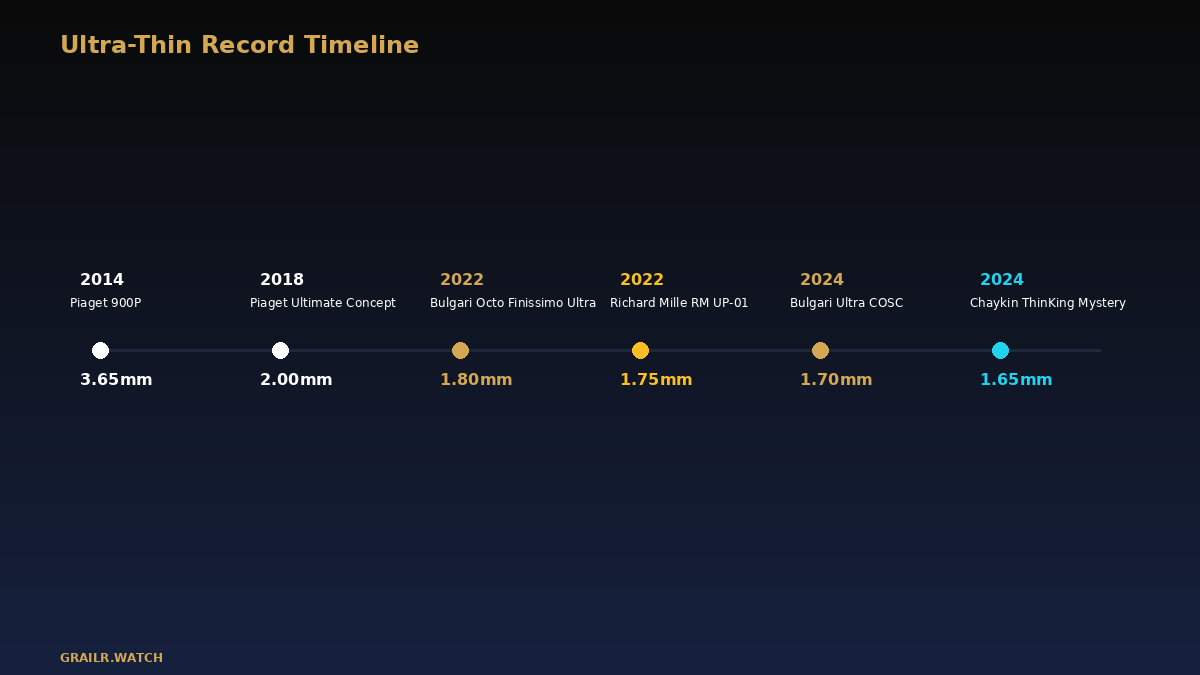
The thinness war has a long history. Piaget and its Altiplano line dominated from the 1960s through the 2010s. Bulgari entered the arena in 2014 with the Octo Finissimo Tourbillon Manual (5.0 mm) and has broken its own record eight times since then. Here is how the overall record has changed.
1957 – Piaget Cal. 9P
Piaget launches the Calibre 9P, a manual-wind movement just 2.0 mm thick. It cements the brand’s identity as the ultra-thin leader.
1960 – Piaget Cal. 12P
The Calibre 12P adds automatic winding in just 2.3 mm, a micro-rotor record that stands for decades.
2014 – Piaget Altiplano 900P (3.65 mm)
Piaget merges the movement into the case itself for the first time. The caseback is the mainplate. The total case thickness is 3.65 mm, a record at the time.
2018 – Piaget Altiplano Ultimate Concept (2.0 mm)
The first watch to break 3 mm. The cobalt-alloy case is the baseplate. Priced at approximately $445,000.
2022 – Richard Mille RM UP-01 Ferrari (1.75 mm)
The first sub-2 mm watch. Only 150 pieces at $1.888 million each. Uses grade-5 titanium and a completely flat escapement.
2022–2024 – Bulgari Octo Finissimo Ultra COSC (1.70 mm)
Bulgari reclaims the record from Richard Mille and adds COSC certification. The barrel drum is the caseback. Approximately €600,000.
2026 – Chaykin ThinKing Mystery (1.65 mm)
Independent watchmaker Konstantin Chaykin claims the record with a mystery-dial watch just 1.65 mm thick. Limited to 12 pieces.
Thin Watches You Can Actually Wear
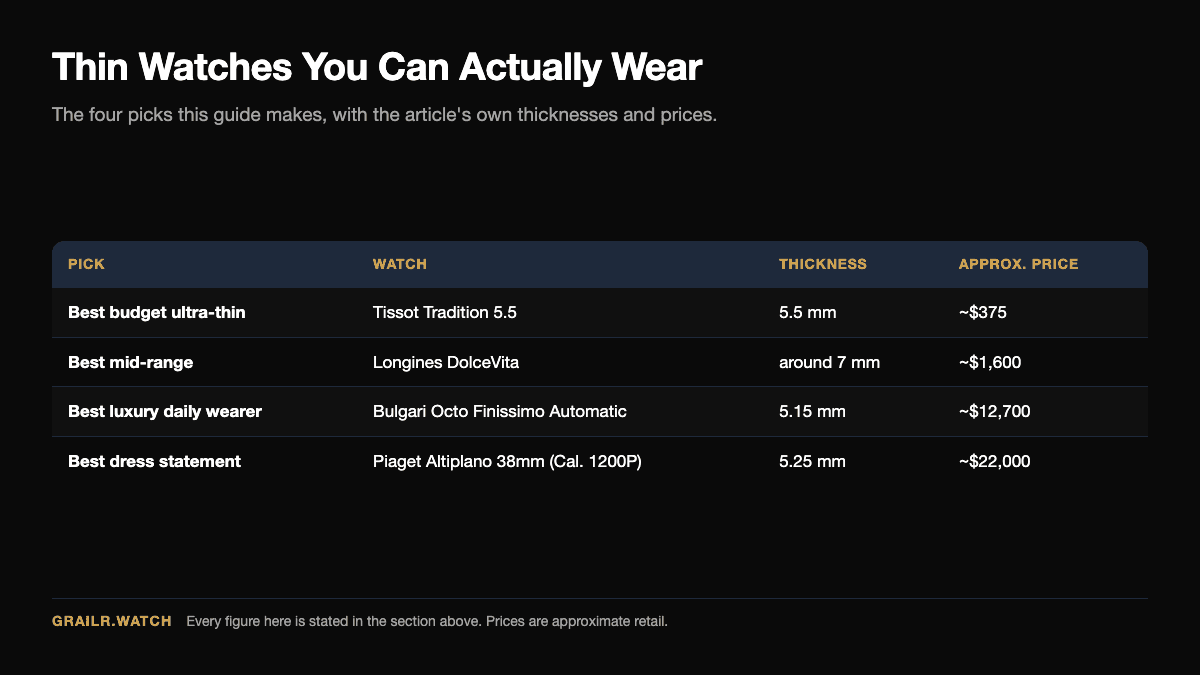
Record-breakers are fascinating but impractical for most collectors. The good news is that the technology developed for the thinness race trickles down into watches you can genuinely wear to the office, a dinner or a weekend trip. Below are the best ultra-thin watches that balance slimness with real-world durability, starting under $400 and climbing to the low five figures. For a deeper dive, read our Bulgari Octo Finissimo guide.
Best Budget Ultra-Thin
Tissot Tradition 5.5 — ~$375
At 5.5 mm including the domed crystal, this quartz dress watch proves you do not need a six-figure budget for genuinely slim wrist presence. Swiss made with a two-hand layout and sapphire crystal.
Best Mid-Range
Longines DolceVita — ~$1,600
Not a record-setter at around 7 mm, but the rectangular case and quartz movement create an elegant dress-watch profile that sits flat against the wrist. See our DolceVita guide.
Best Luxury Daily Wearer
Bulgari Octo Finissimo Auto — ~$12,700
At 5.15 mm with 100 m water resistance and an in-house automatic, this is the thinnest watch you can realistically wear every day. Titanium or steel case.
Best Dress Statement
Piaget Altiplano 38mm — ~$22,000
The Calibre 1200P automatic measures just 5.25 mm in total. White-gold case, 30 m WR and 44-hour power reserve. A true dress-watch icon from the brand that started the ultra-thin race.
If your priority is a slim watch that works as a tool rather than a dress piece, the best dress watches guide covers more options across every budget. For collectors focused on investment, the Octo Finissimo line has held roughly 75–85% of its retail value on the secondary market over the past three years, making it one of the better-performing modern Bulgari models.
Frequently Asked Questions
What is the thinnest watch in the world in 2026?
The Konstantin Chaykin ThinKing Mystery at 1.65mm is the thinnest mechanical watch as of 2026, edging past the Bulgari Octo Finissimo Ultra COSC at 1.70mm. Both are limited-edition pieces priced well into six figures.
How thin is the Bulgari Octo Finissimo Ultra?
The Bulgari Octo Finissimo Ultra COSC measures just 1.70mm thick, making it the thinnest COSC-certified chronometer ever produced. The movement and case are integrated into a single structure to achieve this extreme thinness.
What is the thinnest watch you can actually buy?
The most accessible ultra-thin watch is the Bulgari Octo Finissimo Automatic at 5.15mm thick, starting around $12,700. For a budget option, the Tissot Tradition 5.5 measures 5.5mm and starts at roughly $375.
Are ultra-thin watches fragile?
Ultra-thin watches sacrifice water resistance and shock protection for thinness. Most record-holding models are rated to only 30 metres, and the thinnest examples below 2mm are essentially display pieces. Watches above 5mm thick, like the Octo Finissimo Automatic, are durable enough for daily wear.
What is the thinnest Rolex watch?
Rolex does not compete in the ultra-thin category. The thinnest current Rolex is the Cellini Moonphase at about 11.2mm. The brand prioritises robustness and water resistance over thinness.
Why are ultra-thin watches so expensive?
Shaving each tenth of a millimetre requires re-engineering the movement from scratch. Thinner mainsprings, micro-rotor or peripheral winding systems, and integrated case-movement construction all demand hand-finishing at tolerances most factories cannot achieve, which drives prices from tens of thousands to hundreds of thousands.
Related Articles
The Bottom Line
The thinnest watch in the world is a moving target. Today it belongs to Konstantin Chaykin’s 1.65 mm ThinKing Mystery; next year it may return to Bulgari or land with another independent. What does not change is the engineering reality: below 2 mm, you are buying a mechanical sculpture more than a daily timepiece. For most collectors, the sweet spot is in the 5–6 mm range, where a Bulgari Octo Finissimo Automatic or a Piaget Altiplano delivers genuine ultra-thin presence without the compromises that make sub-2 mm watches impractical. Try them on and feel the difference a few millimetres make on the wrist — it is the best argument any thin watch can make.
Sources and price context
- Bulgari Octo Finissimo collection page — Specifications and lineup for the current Octo Finissimo range including the Ultra COSC.
- Piaget Altiplano collection page — Specifications and pricing for current Altiplano models including the 900P and Ultimate Concept.
These primary sources support the specific specification and lineup points noted above. Prices and thickness figures elsewhere in this guide are indicative editorial figures drawn from manufacturer announcements, authorized dealers and secondary-market listings. Confirm the exact reference, region, condition and current quote before buying; asking prices are not completed-sale prices.