JLC Master Ultra Thin Moon: The Complete Guide
Every Master Ultra Thin Moon reference compared — Calibre 925 specs, steel and rose gold pricing, resale data, and how the Perpetual Calendar steps things up.
Price context: this guide includes indicative prices from its original publication period. They have not all been refreshed to current quotes. Use the linked primary sources for specifications and policies, and verify prices independently.
- The Master Ultra Thin Moon is JLC’s most accessible moon-phase complication, starting around $11,200 in steel
- Calibre 925/1 delivers a 70-hour power reserve and a moon phase accurate to one day in 122.5 years
- Pre-owned steel examples trade between $7,500 and $10,500 — strong value for an in-house moon phase
- The Perpetual Calendar upgrade adds day, month and a leap-year indicator from around $30,000
Why the Master Ultra Thin Moon
Jaeger-LeCoultre has been making moon-phase watches since the 1930s, but the Master Ultra Thin Moon distils that heritage into a case barely 10 mm thick. It pairs a precise 122.5-year moon-phase display with the in-house Calibre 925/1 — a self-winding movement that delivers 70 hours of power reserve and is visible through a sapphire caseback. For a fully in-house moon phase from a Vallée de Joux manufacture, the price of entry is remarkably low.
Where competitors like the Omega De Ville Prestige Moonphase use outsourced base movements and simpler moon-phase modules, JLC builds every component in-house at its Le Sentier manufacture. That matters for two reasons: finishing quality, which you can inspect through the caseback, and long-term serviceability, since JLC services its own calibres indefinitely.
The watch occupies a rare sweet spot — dressy enough for black tie, slim enough to slide under a shirt cuff, and priced well below comparable pieces from Patek Philippe or A. Lange & Söhne. If you want a genuine complication from a top-tier manufacture without the five-figure-plus entry of the Holy Trinity, this is where you start.
Every Current Reference
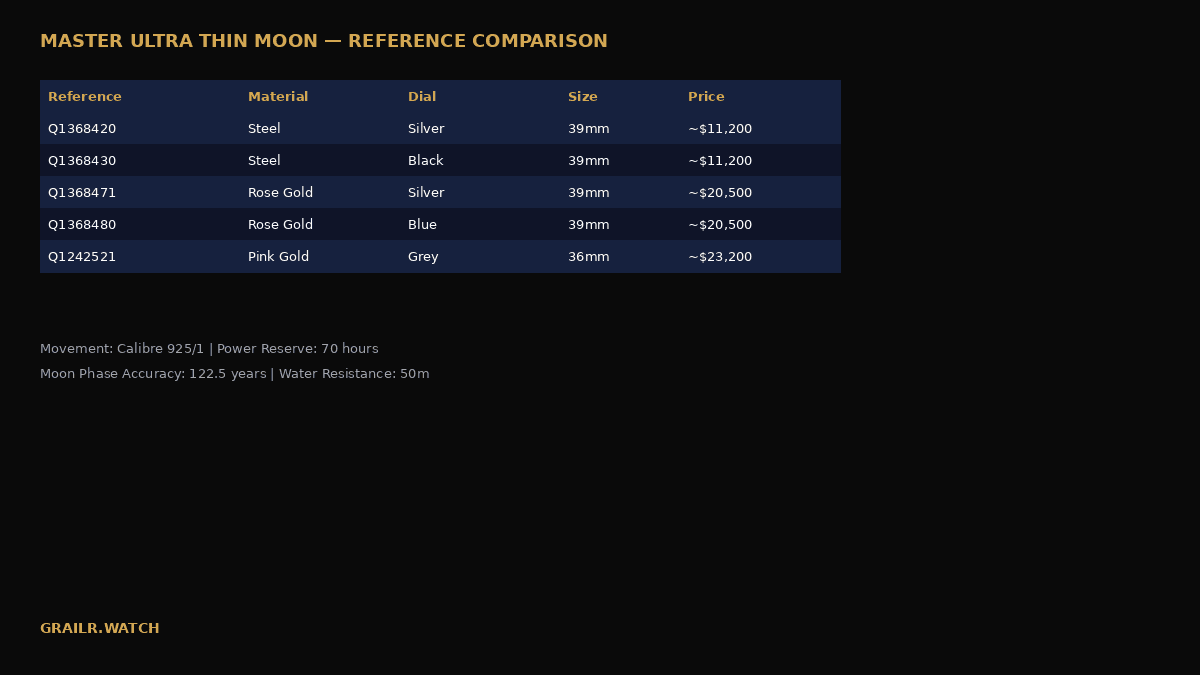
JLC has expanded the Master Ultra Thin Moon family across steel and precious-metal cases since the line debuted. The current generation centres on a 39 mm case, though a new 36 mm pink-gold reference arrived in late 2026. Here is every production reference still in the catalogue or recently available at retail.
39 mm Stainless Steel
The steel models are the volume sellers and the most accessible entry point. Reference Q1368420 pairs a sunburst silver dial with applied hour markers and a blue-tipped moon-phase hand. Reference Q1368430 swaps in a black dial with the same layout. Both use an alligator strap with a pin buckle and are fitted with the Calibre 925/1. The steel case measures 39 mm across and 10.04 mm thick, thin enough that the watch disappears under most cuffs.
39 mm Rose Gold
Reference Q1368471 comes in 18-carat pink gold with a silvered dial, while reference Q1368480 features a striking blue sunburst dial that has become one of the most photographed JLC watches on collector forums. Rose gold adds warmth and weight — the case comes in at the same 39 mm diameter but feels noticeably more substantial on the wrist than steel.
36 mm Pink Gold (2026)
New for 2026, reference Q1242521 shrinks the Master Ultra Thin Moon to 36 mm in 18-carat pink gold. Priced at CHF 19,800 (approximately US$23,200), it targets buyers who find 39 mm too large for a dress watch or who prefer vintage proportions. The thinner case also brings the profile closer to shirt-cuff territory, which is the whole point of the “Ultra Thin” name.
| Reference | Case | Size | Dial | Est. Retail |
|---|---|---|---|---|
| Q1368420 | Steel | 39 mm | Silver | ~$11,200 |
| Q1368430 | Steel | 39 mm | Black | ~$12,500 |
| Q1368471 | Rose Gold | 39 mm | Silver | ~$20,000 |
| Q1368480 | Rose Gold | 39 mm | Blue | ~$24,000 |
| Q1242521 | Pink Gold | 36 mm | Silver | ~$23,200 |
Calibre 925: Movement Deep Dive
The heart of the Master Ultra Thin Moon is the Calibre 925/1, developed and manufactured entirely in-house at JLC’s Le Sentier facility. It is a self-winding movement that beats at 28,800 vibrations per hour (4 Hz), the standard frequency for modern Swiss automatics, and stores 70 hours of power reserve — nearly three full days, enough to survive a long weekend off the wrist.
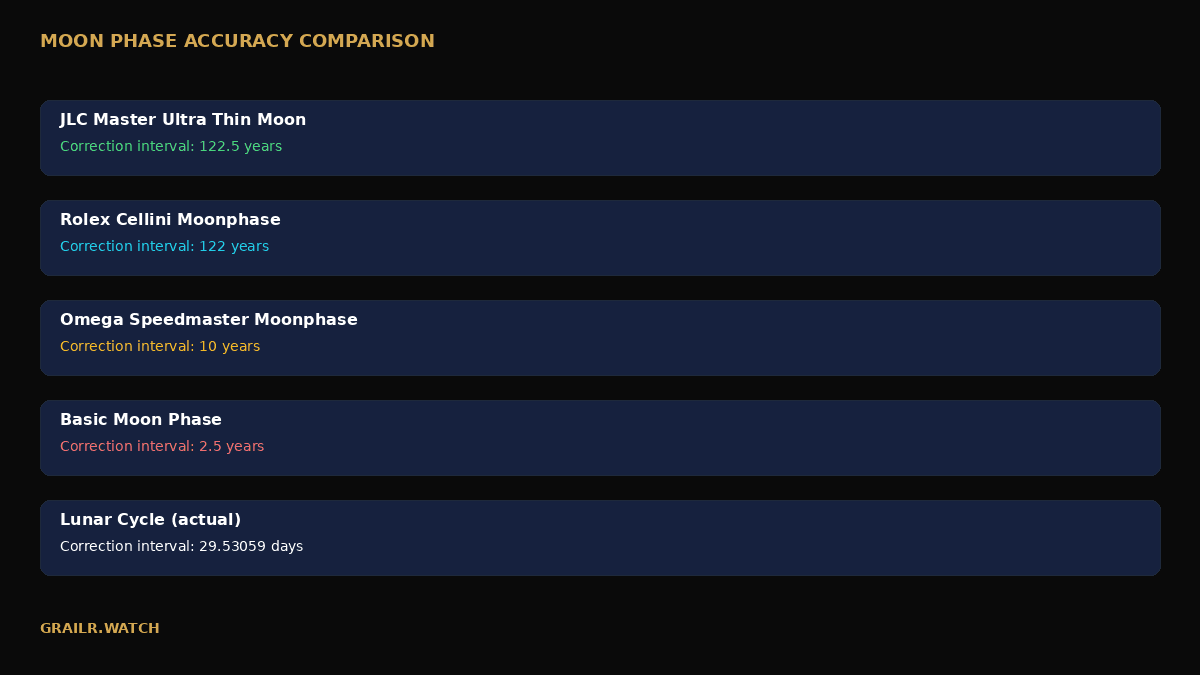
The moon-phase complication uses a 135-tooth wheel that tracks the 29.53059-day lunar cycle with an error of just one day every 122.5 years. In practical terms, if you set the moon phase correctly today, your grandchildren would need to adjust it by a single day. That level of astronomical accuracy puts it on par with moon-phase modules found in watches costing two or three times as much.
Decoration is where JLC separates itself from the mid-range. The bridges receive Côtes de Genève striping, the rotor is finished with circular graining, and the 18-carat gold oscillating weight carries the JLC logo. All of this is visible through the sapphire caseback — and worth seeing. Compared with the solid casebacks on an Omega De Ville Prestige at a similar price, the display back is a meaningful differentiator.
Servicing intervals are recommended at every eight to ten years. JLC operates its own service centres worldwide, which keeps costs predictable — a full service including the moon-phase module typically runs $600–$900, depending on region. That is roughly comparable to what you would pay for an Omega service and considerably less than Patek Philippe or Vacheron Constantin.
Pricing and Resale Data
The Master Ultra Thin Moon offers strong value at retail for what you get — an in-house manufacture moon phase in a slim, well-finished case. But like most JLC models outside the Reverso Tribute and the Polaris Mariner, it does not trade above retail on the secondary market. That is actually good news for buyers: you can find recent examples at significant discounts.
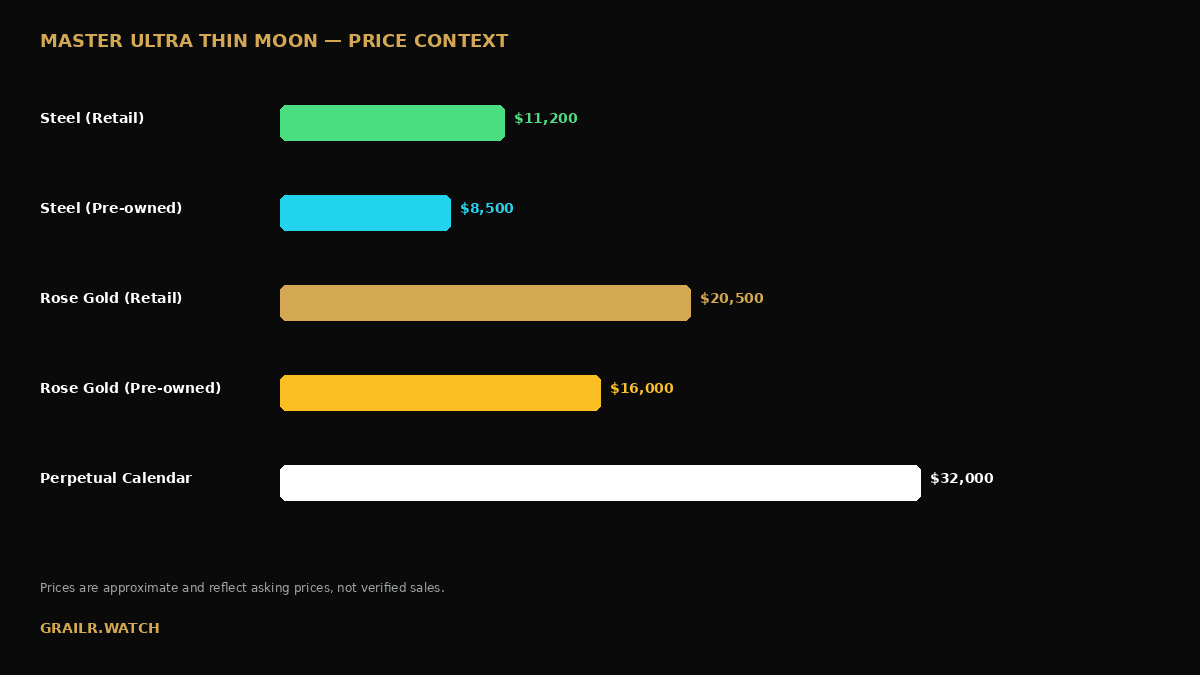
| Reference | Material | Est. Retail | Pre-Owned | Retention |
|---|---|---|---|---|
| Q1368420 | Steel | ~$11,200 | $7,500–$9,000 | ~70% |
| Q1368430 | Steel | ~$12,500 | $8,500–$10,500 | ~75% |
| Q1368471 | Rose Gold | ~$20,000 | $13,000–$16,000 | ~70% |
| Q1368480 | Rose Gold | ~$24,000 | $16,000–$20,000 | ~73% |
The black-dial steel reference (Q1368430) tends to command a slight premium over the silver dial on the secondary market, likely because it photographs better and reads more legibly in low light. The blue-dial rose gold (Q1368480) is the collector favourite and holds value best in absolute terms. If you are buying new for long-term enjoyment, buy what you love. If you are buying pre-owned for value, the silver-dial steel Q1368420 offers the lowest cost of entry for the full Master Ultra Thin Moon experience. Use Grailr’s appraisal tool to check current market pricing before you commit.
Check Any Watch Price in Seconds
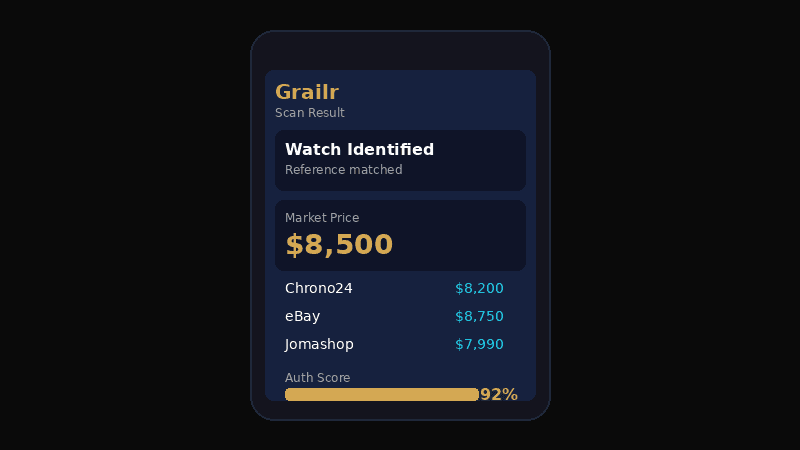
Grailr scans your watch photo and pulls live pricing from Chrono24, eBay, and Jomashop.
- AI identifies brand, model & reference number
- Live market prices from 3+ sources
- Authentication confidence score
The Perpetual Calendar Step-Up
If the Master Ultra Thin Moon leaves you wanting more, JLC’s next rung is the Master Ultra Thin Perpetual Calendar. Where the Moon shows hours, minutes, seconds, date and moon phase, the Perpetual Calendar adds the day of the week, the month, and a four-year leap-year cycle. It will not need a date correction until the year 2100, when the Gregorian calendar skips a leap year.
The Perpetual Calendar uses the Calibre 868, also fully in-house, with a 70-hour power reserve. In rose gold (reference Q1302520), it retails from around $30,000. That is a significant jump from the Moon’s entry price, but it is still considerably less than a Patek Philippe 5320G perpetual calendar, which starts above $80,000.
Both watches share the same design language — thin case, applied markers, sunburst dials — so they look right worn side by side as part of a collection. If you are considering the Moon now but suspect you will want the complication upgrade later, that consistency makes the path straightforward. The Grailr perpetual calendar guide covers the broader landscape.
How It Compares to Rivals
The Master Ultra Thin Moon sits at the intersection of manufacture credibility and accessible pricing. Here is how it stacks up against the moon-phase watches you are most likely cross-shopping.
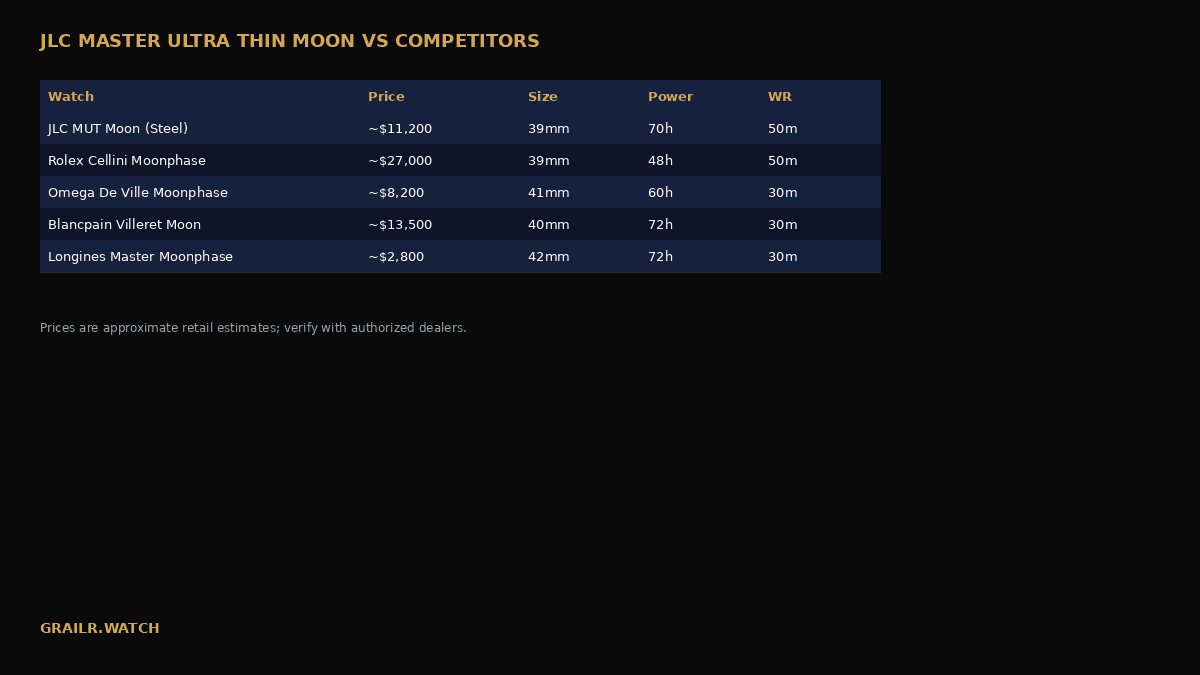
vs Omega De Ville Prestige Moonphase (~$7,500)
The Omega is cheaper, but it uses a modified ETA base calibre (not fully in-house), has a solid caseback, and a less precise moon-phase module. The JLC’s finishing, movement provenance and 122.5-year moon accuracy justify the premium for anyone who values watchmaking depth. The Omega is better value if you just want a moon-phase dial on the wrist.
vs Blancpain Villeret Quantieme de Lune (~$13,500)
Blancpain’s Villeret is the closest competitor. It runs a fully in-house calibre with a 72-hour power reserve and similar moon-phase accuracy. The Villeret wears larger at 40.25 mm and thicker at 11.26 mm. At a similar price point it is a genuine toss-up, and the choice often comes down to dial aesthetics and brand preference.
vs Rolex Cellini Moonphase (Discontinued, ~$20,000 pre-owned)
The Cellini Moonphase used a patented meteorite moon disc and kept time to one day every 122 years. It was priced higher than the JLC at retail and now trades around $20,000 pre-owned. The Rolex 1908 replaced the Cellini line without a moon phase, so the JLC has the segment largely to itself at this price.
vs A. Lange & Söhne Saxonia Moon Phase (~$28,000)
Lange offers superior hand-finishing and a three-quarter plate movement visible through a sapphire caseback. The Saxonia Moon Phase is a step up in exclusivity and finishing, but at roughly double the price of the JLC in steel. If your budget stretches that far and you value German Feinste Uhrmacherkunst, it is hard to beat.
5 Tips Before You Buy
1. Try Both Dial Colours
The silver dial looks lighter and dressier in person than in photographs, while the black dial has more contrast and works better in low light. Visit a JLC boutique or authorised dealer to see both before deciding — the difference is much larger in the metal than on screen.
2. Check the Moon-Phase Setting
If buying pre-owned, verify the moon-phase display is set correctly and that the corrector pusher (recessed at 8 o’clock) clicks cleanly. A stiff or non-responsive corrector can indicate water ingress or a worn spring, both of which add to service costs.
3. Consider Pre-Owned for Value
Steel models trade 25–35% below retail on the secondary market. A two-year-old example with box and papers saves you $3,000–$4,000 and still falls within JLC’s recommended service interval. Verify the reference number with Grailr before sending payment.
4. Scan Before You Buy
Use Grailr’s free scanner to photograph any listing and check the suggested identification against the seller’s description. A photo scan provides an indicative estimate, not proof of authenticity — always request the full certificate and service history.
5. Budget for the Strap
The factory alligator strap is beautiful but shows wear quickly. A replacement from JLC costs $300–$500. Aftermarket straps from providers like Delugs or ABP fit the 21 mm lug width and cost $80–$200 in comparable leather. Factor that into your total cost of ownership.
Frequently Asked Questions
How accurate is the JLC Master Ultra Thin Moon phase?
The moon-phase display loses just one day every 122.5 years, making it one of the most precise lunar complications available at this price point. You would need to advance the moon phase by a single day sometime around the year 2148.
What is the retail price of the Master Ultra Thin Moon in steel?
The current-generation steel models retail for approximately $11,200 to $12,500 depending on dial colour and region. Pre-owned examples in good condition trade between $7,500 and $10,500.
What movement does the Master Ultra Thin Moon use?
It runs the in-house Calibre 925/1, a self-winding movement beating at 28,800 vph with a 70-hour power reserve. The rotor and bridges are decorated with Côtes de Genève finishing, visible through the sapphire caseback.
Is the Master Ultra Thin Moon a good investment?
Steel models retain roughly 65–85% of retail on the secondary market. It is not a speculative watch, but it holds value well for a dress complication and far better than fashion-brand watches at the same price.
What is the difference between the Moon and the Perpetual Calendar?
The Moon shows hours, minutes, seconds, date and moon phase. The Perpetual Calendar adds day, month and a four-year leap-year cycle that requires no manual correction until 2100. The Perpetual starts at roughly $30,000 in rose gold.
Can you wear the Master Ultra Thin Moon every day?
Yes, with care. At 50 metres water resistance and 10 mm thick it handles everyday tasks, rain and hand-washing. However, its polished case and alligator strap are better suited to office and evening wear than outdoor sports.
Related Articles
The Bottom Line
The Jaeger-LeCoultre Master Ultra Thin Moon is one of the best values in haute horlogerie. A fully in-house moon phase with 122.5-year accuracy, a 70-hour power reserve and manufacture finishing — all in a case that slips under any cuff — for around $11,000 in steel. Pre-owned buyers can enter for under $8,000. If you want genuine complication watchmaking without Patek Philippe pricing, this is the watch to buy.
Considering a JLC Moon Phase?
Grailr uses a photo to suggest a watch identity and an indicative price estimate, with active eBay listings where available. Check the exact reference and condition independently; a photo scan cannot authenticate a watch.
Scan a Watch NowSources and price context
- Jaeger-LeCoultre Master Ultra Thin Moon product page — Official specifications for the Q1368430 reference including Calibre 925/1 details and case dimensions.
- Watchbase Calibre 925/1 technical data — Independent movement database with beat rate, power reserve and component count for this calibre.
These primary sources support the specific specification and calibre points noted above. Prices and resale percentages elsewhere in this guide are indicative editorial figures, not a verified transaction dataset or guaranteed returns. Confirm the exact reference, region, condition and current quote before buying; asking prices are not completed-sale prices.