Tiffany Portfolio Watches: History, Specs and Prices
Tiffany’s most accessible watch line explained — what a Portfolio is, what it isn’t, and what one costs today on the secondary market.
Price context: this guide includes indicative prices from its original publication period. They have not all been refreshed to current quotes. Use the linked primary sources for specifications and policies, and verify prices independently.

- The Tiffany Portfolio is a discontinued quartz dress-watch line produced from the late 1980s through the 2000s
- Cases range from gold-plated ($80–$200 pre-owned) to solid 14k gold ($500–$1,500+)
- Swiss-made quartz movements by houses such as Concord and Movado Group
- Not to be confused with Tiffany-signed Patek Philippe or Rolex pieces, which trade at six figures or more
What Is a Tiffany Portfolio Watch?
The Tiffany Portfolio is a family of Swiss-made quartz dress watches that Tiffany & Co. introduced in the late 1980s and continued producing into the early 2000s. It was designed as the brand’s most accessible watch line — a way to wear the Tiffany name on your wrist without the five-figure price of a Tiffany-signed complication or a Patek Philippe co-branded piece.
Tiffany’s watchmaking history runs deeper than most people realise. The company was founded in 1837 and opened its own Geneva workshop in 1874, decades before it became synonymous with engagement rings. Throughout the twentieth century, Tiffany maintained relationships with top-tier Swiss manufacturers — most famously Patek Philippe, whose “Tiffany & Co.” dual-signed dials remain among the most coveted auction lots in horology.
The Portfolio was something different entirely. Rather than a prestige partnership, it was a straightforward consumer product: a slim, well-finished quartz watch bearing the Tiffany name, made by established Swiss houses under contract. Concord and the Movado Group are the two manufacturers most commonly associated with Portfolio production. The watches used reliable Swiss quartz calibers — typically ETA-derived movements — chosen for accuracy and low maintenance rather than horological ambition.
Original retail prices ranged from about $500 for a basic gold-plated model to as much as $3,500 for a solid 14-karat gold version. For context, a Cartier Tank or a Cartier dress watch from the same era would have cost two to five times more. The Portfolio was marketed to the same customer who bought Tiffany sterling silver or stationery — someone who valued the brand association and design quality but was not necessarily a watch collector.
The Portfolio Lineup by Material
Gold-Plated
The most common Portfolio watches on the secondary market are gold-plated models. These feature a base metal case — typically brass — with a layer of gold electroplating. When new, they had the visual warmth of solid gold at a fraction of the price. The trade-off is durability: decades of wear can rub through the plating, particularly on the caseback, crown, and edges. Gold-plated Portfolios originally retailed for $500 to $1,000 and now trade pre-owned for roughly $80 to $200. Corporate gift variants (branded for companies such as Visa or American Express) sit at the lower end of that range.
Stainless Steel
Steel Portfolio watches are less common than gold-plated examples but more durable. They resist scratching better, age more gracefully, and avoid the plating-wear issue entirely. Case sizes for men’s steel models run around 30–33mm — small by modern standards but period-correct for a 1990s dress watch. Women’s versions measure 20–25mm. Pre-owned steel Portfolios typically sell for $200 to $400, depending on condition and the presence of box and papers.
Two-Tone (Steel and Gold)
Two-tone Portfolios combine a stainless steel case with gold-plated or gold-capped accents — a bezel, bracelet links, or crown in a warm gold tone against brushed steel. This style was extremely popular in the late 1980s and early 1990s and has experienced a modest resurgence as vintage two-tone watches have come back into fashion. Pre-owned two-tone models generally fall between the steel and solid gold tiers, trading for $250 to $600.
Solid 14k Gold
At the top of the Portfolio range sat solid 14-karat yellow gold models. These are the rarest on the secondary market and the most valuable, with pre-owned asking prices from $500 to $1,500 or more. Solid gold Portfolios weigh noticeably more than their plated counterparts and carry a karat stamp (typically “14K” or “585”) on the caseback. The intrinsic gold value alone provides a floor price that plated models lack. If you’re buying a solid gold Portfolio, the gold content by weight is worth verifying, since the melt value can exceed the watch’s resale price in some configurations.
Specifications Overview
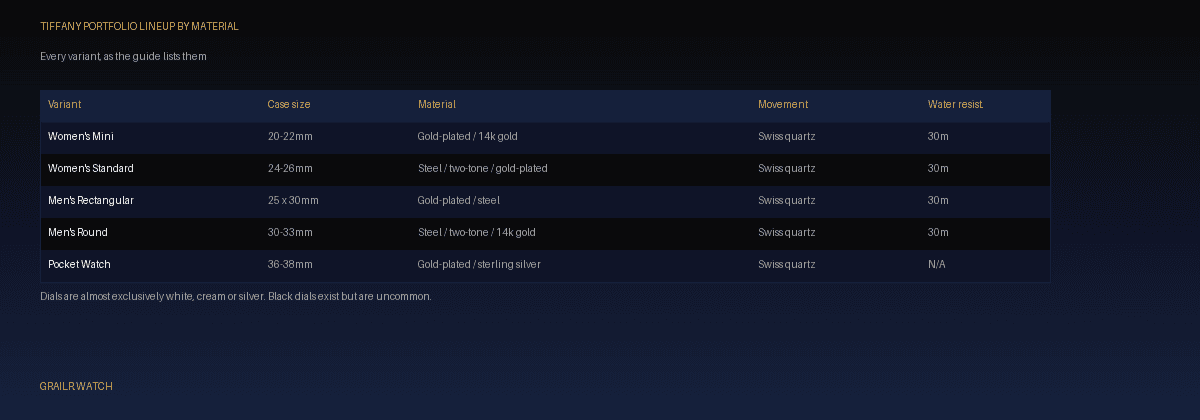
Portfolio watches were not complicated timepieces. They were quartz, time-only or time-and-date, and thin enough to slide under a shirt cuff. The table below summarises the common variants you’ll encounter on the secondary market. Exact reference numbers vary; Tiffany did not use a public reference-numbering scheme as consistently as watch-first brands.
| Variant | Case Size | Material | Movement | Water Resist. |
|---|---|---|---|---|
| Women’s Mini | 20–22mm | Gold-plated / 14k gold | Swiss quartz | 30m |
| Women’s Standard | 24–26mm | Steel / two-tone / gold-plated | Swiss quartz | 30m |
| Men’s Rectangular | 25 × 30mm | Gold-plated / steel | Swiss quartz | 30m |
| Men’s Round | 30–33mm | Steel / two-tone / 14k gold | Swiss quartz | 30m |
| Pocket Watch | 36–38mm | Gold-plated / sterling silver | Swiss quartz | N/A |
Dial colours are almost exclusively white, cream, or silver. Black dials exist but are uncommon. Most models feature applied Roman numerals or baton indices and thin dauphine or leaf-shaped hands — classic dress-watch design language that prioritises legibility and elegance.
Pre-Owned Pricing Guide
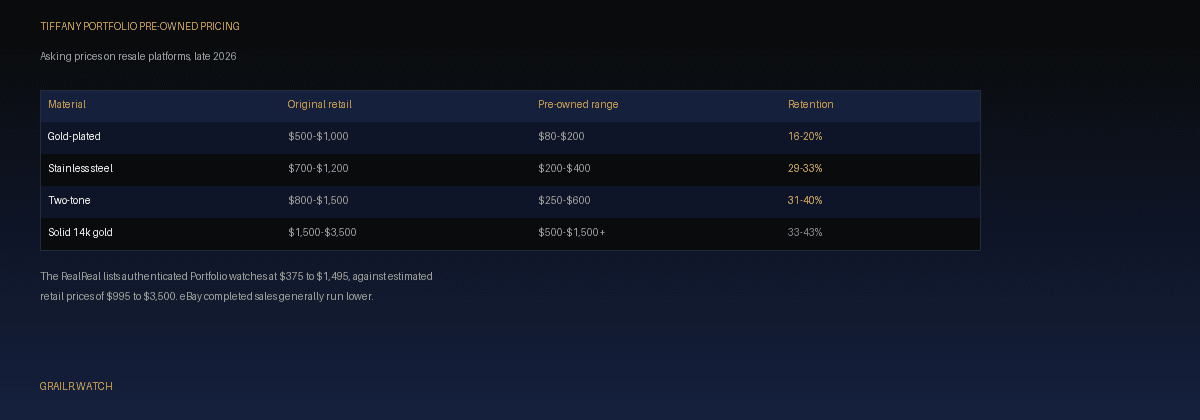
Portfolio watches are not scarce. They were produced in large quantities over roughly fifteen years, so the secondary market is well supplied. That supply, combined with limited collector demand for quartz dress watches, keeps prices accessible. The ranges below reflect asking prices on resale platforms as of late 2026 and are indicative, not guaranteed sale prices. Condition, completeness (box, papers, receipt), and the specific material tier are the main drivers.
| Material | Original Retail | Pre-Owned Range | Retention |
|---|---|---|---|
| Gold-plated | $500–$1,000 | $80–$200 | 16–20% |
| Stainless steel | $700–$1,200 | $200–$400 | 29–33% |
| Two-tone | $800–$1,500 | $250–$600 | 31–40% |
| Solid 14k gold | $1,500–$3,500 | $500–$1,500+ | 33–43% |
Consignment platforms like The RealReal list authenticated Portfolio watches at $375 to $1,495, typically positioned against estimated retail prices of $995 to $3,500. eBay completed-sale listings generally run lower than consignment asking prices, so check actual sold-for data before treating any listing as market value. For more context on how fashion-brand watches perform on resale, see our guide to fashion brand watch resale values.
Portfolio vs Tiffany-Signed Patek Philippe and Rolex
This distinction trips up nearly every newcomer who searches for “Tiffany watch” and sees results ranging from $80 to $6.5 million. The confusion is understandable, so let’s be direct: a Tiffany Portfolio watch and a Tiffany-signed Patek Philippe Nautilus exist in entirely different categories.
Dual-signed pieces are watches manufactured by Patek Philippe, Rolex, or another prestige house with the “Tiffany & Co.” name printed alongside the maker’s name on the dial. These were produced for Tiffany’s retail network under a formal partnership. A Patek Philippe Nautilus 5711/1A with a Tiffany-signed dial sold at Phillips auction in December 2021 for $6.5 million. Even less famous examples — a Tiffany-signed Rolex Datejust or Day-Date — routinely command premiums of 50–200% over their unsigned equivalents.
The Portfolio is Tiffany’s own product, not a co-branded piece from another manufacturer’s line. It carries only the Tiffany name, uses a contract-sourced Swiss quartz movement, and was sold as an affordable fashion accessory. It has no relationship to the dual-signed collector market, and no amount of condition or rarity will bridge that gap.
If you are evaluating a Tiffany watch and are unsure which category it falls into, look at the dial. A dual-signed piece shows two names: the manufacturer (“Patek Philippe”, “Rolex”) and “Tiffany & Co.” below it. A Portfolio shows only “Tiffany & Co.” and sometimes “Portfolio” printed below the logo. If your watch has “Portfolio” anywhere on the dial or caseback, it is from the Portfolio line.
How to Authenticate a Tiffany Portfolio Watch
Tiffany Portfolio watches are not commonly faked — the secondary-market value is too low to make counterfeiting profitable at scale. That said, the Tiffany name carries enough cachet that you will occasionally encounter misrepresented pieces: a generic quartz watch with a Tiffany caseback sticker, or a re-dialed piece with an aftermarket Tiffany logo. Here is what to check.
Caseback Engravings
Genuine Portfolio watches have a crisp “TIFFANY & CO.” engraving on the caseback, along with “SWISS MADE”, a serial number, and the case material designation (e.g. “STAINLESS STEEL” or “14K”). The engraving should be clean, evenly spaced, and deep enough to feel with a fingernail. Shallow, unevenly spaced, or laser-etched text on a model from this era is a red flag.
Dial Quality
The Tiffany logo on the dial should be sharply printed with no bleeding or smudging. Applied indices (where present) should sit flush and uniform. Examine the spacing between “TIFFANY” and “& CO.” — fakes often get this wrong. Under magnification, the printing quality on a genuine dial is noticeably cleaner than aftermarket work.
Crown Stamp
Most Portfolio watches have a small “T & Co.” stamp or the Tiffany logo on the crown. It is small and easy to miss on genuine pieces, but entirely absent on many fakes. The crown should also pull and push smoothly; Portfolio quartz crowns are small and delicate.
Weight and Finish
A genuine Portfolio feels well-made for its size. Gold-plated models should have a uniform, warm tone without brassy patches. Solid 14k gold models are noticeably heavier than plated versions of the same design. If the weight feels inconsistent with the stated material, ask for more documentation before buying.

Where to Buy and What to Pay
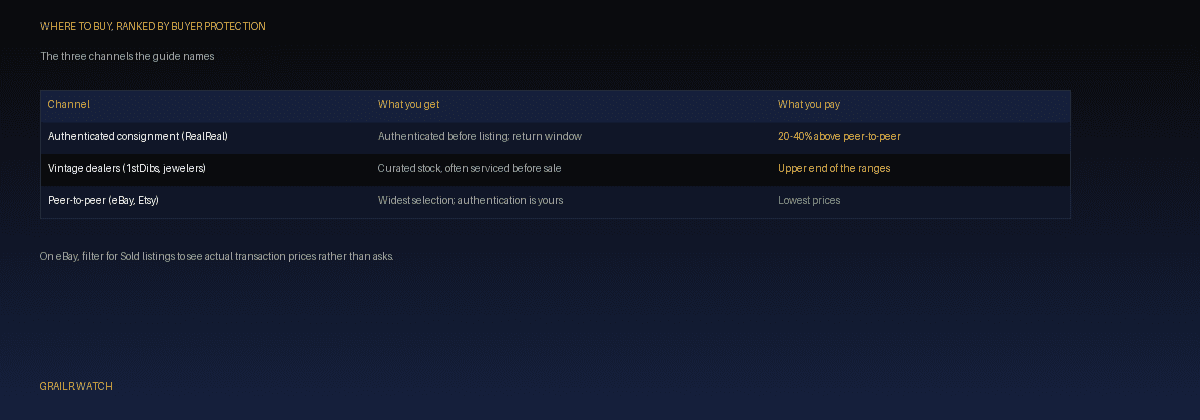
Portfolio watches are widely available on resale platforms. The main question is not whether you can find one but whether you’re paying a fair price for the specific material and condition. Here are the most common channels, ranked by buyer protection.
Authenticated consignment (The RealReal, Vestiaire Collective): these platforms authenticate items before listing them, which removes much of the risk. Prices tend to be 20–40% higher than peer-to-peer platforms, but you get a return window and authentication guarantee. The RealReal is the most common source for Portfolio watches in this category.
Vintage dealers (1stDibs, Chairish, local jewelers): curated inventory with dealer markup. Expect to pay at the upper end of the ranges in the pricing table. The advantage is that dealers often service the watch before selling.
Peer-to-peer marketplaces (eBay, Etsy): the widest selection and lowest prices, but authentication is your responsibility. On eBay, filter for “Sold” listings to see actual transaction prices rather than aspirational asks. A gold-plated Portfolio that sold for $95 on eBay is a better price anchor than one listed at $450 on a dealer site.
Estate sales and auctions: Portfolio watches occasionally surface at local estate sales, often bundled with other jewellery. If you know what to look for, these can be the best values. The affordable watch buying guide covers general strategies for finding underpriced pieces in non-specialist venues.
Should You Buy a Portfolio Watch?
The honest answer depends on what you want from it. A Portfolio is not a horological investment, and it is not a status symbol in collector circles. What it is, however, is a well-made quartz dress watch with clean proportions, a recognisable brand name, and a price that has already depreciated to the point where the downside risk is minimal.
If you admire Tiffany’s design language and want an elegant, thin watch for formal wear, a steel or two-tone Portfolio for $200–$500 is genuinely good value. It will keep accurate time, fit under a cuff, and carry a name that most people recognise immediately. If you want something that holds its value or appreciates over time, a Portfolio is the wrong choice — look at mechanical watches from established watchmakers instead.
One scenario where the Portfolio makes particular sense: as a gift. The Tiffany blue box still carries emotional weight, and a vintage Portfolio in good condition with its original box can deliver the full Tiffany unboxing experience for a few hundred dollars. That combination of brand recognition, presentation, and affordability is hard to replicate with any other vintage watch line.
Frequently Asked Questions
What is a Tiffany Portfolio watch?
The Tiffany Portfolio is a line of Swiss-made quartz dress watches that Tiffany & Co. sold from the late 1980s through the 2000s. They came in gold-plated, stainless steel, two-tone, and solid 14k gold cases at original retail prices from about $500 to $3,500.
How much is a Tiffany Portfolio watch worth today?
Pre-owned Tiffany Portfolio watches typically sell for $80 to $200 in gold-plated versions, $200 to $400 in stainless steel, and $500 to $1,500 or more in solid 14k gold. Condition, box and papers, and case material are the main value drivers.
Are Tiffany Portfolio watches the same as Tiffany-signed Patek Philippe watches?
No. Tiffany-signed Patek Philippe or Rolex watches are dual-signed pieces that can sell for six or seven figures at auction. The Portfolio is Tiffany's own quartz dress-watch line and trades in the hundreds of dollars, not tens of thousands.
Who made the movements in Tiffany Portfolio watches?
Tiffany outsourced Portfolio production to Swiss watch houses including Concord and Movado Group. The movements are Swiss-made quartz calibers, typically ETA or similar, chosen for reliability rather than horological prestige.
Does Tiffany still make Portfolio watches?
No. The Portfolio line was discontinued in the 2000s. Since LVMH acquired Tiffany in 2021, the brand's watch strategy has shifted toward higher-end collections. Portfolio watches are only available pre-owned.
Is a Tiffany Portfolio watch a good investment?
Portfolio watches are not investment pieces. Most have depreciated well below their original retail price. They are best approached as affordable, well-made quartz dress watches with the Tiffany name rather than as collectibles that will appreciate.
Related Articles
The Bottom Line
The Tiffany Portfolio is not a grail watch. It is a well-made quartz dress watch from one of the world’s most recognisable luxury brands, and it can be had today for less than a decent pair of shoes. If you want an elegant everyday piece or a thoughtful gift that arrives in that famous blue box, a Portfolio at $200–$500 delivers genuine value. Just know what you’re getting: a Tiffany accessory, not a horological collectible.
Sources and price context
- Tiffany & Co. watch care and service FAQ — Background on Tiffany’s watchmaking services and the brands it has partnered with over its history.
- 1stDibs: Portfolio Tiffany watches — Curated dealer listings for vintage Portfolio watches across all material tiers.
These primary sources support the specific history and marketplace points noted above. Prices and resale percentages elsewhere in this guide are indicative editorial figures, not a verified transaction dataset or guaranteed returns. Confirm the exact reference, condition and current quote before buying; asking prices are not completed-sale prices.