Tudor 1926 Luna: Moon Phase Specs and Prices
Tudor’s first moon phase complication — three dial colours, a Jubilee-style bracelet, and 100 m water resistance for $3,000.
Price context: this guide includes indicative prices from its original publication period. They have not all been refreshed to current quotes. Use the linked primary sources for specifications and policies, and verify prices independently.
- The Tudor 1926 Luna is Tudor’s first-ever moon phase watch, added to the 1926 dress collection in late 2025
- All three dial colours — blue, black and champagne — retail at $3,000 on a stainless steel bracelet
- The 39 mm case is rated to 100 m — roughly three times the water resistance of competing moon phase watches at this price
- The Calibre T607-9 (Sellita SW280-1 base) is not in-house, which keeps the price under $3,500
Tudor’s First Moon Phase
Tudor has built dive watches, chronographs, GMT travellers and even a fixed-lug military model, but until the 1926 Luna arrived in late 2025 the brand had never released a watch with a moon phase indicator. That makes the Luna a genuine first for a company with eight decades of production history — and it places the complication inside Tudor’s most affordable stainless steel dress collection rather than a limited run priced to match.
The 1926 collection itself launched in 2018 as Tudor’s answer to the entry-level dress watch segment. With sizes from 28 mm to 41 mm, diamond-set dial options and retail prices starting below $2,000, it occupies a tier well below the Black Bay family. Adding a moon phase complication to that foundation rather than to a Black Bay or Pelagos was a deliberate move: it keeps the retail price at $3,000, roughly a thousand dollars below most Swiss-made moon phase competitors on a bracelet.
The name “Luna” refers to the moon, naturally, but also nods to the date Tudor was founded — 1926 — and the classical tone the collection aims for. With a domed sapphire crystal, applied Arabic numerals and a polished bezel, the watch reads more like a Longines Master or a Frederique Constant Classics than a typical Tudor sports piece. Whether that shift appeals or not depends on what you want from the brand, and the rest of this guide covers the technical details that will help you decide.
Full Specifications
The Tudor 1926 Luna shares its 39 mm case diameter with the standard 1926 39 mm time-and-date models. The addition of the moon phase sub-dial at 6 o’clock adds roughly 1 mm of case thickness, bringing the total to 10.1 mm. That is still noticeably thinner than the Pelagos 39 at 12.8 mm, making the Luna a genuine dress-watch profile.
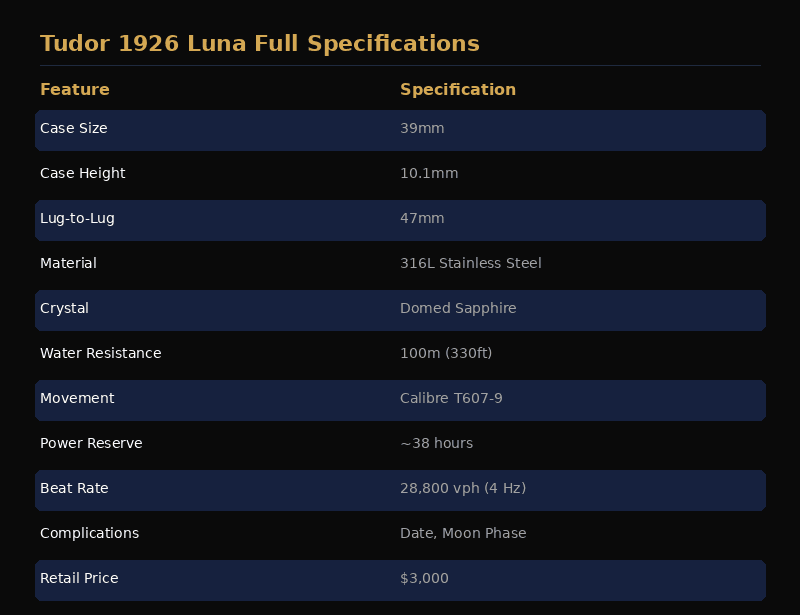
| Specification | Detail |
|---|---|
| Reference | M91560-0001 / -0002 / -0003 |
| Case material | 316L stainless steel |
| Diameter | 39 mm |
| Height | 10.1 mm |
| Lug-to-lug | 47 mm |
| Water resistance | 100 m (330 ft) |
| Crystal | Domed sapphire |
| Caseback | Solid, screw-in, engraved Tudor Genève |
| Movement | Calibre T607-9 (Sellita SW280-1 base) |
| Winding | Automatic + manual |
| Frequency | 28,800 vph (4 Hz) |
| Power reserve | ~38 hours |
| Accuracy | −4/+6 s/day (Sellita chronometer grade) |
| Functions | Hours, minutes, seconds, date, moon phase |
| Lume | None |
| Retail price | $3,000 USD (all variants) |
Three Dials, Three Personalities
Tudor launched the 1926 Luna in three dial colours, each at the same $3,000 retail price. All three share the same sunray-brushed finishing, applied Arabic numerals at even hours and faceted triangular indices at odd hours. The date aperture sits at 3 o’clock, while the moon phase indicator occupies 6 o’clock behind a polished bevel.
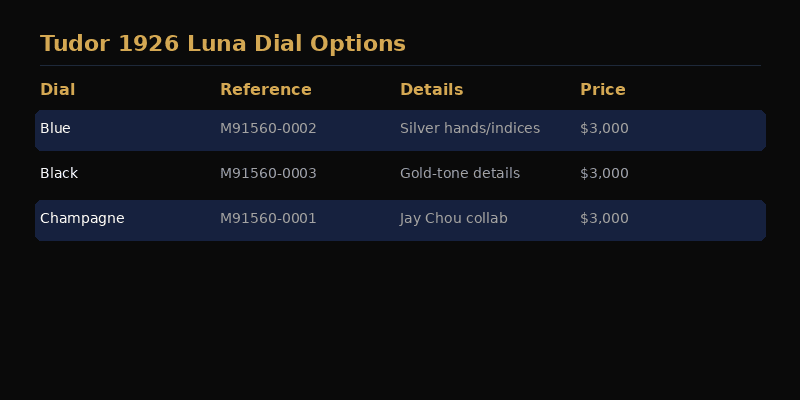
Blue Sunray — M91560-0002
Silver-tone hands and applied indices over a deep blue dial. The blue version is the most photographed of the three and the closest in aesthetic to the Tudor Monarch’s blue-dial variant. Under warm lighting the sunray effect shifts from navy to cobalt, giving the watch a presence that photographs often undersell.
Black Sunray — M91560-0003
Gold-tone hands and indices against a black sunray dial. The warmer metal accents give this version a slightly more traditional character. The gold moon disc at 6 o’clock blends with the gold-tone elements, making the complication feel integrated rather than tacked on.
Champagne — M91560-0001
The champagne dial was developed in collaboration with Taiwanese musician and actor Jay Chou. A black “cloud” partially covers the gold moon disc, creating a visual effect unique to this reference. Of the three, the champagne version is the most polarising — and the one most likely to become a collector’s curiosity in the years ahead.
None of the three dials feature luminous material on the hands or indices. That is a deliberate design choice — the Luna is a dress watch, not a tool watch — but it does mean reading the time in a dark restaurant or cinema requires the Indiglo-era move of angling the watch toward a light source.
The T607-9 Movement Explained
The Calibre T607-9 is not an in-house Tudor movement. It is based on the Sellita SW280-1, a moon phase module built on the workhorse SW200 automatic platform. Tudor finishes the movement with machined striping, perlage and gold-filled engraving on the rotor — all hidden behind a solid caseback you will never see without a case opener.
That sourcing decision matters for two reasons. First, it keeps the retail price at $3,000 rather than the $3,700–$4,000 range that an in-house MT-series calibre would require. Second, the Sellita base means any qualified independent watchmaker can service the watch without proprietary Tudor parts. The counterpoint is that Tudor’s in-house movements — like the MT5402 in the Black Bay — offer 70-hour power reserves versus the Luna’s 38 hours and carry COSC certification.
The T607-9 runs at 28,800 vibrations per hour (4 Hz), delivers a 38-hour power reserve and carries Sellita’s own chronometer-grade rating of −4/+6 seconds per day. That is not a COSC certificate — the movement is not submitted to the Swiss testing body — but Sellita guarantees COSC-equivalent accuracy under its own grading protocol. In practice, forum owners report settling around −2/+4 seconds per day after a few weeks of wear.
The moon phase itself uses a standard 59-tooth gear, which drifts by approximately one day every 2 years and 7 months. You correct it via the crown — pull to the first position and advance the moon disc. High-end astronomical moon phases from brands like A. Lange & Söhne and Patek Philippe achieve accuracy within one day per 122 years, but those movements start at roughly ten times the Luna’s price. At $3,000, the 59-tooth standard is universal.
The Jubilee-Style Bracelet
Tudor pairs the Luna with a seven-link stainless steel bracelet that borrows heavily from Rolex’s Jubilee design. The links alternate between brushed centre links and polished outer links, giving the bracelet a dressy shimmer that suits the moon phase dial. At 39 mm on this bracelet, the Luna wears lighter and more refined than any Tudor North Flag or Pelagos.
The clasp is a two-part folding design with the Tudor name etched into the underside. It does not include push-buttons or a micro-adjustment system. That is the Luna’s most common criticism in owner forums: on a warm day, the bracelet can feel slightly too tight, and there is no half-link solution or quick-adjust built into the clasp. The alternative is to have your authorised dealer remove or add a link, which is a permanent adjustment rather than the tool-free convenience found on the Pelagos’s spring-loaded clasp.
Tudor does not currently offer the Luna on a leather strap from the factory, though the 20 mm lug width accepts aftermarket straps without modification. A dark brown or navy alligator strap can push the watch further into dress territory, while a canvas NATO — if you can forgive the tonal mismatch — makes it more casual.
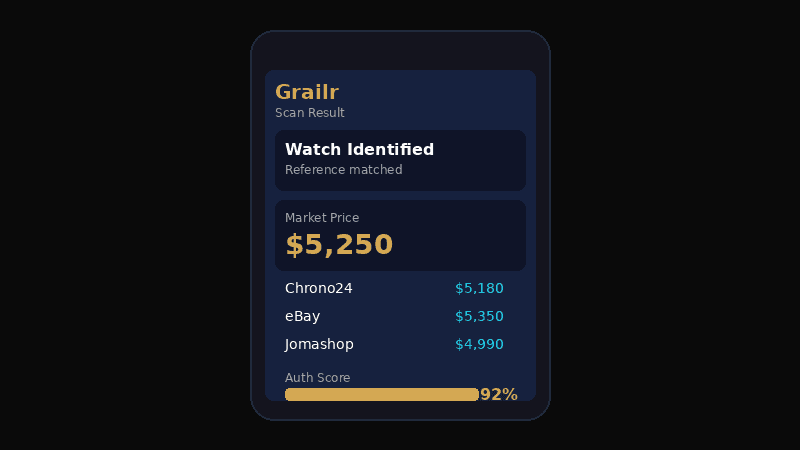
Check Any Watch Price in Seconds
Grailr scans your watch photo and pulls live pricing from Chrono24, eBay, and Jomashop.
- AI identifies brand, model & reference number
- Live market prices from 3+ sources
- Authentication confidence score
How the Luna Compares
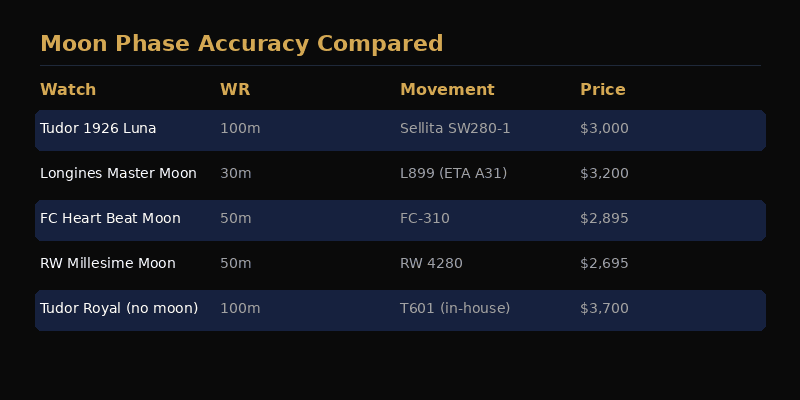
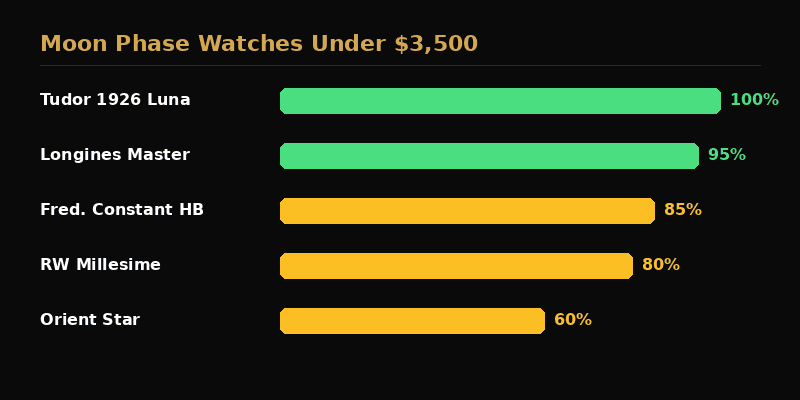
The sub-$3,500 moon phase segment has more options than most buyers expect. Here is how the Luna stacks up against the models you are most likely cross-shopping.
| Watch | Size | WR | Bracelet | Price |
|---|---|---|---|---|
| Tudor 1926 Luna | 39 mm | 100 m | Steel (incl.) | $3,000 |
| Longines Master Moonphase | 40 mm | 30 m | Leather | ~$3,200 |
| FC Heartbeat Moonphase | 40 mm | 30 m | Leather | $2,895 |
| Raymond Weil Millésime | 39.5 mm | 50 m | Leather | $2,695 |
| Tudor Royal (day-date) | 41 mm | 100 m | Steel (incl.) | ~$3,700 |
Water resistance is where the Luna pulls ahead decisively. At 100 m it is three times the rating of the Longines and Frederique Constant models, meaning you can wash your hands, get caught in rain, or even take an impulsive pool dip without removing the watch. Neither the Longines nor the Frederique Constant should go near a pool at their 30 m rating.
Bracelet inclusion is the other differentiator. The Longines, FC and Raymond Weil all ship on leather straps. If you want a steel bracelet for any of those, you are either buying aftermarket or looking at a higher-priced variant. The Luna includes its seven-link bracelet at $3,000, which makes the effective price gap even wider.
Movement prestige favours the Longines. Its L899 calibre is an in-house automatic with a 72-hour power reserve, nearly doubling the Luna’s 38 hours. If power reserve matters to you — particularly for a weekend watch that sits on a nightstand from Friday to Monday — the Longines has a meaningful advantage.
Pricing and Early Resale Data
All three Tudor 1926 Luna references retail at $3,000 USD. That is roughly $500 more than the standard 1926 39 mm time-and-date model on the same bracelet, making the moon phase complication a relatively modest upcharge. In the UK, the blue dial is listed at £2,655 (inclusive of VAT), and the Euro-zone retail is approximately €2,720.
On the secondary market, the Luna has been trading below retail since its first months. Pre-owned and unworn examples have appeared on dealer and forum listings between $1,950 and $2,700, with the blue dial consistently commanding the highest ask prices. The champagne dial — perhaps because of the Jay Chou association and its niche appeal — has traded at the lowest end of that range.
That depreciation pattern is typical for Tudor’s non-sport models. The watches that hold their value best in Tudor’s lineup are the Black Bay and Pelagos ranges, where limited production and strong brand association with Rolex support secondary market pricing. The 1926 collection, by contrast, is widely available at authorised dealers and does not generate waitlist demand.
That is not a criticism — it means you can walk into an AD, try the watch on, and leave wearing it the same day. And if you are buying pre-owned, the below-retail asking prices mean you can pick up a barely-worn Luna for $300–$500 less than the sticker. Use Grailr’s scanner to check what comparable references are currently asking before you commit.
Where to Buy the Tudor 1926 Luna
Authorised Dealers
Tudor’s official retailer locator shows availability by region. The Luna is not a waitlist piece — most ADs with Tudor stock will have at least one dial variant in the case. Buying from an AD gets you Tudor’s five-year international guarantee.
Pre-Owned & Grey Market
Chrono24, WatchPatrol and dealer platforms like Bob’s Watches regularly list unworn or lightly-worn Luna references at $1,950–$2,700. If you are comfortable buying pre-owned, the savings are real. Check that the five-year Tudor warranty card is still active — a 2025 purchase gives you coverage through 2030.
Try Before You Buy
The 39 mm case with 47 mm lug-to-lug wears slightly larger than the numbers suggest because the mostly-polished case catches light and draws attention. If you normally wear 38–40 mm watches you will be fine, but try it on if you lean toward smaller pieces — the polished finish adds visual volume.
Scan Before You Send Money
If you are buying a used Tudor 1926 Luna from a private seller or marketplace, use Grailr’s free scanner to photograph the listing. Grailr will suggest the reference, check active market pricing and flag anything that looks off. It is not a substitute for professional authentication, but it catches mispriced and mislabelled listings before you commit.
Frequently Asked Questions
What movement does the Tudor 1926 Luna use?
The Tudor 1926 Luna uses the Calibre T607-9, based on the Sellita SW280-1. It is automatic with manual winding, runs at 28,800 vph, and delivers approximately 38 hours of power reserve.
How much does the Tudor 1926 Luna cost?
All three Tudor 1926 Luna dial variants retail at $3,000 USD on the stainless steel bracelet. Pre-owned examples have been asking between $1,950 and $2,700 in 2026.
Does the Tudor 1926 Luna have an in-house movement?
No. The Calibre T607-9 is based on the Sellita SW280-1. Tudor reserves its in-house MT-series calibres for the Black Bay and Pelagos lines. The Luna sits at a lower price point partly because of this sourcing choice.
Is the Tudor 1926 Luna water resistant?
Yes, the Luna is rated to 100 metres (330 feet). That is well above most moon phase competitors in the sub-$3,500 range, which typically top out at 30-50 metres.
How accurate is the moon phase complication?
The Luna uses a standard 59-tooth moon phase gear, which drifts by roughly one day every 2 years and 7 months. You can correct it manually via the crown. High-end astronomical moon phases are more precise but cost ten times more.
What dial colours does the Tudor 1926 Luna come in?
Three options: blue sunray (M91560-0002), black sunray with gold accents (M91560-0003), and champagne (M91560-0001) developed in collaboration with Jay Chou. All retail at the same $3,000 price.
Related Articles
The Bottom Line
The Tudor 1926 Luna does one thing that no other Tudor has done before: it puts a moon phase on your wrist for $3,000, backed by 100 m water resistance and a steel bracelet. The movement is not in-house, the power reserve is modest at 38 hours, and there is no lume — but those are the trade-offs that keep the price where it is. If you want a dressy moon phase from a brand with Rolex parentage and strong AD support, the Luna is the most accessible way in.
Considering a Tudor 1926 Luna?
Grailr uses a photo to suggest a watch identity and an indicative price estimate, with active eBay listings where available. Check the exact reference and condition independently; a photo scan cannot authenticate a watch.
Scan a Watch NowSources and price context
- Tudor 1926 Luna M91560-0002 specifications — Official Tudor page with case, movement and water resistance details for the blue dial reference.
- Sellita SW280-1 movement specifications — Manufacturer page with calibre details, frequency and power reserve for the base movement used in the T607-9.
These primary sources support the specific specification and movement points noted above. Prices and resale figures elsewhere in this guide are indicative editorial figures, not a verified transaction dataset or guaranteed returns. Confirm the exact reference, region, condition and current quote before buying; asking prices are not completed-sale prices.