Tudor Monarch Buying Guide: Specs, Price and Value
Everything you need to know about Tudor’s most talked-about 2026 release — the California-dial, METAS-certified sports watch that enters the integrated-bracelet conversation at under $6,000.
Price context: this guide includes indicative prices from its original publication period. They have not all been refreshed to current quotes. Use the linked primary sources for specifications and policies, and verify prices independently.

- The Tudor Monarch is a 39mm stainless steel sports watch with a California dial and an exhibition caseback, priced at CHF 4,800 / $5,875
- It uses the in-house Caliber MT5662-2U with 65-hour power reserve and dual COSC + METAS Master Chronometer certification
- The two-link bracelet with T-Fit clasp offers tool-free micro-adjustments and polished mid-link finishing
- Secondary market prices already sit 15–20% above retail, signalling strong early demand
What Is the Tudor Monarch?
The Tudor Monarch is a 39mm stainless steel sports watch launched at Watches & Wonders 2026. It marks Tudor’s entry into the integrated-bracelet luxury sports watch category — a space historically defined by the Audemars Piguet Royal Oak, Patek Philippe Nautilus and Vacheron Constantin Overseas, all of which cost ten to fifty times as much.
The name has history: Tudor sold a quartz “Monarch” line in the 1990s. But aside from the name and the Tudor shield at twelve o’clock, the 2026 Monarch shares absolutely nothing with its predecessor. The case geometry is new, the dial layout is new, and the in-house movement is new. This is a ground-up design that happens to carry a familiar badge.
What makes the Monarch interesting is the combination it offers at its price. You get a METAS Master Chronometer certified in-house movement, an exhibition caseback, a California dial, and finishing that reviewers have compared favourably to watches costing two to three times as much. Whether it justifies a $1,500–$2,000 premium over the Black Bay is the question every prospective buyer will need to answer for themselves.
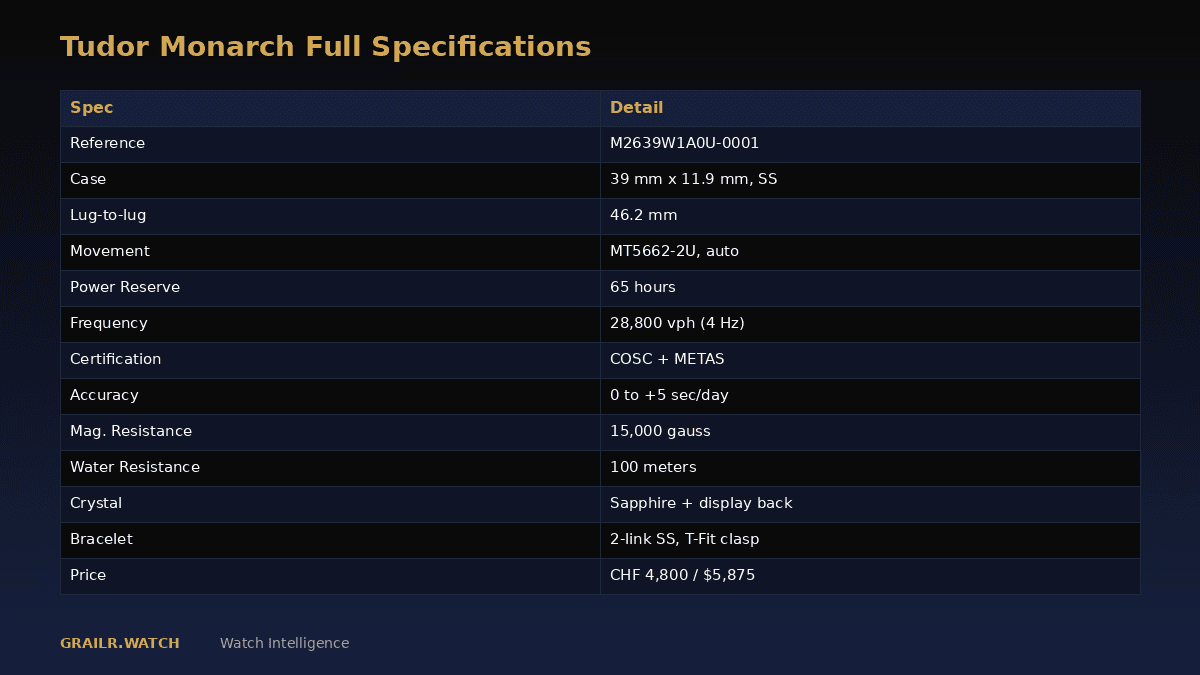
Full Specifications
| Specification | Detail |
|---|---|
| Reference | M2639W1A0U-0001 |
| Case diameter | 39 mm |
| Case thickness | 11.90 mm |
| Lug-to-lug | 46.20 mm |
| Case material | Stainless steel with faceted sides |
| Crystal | Sapphire (front and exhibition caseback) |
| Dial | Dark champagne, papyrus texture, California layout |
| Movement | Caliber MT5662-2U (in-house, automatic) |
| Power reserve | 65 hours |
| Frequency | 28,800 vph (4 Hz) |
| Jewels | 32 |
| Certification | COSC + METAS Master Chronometer |
| Accuracy | 0 to +5 sec/day (METAS) |
| Magnetic resistance | 15,000 gauss |
| Water resistance | 100 m |
| Bracelet | Two-link steel, brushed/polished, T-Fit clasp |
| Limited edition | No |
The 39mm case hits a sweet spot for wrist presence without tipping into oversized territory. At 46.2mm lug-to-lug it should sit comfortably on wrists from about 6.5 inches up. The 11.9mm thickness keeps it thinner than a Black Bay 58 (11.9mm vs 12.5mm on a Black Bay Pro) while housing a more advanced movement with METAS certification.
The MT5662-2U Movement and METAS Certification
The Caliber MT5662-2U is an entirely new in-house automatic movement developed for the Monarch. It delivers hours, minutes and small seconds at six o’clock, beating at the industry-standard 4 Hz (28,800 vibrations per hour) with a 65-hour power reserve. Thirty-two jewels keep friction low across the gear train. For context, Tudor’s workhorse MT5602 in the Black Bay 58 offers 70 hours of reserve, so the Monarch trades five hours of power for slimmer architecture.
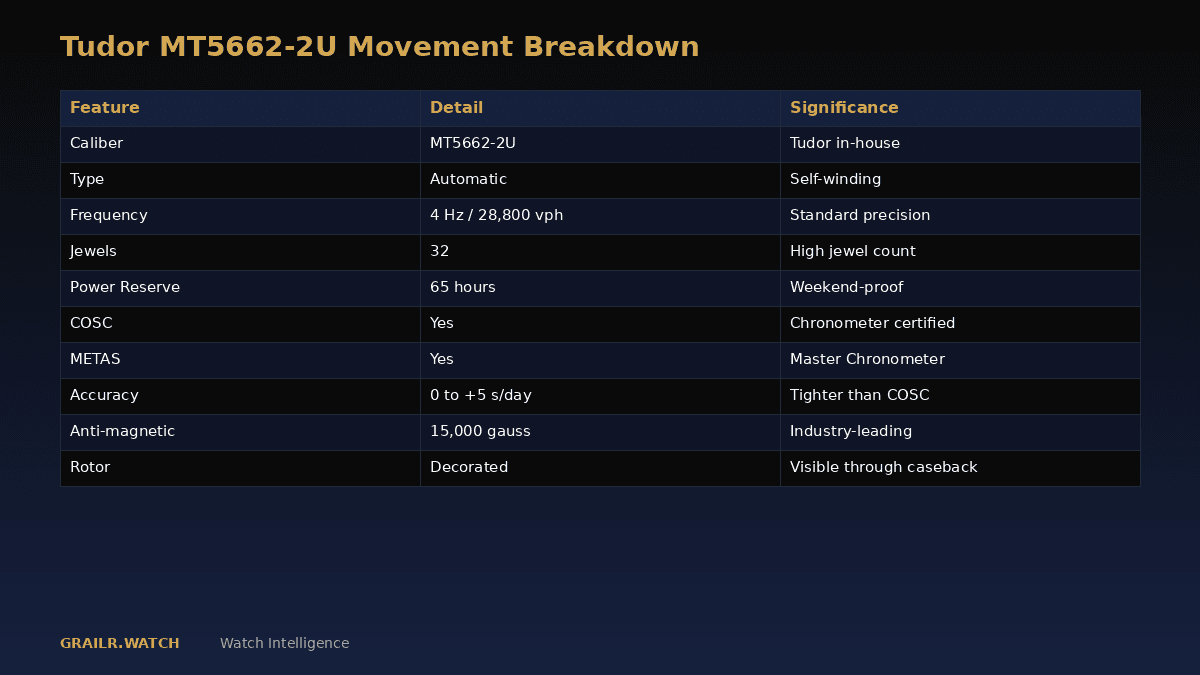
The real story is the certification. The Monarch carries both COSC chronometer and METAS Master Chronometer certification. COSC tests the bare movement to ±4/+6 seconds per day. METAS goes further: it tests the fully assembled watch for accuracy (0 to +5 sec/day), water resistance and magnetic resistance up to 15,000 gauss. That level of magnetic protection means the Monarch will keep ticking accurately next to a laptop, an MRI scanner door, or any of the common magnetic fields in daily life. To learn more about what the certification covers, read our METAS certification guide.
The sapphire exhibition caseback lets you see the movement at work. Tudor has added a rotor with Geneva stripes and a sandblasted finish on the bridges. It’s not Lange-level finishing, but it’s a clear step above what you see through most watches under $10,000 — and a first for Tudor, which historically used solid casebacks on its steel sports models.
The California Dial
The Monarch’s dial is one of its most distinctive features. Tudor calls it a “California” layout: Roman numerals on the upper half and Arabic numerals on the lower half, with a small seconds subdial at six. The dark champagne colour has a subtle papyrus-inspired texture that catches light differently depending on the angle — warm gold in sunlight, closer to grey in shade.
California dials have a long history in watchmaking. Rolex produced them in the 1930s and 1940s, and Panerai made the style famous with its Radiomir line. Tudor’s interpretation is entirely its own: the font choices, the proportions and the texture give it a modern character that doesn’t lean on vintage nostalgia. The Tudor shield logo sits at twelve o’clock in place of a numeral, the only visual link to the original 1990s Monarch.
Legibility is good but not exceptional. The Roman numerals on the upper half are less instantly readable than the Arabic numerals below, and one early hands-on review noted the absence of lume on the applied hour markers. In low light the small seconds subdial can be hard to pick out. This is a watch designed to be looked at as much as read.
Bracelet and T-Fit Clasp
The Monarch’s two-link bracelet is a significant departure from the five-link bracelets on the Black Bay and Pelagos lines. Each link alternates between a brushed centre and polished bevelled edges, giving it a play of light that lifts the overall feel of the watch. The links taper subtly from the case to the clasp, which helps the watch sit naturally on the wrist.
Tudor’s T-Fit clasp is the same tool-free micro-adjustment system introduced on recent Black Bay models. It allows you to extend or shorten the bracelet by small increments throughout the day without removing links — a genuine quality-of-life feature for anyone whose wrist swells in heat or after exercise. The folding clasp is signed with the Tudor shield and sits flush against the underside of the wrist.
Compared to the Pelagos’s titanium bracelet, the Monarch’s steel links have more weight and a more traditional feel. The finishing quality is closer to what you’d expect on a Rolex Oyster Perpetual than on a typical Tudor — which helps justify the price premium.
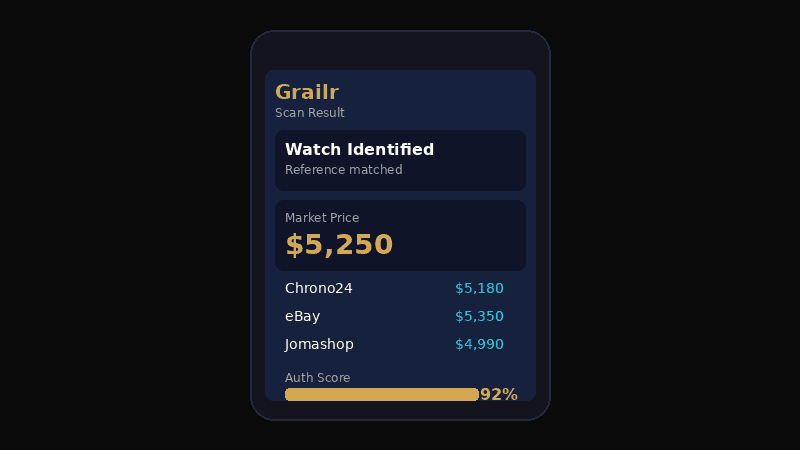
Check Any Watch Price in Seconds
Grailr scans your watch photo and pulls live pricing from Chrono24, eBay, and Jomashop.
- AI identifies brand, model & reference number
- Live market prices from 3+ sources
- Authentication confidence score
Pricing and Secondary Market
| Market | Retail Price | Secondary Market | Premium |
|---|---|---|---|
| Switzerland | CHF 4,800 | CHF 5,500–6,200 | +15–29% |
| United States | $5,875 | $6,500–7,200 | +11–23% |
| United Kingdom | £4,600 | £5,200–5,800 | +13–26% |
| Europe | €5,200 (est.) | €6,750–7,022 | +30–35% |
The Monarch is Tudor’s most expensive steel time-only watch. For context, a Black Bay 58 retails at around $3,575 and a Black Bay Pro at $4,075. That makes the Monarch roughly $1,800–$2,300 more than the core Black Bay line — a meaningful jump that buys you the new case design, exhibition caseback, California dial and upgraded bracelet finishing.
Early secondary market demand has been strong. Within the first weeks of availability, asking prices on dealer sites ranged from 15% to 35% above retail depending on the region. Whether that premium holds will depend on how aggressively Tudor ramps up production. The watch is not limited, so sustained premiums are unlikely in the long term — but in the short term, walking into an AD and buying one off the shelf may be difficult.
How the Monarch Compares to Competitors
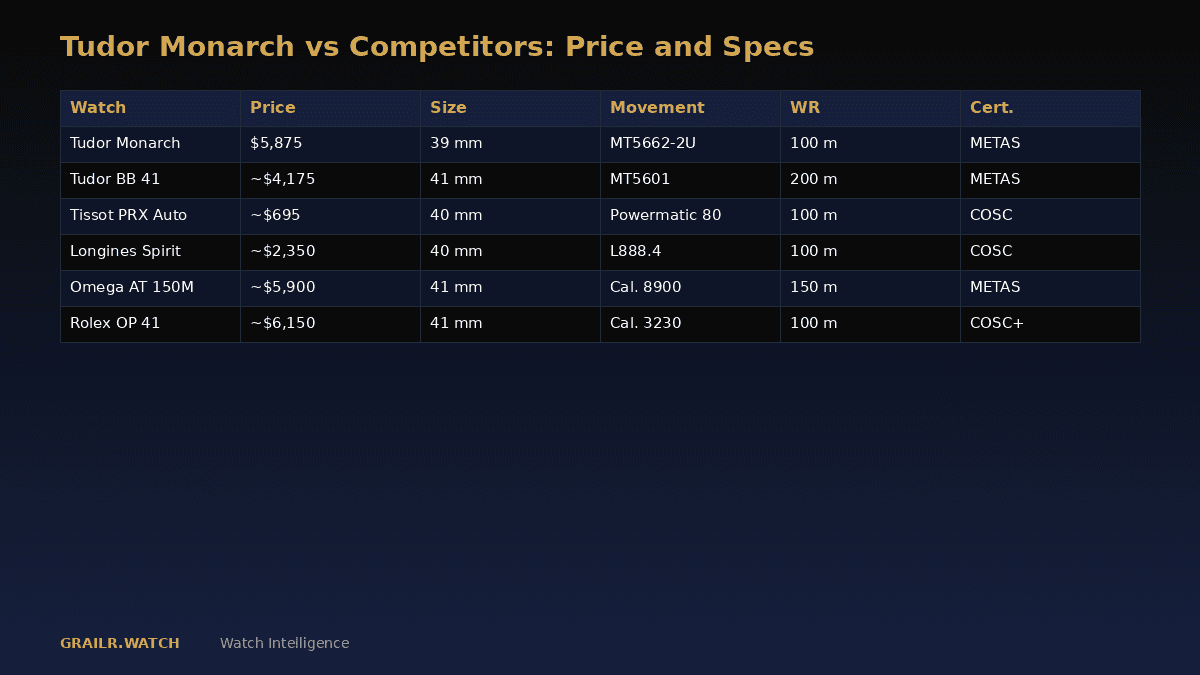
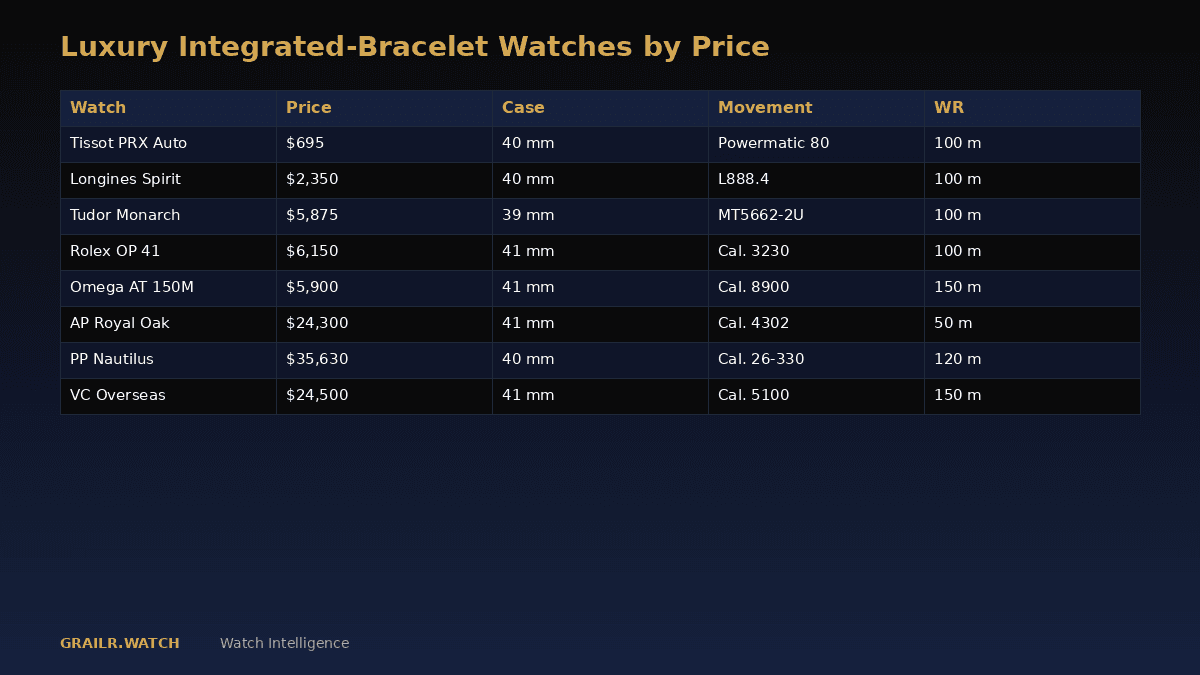
The integrated-bracelet sports watch category spans from $650 to $65,000. The Monarch slots in at the lower end of the premium tier — more expensive than fashion-forward entry options, far less than the icons that defined the category. Here is how it stacks up against the watches most buyers will cross-shop.
vs Tissot PRX Powermatic 80 ($650)
The Tissot PRX popularised the affordable integrated-bracelet look. It offers an 80-hour power reserve, a solid bracelet and a recognisable 1970s-inspired design for under $700. The Monarch adds an in-house movement, METAS certification, sapphire caseback, superior finishing and more original design language — but at nine times the price. If the style is what you want and the budget matters, the PRX remains extraordinary value. If you want something that feels hand-built rather than mass-produced, the Monarch delivers.
vs Tudor Black Bay 58 ($3,575)
The Black Bay 58 is Tudor’s best-selling watch and a frequent recommendation for a first serious purchase. It offers 70 hours of power reserve, METAS certification on current models, and a proven design that has held strong resale value. The Monarch costs $2,300 more and gives you a completely different aesthetic — refined and dressy rather than tool-watch rugged. The Black Bay 58 is the safer buy for long-term value; the Monarch is the more distinctive choice.
vs Rolex Oyster Perpetual 41 ($6,150)
At just $275 less than a Rolex Oyster Perpetual 41, the Monarch enters Rolex territory. The OP 41 trades on a 70-hour power reserve, the Rolex name and historically strong resale (it has traded above retail). The Monarch counters with METAS certification, an exhibition caseback that the Rolex lacks, and a more complex dial. On paper the specs are competitive, but the Rolex brand premium and deeper resale history are real factors. Buyers choosing between these two are ultimately choosing between Tudor’s ambition and Rolex’s track record.
vs Audemars Piguet Royal Oak ($22,600+)
The watch the Monarch will inevitably be compared to, if only by silhouette. The Royal Oak defined the integrated-bracelet luxury sports watch in 1972. It commands $22,600 at retail for the entry 37mm Selfwinding and considerably more on the secondary market. The Monarch offers METAS certification that the Royal Oak lacks, a larger power reserve and a price that is roughly a quarter of the AP. It does not have the Royal Oak’s octagonal bezel, 50-year heritage, or in-house caliber with the same level of finishing. The comparison is instructive for positioning — the Monarch brings the concept down market without pretending to be a Royal Oak.
Buying Advice
1. Try It On Before Committing
The 39mm case with its angular geometry wears differently from the rounded Black Bay. At 46.2mm lug-to-lug, it may feel large on wrists under 6.5 inches. Visit an authorised dealer to check the fit — the California dial and champagne texture also look quite different in person than in press photos.
2. Buy at Retail If You Can
With secondary prices 15–35% above retail, buying from an AD saves real money. The Monarch is not limited, so supply should improve over the coming months. If you can wait, you will likely find it at retail without too much difficulty. Use Grailr’s scanner to verify pricing on any listing before you commit.
3. Consider the Long-Term Value
Launch premiums almost always fade on non-limited Tudor models. The Black Bay 58 launched with grey market premiums and now trades at or slightly below retail. Expect similar dynamics with the Monarch over 12–18 months. If you’re buying to wear, the current premium is the cost of being first. If you’re buying for value, patience will be rewarded.
4. Authenticate Pre-Owned Carefully
The Monarch is new enough that counterfeiters have not had time to produce convincing fakes, but that will change. If buying pre-owned in the future, check the exhibition caseback for correct movement markings and the bracelet for proper T-Fit clasp functionality. Read our authentication guide for a step-by-step checklist.
5. Know What You’re Giving Up
Water resistance is 100m, not the 200m of a Black Bay or the 300m of a Pelagos. There is no date complication. Lume appears limited or absent on the applied markers. The Monarch is a dressy sports watch, not a tool watch. If you need something for actual diving or outdoor use, Tudor’s Pelagos or Black Bay lines are better suited. Use Grailr’s identification tool to explore alternatives.
Frequently Asked Questions
How much does the Tudor Monarch cost?
The Tudor Monarch retails at CHF 4,800 in Switzerland, $5,875 in the United States and £4,600 in the United Kingdom. Secondary market asking prices currently sit 15–35% above retail depending on the region.
What movement does the Tudor Monarch use?
The Monarch uses the in-house Caliber MT5662-2U, an automatic movement beating at 28,800 vph with a 65-hour power reserve. It is certified by both COSC and METAS to 0 to +5 seconds per day and resists magnetic fields up to 15,000 gauss.
Is the Tudor Monarch METAS certified?
Yes. The Monarch carries both COSC chronometer and METAS Master Chronometer certification. METAS tests the fully assembled watch for accuracy, water resistance and magnetic resistance, not just the bare movement.
Is the Tudor Monarch a limited edition?
No. The Tudor Monarch is part of the regular collection and is not limited in production numbers, though availability at authorized dealers may vary in the first months after launch.
What is the Tudor Monarch bracelet like?
The Monarch features a two-link stainless steel bracelet with alternating brushed and polished surfaces. It uses Tudor’s T-Fit clasp, which allows tool-free micro-adjustments for a precise fit throughout the day.
How does the Tudor Monarch compare to the Tissot PRX?
The Tissot PRX Powermatic 80 costs around $650 and offers a similar integrated-bracelet look with an 80-hour power reserve. The Monarch adds an in-house movement, METAS certification, sapphire caseback, finer finishing and a more original design, but at roughly nine times the price.
Related Articles
The Bottom Line
The Tudor Monarch is an ambitious watch that signals where Tudor wants to go: upmarket, more refined, and further from the shadow of Rolex. At $5,875 it competes directly with the Rolex Oyster Perpetual on price, but it offers things the Rolex does not — METAS certification, an exhibition caseback, and a design language that stands entirely on its own. The California dial will not be for everyone, and the 100m water resistance limits its tool-watch credentials. But as a daily-wear sports watch with genuine horological substance, the Monarch makes a compelling case. Buy it because you love the design; hold it because Tudor’s reputation is still climbing. Use Grailr’s appraisal tool to track its value over time.
Considering a Tudor Monarch?
Grailr uses a photo to suggest a watch identity and an indicative price estimate, with active eBay listings where available. Check the exact reference and condition independently; a photo scan cannot authenticate a watch.
Scan a Watch NowSources and price context
- Tudor Monarch official page — Official specifications, case dimensions and movement details for the M2639W1A0U-0001.
- Wrist Review: Tudor Watches & Wonders 2026 novelties — Hands-on review with bracelet, dial and movement impressions.
These primary sources support the specific specification and policy points noted above. Prices and secondary market percentages elsewhere in this guide are indicative editorial figures, not a verified transaction dataset or guaranteed returns. Confirm the exact reference, region, condition and current quote before buying; asking prices are not completed-sale prices.