Buying guide
Tudor Royal Buying Guide: 2026 Models vs Older Watches
Compare the new Tudor Royal with older 28–41mm models. Check movements, bracelet fit, prices and condition before deciding which Royal is worth buying.
By Grailr Watch Intelligence · · 12 min read
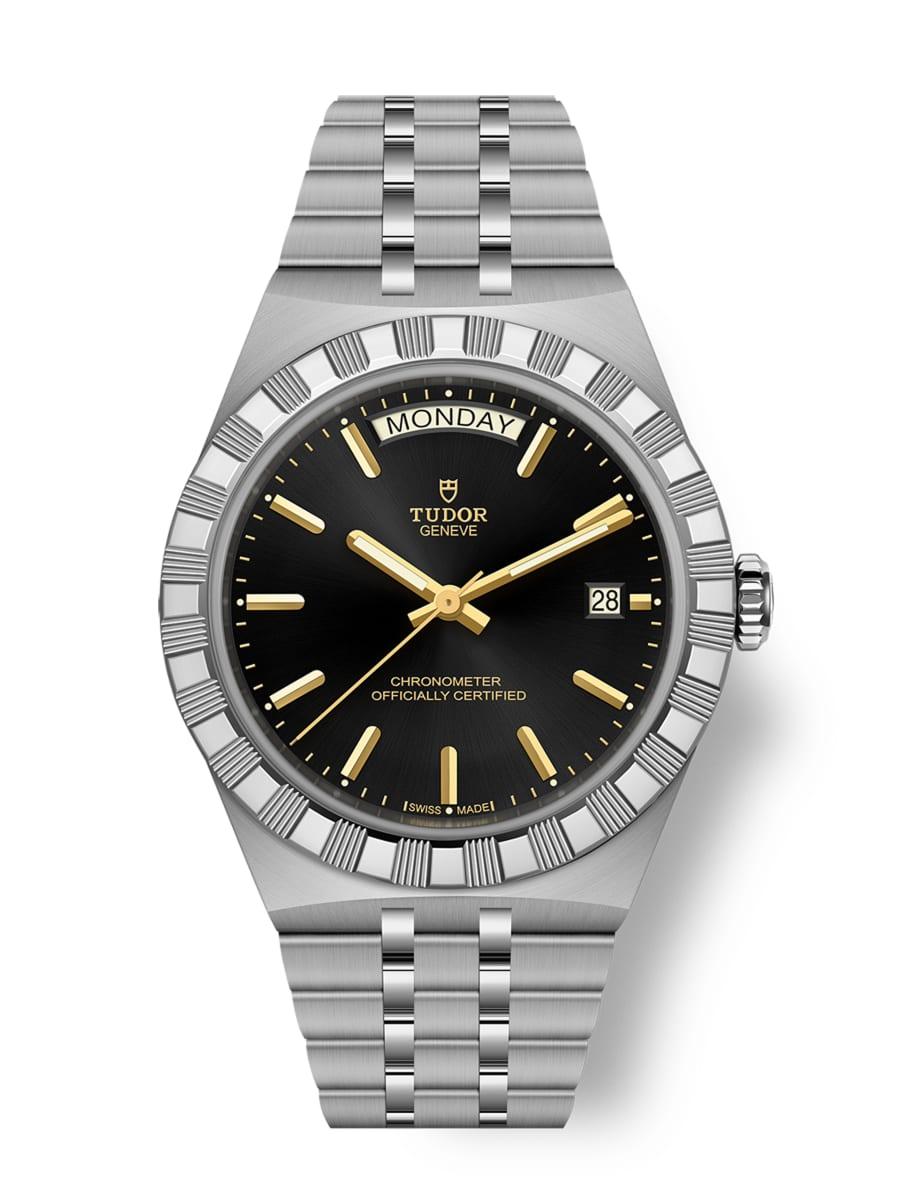
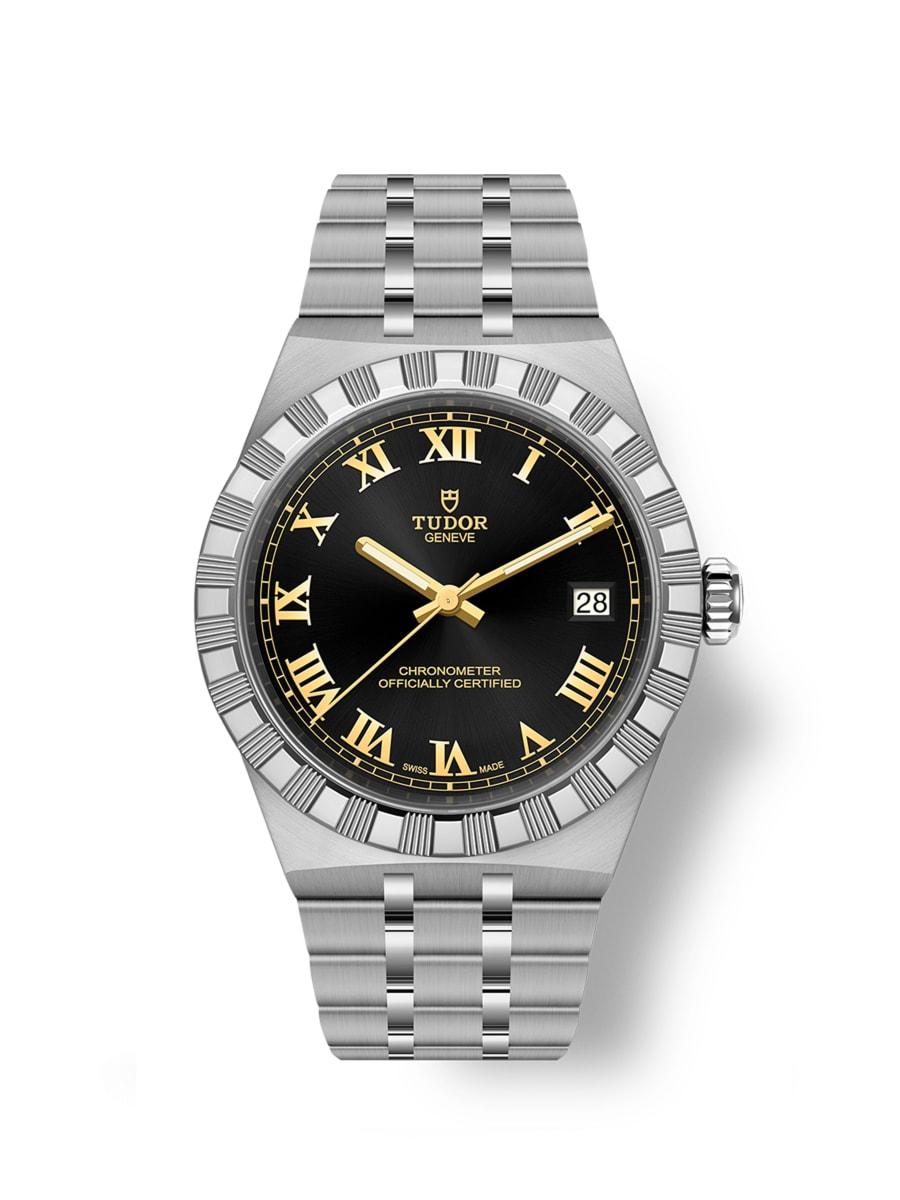
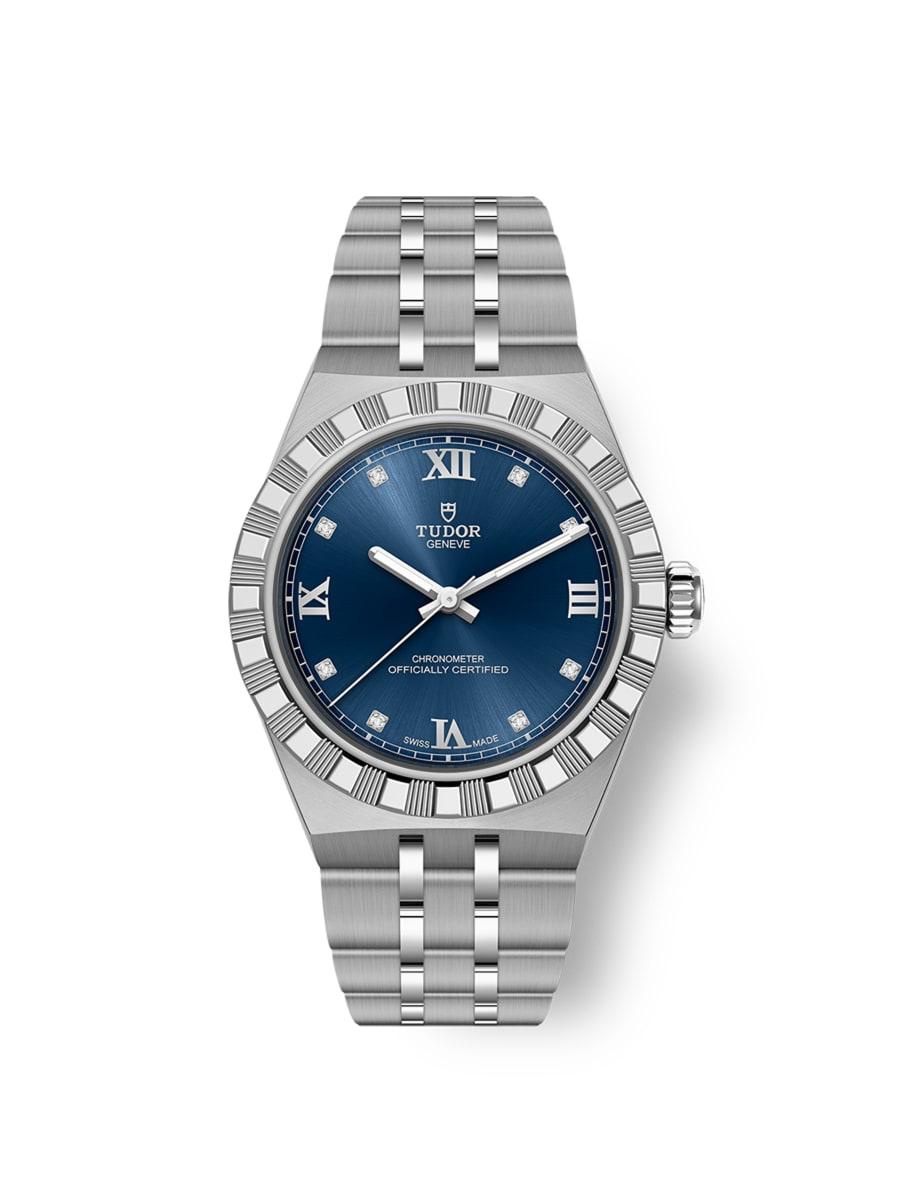
Both photographs show the 2026 Royal generation. The older models discussed below have different references and specifications.
Start with the Royal’s generation
The Tudor Royal is now a more complicated used-watch search than its familiar name suggests. A listing can show an older 41mm day-date, a current 40mm model, or a smaller version with a different movement and display. They are not the same watch in slightly different sizes. Before deciding whether a price looks attractive, establish which generation is actually being offered.
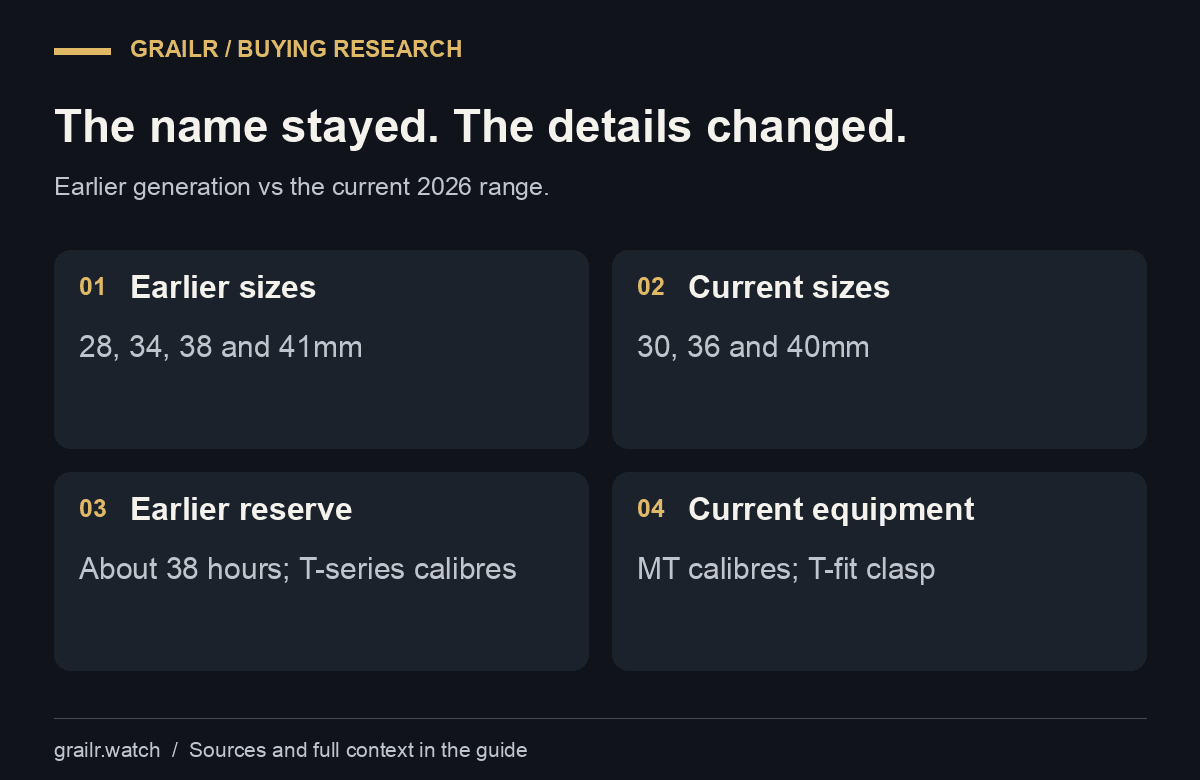
The current Tudor Royal collection uses 30, 36 and 40mm cases. The preceding range documented in Tudor’s 2023 technical sheet used 28, 34, 38 and 41mm cases. A watch sold recently can still be an earlier model, so the date on a receipt is not enough. Ask for the full reference, then compare it with the appropriate manufacturer record.
Our starting recommendation is the current 36mm for someone wanting a compact date watch, or the current 40mm if the day display matters. Those are shortlist suggestions, not universal sizing rules. An older 38mm may fit you better than either, and its design may be the one you prefer. The sensible purchase is the configuration you want at an explainable price, rather than whichever listing carries the newest year.
This guide focuses on steel examples and the practical differences between generations. Gold content, gem setting and dial configuration need their own comparisons. For the brand’s broader options, our Tudor collection guide helps you decide whether an integrated bracelet, a dive bezel or a simpler field-watch layout best fits your routine.
Current Tudor Royal models compared
The references below are three specific current configurations, not shorthand for every dial or bezel in each size. They show why “Royal automatic” is too vague a description for a price comparison. Manufacturer specifications were checked on 19 November 2026; the linked product pages remain the place to confirm later changes.
| Detail | Royal 30 | Royal 36 | Royal 40 |
|---|---|---|---|
| Reference | M2830A1A0-0001 | M2836C1A0-0101 | M2840D1A0-0001 |
| Case diameter / thickness | 30 / 8.7mm | 36 / 9.7mm | 40 / 11.4mm |
| Movement | MT5201 | MT5412 | MT5633 |
| Power reserve, approximately | 50 hours | 70 hours | 70 hours |
| Display | Time only | Time and date | Time, day and date |
| Water-resistance rating | 100m | 100m | 100m |
| Bracelet adjustment | T-fit | T-fit | T-fit |
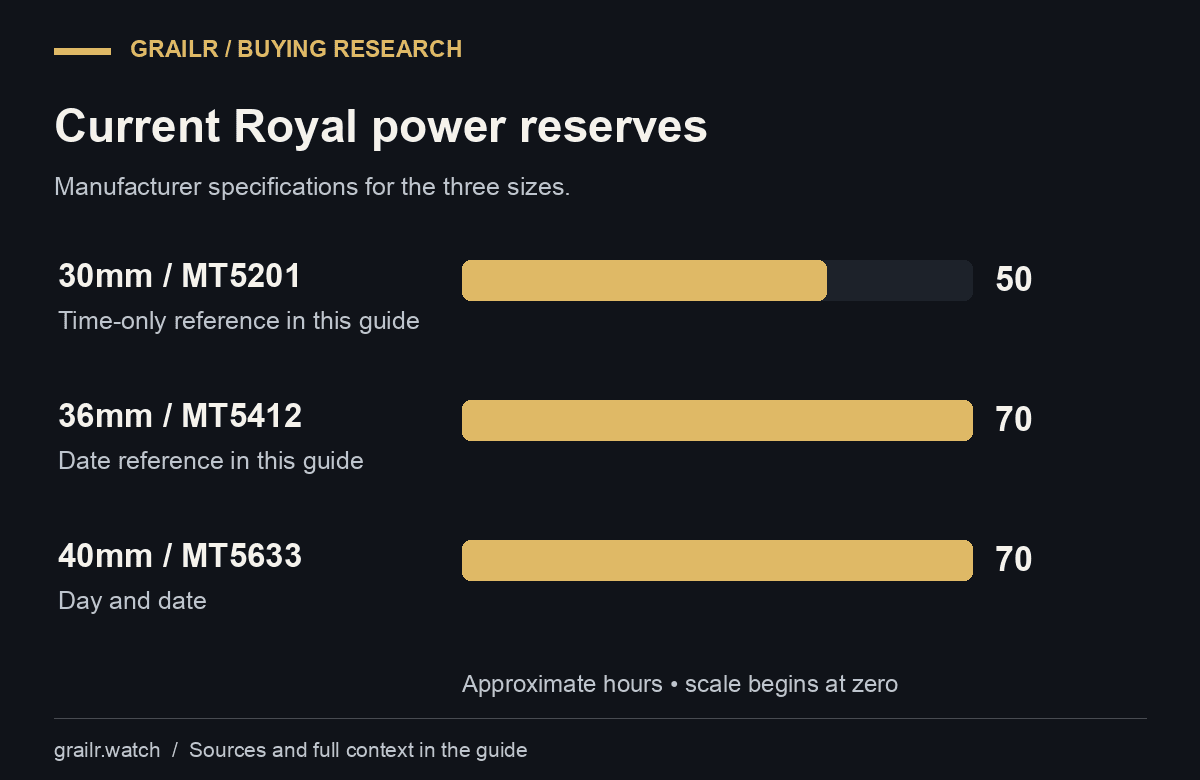
Tudor lists these movements as COSC-certified. That is a specific precision certification, not a statement that every older Royal shares the same movement or testing. COSC explains its chronometer testing and the distinction between certification and a watch’s later performance. A used watch still needs a condition assessment; its original certification does not reveal what happened during years of ownership.
For your shortlist, separate desirable features from essential ones. If the day display makes the dial feel too busy, a larger reserve does not remove that preference. If you use the date constantly, the smaller time-only configuration might be a poor daily choice despite fitting neatly. Write down those preferences before comparing prices so a seller’s discount does not decide them for you.
What the older Royal does differently
Tudor’s 2023 Royal technical sheet identifies the earlier 41mm with calibre T603, the 38 and 34mm versions with T601, and the 28mm with T201. It specifies an approximately 38-hour reserve for that range. The 41mm carries the day display. Those details are useful when a second-hand listing borrows a description from a newer watch.
| Reference family | Case size | Movement | Calendar layout |
|---|---|---|---|
| 28300 / 28303 | 28mm | T201 | Date |
| 28400 / 28403 | 34mm | T601 | Date |
| 28500 / 28503 | 38mm | T601 | Date |
| 28600 / 28603 | 41mm | T603 | Day and date |
A reference family is only the beginning. Preserve the suffix identifying the actual configuration when recording an offer. Two watches sharing the first digits can have different dials, materials or decoration. If a seller supplies only “28600,” request the complete reference and clear photographs instead of assuming it is the same version as another advertisement.
The newer range does not make an older watch defective or obsolete. You may like the earlier proportions or dial more. What changes is the basis for negotiation: compare older examples with their peers, then decide whether the additional features of a current model justify its extra cost. That is more useful than applying the new model’s retail price to every Royal carrying the same brand name.
Bracelet fit can settle the choice
The Royal’s bracelet visually continues the case, so fit is part of the design rather than an accessory decision to postpone. Try the watch with the bracelet adjusted close to your actual size. Check where the first links bend, whether the clasp sits comfortably underneath and whether the case stays centred when your hand moves. An oversized shop bracelet can make a good fit look poor.
The current range’s T-fit clasp is a meaningful feature to try in person. Ask the retailer to demonstrate its adjustment and how it feels at both ends of the usable range. Do not assume every older Royal includes it, or that a newer clasp can simply be fitted to an earlier bracelet. Replacement compatibility requires an exact answer from a retailer or service centre.
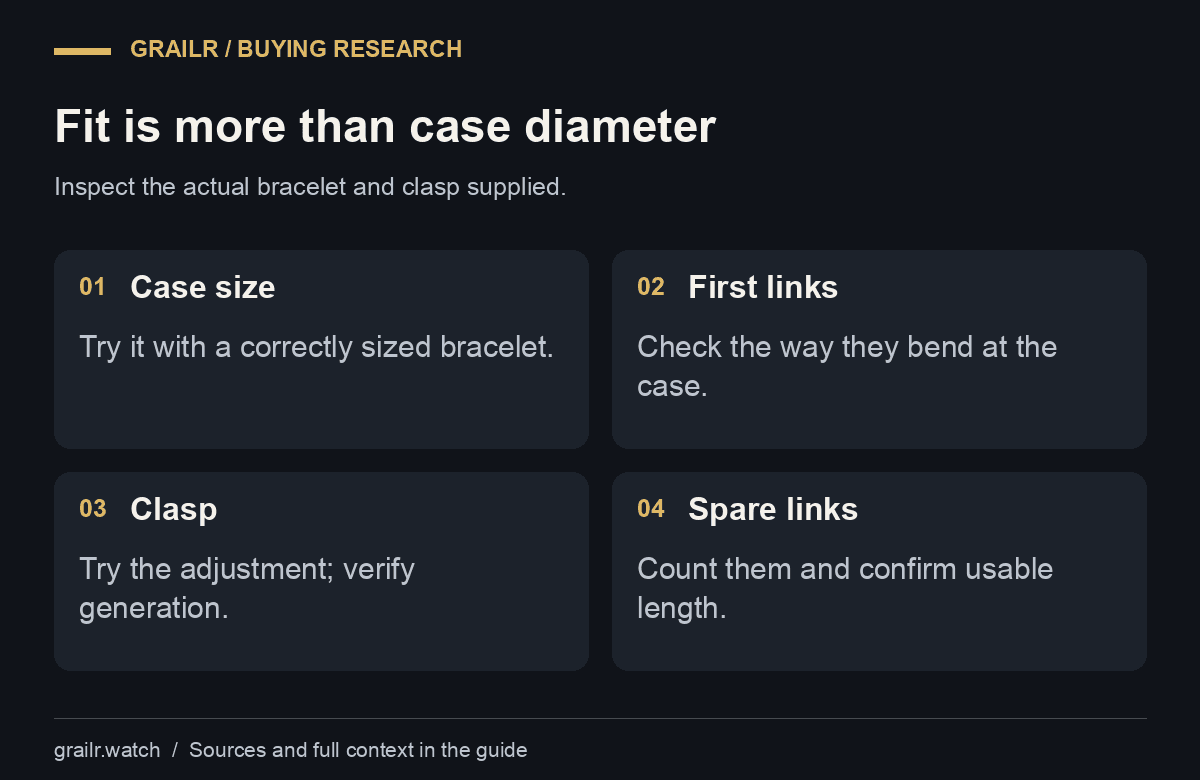
For a used watch, request the current bracelet length and photographs of removed links. A seller describing a watch as “complete” may mean the packaging is present, while the bracelet is too short for your wrist. Ask separately about the clasp, link screws or pins, prior repairs and any aftermarket parts. Obtain a quote if you need additional pieces rather than assuming they are inexpensive.
Assess the dial in ordinary light as well. A colour that looks dramatic under a spotlight may be harder to read in your normal environment. Hold the watch at a comfortable angle and check how quickly you can read the hands. These tests cost nothing and are more relevant to long-term satisfaction than choosing a watch because another person assigned it to a particular gender or wrist size.
Price snapshots and fair comparisons
When checked on 19 November 2026, Tudor’s website displayed a suggested retail price of $3,425 for the black-dial steel 36mm M2836C1A0-0101 and $3,675 for the black-dial steel 40mm M2840D1A0-0001. The blue-dial steel 30mm M2830A1A0-0001 was displayed at $4,100. These are the site’s USD price snapshots for those exact configurations. Confirm local tax treatment, availability and the final quote with an official retailer.
The smallest watch is not automatically the least expensive. Equally, a dial, gem-set bezel or steel-and-gold version should not be treated as a simple size upgrade. Use the actual 30mm, 36mm and 40mm records rather than a generic starting-price advertisement.
For pre-owned examples, collect offers for the same generation, reference and material. Then separate dealer stock from private sales and record the condition and accessories. Current asking prices are useful comparison points, but they do not establish completed-sale prices. A watch advertised for a long time at an ambitious amount does not become more valuable merely because the advertisement remains online.
A useful price note records the date, source, reference, seller’s description and what is missing. Grailr can help organise the initial identification and value research, while the manufacturer record and seller evidence settle the configuration. If the scan and the listing disagree, resolve that disagreement before using either estimate to justify a purchase.
Work out the saving after costs
Suppose you are comparing two used examples of the same older reference. In this hypothetical calculation, the cheaper watch needs a written quote for bracelet parts and some immediate work. The figures below illustrate the method only; they are not Royal market valuations, repair-price guidance or a prediction of the work any watch will need.
| Item | Watch A | Watch B |
|---|---|---|
| Asking price | $2,000 | $2,300 |
| Delivery | $80 | Included |
| Quoted immediate work / parts | $350 | None identified |
| Known subtotal before taxes | $2,430 | $2,300 |
| Open items | Taxes and unquoted issues | Taxes and unquoted issues |
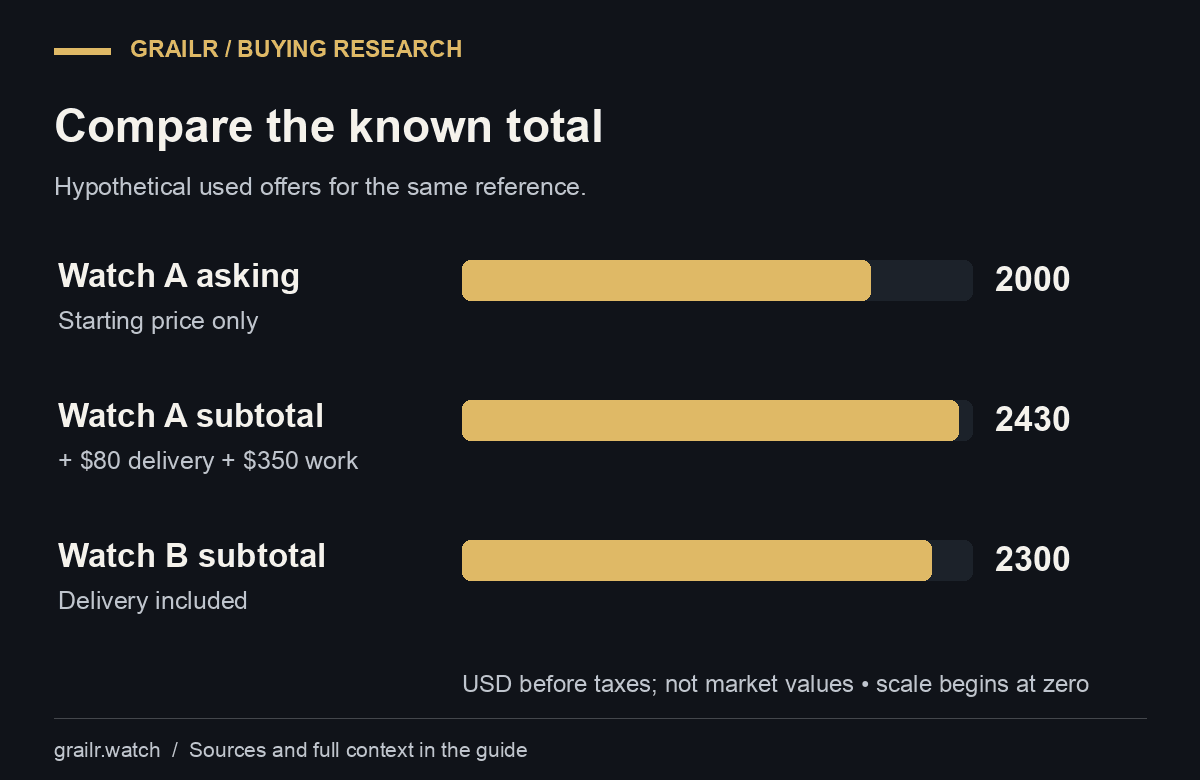
The advertised $300 saving has become a $130 extra cost on the known items. You might still prefer Watch A because of its dial or cosmetic condition, but you would be making that choice consciously. If there is no quote for the work, leave the amount unresolved. A precise-looking total built from guesses is less useful than an honest list of unanswered questions.
Use this comparison alongside our watch service cost guide and ask the service provider about the exact reference. Separate movement servicing from bracelet repairs, cosmetic work and replacement parts. Also consider the time the watch may be unavailable. An apparent saving is less appealing if you need the watch for a particular event and the required work cannot be completed in time.
Questions to ask before buying a used Royal
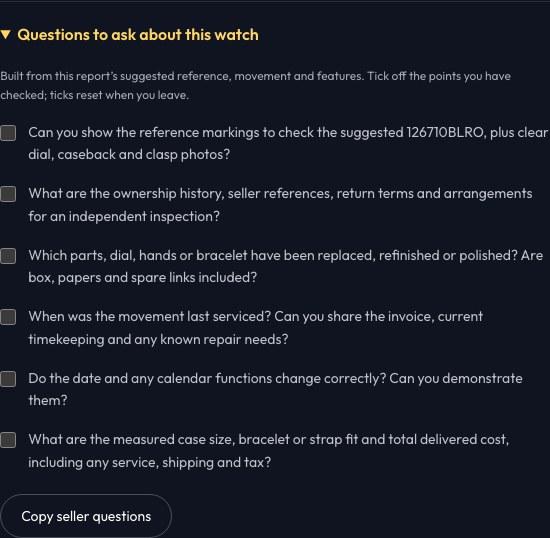
Ask for current photographs of the actual watch: dial, bezel, both sides, crown, back, bracelet and clasp. Request ordinary lighting and enough detail to assess edges and surface finish. Marketing photographs can be attractive without answering whether a case has dents, a bracelet has missing parts or the clasp operates properly. A brief video can help show the calendar and clasp functions, but it is not a substitute for inspection.
Keep your questions specific. Which full reference is on the paperwork? Has the watch been polished? Are all links present? Who last serviced it, on what date, and is the invoice available? Have any dial, hand, crown or bracelet components been replaced? Ask the seller to describe known issues in writing, even if they appear in photographs. A clear answer is more useful than the phrase “excellent for its age.”
Tudor’s current product pages describe a five-year transferable guarantee without registration or periodic maintenance checks as a condition of that guarantee. For a used watch, confirm the original sale date and the remaining coverage on its documents. A dealer’s own guarantee is a separate promise. Record who handles it, what is covered and how shipping or an inspection would work.
Before paying, settle the return or approval period and any limits on independent inspection. If the watch must stay unopened to preserve a return right, arrange the sequence with the seller before asking a watchmaker to examine it. Do not let a short deadline force you to accept a reference mismatch or an explanation you cannot verify.
Which Royal makes the strongest case for you?
Choose the current generation when its movement, clasp and proportions solve problems you care about. Choose an earlier example when you prefer its actual design and its price still makes sense after checking condition and completeness. Neither choice needs a claim that the watch will appreciate in value. The question is whether it is a good purchase for your use, supported by evidence about the specific watch.
If you are undecided about the Royal’s integrated bracelet, compare a Tissot PRX for a different budget or an IWC Ingenieur for a different approach to fit and finishing. These are design alternatives, not equivalent products whose prices should be averaged together. Try the category before committing to its most appealing photograph.
A worthwhile offer should survive three checks: it is the exact version you want, you understand its present condition, and you can explain the total cost. If one of those is missing, pause the purchase and ask for the missing evidence. That short delay is often more valuable than negotiating a small discount on a watch you have not yet identified properly.
Frequently asked questions
What changed on the Tudor Royal in 2026?
The current generation uses 30, 36 and 40mm cases, manufacture movements and integrated bracelets with T-fit adjustment. The older generation used 28, 34, 38 and 41mm cases and different movements. Compare complete references; a recent purchase date alone does not identify the generation.
Is the Tudor Royal 41mm the current model?
The 41mm Royal belongs to the older generation discussed here. The current large Royal is 40mm. An older 41mm example can still be a legitimate and appealing purchase, but its T603 movement and specification should not be advertised as those of the newer MT5633 model.
Does every Tudor Royal have a 70-hour power reserve?
No. The current 36 and 40mm models have approximately 70 hours, while the current 30mm has approximately 50 hours. Tudor’s 2023 technical sheet specifies approximately 38 hours for the older range. Verify the movement and reference on the actual listing.
Which Tudor Royal has a day display?
The 40mm current Royal has the day at twelve and date at three. In the older generation, the day display is associated with the 41mm model. The current 36mm reference compared here has a date; the current 30mm reference is a time-only configuration.
Is a cheaper older Royal better value?
It can be if you prefer its size and design and the saving remains meaningful after condition, bracelet completeness and any required work are considered. Compare it with other older examples first. A discount against a different new generation does not by itself establish a bargain.
Can a Grailr scan tell me whether to buy a Royal?
A scan can help you identify the likely watch and explore an indicative value before comparing the seller’s asking price. Confirm the exact generation and reference, then check the actual watch’s condition, documents and seller terms. The buying decision depends on that combined evidence.
Sources and research method
This is a desk-researched buying guide, not a hands-on test. Manufacturer specifications were checked on 19 November 2026. Price snapshots identify their currency and source; worked examples are hypothetical. Our recommendations are editorial judgments about fit, evidence and buying costs.