Do Watches Make Money at Auction? A Reality Check
A single Phillips lot sold for $96.3M in 2026. Meanwhile 38% of watches at auction sell below estimate. Both are true, and here’s what that actually means for your watch.
Price context: figures in this guide are indicative editorial estimates drawn from published auction results and industry reporting current to this article’s publication date. Auction hammer prices and asking prices are not guaranteed returns, and watch identification or AI-generated estimates do not establish authenticity, professional appraisal value, or completed-sale prices. Verify any figure independently before making a financial decision.

- About 38% of watch lots sell below their pre-auction estimate — auction is not a guaranteed markup
- Buyer’s premiums of 20-28% plus seller commissions of 5-15% mean fees eat a real share of any sale before proceeds reach you
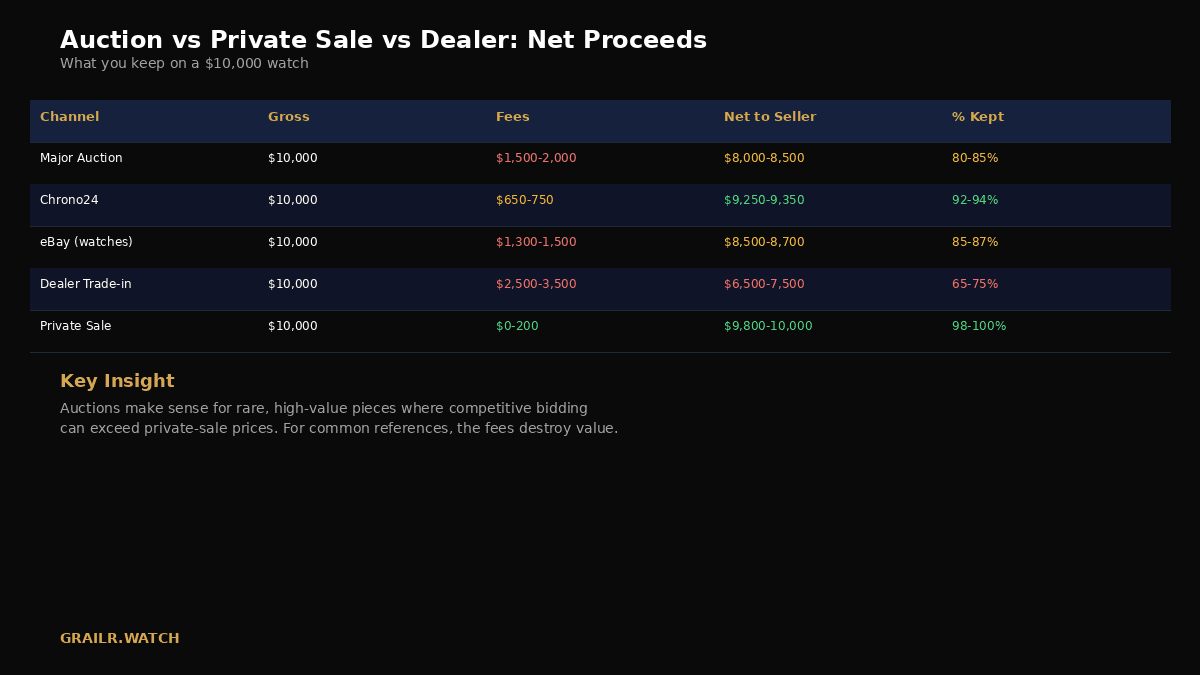
- Net seller proceeds at auction run roughly 80-85% of hammer price — lower than Chrono24 (92-94%) or a private sale (98-100%)
- Phillips sold a single watch for $96.3M in 2026 and reported roughly $370M in total 2025 sales — records that reflect an extremely curated, top-heavy market, not typical outcomes
- Rare, limited, provenance-backed, and military-issued watches are the ones that reliably do well; common modern references usually don’t
Does Selling at Auction Actually Make Money?
Ask the question with a headline in front of you — a $96.3M single-lot sale at Phillips in 2026, roughly $370M in total sales at that same house across 2025 — and the answer feels obvious. Auctions mint fortunes. Ask the same question with a spreadsheet of actual lot results in front of you instead, and the picture gets considerably less flattering: about 38% of watches consigned to auction sell below their pre-sale estimate, meaning the house’s own specialists, who set the number to reflect realistic demand, still overshot more than a third of the time.
Both facts are true simultaneously, and reconciling them is the point of this guide. Auction houses do produce genuine, life-changing results for a narrow slice of watches — the ones with rarity, documented history, or cultural significance that create real competitive bidding. For the much larger number of watches that don’t have those qualities, auction is simply one selling channel among several, and not obviously the best one once fees, uncertainty, and timeline are weighed against private sale or marketplace alternatives.
The honest framing, and the one this guide uses throughout, is contrarian relative to how auction results get reported: most watches don’t make money at auction relative to what they’d net elsewhere, but some watches do, spectacularly. The rest of this article is about telling which category your watch falls into before you sign a consignment agreement, not after.
The Real Cost of Selling at Auction
Auction fees are layered and easy to underestimate if you only look at the hammer price reported in a headline. As a seller, you owe a commission to the house, plus incidental costs; as a buyer, a premium is added on top of whatever you bid, which shapes how high bidding goes in the first place and therefore how much a seller can realistically expect.
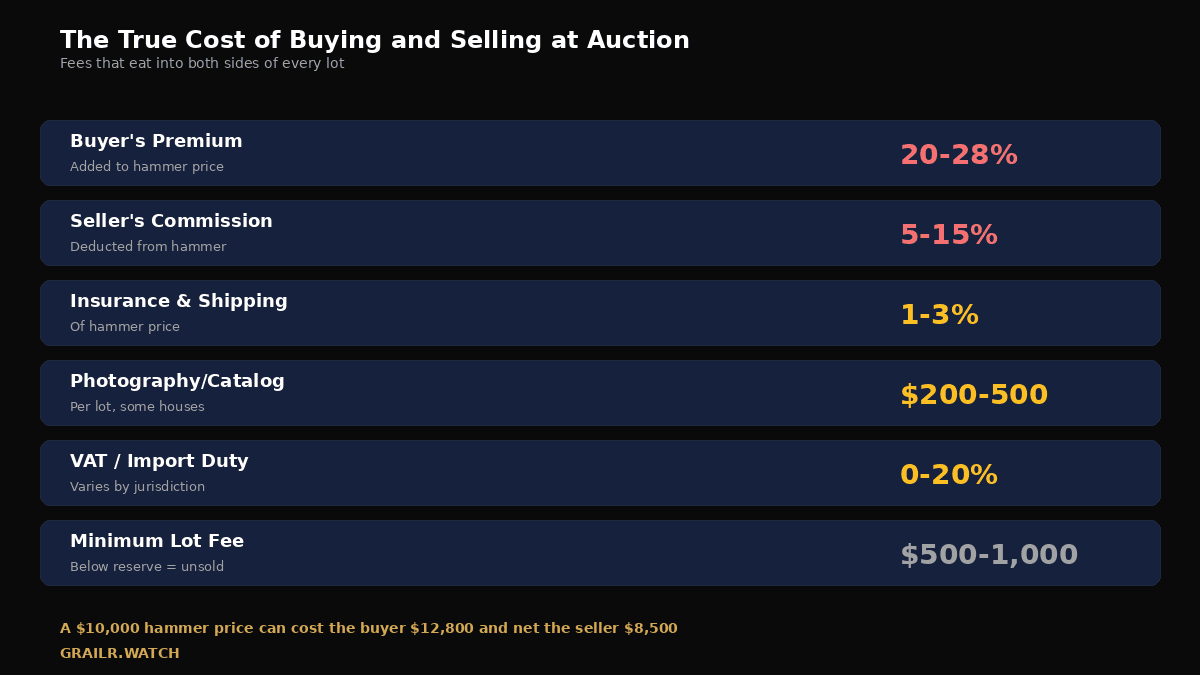
On the seller side, expect a commission of roughly 5-15% of the hammer price, negotiable based on the watch’s estimated value and how eager a house is to win the consignment. Insurance and shipping typically add another 1-3%, covering the watch while it’s in the house’s custody and in transit to and from the sale. Photography and catalog production — the professional images and copy that appear in the printed and online catalog — usually run $200-500 per lot, billed whether or not the watch ultimately sells.
On the buyer side, the premium is the larger number and the one that most directly shapes final demand. Buyer’s premiums at major houses in 2026 run from 25% to 28% of the hammer price, meaning a watch that hammers at $20,000 actually costs the winning bidder $25,000-$25,600 once the premium is added. Because bidders factor the premium into what they’re willing to bid, it effectively compresses the hammer prices a seller can expect relative to a private transaction where no such surcharge exists.
Net all of this together and a successful auction sale typically returns roughly 80-85% of the hammer price to the seller — a meaningful haircut before you even get to the question of whether the watch hammered at, above, or below its estimate in the first place.
| Auction House | Buyer’s Premium | Seller Commission | Reported Sell-Through |
|---|---|---|---|
| Phillips | ~26% | 5–15% | ~99.5% (curated sales) |
| Christie’s | ~26% | 5–15% | ~99.5% (curated sales) |
| Sotheby’s | 25%+ (tiered) | 5–15% | ~99.5% (curated sales) |
| Bonhams | 27.5% | 5–15% | Varies by sale |
| Antiquorum | 25–28% | 5–15% | Varies by sale |
Buyer’s premium and sell-through figures are indicative, current to 2026 reporting on the top-tier watch sales at each house; verify current published rate cards before consigning.
Auction vs Other Ways to Sell
Auction is only one of several ways to turn a watch into cash, and it’s worth lining the options up side by side before assuming a specialist sale room is the best route. The comparison below uses indicative net proceeds — what a seller typically walks away with after each channel’s fees, expressed as a percentage of the watch’s fair market value.
| Selling Channel | Typical Net Proceeds | Time to Sell |
|---|---|---|
| Private sale (buyer-to-seller) | 98–100% | Unpredictable |
| Chrono24 marketplace | 92–94% | Days–weeks |
| eBay | 85–87% | Days–weeks |
| Auction house | 80–85% | Weeks–months |
| Dealer trade-in | 65–75% | Immediate |
Read plainly, auction sits in the middle of the pack on net proceeds, ahead of a same-day dealer trade-in but behind a patient private sale or a well-managed marketplace listing. What auction offers that the others don’t is the possibility of genuine price discovery through competitive bidding — the mechanism that produces headline results for the right watch. For a reference with no scarcity and no bidding war to trigger, that upside case simply doesn’t apply, and the fee structure works against you instead. If you’re weighing this decision for a specific watch, our guide to where to sell a watch online breaks down the marketplace options in more detail.
Considering Consigning a Watch?
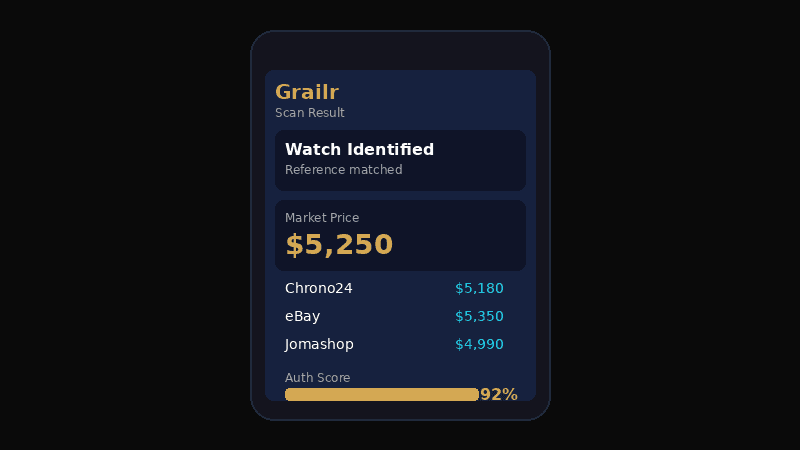
Before you commit to a saleroom, get an indicative sense of what your watch might be worth. Grailr scans a photo to suggest a model identification and an indicative value estimate, with active listings where available.
- Instant model identification from a photo
- Indicative value estimate, not an appraisal
- Active listings where available for context
Which Watches Win and Which Lose
The single biggest factor in whether a watch makes money at auction isn’t the house you consign to or the timing of the sale — it’s whether the watch itself gives collectors a genuine reason to compete for it. Scarcity, documented history, and cultural or historical significance are what create bidding wars; a watch that can be bought new or nearly-new from any authorized dealer or marketplace listing rarely inspires one.
| Tends to Win at Auction | Tends to Lose at Auction |
|---|---|
| Rare or limited production references | Common, widely available references |
| Vintage pieces with documented provenance | Recent production with no scarcity story |
| Military-issued or historically significant watches | Fashion-brand watches |
| Early or transitional serial numbers | Damaged, over-polished, or modified pieces |
The decline side of this pattern is just as instructive as the wins. Take the Patek Philippe 5711 — the steel Nautilus that became the poster child of the pandemic-era watch boom — which traded at multiples of retail during 2021-2022 and has since fallen roughly 50% from that peak. It remains a genuinely desirable watch by any normal standard; what changed is that speculative demand, not scarcity of the watch itself, was driving the earlier prices, and speculative demand is the least durable kind.
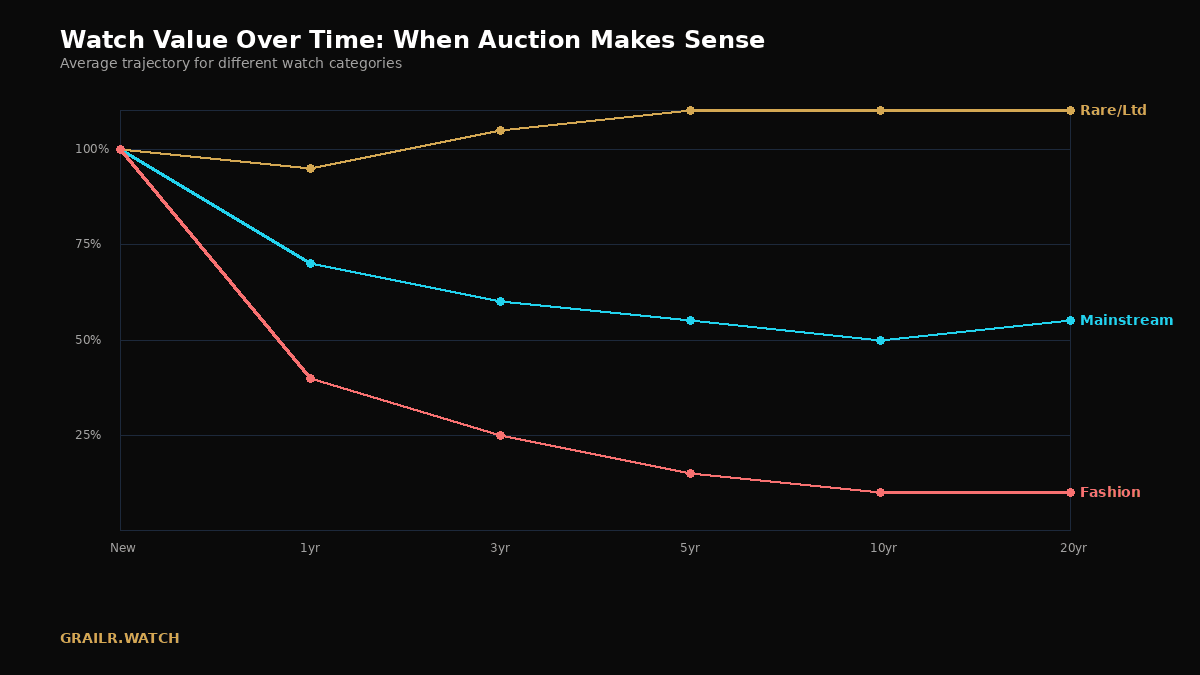
The lesson generalizes: a reference that’s hot because everyone currently wants one is exactly the kind of watch that can lose value quickly once sentiment shifts, while a reference that’s desirable because very few genuinely exist tends to hold up better across cycles. Our guide to which watch brands hold value best and our look at watches that actually appreciate both dig further into that distinction.
How the Major Auction Houses Compare
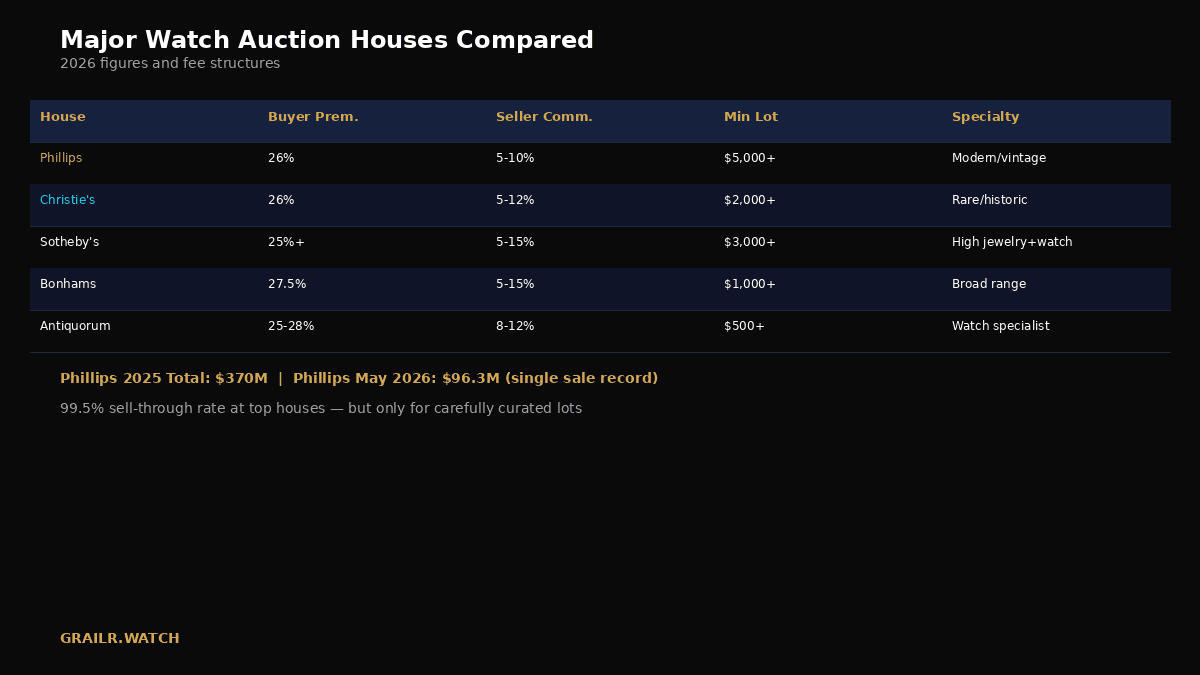
Phillips has positioned itself as the dominant force in the watch-specific auction market over the past decade, built almost entirely on a specialist watch department rather than watches as one category among many. That focus is a large part of why Phillips produced 2026’s headline $96.3M single-lot result and reported roughly $370M in total 2025 sales — it has cultivated the relationships and curatorial reputation that pull the rarest material into its rooms first.
Christie’s and Sotheby’s remain the other two members of what the trade treats as the top tier, each running dedicated watch departments with comparable buyer’s premiums and similarly heavy curation for their headline evening sales — the reason sell-through rates at that level cluster near 99.5%. That figure says more about pre-sale filtering than it does about auction as a mechanism: lots unlikely to sell well are simply declined or redirected to a day sale before they ever reach the room.
Bonhams and Antiquorum operate a tier below in typical hammer prices but remain legitimate venues, particularly for vintage and independent-brand material that the very top houses pass on. Their buyer’s premiums run slightly higher (27.5% at Bonhams, up to 28% at Antiquorum), and sell-through rates vary more by individual sale since curation is generally less aggressive than at the top three.
What the Record Sales Don’t Tell You
Every headline auction number is true and, in isolation, misleading. The $96.3M Phillips result and the roughly $370M in 2025 total sales are real figures from a real sale, but they describe the extreme top of a heavily curated market — the handful of lots each season with the provenance, rarity, and collector interest to justify the coverage. They say almost nothing about what happens to the far larger number of watches that get consigned, cataloged, and hammered without ever making a headline.
The 99.5% sell-through rate reported at the top houses’ marquee sales tells a similar half-story. It reflects a sale where specialists have already turned away or redirected weaker material before the auction, not a general property of auctions as a selling mechanism. Meanwhile, the 38% of lots across the broader market that sell below estimate is the figure that better represents what an average consignor should expect — a number the record headlines never mention because it doesn’t make for interesting press.
None of this means auction is a bad choice for every watch. It means the record headlines are a poor guide for deciding whether your specific watch belongs there. The right question isn’t “did a watch sell for a fortune at auction recently” — it’s whether your watch has the same scarcity and demand characteristics that made that one sale possible.
5 Tips Before You Consign a Watch
1. Ask Why Someone Would Compete to Buy It
If a nearly identical example is available for immediate purchase from a dealer or marketplace listing, there’s little reason for auction bidders to compete for yours. Auction rewards scarcity and story, not just condition.
2. Get the Full Fee Schedule in Writing
Seller commission, insurance, shipping, and photography fees should all be disclosed before you sign a consignment agreement. Ask what happens to those costs if the watch fails to sell — some are non-refundable regardless of outcome.
3. Set a Realistic Reserve, Not a Hopeful One
A reserve set above genuine market demand is the most common reason a watch sells below estimate or fails to sell at all. Base it on recent comparable results, not on what you paid or what you’d like the watch to be worth.
4. Get an Independent Read Before You Commit
Use Grailr’s indicative estimate tool to get a starting sense of your watch’s market position before an auction specialist gives you their number. It is a data point for your own research, not a professional appraisal or proof of authenticity — pair it with an independent, in-person assessment before consigning anything of real value.
5. Compare Timelines, Not Just Percentages
Auction proceeds are typically paid out weeks to months after the sale, following the settlement period, versus an immediate trade-in or a private sale that can close in days. If you need cash quickly, that timeline gap matters as much as the fee difference.
Frequently Asked Questions
Do watches make money at auction?
Most don't, at least not once fees are counted. Roughly 38% of lots sell below their pre-auction estimate, and even a successful sale is reduced by a 20-28% buyer's premium and a 5-15% seller commission. A small number of rare, provenance-backed, or historically significant watches do make substantial money — including a single Phillips lot that sold for $96.3M in 2026 — but they are the exception, not the norm.
What percentage of watches sell below estimate at auction?
Around 38% of lots at watch auctions sell below their pre-sale estimate. The figure looks better at the very top of the market, where curated evening sales at major houses report sell-through rates near 99.5%, because unsold or weak lots are filtered out well before the sale rather than being included and missing estimate on the record.
How much does it cost to sell a watch at auction?
Sellers typically pay a 5-15% seller's commission plus 1-3% for insurance and shipping, and often $200-500 in photography and catalog fees per lot. Buyers separately pay a 20-28% buyer's premium on top of the hammer price. Combined, net seller proceeds after a successful sale typically land around 80-85% of the hammer price.
What is the buyer's premium at major watch auction houses?
In 2026, Phillips and Christie's both charge around 26%, Sotheby's is 25% or higher on a tiered scale, Bonhams charges 27.5%, and Antiquorum ranges from 25-28% depending on the sale. These percentages are layered on top of the hammer price.
Is it better to sell a watch at auction or through a private sale?
For most watches, no. Indicative net proceeds run roughly 80-85% of hammer price at auction, compared with about 92-94% on a marketplace like Chrono24, 85-87% on eBay, and 98-100% in a private, buyer-to-seller sale. Auction earns its premium back only for watches with enough rarity or provenance to generate genuine bidding competition.
Which watches perform best at auction?
Rare or limited production references, vintage watches with documented provenance, military-issued pieces, and early or transitional serial numbers tend to outperform at auction. Common modern references, recent production with no waiting-list scarcity, fashion-brand watches, and anything damaged or modified typically underperform or sell below estimate.
How big was the Phillips $96.3M watch auction record in 2026?
Phillips recorded a single-lot sale of $96.3M in 2026, contributing to reported total 2025 sales of roughly $370M for the house. Headline results like this represent an extremely small, heavily curated slice of the market and should not be read as evidence that watches broadly appreciate at auction.
Related Articles
The Bottom Line
Auction can make you real money on a watch — but only if the watch itself has the scarcity, provenance, or historical weight to make collectors compete for it. For everything else, the combined weight of buyer’s premiums, seller commissions, insurance, and catalog fees puts auction behind a patient private sale and often behind a well-run marketplace listing on net proceeds, with a real chance of landing among the 38% that sell below estimate. Know which category your watch falls into before you consign it, not after the gavel comes down.
Wondering What Your Watch Is Worth?
Grailr uses a photo to suggest a watch identity and an indicative value estimate, with active listings where available. Check the exact reference and condition independently; a photo scan cannot authenticate a watch or establish a completed-sale price.
Get an Indicative EstimateSources and price context
- Phillips Watches department — Auction calendar, results archive, and the house’s published buyer’s premium schedule.
- Christie’s Watches department — Auction results and sale terms for comparison against Phillips and Sotheby’s.
- WatchCharts market index — Independent secondary-market pricing data referenced for the Patek Philippe 5711 trend noted above.
These primary sources support the auction house terms and market trend points noted above. Fee percentages, sell-through rates, and net proceeds figures elsewhere in this guide are indicative editorial estimates, not a verified transaction dataset or guaranteed returns. Confirm current rate cards and comparable results with the relevant house before consigning; hammer prices and asking prices are not guaranteed completed-sale outcomes.