Watch Brand Tier List 2026: Every Luxury Brand Ranked
The definitive tier list — from the Holy Trinity to accessible luxury, with real data on pricing, resale value, and who each brand is actually for.
Price context: this guide includes indicative prices from its original publication period. They have not all been refreshed to current quotes. Use the linked primary sources for specifications and policies, and verify prices independently.
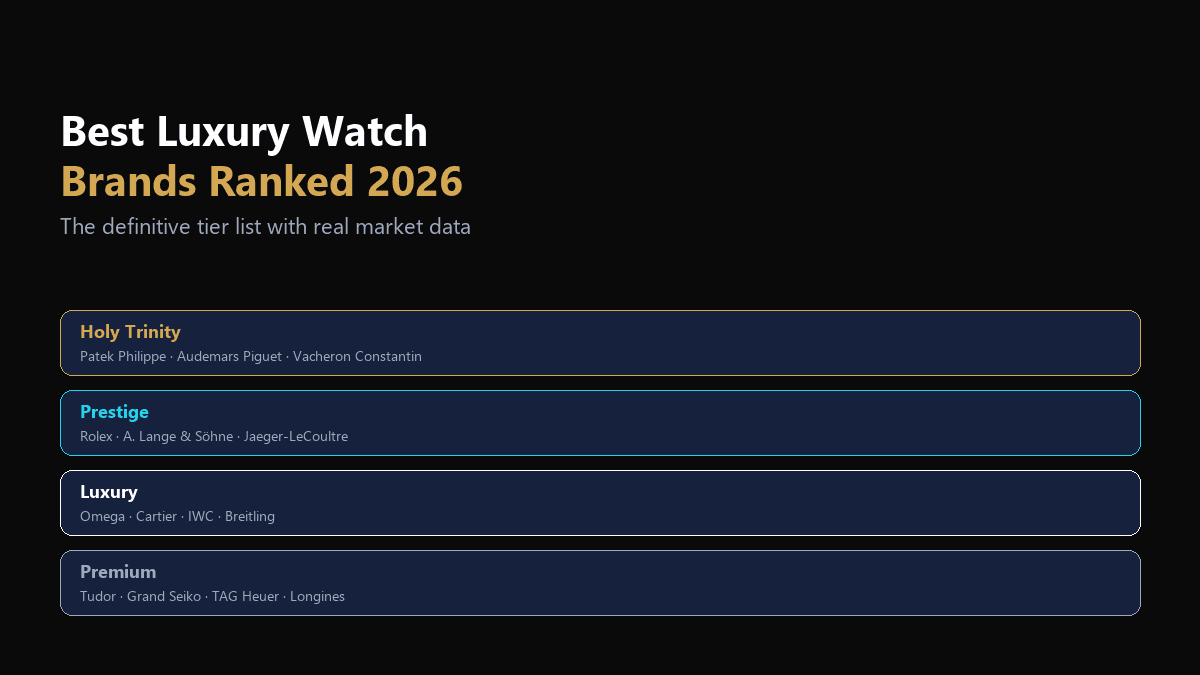
- The Holy Trinity (Patek Philippe, AP, Vacheron Constantin) represents the pinnacle of horology
- Rolex has the best resale value (105%+ average) and global brand recognition of any watch brand
- Tudor and Grand Seiko offer the best value per dollar in the luxury segment
- The “best” brand depends entirely on your priorities: investment, craftsmanship, value, or style
How We Ranked These Brands
Rankings are based on five weighted criteria: heritage (history and horological contribution), craftsmanship (finishing, movement quality, materials), value retention (secondary market performance), innovation (proprietary technology and complications), and accessibility (entry price and availability).
No single brand wins every category. Rolex dominates resale and recognition. Grand Seiko leads in finishing per dollar. Patek Philippe sits at the apex of complication and heritage. The best brand for you depends on what you value most.
What Each Tier Actually Means
Most tier lists hand you a pyramid and leave you to infer the rules. The tiers below are not a popularity ordering — each one is a different kind of brand, and the jump between two tiers is rarely a jump in quality so much as a jump in what you are paying for. Read the right-hand column before you argue with the left.
| Tier | Brands | Entry band | What the money actually buys |
|---|---|---|---|
| Holy Trinity | Patek Philippe, Audemars Piguet, Vacheron Constantin | $18,000–$24,500 | Hand finishing you need a loupe to see, and complication depth nobody else attempts at volume. Also scarcity: allocation, not price, is the gate |
| Prestige | Rolex, A. Lange & Söhne, Jaeger-LeCoultre | $5,800–$25,000 | Three different bargains in one tier: Rolex sells recognition and resale, Lange sells movement architecture, JLC sells calibre engineering at a third of the price of either |
| Core luxury | Omega, Cartier, IWC, Grand Seiko | $3,050–$5,400 | In-house movements and real heritage, bought at a retail price you can actually pay on request rather than on a waiting list. The tier where the pre-owned discount is biggest |
| Accessible luxury | Tudor, TAG Heuer | $1,750–$2,275 | Specification per dollar. Tudor is the outlier of the whole list — it holds value like a tier above it while pricing like this one |
Two things fall out of that table that a ranking alone hides. The first is that the tiers are not evenly spaced: the gap between accessible luxury and core luxury is about $1,000 of retail, and the gap between prestige and the Trinity can be $20,000 for a watch that keeps time no better. The second is that one brand sits in the wrong tier on purpose. Tudor is priced in the bottom tier and retains value like the one two above it, which is why it appears in almost every “what should I buy first” answer on this page.
The Holy Trinity
Three brands sit above all others in the traditional watchmaking hierarchy:
Patek Philippe (est. 1839)
The undisputed king. “You never actually own a Patek Philippe, you merely look after it for the next generation” isn’t just marketing — it’s fact. The Nautilus 5711 was discontinued and tripled in value. The Calatrava defines the dress watch. Entry: $24,500. Best model: Nautilus 5711 (if you can find one).
Audemars Piguet (est. 1875)
The Royal Oak changed watchmaking in 1972 when Gérald Genta designed a luxury steel sports watch. Today, AP produces some of the most coveted timepieces on earth. Entry: $21,900 (Royal Oak 15500ST). Best model: Royal Oak “Jumbo” Extra-Thin 16202.
Vacheron Constantin (est. 1755)
The oldest continuously operating watch manufacturer. Vacheron excels at ultra-thin complications and hand finishing that rivals Patek. Less commercially aggressive than AP, which makes their pieces more attainable. Entry: ~$18,000. Best model: Overseas for sport, Patrimony for dress.
Prestige Tier
Rolex (est. 1905)
The most recognized watch brand on earth, with 30%+ of the luxury watch market by revenue. Rolex doesn’t make the most complex watches — it makes the most reliable and desirable ones. Unmatched resale value. Entry: $5,800 (Oyster Perpetual). Best model: Submariner 126610LN.
A. Lange & Söhne (est. 1845)
The crown jewel of German watchmaking. Every movement is assembled twice, with hand-engraved balances and the distinctive Glashutte three-quarter plate. If you care about movement beauty above all else, Lange is unmatched. Entry: ~$25,000. Best model: Lange 1.
Jaeger-LeCoultre (est. 1833)
Known as the “watchmaker’s watchmaker,” JLC has created over 1,400 calibres and supplied movements to Patek Philippe, AP, and others. The Reverso is one of the most iconic designs in horology. Entry: ~$6,500. Best model: Reverso Classic.
The Complete Tier List
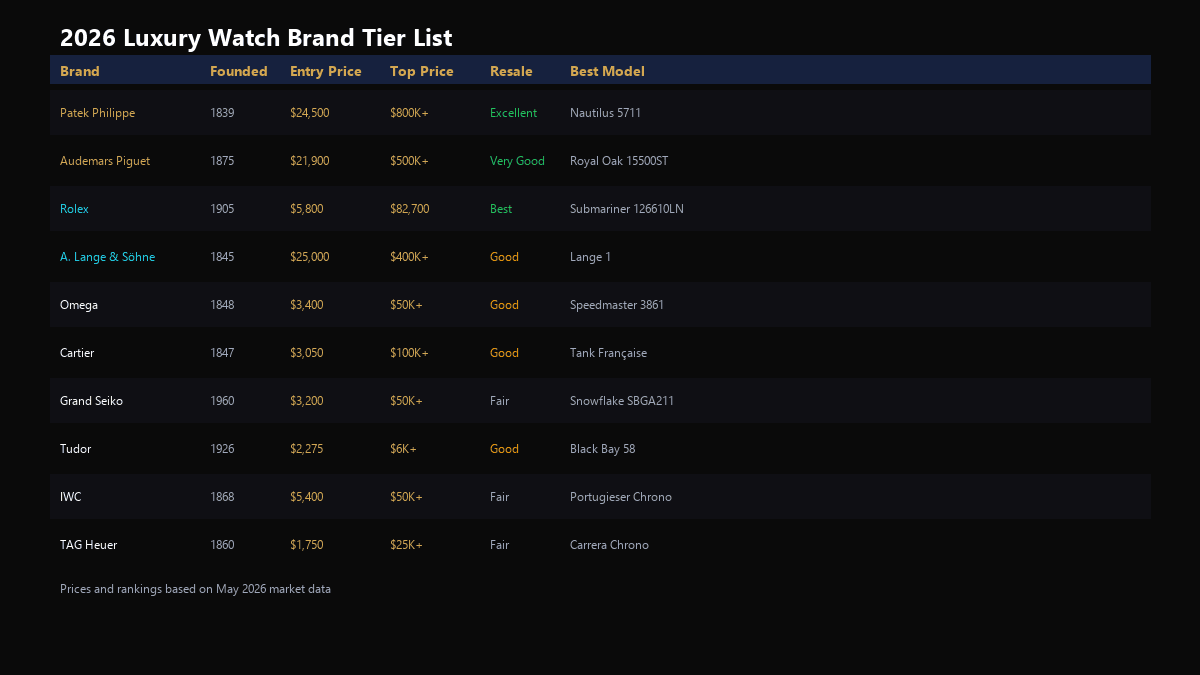
| Brand | Entry Price | Resale | Best Model |
|---|---|---|---|
| Patek Philippe | $24,500 | 95% | Nautilus 5711 |
| Audemars Piguet | $21,900 | 88% | Royal Oak 15500ST |
| Rolex | $5,800 | 105% | Submariner 126610LN |
| A. Lange & Söhne | $25,000 | 80% | Lange 1 |
| Omega | $3,400 | 75% | Speedmaster 3861 |
| Cartier | $3,050 | 72% | Tank Française |
| Grand Seiko | $3,200 | 65% | Snowflake SBGA211 |
| Tudor | $2,275 | 80% | Black Bay 58 |
| IWC | $5,400 | 62% | Portugieser Chrono |
| TAG Heuer | $1,750 | 55% | Carrera Chronograph |
Any Brand. Any Model. Instant Pricing.
Grailr uses a photo to suggest a watch identity and an indicative price estimate, with active eBay listings where available. Check the exact reference and condition independently; a photo scan cannot authenticate a watch.
- Covers 50+ luxury brands
- Indicative price estimates
- Free to use — no signup required
Resale Value, Ranked
The tier list above sorts by prestige. Sort the same ten brands by retention instead and the order changes substantially — which is the single most useful thing on this page if you expect to sell the watch one day.
| Rank | Brand | Indicative retention | Tier it sits in |
|---|---|---|---|
| 1 | Rolex | 105% | Prestige |
| 2 | Patek Philippe | 95% | Holy Trinity |
| 3 | Audemars Piguet | 88% | Holy Trinity |
| =4 | Tudor | 80% | Accessible luxury |
| =4 | A. Lange & Söhne | 80% | Prestige |
| 6 | Omega | 75% | Core luxury |
| 7 | Cartier | 72% | Core luxury |
| 8 | Grand Seiko | 65% | Core luxury |
| 9 | IWC | 62% | Core luxury |
| 10 | TAG Heuer | 55% | Accessible luxury |
A. Lange & Söhne and Tudor tie at 80% from opposite ends of the list — a $25,000 entry price and a $2,275 one. That is the clearest argument on this page against reading a tier list as a buying order: retention is not a function of tier, and the brand ranked tenth here is not the tenth-best watchmaker.
These retention figures are the same indicative percentages carried in the tier list above and in the chart below; they date from this guide’s original publication period and have not been refreshed to current quotes. They describe past price history, not a forecast, and an active listing is an asking price rather than a completed sale. Verify the exact reference, condition and sale date before relying on any of them.
Resale Value by Brand
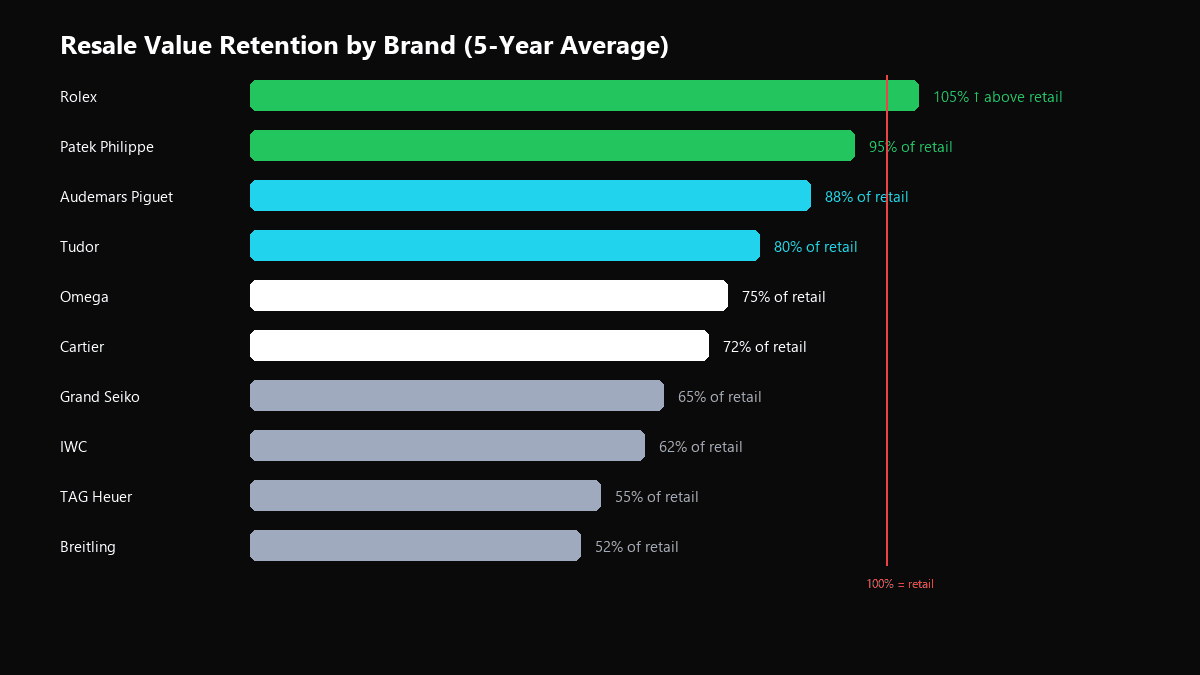
Rolex leads with an average 105%+ retention — meaning many models actually appreciate above retail price. Patek Philippe follows at 95%, driven by the discontinued Nautilus effect. The surprise performer is Tudor at 80%, outperforming Swiss brands costing twice as much. Read our full investment guide for detailed analysis.
At the other end, TAG Heuer (55%) and IWC (62%) depreciate significantly on the secondary market. This doesn’t mean they’re bad watches — it means the pre-owned market is where the smart buyer finds value.
Ultra-Thin and Grand Complications: Who Actually Leads
Two sub-rankings get asked for constantly and belong nowhere in the tier list above, because the brands that win them are not the brands that win on resale or recognition. Both are settled by documented records rather than opinion, so here they are with the records attached.
Ultra-thin
This is a two-horse race and Bulgari is in front. Its Octo Finissimo Ultra arrived in 2022 at 1.8 mm from crystal to case back — 0.2 mm slimmer than the Piaget Altiplano Ultimate Concept it displaced, which stood at 2.0 mm. Piaget still holds the thinnest-tourbillon record with the Altiplano Ultimate Concept Tourbillon.
One caveat that most lists omit, and it comes from the same specialist who reported the record: on a strict reading the Jean Lassale 1200 of the late 1970s holds the historic record at 1.2 mm, which makes the Bulgari the second-thinnest mechanical watch ever made rather than the thinnest. “Thinnest ever” in modern marketing means thinnest of the modern era. Details in Watches by SJX’s account of the Ultra, including the correction.
Note what is not on that podium: no Holy Trinity brand, and no Rolex. Thinness is a specialism, and the two houses that pursue it hardest sit outside the top tier of every general ranking including this one.
| Watch | Thickness | Year | Standing |
|---|---|---|---|
| Jean Lassale 1200 | 1.2 mm | late 1970s | Thinnest mechanical watch ever, on a strict reading — and almost never counted |
| Bulgari Octo Finissimo Ultra | 1.8 mm | 2022 | Thinnest of the modern era, and what “thinnest ever” usually means |
| Piaget Altiplano Ultimate Concept | 2.0 mm | 2018 | Held the record until the Bulgari; still holds the thinnest-tourbillon record |
Grand complications
Here the Trinity does win, and one member of it wins outright. Vacheron Constantin’s Les Cabinotiers — The Berkley Grand Complication, shown in 2024, carries 63 complications across 2,877 components and is the most complicated watch ever made. It beat the record Vacheron already held with Reference 57260, took eleven years of development including a full year of assembly, and includes a true Chinese perpetual calendar — the complication that had never been executed mechanically before. Vacheron’s own announcement carries the specification.
Be careful with the number itself. Specialist coverage notes that several of the 63 are arguable — the winding system, the concealed crown and the mechanisms that disengage the alarm and striking barrels when fully wound would not be counted as complications by every watchmaker. Roughly seven of them are contested. The record stands; the count is a convention rather than a measurement, which is worth knowing before using “63” to settle an argument.
The short ranking, if you want one. Ultra-thin: Bulgari, then Piaget, then nobody close. Grand complications: Vacheron Constantin, then Patek Philippe, then Audemars Piguet. Neither list is the same as the tier list above, and that is the point — “best brand” is unanswerable until you say best at what.
Which Brand Is Right for You?
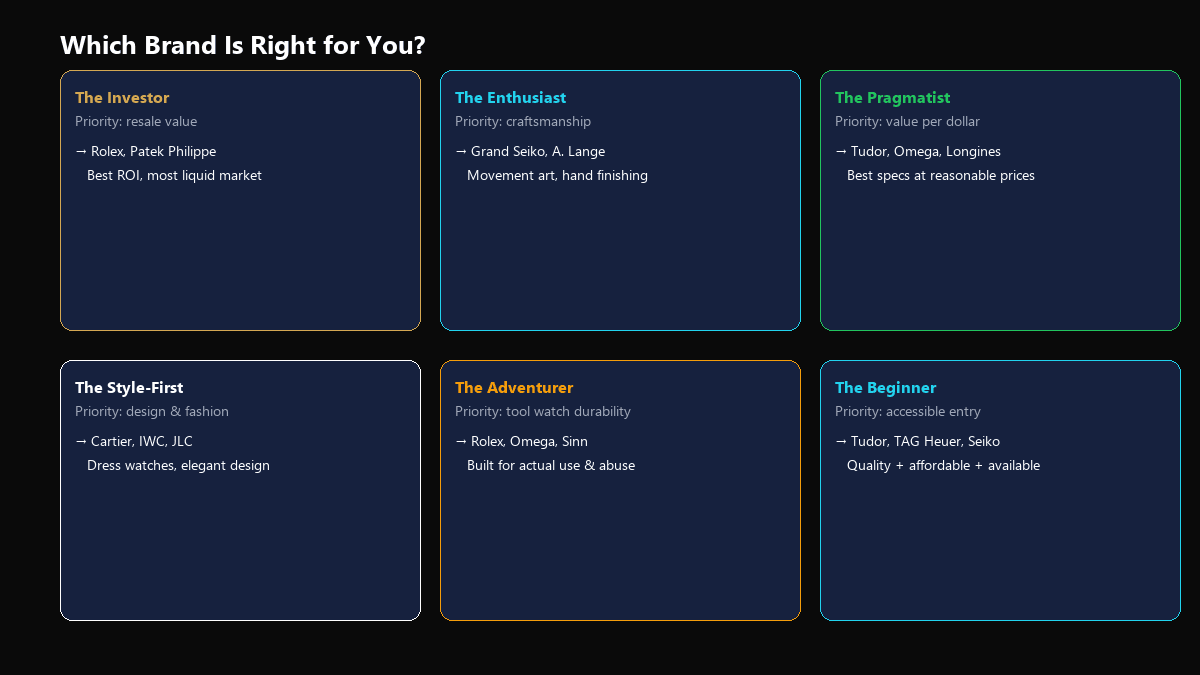
The Investor
Rolex, Patek Philippe. Best ROI, most liquid secondary market.
The Enthusiast
Grand Seiko, A. Lange. Movement art, hand finishing, connoisseur appeal.
The Pragmatist
Tudor, Omega, Longines. Best specs at reasonable prices.
The Style-First
Cartier, IWC, JLC. Elegant design, dress watches, fashion-forward.
The Adventurer
Rolex, Omega, Sinn. Tool watches built for actual use and abuse.
The Beginner
Tudor, TAG Heuer, Seiko. Quality, affordable, available now.
Best Entry Point for Each Brand
Patek Philippe
Calatrava 5196
$24,500
Audemars Piguet
Royal Oak 15500ST
$21,900
Rolex
Oyster Perpetual 36
$5,800
Omega
Seamaster Aqua Terra
$3,400
Cartier
Tank Must
$3,050
Grand Seiko
SBGW231 (quartz Heritage)
$3,200
Tudor
Royal
$2,275
TAG Heuer
Carrera Date
$1,750
Longines
Spirit Prestige Edition
$1,500
Frequently Asked Questions
What are the top 3 luxury watch brands?
The 'Holy Trinity' of watchmaking is Patek Philippe, Audemars Piguet, and Vacheron Constantin — representing the pinnacle of horological craftsmanship, heritage, and complication.
Is Rolex the best watch brand?
Rolex is the most recognized and commercially successful, with the best resale values (90-120%+). But Patek, Lange, and Grand Seiko surpass it in certain aspects of craftsmanship and movement technology.
What is the best luxury watch brand for investment?
Rolex has the strongest resale value. Patek Philippe follows with discontinued models appreciating significantly. AP Royal Oak models also perform well on the secondary market.
What is the best entry-level luxury watch brand?
Tudor ($2,275+), Longines ($1,500+), and TAG Heuer ($1,750+) offer the best entry points. For slightly more, Omega ($3,400+) and Grand Seiko ($3,200+) are exceptional.
Which brand has the best movement technology?
Grand Seiko's Spring Drive achieves ±1 sec/day with a unique smooth sweep. A. Lange & Söhne produces the most beautifully finished movements. Rolex sets the reliability benchmark.
What are the tiers in the watch brand hierarchy?
Four, on this page: the Holy Trinity (Patek Philippe, Audemars Piguet, Vacheron Constantin), Prestige (Rolex, A. Lange & Söhne, Jaeger-LeCoultre), Core luxury (Omega, Cartier, IWC, Grand Seiko) and Accessible luxury (Tudor, TAG Heuer). The tiers describe what the money buys rather than which watch is better, they are not evenly spaced, and retention does not follow them — Tudor ties A. Lange & Söhne at 80% from a tenth of the entry price.
Which brand leads in ultra-thin watches and grand complications?
Bulgari leads ultra-thin: its Octo Finissimo Ultra of 2022 measures 1.8 mm, ahead of Piaget's 2.0 mm Altiplano Ultimate Concept, though on a strict reading the 1.2 mm Jean Lassale 1200 of the late 1970s is thinner still. Vacheron Constantin leads grand complications with Les Cabinotiers — The Berkley Grand Complication, at 63 complications across 2,877 components, the most complicated watch ever made. Neither ranking matches the tier list.
Related Articles
The Bottom Line
There is no single “best” luxury watch brand — only the best brand for your priorities. If you want investment security, buy Rolex. If you want artisanal craftsmanship, buy Grand Seiko or Lange. If you want the absolute pinnacle, save for Patek Philippe. And if you want the best value, start with Tudor and work your way up. Whatever you choose, scan it with Grailr first as one reference point when assessing an asking price.
Explore Any Watch Brand
Grailr uses a photo to suggest a watch identity and an indicative price estimate, with active eBay listings where available. Check the exact reference and condition independently; a photo scan cannot authenticate a watch.
Scan a Watch NowSources and price context
- Audemars Piguet Royal Oak history — Documents the 1972 launch and later collection developments.
- Grand Seiko SBGA211 specifications — Supports the Snowflake discussion of titanium, Spring Drive and power reserve.
These primary sources support the specific history, specification or policy points noted above. Prices and resale percentages elsewhere in this guide are indicative editorial figures, not a verified transaction dataset or guaranteed returns. Confirm the exact reference, region, condition and current quote before buying; asking prices are not completed-sale prices.