Citizen Caliber 0100: The Most Accurate Watch Ever Made
How Citizen built a solar-powered quartz watch that gains or loses no more than one second in an entire year — and why it matters for the future of precision timekeeping.
Price context: this guide includes indicative prices from its original publication period. They have not all been refreshed to current quotes. Use the linked primary sources for specifications and policies, and verify prices independently.

- The Caliber 0100 achieves ±1 second per year — five times better than any previous autonomous watch and roughly 25 times more accurate than COSC quartz
- Powered by Eco-Drive solar technology with no battery changes needed, running 6 months on a full charge or 8 months in power-save mode
- All models are limited editions — fewer than 900 pieces total across four references, priced from $7,400 to $16,800 at launch
- The Caliber 0200 is a completely different mechanical automatic movement — not an upgraded or successor quartz caliber
- One documented owner reports only +1 second gained after five years of continuous daily wear
What Is the Caliber 0100?
The Citizen Caliber 0100 is an Eco-Drive quartz movement rated at ±1 second per year — the most accurate timekeeping specification ever achieved by an autonomous wristwatch, meaning one that runs on its own power without synchronizing to an external radio or GPS signal. Citizen unveiled it in 2019 as a centennial project marking the company’s 100th anniversary, and the name itself reflects that milestone: 0100 for the year zero of the next century.
To understand how unusual that accuracy claim is, consider the landscape Citizen was entering. The previous best autonomous wristwatch accuracy — held jointly by Citizen’s own Chronomaster AQ4020 and the Longines Conquest VHP — was ±5 seconds per year. Grand Seiko’s celebrated 9F quartz caliber targets ±10 seconds per year. A standard COSC-certified quartz movement allows ±0.07 seconds per day, which accumulates to roughly ±25.5 seconds across a year. The Caliber 0100 does not just edge past those numbers; it beats the previous best by a factor of five.
What makes this doubly striking is that the movement runs on light. Like every Eco-Drive caliber, the 0100 converts ambient light — sunlight, LED, fluorescent — into electrical energy stored in a rechargeable cell, so there is no battery to swap. A full charge keeps the watch running for approximately six months in total darkness, or eight months if the power-save function activates. Citizen didn’t achieve record accuracy by adding a radio receiver or GPS antenna; they did it by pushing quartz crystal technology further than anyone had before. For more on how Eco-Drive technology works across Citizen’s full range, see our Citizen Eco-Drive guide.
How ±1 Second per Year Works
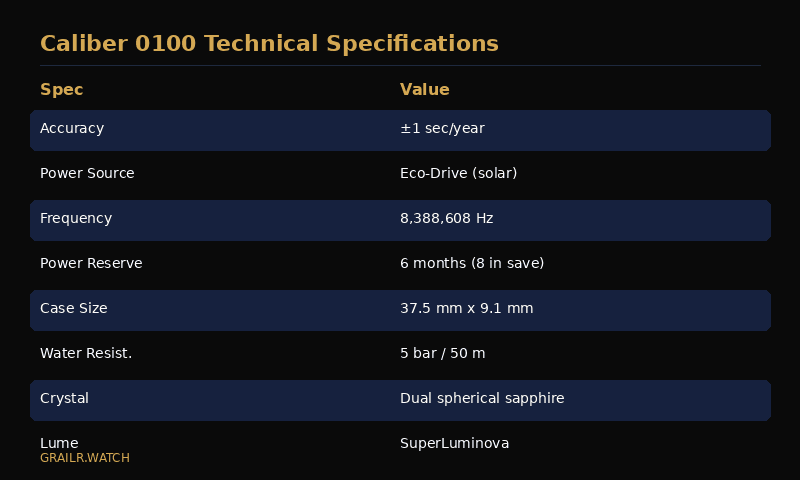
A conventional quartz watch oscillates its crystal at 32,768 Hz — a frequency chosen in the 1970s because it is a power of two (215) and divides cleanly down to one pulse per second. That frequency is accurate enough for everyday timekeeping, but it drifts with temperature changes, crystal aging, and manufacturing tolerances. The Caliber 0100 attacks all three problems at once.
First, it replaces the standard tuning-fork crystal with an AT-cut quartz crystal oscillating at 8,388,608 Hz (223, or 8.38 MHz). An AT-cut crystal has a fundamentally flatter frequency-versus-temperature curve than the tuning-fork shape used in ordinary quartz watches, meaning its oscillation rate changes far less as the watch heats up on a summer wrist or cools in an air-conditioned office. The higher frequency also means each timing error is divided across more cycles per second, shrinking the per-cycle error that accumulates into a visible drift.
Second, the movement performs thermocompensation every 60 seconds. An internal temperature sensor reads the crystal’s environment once a minute, and the movement’s integrated circuit applies a correction factor calculated from a factory-measured profile of that specific crystal’s behavior. This isn’t a one-size-fits-all lookup table — each crystal is individually characterized and its correction polynomial burned into the movement before it leaves the factory. The same correction cycle also compensates for long-term aging drift, so the movement doesn’t gradually lose accuracy over years of use the way a standard quartz watch does.
Third, the physical movement construction supports that precision. The plates are finished with a ruthenium blackening treatment for corrosion resistance, and the hands are heavy brass driven by high-torque stepper motors rather than the lightweight plastic hands most quartz watches use. The second hand is bent slightly at its tip to reduce parallax when reading time against the dial markers — a finishing detail borrowed from high-end mechanical watchmaking, applied here because a movement this accurate deserves a display that doesn’t blur the reading.
Launch Models and Pricing
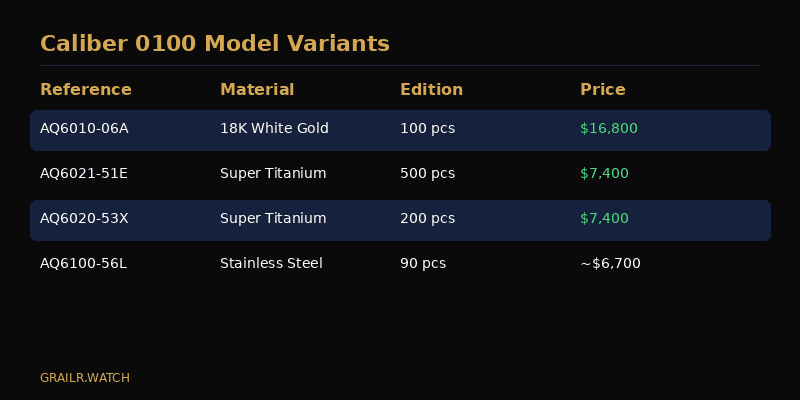
Citizen launched three Caliber 0100 references simultaneously in 2019, followed by a fourth in 2020. All four are limited editions — there is no open-production Caliber 0100 watch — and total production across the entire range is fewer than 900 pieces. Every model shares a 37.5 mm case diameter, 9.1 mm thickness, 5 bar water resistance, dual spherical sapphire crystal with anti-reflective coating, and SuperLuminova indices. For a broader look at Citizen’s full catalog, including more accessible models, see our Citizen watches for men guide.
| Reference | Case Material | Dial | Edition | Launch Price |
|---|---|---|---|---|
| AQ6010-06A | 18K White Gold | Light Ivory | 100 pcs | $16,800 |
| AQ6021-51E | Super Titanium (Duratect α) | Black Lacquer | 500 pcs | $7,400 |
| AQ6020-53X | Super Titanium | Dark Mother-of-Pearl | 200 pcs | $7,400 |
| AQ6100-56L | Stainless Steel | Blue | 90 pcs | ∼737,000 ¥ |
The AQ6021-51E is the most widely discussed reference because it combines the Caliber 0100 movement with Citizen’s Duratect α surface hardening, which brings the Super Titanium case to over 2,000 Vickers hardness — significantly harder than untreated stainless steel at roughly 200 Vickers. The result is a case that resists everyday scratches in a way few watch materials can match. The AQ6010-06A in 18K white gold sits at the opposite end of the spectrum: a precious-metal dress watch limited to 100 pieces, paired with a crocodile strap and a light ivory dial that reads as a quiet luxury piece rather than a technology showcase.
The 2020 AQ6100-56L is the rarest of the four at just 90 pieces, offered initially through the Japanese market at approximately 737,000 yen. Its stainless steel case makes it the most conventional-looking reference in the range, though the movement inside is identical to the 2019 models.
Check Any Watch Price in Seconds
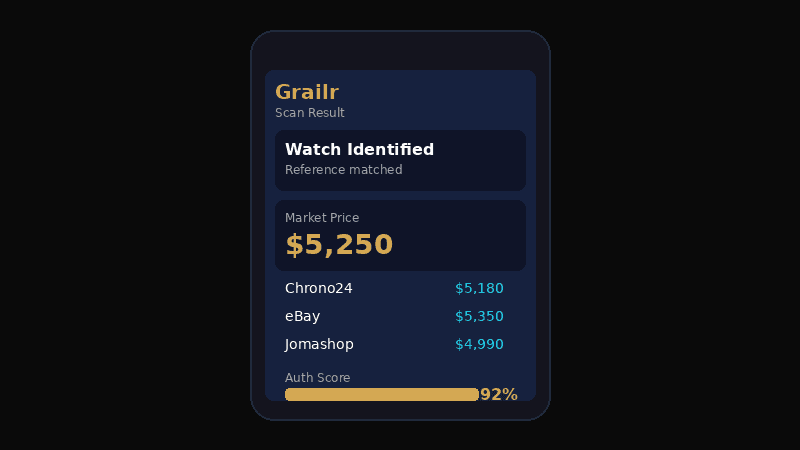
Grailr scans your watch photo and pulls live pricing from Chrono24, eBay, and Jomashop.
- AI identifies brand, model & reference number
- Live market prices from 3+ sources
- Authentication confidence score
Accuracy Compared
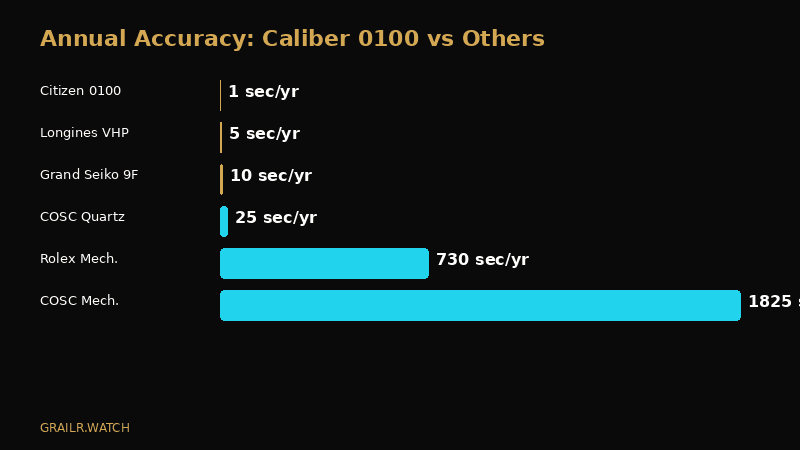
Accuracy claims are easy to throw around; the numbers below put them in context. The table converts every rating to seconds per year for a direct comparison. Where a specification is given as seconds per day, the annual figure multiplies by 365. For a deeper look at the best quartz movements across all price ranges, see our best quartz movements guide.
| Watch / Movement | Type | Rated Accuracy | Sec / Year |
|---|---|---|---|
| Citizen Caliber 0100 | Eco-Drive Quartz | ±1 sec/year | ±1 |
| Citizen AQ4020 / Longines VHP | HAQ Quartz | ±5 sec/year | ±5 |
| Grand Seiko 9F | Quartz | ±10 sec/year | ±10 |
| COSC Quartz Standard | Quartz | ±0.07 sec/day | ∼±25.5 |
| Rolex Superlative Chronometer | Mechanical | ±2 sec/day | ∼±730 |
| COSC Mechanical Standard | Mechanical | −4/+6 sec/day | ∼±1,825 |
The gap between quartz and mechanical is always large, but the gap between the Caliber 0100 and even premium quartz movements is what stands out. Grand Seiko’s 9F is widely considered the finest regular-production quartz caliber in the world, and the 0100 is ten times more precise. Against a COSC-certified quartz movement — the industry-wide gold standard for quartz accuracy — it is roughly 25 times tighter.
These numbers come with an important caveat: rated accuracy is a specification, not a guarantee for every individual watch. Real-world performance depends on wearing habits, temperature exposure, and crystal aging. But the engineering headroom Citizen built into the 0100 — the 8.38 MHz crystal, per-minute thermocompensation, individual crystal profiling — gives the movement far more margin than conventional quartz designs carry. For our broader survey of accuracy across the industry, see the most accurate watches guide.
Caliber 0100 vs Caliber 0200
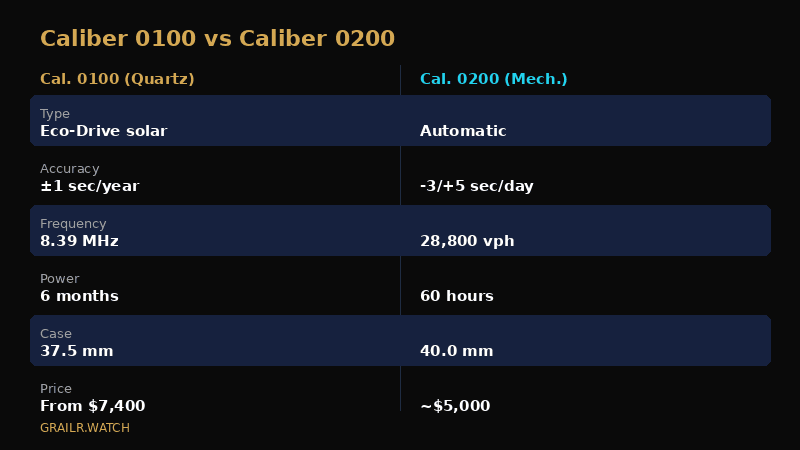
The numbering suggests a progression — the 0200 replacing or improving on the 0100 — but these are completely different types of movement. The Caliber 0100 is a thermocompensated Eco-Drive quartz caliber. The Caliber 0200 is a mechanical automatic movement, co-developed with Swiss manufacture La Joux-Perret (a Citizen Group subsidiary), that runs on a mainspring and escapement, not a crystal oscillator and solar cell.
The Caliber 0200 carries 26 jewels, beats at 28,800 vibrations per hour (4 Hz), delivers a 60-hour power reserve, and is rated at −3/+5 seconds per day — respectable for a mechanical movement but roughly 1,460 times less accurate than the Caliber 0100. It appears in Citizen’s Series 8 collection, a line of mechanical watches priced well below the 0100 range. The two calibers do not share components, technology, or design intent.
Confusing the two is common in online discussions, partly because the names suggest a sequence and partly because both represent Citizen pushing into territory typically associated with Swiss watchmaking. But they solve different problems. The 0100 asked: how accurate can a quartz watch be? The 0200 asked: can Citizen build a competitive mechanical movement? The answers have nothing to do with each other.
Quick Rule of Thumb
If you want the most accurate autonomous watch ever made, you want the Caliber 0100 (quartz, solar, ±1 sec/year). If you want a Citizen mechanical automatic at an accessible price, you want the Caliber 0200 (automatic, mainspring, −3/+5 sec/day). Don’t cross-shop them — they aren’t alternatives to each other.
Real-World Ownership
Specifications are one thing; living with a Caliber 0100 watch is another. The most telling data point from the ownership community is a documented report of only +1 second gained after five years of daily wear. That is well within the ±1 second per year specification — in fact, it suggests the watch was running even tighter than rated for most of that period. While a single data point is not a statistical sample, it aligns with the engineering headroom built into the movement’s thermocompensation and crystal profiling systems.
Practically, the 37.5 mm case wears like a traditional dress watch. It sits at 9.1 mm thick, which keeps it slim under a shirt cuff, and the 5 bar (50 m) water resistance is adequate for handwashing and light rain but not for swimming or any water sport. The dual spherical sapphire crystal virtually eliminates reflections at oblique angles, and the SuperLuminova on the indices provides enough glow for reading in dim light, though this is not a tool watch built for nighttime legibility at a distance.
Servicing is straightforward in principle: Eco-Drive movements have no battery to replace, and the rechargeable cell has an expected lifespan of decades. Citizen recommends periodic factory service every 7–10 years for gasket and lubrication maintenance, though the movement itself should not need adjustment unless the crystal ages beyond its factory-profiled correction range. Given the limited production numbers, sourcing parts outside Citizen’s own service network could become difficult in the long term — a factor worth weighing if you plan to hold the watch for decades.
Should You Buy a Caliber 0100?
The honest answer depends on what you value. If absolute precision in an autonomous wristwatch matters to you — not as a party trick but as a genuine engineering achievement — there is nothing else like the Caliber 0100. No radio sync, no GPS, no Bluetooth: just a crystal oscillating at 8.38 MHz, corrected every minute by an individually profiled algorithm, powered by light. It is the furthest anyone has pushed quartz accuracy in a wearable form, and Citizen has shown no sign of superseding it.
The practical barriers are availability and price. With fewer than 900 units produced across four references, finding a Caliber 0100 watch on the secondary market is not straightforward. The Super Titanium models launched at $7,400 and the white gold at $16,800; secondary-market prices depend entirely on which reference appears and in what condition. These are not watches you walk into a boutique and buy off the shelf.
For buyers who want exceptional quartz accuracy at a more accessible price point, Citizen’s Chronomaster AQ4020 series offers ±5 seconds per year in an Eco-Drive format at a fraction of the Caliber 0100’s cost, and the Longines Conquest VHP matches that specification in a more conventional Swiss-brand package. Both are reviewed in our most accurate watches guide.
Before You Buy
Use Grailr’s identification tool to photograph a listing and verify the reference number against known Caliber 0100 models. A photo scan provides a suggested model identity and indicative price estimate, but it is not proof of authenticity — always pair it with an independent inspection or Citizen service center verification, especially on a limited-edition piece at this price level.
Frequently Asked Questions
How accurate is the Citizen Caliber 0100?
The Caliber 0100 is rated at ±1 second per year, making it the most accurate autonomous watch ever produced. This is five times better than Citizen's previous best and roughly 25 times more accurate than a standard COSC-certified quartz movement.
Does the Citizen Caliber 0100 need a battery?
No. The Caliber 0100 uses Citizen's Eco-Drive solar technology, converting any light source into electrical energy. A full charge provides approximately 6 months of running time, or 8 months in power-save mode. There is no battery to replace.
What is the difference between Caliber 0100 and Caliber 0200?
They are completely different movements. The Caliber 0100 is a thermocompensated quartz movement achieving ±1 second per year. The Caliber 0200 is a mechanical automatic movement co-developed with La Joux-Perret, running at 28,800 vibrations per hour with −3/+5 seconds per day accuracy. They share only the Citizen name.
How much does a Citizen Caliber 0100 watch cost?
Launch prices ranged from $7,400 for the Super Titanium models to $16,800 for the 18K white gold AQ6010-06A. A later stainless steel model (AQ6100-56L) was offered at approximately 737,000 yen. All Caliber 0100 watches are limited editions, so secondary-market prices vary with availability.
How many Caliber 0100 watches were made?
Fewer than 900 units total. The white gold AQ6010-06A was limited to 100 pieces, the mother-of-pearl AQ6020-53X to 200, the black lacquer AQ6021-51E to 500, and the stainless steel AQ6100-56L to 90 pieces.
Is the Caliber 0100 more accurate than Grand Seiko quartz?
Yes, by a factor of ten. Grand Seiko's 9F quartz movement is rated at ±10 seconds per year. The Caliber 0100's ±1 second per year specification is achieved through its 8.38 MHz AT-cut crystal and per-minute thermocompensation cycle — technology the 9F does not use.
Related Articles
The Bottom Line
The Citizen Caliber 0100 is a quietly extraordinary watch. It does not announce itself with a rotating bezel, a chronograph, or a tourbillon visible through the caseback. It simply keeps time more accurately than any other autonomous wristwatch ever made — ±1 second per year, powered by light, with no signal sync and no battery changes. The limited production run, relatively understated case design, and Citizen branding mean it will never command the secondary-market premiums of a Patek or a Rolex, but for a buyer who values genuine engineering substance over brand prestige, there is nothing else in the category. Confirm the exact reference, edition size, and condition before committing to a purchase; a photo and listing description are a starting point, not a guarantee.
Found a Caliber 0100 Listing?
Grailr uses a photo to suggest a watch identity and an indicative price estimate, with active listings where available. Check the exact reference and condition independently; a photo scan cannot authenticate a watch.
Get an Indicative EstimateSources and price context
- Citizen Caliber 0100 technology page — Official specifications for the AT-cut crystal, thermocompensation system, power reserve, and Eco-Drive integration.
- Grand Seiko 9F quartz movement — Reference for the ±10 sec/year specification used in the accuracy comparison table above.
These primary sources support the specifications and accuracy comparisons noted above. Prices elsewhere in this guide are indicative editorial figures from the original publication period, not a verified transaction dataset. Confirm the exact reference, edition, condition and current quote before buying; asking prices are not completed-sale prices.