Girard-Perregaux Buying Guide: Every Collection Compared
Laureato, 1966, Bridges and Cat’s Eye — in-house movements, real pricing and what to check before you buy.
Price context: this guide includes indicative prices from its original publication period. They have not all been refreshed to current quotes. Use the linked primary sources for specifications and policies, and verify prices independently.
- Girard-Perregaux has manufactured its own movements since 1791 — one of the oldest Swiss manufactures still operating
- New prices start around $9,000 for 1966 references and $14,300 for the Laureato 42 mm in steel
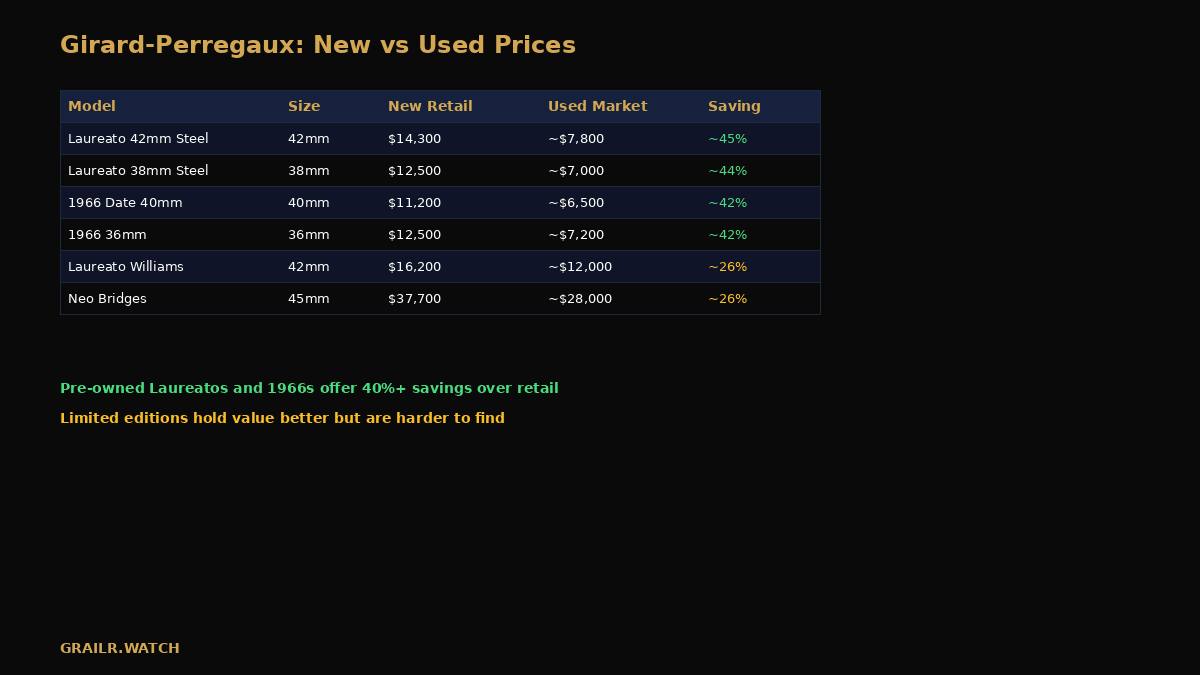
- Pre-owned Laureatos trade at roughly $7,000–$8,000, saving 40–50% over retail
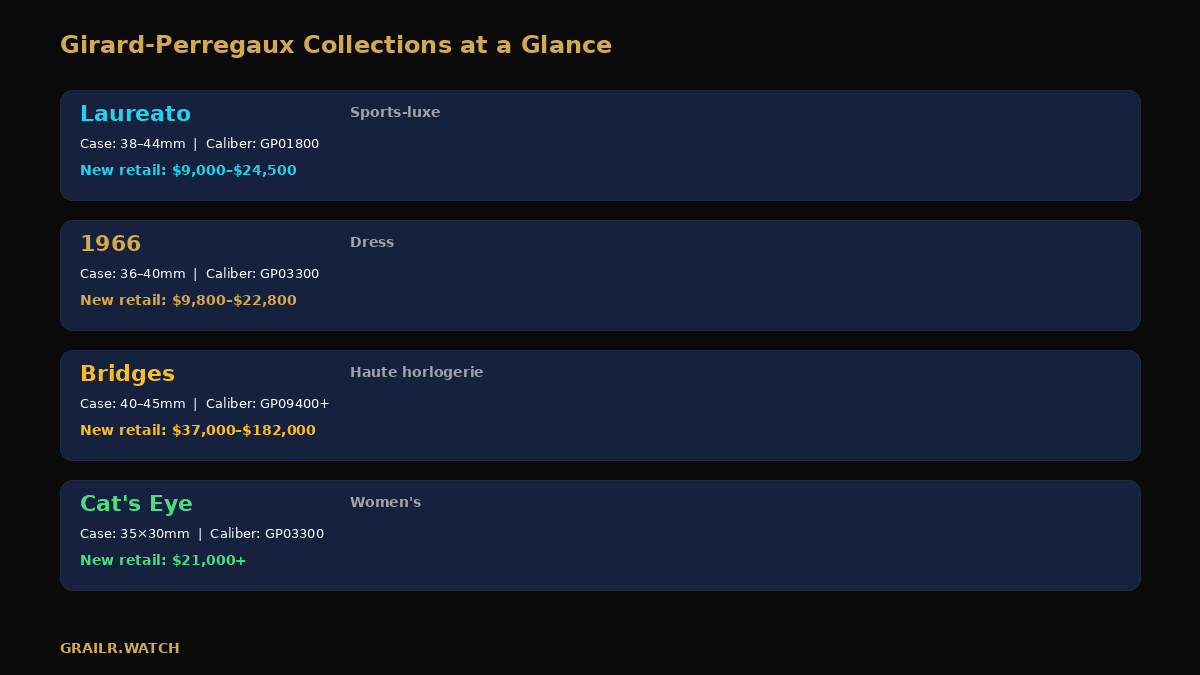
- Four main collections — Laureato, 1966, Bridges and Cat’s Eye — cover sports, dress, haute horlogerie and women’s watches
Why Girard-Perregaux Belongs on Your Shortlist
Girard-Perregaux is one of the last true Swiss manufactures — a maker that designs and builds its own movements under one roof. Founded in 1791 in La Chaux-de-Fonds, the brand predates Patek Philippe by half a century and has been producing calibers continuously longer than almost anyone in the industry. It is now part of the Kering luxury group alongside Gucci, Boucheron and Ulysse Nardin, which gives it access to serious R&D investment while keeping production volumes low.
What makes GP interesting for buyers in 2026 is the gap between its horological credibility and its secondary-market prices. A steel Laureato with an in-house automatic sits in a similar category to the Audemars Piguet Royal Oak — integrated bracelet, octagonal bezel, luxury sports watch — but costs a fraction on the used market. If you care more about the actual watchmaking than about resale curves, Girard-Perregaux delivers an enormous amount of movement for the money.
The brand runs four main collections. The Laureato is the sports-luxe flagship. The 1966 covers classical dress watches. The Bridges line houses the brand’s signature visible-movement complications. And Cat’s Eye is the dedicated women’s range. Each uses an in-house caliber, and each targets a different buyer. This guide walks through all four, then covers pricing, value retention and what to check when buying pre-owned.
The Laureato Collection
The Laureato is the watch most people think of when they hear Girard-Perregaux. Launched in 1975 — the same year as the Royal Oak Offshore concept began to stir at AP — it was one of the first luxury stainless-steel sports watches with an integrated bracelet. The octagonal bezel, clou de Paris (hobnail) dial texture and polished-brushed case finishing put it squarely in the same conversation as the Royal Oak and Nautilus, at a significantly lower price of entry.
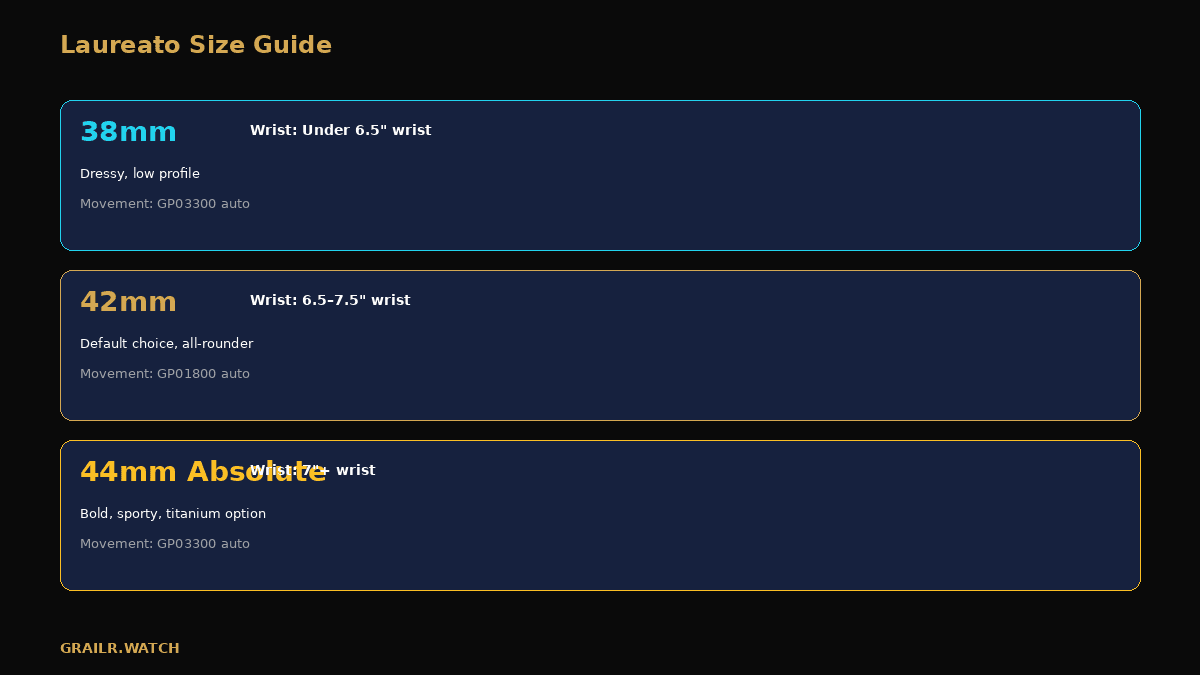
The current range spans three case sizes. The 38 mm suits wrists under 6.5 inches and leans dressy. The 42 mm is the default for most buyers, housing the in-house GP01800 caliber with roughly 46 hours of power reserve. And the 44 mm Absolute is a grade-5 titanium option with 300 m water resistance, aimed at the boldest wrists. All three use an in-house automatic movement; there are no outsourced Laureato references.
Retail for the steel 42 mm starts at approximately $14,300. The 2026 Williams Edition chronograph — linked to the Formula 1 partnership — runs $20,900, while the limited Laureato F1 Aston Martin Edition (88 pieces, titanium, 44 mm) also listed at about $14,300 retail but trades higher on the secondary market thanks to scarcity and collector demand. At the top of the range, the 2026 Laureato Fifty re-editions in steel start at $23,100 and the Fifty Tourbillon reaches $95,600.
For a deeper comparison of the 38 mm and 42 mm Laureato references, including bracelet fit and used-market pricing, see our dedicated Laureato buying guide.
The 1966 Collection
The 1966 commemorates the year Girard-Perregaux won the Neuchâtel Observatory chronometry prize with its high-frequency caliber. Where the Laureato is a sports watch, the 1966 is a pure dress piece: thin case, domed sapphire crystal, sector or sunburst dial, and a simple round silhouette that slips under any shirt cuff.
The collection comes in 36 mm and 40 mm case sizes. The 36 mm models house the GP03300 automatic caliber with a 46-hour power reserve, while the 40 mm references use the same base caliber with optional date or moonphase complications. Cases are available in stainless steel, rose gold and white gold, with leather straps standard across the range.
Retail pricing opens at around €9,800 for a steel 40 mm with a simple dial, climbing to roughly €22,800 for gold cases or complication additions. The 36 mm in steel sits at approximately €10,100–11,000. These are substantially lower entry points than the Laureato, which makes the 1966 the most accessible new Girard-Perregaux if you are comfortable with a dress-watch format.
On the secondary market, 1966 references drop more steeply than Laureatos because dress watches in general face lower demand. That discount is a genuine opportunity: the in-house movement, finishing quality and sapphire caseback are identical to the brand’s higher-priced pieces. If you want GP quality at the lowest real-world cost, a used 1966 is the entry.
The Bridges Collection
The Bridges is what makes Girard-Perregaux genuinely unique. The Three Gold Bridges design — three arrow-shaped plates suspending the movement’s barrel, wheel train and escapement in a vertical stack, visible through a sapphire dial — was first patented in 1884 and has been a GP signature ever since. No other brand makes anything quite like it.
The modern collection splits into two tiers. The Neo Bridges series uses the GP08400 micro-rotor automatic caliber in an openworked layout. The Neo Bridges Aston Martin Edition (45 mm titanium with black DLC, limited to 250 pieces) lists at approximately $37,700 retail and trades in the high $20,000s used. The standard Neo Bridges in steel sits somewhat lower.
Above that sits the Three Gold Bridges Tourbillon family, where prices start in the six figures. The 2026 Laureato Fifty Three Gold Bridges, for instance, lists at €178,000 / $182,000. These are haute horlogerie pieces — hand-engraved bridges, hand-chamfered edges, micro-rotor tourbillon movements — and they compete with the most complicated work from the full Bridges catalogue on the GP website.
As a buyer, the Bridges line is best understood as GP’s showpiece. If you are shopping in the $25,000–$40,000 range, the Neo Bridges offers a truly distinctive alternative to the more common perpetual-calendar or chronograph complications at that price. Above $100,000, you are in bespoke territory where every piece is essentially made to order.
The Cat’s Eye Collection
Cat’s Eye is Girard-Perregaux’s dedicated women’s line, distinguished by its oval case shape (roughly 35 mm × 30 mm). Unlike many brands that simply shrink a men’s model and add diamonds, GP designed the Cat’s Eye from the ground up with a proprietary automatic caliber sized for the smaller case.
The range includes time-only models, moonphase variants, power-reserve indicators and, at the top, a tourbillon with gold bridges that fits inside the oval case — a serious mechanical achievement. The Cat’s Eye Eternity Edition (limited to 88 pieces in stainless steel) lists at approximately €21,100. Standard models in steel start lower, while precious-metal and diamond-set variants climb to €35,000 and above.
Pre-owned Cat’s Eye watches are uncommon because production is small, but when they appear they typically sell at significant discounts. If you want a distinctive women’s mechanical watch that isn’t a Cartier or a downsized men’s piece, the Cat’s Eye is one of the strongest options in the market.
Price Guide and Value Retention
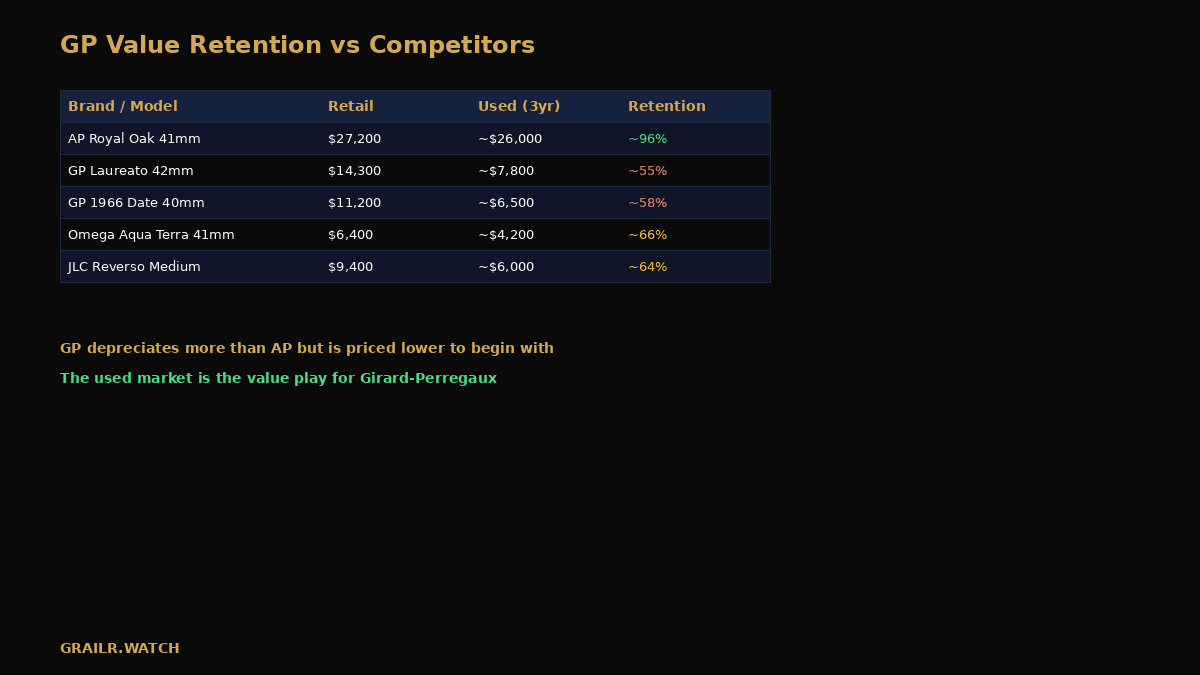
Girard-Perregaux sits in a complicated spot on the value-retention spectrum. The brand’s horological credentials are on a par with Patek Philippe and Audemars Piguet, but its secondary-market demand is substantially lower. For buyers, that gap is the entire opportunity: you get manufacture-grade watchmaking at pre-owned prices that look like a rounding error next to comparable AP or Patek references.
| Collection | Entry Retail | Pre-Owned Range | Approx. Retention |
|---|---|---|---|
| Laureato 42 mm Steel | $14,300 | $7,000–$8,500 | 50–60% |
| Laureato Fifty Steel | $23,100–$24,500 | $18,000–$21,000 | 78–86% |
| 1966 40 mm Steel | ~$10,500 | $5,000–$7,000 | 48–67% |
| Neo Bridges | ~$30,000 | $20,000–$28,000 | 67–93% |
| Cat’s Eye Steel | ~$12,000 | $6,000–$9,000 | 50–75% |
| Three Gold Bridges Tourbillon | $95,600+ | $60,000–$80,000 | 63–84% |
The pattern is clear: standard references lose 30–50% from retail, while limited editions and new releases hold tighter. If you are buying for enjoyment rather than appreciation, that depreciation curve is your best friend — unlike brands that hold value tightly, GP’s secondary prices let you own genuinely elite watchmaking without the elite price tag.
Use Grailr’s appraisal tool to check a specific reference against current asking prices before committing. The difference between a fair pre-owned price and an optimistic dealer listing can be several thousand dollars on a single Laureato.
Check Any Watch Price in Seconds
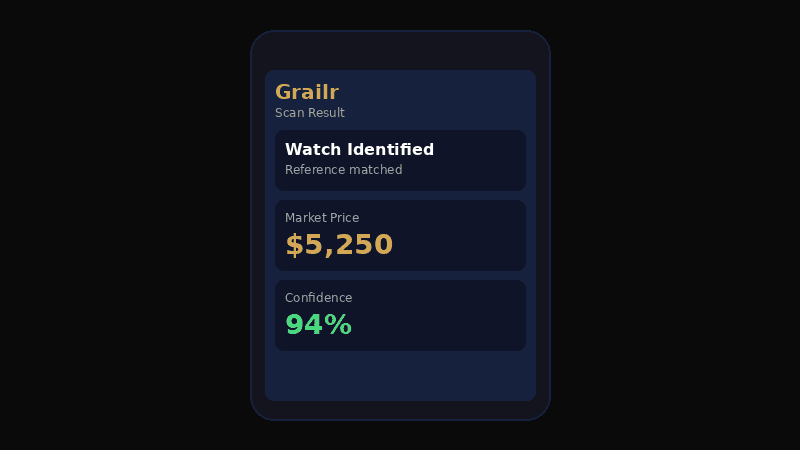
Grailr scans your watch photo and pulls live pricing from Chrono24, eBay, and Jomashop.
- AI identifies brand, model & reference number
- Live market prices from 3+ sources
- Authentication confidence score
Buying Used: What to Check
Pre-owned is where Girard-Perregaux makes the most financial sense, but it also carries the usual risks. Here is what to verify before you send the money.
| Check | What to Look For | Red Flag |
|---|---|---|
| Movement | Inspect through the exhibition caseback. GP movements have distinctive Côtes de Genève decoration and blued screws. | Generic finishing, misaligned engravings |
| Papers | Dated warranty card with matching serial number and reference. Limited editions should include “One of X” documentation. | Missing papers, mismatched serial |
| Bracelet / Clasp | Laureato bracelets stretch over time. Check for play in the links and clean deployment clasp operation. | Excessive play, missing links, aftermarket clasp |
| Case condition | Polished and brushed surfaces should still show defined edges. Light scratches are normal; deep gouges and rounded edges suggest heavy wear or poor polishing. | Rounded lugs, mixed finishes |
| Service history | Ask for receipts. GP recommends a full service every 4–5 years at approximately $600–$1,200 depending on complexity. | No service records on a 10+ year old watch |
Grailr’s identification tool can help confirm the reference number from a photograph, but it is not a substitute for a physical inspection by a qualified watchmaker. For a purchase above $10,000, consider requesting an independent condition report or buying from a dealer who offers a return period.
Reputable sources for pre-owned GP include Chrono24’s Trusted Seller programme, WatchBox (now 1916 Company), and authorized Girard-Perregaux retailers who carry certified pre-owned stock. Avoid private sellers who cannot provide full documentation.
Frequently Asked Questions
What is the cheapest new Girard-Perregaux you can buy?
The most affordable new GP models are the simpler 1966 references and the steel Laureato 38 mm, starting around $9,000 to $11,000 at retail depending on the dial and configuration.
Is Girard-Perregaux a good investment watch?
Most GP models lose 30 to 50 percent of their retail price on the secondary market, which makes them poor short-term investments but excellent used-market value. Limited editions like the Laureato F1 Aston Martin can hold or gain value when demand outstrips the production run.
What movement does Girard-Perregaux use?
GP manufactures its own movements. The Laureato uses the GP01800 automatic, the 1966 uses the GP03300, and the Bridges features the GP09400 and GP09600 tourbillon calibers. The brand has been making movements in-house since 1791.
How does Girard-Perregaux compare to Audemars Piguet?
Both are independent Swiss manufactures with signature integrated-bracelet sports watches. The AP Royal Oak starts around $22,000 and holds its value better on the secondary market. The GP Laureato starts at $14,300 retail but can be found pre-owned for $7,000 to $8,000, offering similar finishing and an in-house movement at a lower real-world cost.
Should I buy a Girard-Perregaux new or used?
For standard Laureato and 1966 references, buying pre-owned saves 30 to 50 percent and the watches run reliably for years between services. Buy new only for limited editions that may trade above retail, or if the full manufacturer warranty matters to you.
How often does a Girard-Perregaux need servicing?
Girard-Perregaux recommends a full service every four to five years. Use the brand’s own service centre or a watchmaker experienced with GP calibers, since the in-house movements require specific tooling and parts.
Related Articles
The Bottom Line
Girard-Perregaux is the insider’s brand. It lacks the name recognition of Rolex or AP, and its secondary-market prices reflect that — which is precisely why it deserves a place on your shortlist. You get a 230-year manufacture heritage, fully in-house movements, and finishing that competes with watches costing twice as much. The Laureato is the natural starting point, the 1966 is the quiet alternative, and the Bridges line is unlike anything else in watchmaking. Use Grailr’s appraisal to check the reference you’re considering, compare asking prices across dealers, and buy the one that makes sense for your wrist and your budget.
Sources and price context
- Girard-Perregaux Laureato collection — Official specifications, case dimensions and reference numbers for the current Laureato range.
- Chrono24 Laureato price listings — Current asking prices for new Girard-Perregaux Laureato references from verified dealers.
These primary sources support the specific specification and pricing points noted above. Prices and retention percentages elsewhere in this guide are indicative editorial figures, not a verified transaction dataset or guaranteed returns. Confirm the exact reference, region, condition and current quote before buying; asking prices are not completed-sale prices.