How to Demagnetize a Watch: Causes, Tests and Fixes
Why your mechanical watch suddenly runs fast, how to confirm it with a compass, and how to fix it in under sixty seconds with a $15 tool.
Product mentions in this guide are for reference. Verify current pricing and availability with the linked retailers before purchasing.

- A magnetized watch typically gains 20+ seconds per day because the hairspring coils stick together and shorten the oscillation cycle
- You can confirm magnetism in seconds by holding a small compass next to the case and watching for needle deflection
- A $10–$20 consumer demagnetizer fixes the problem at home in one pass with no risk of damage
- Modern antimagnetic watches with silicon hairsprings resist fields up to 15,000 gauss, making the issue irrelevant
- Magnetism does not cause permanent damage — once demagnetized, the watch returns to its original rate
What Magnetism Does to a Watch
Inside every mechanical watch, a hairspring oscillates back and forth at a precise frequency — typically 28,800 vibrations per hour (4 Hz) in a modern movement. The hairspring is a thin coil of metal alloy, often Nivarox or a proprietary alternative like Rolex’s Parachrom. When that coil passes through a magnetic field strong enough to magnetize its material, adjacent loops of the spring begin to attract each other.
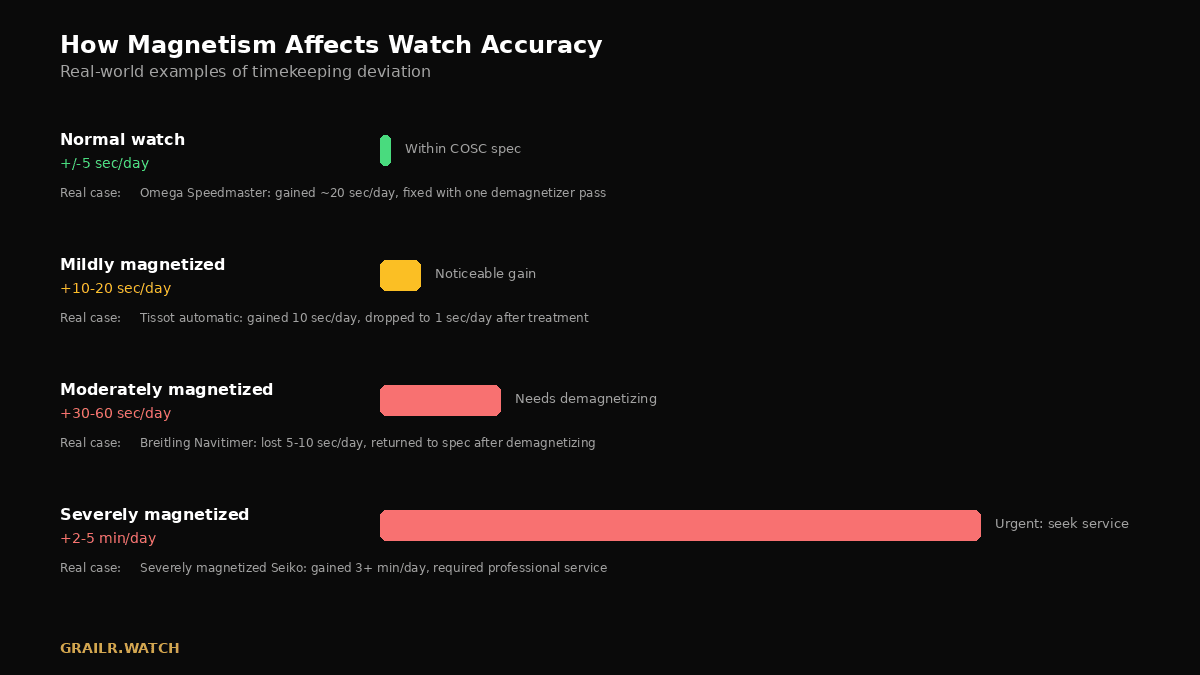
The effect is immediate and measurable. Coils that stick together shorten the spring’s effective length, which increases the oscillation frequency. A faster oscillation means the watch counts seconds too quickly — it runs fast. Mild magnetism might add 10–20 seconds per day. Severe magnetism can push a watch minutes ahead in a single day. A Speedmaster owner on a watch forum reported a gain of roughly 20 seconds per day after placing the watch on a laptop speaker overnight. A Tissot owner saw a 10–second daily gain drop to just 1 second after a single pass over a demagnetizer.
The good news: magnetism does not damage the movement. No parts are bent, worn, or permanently altered. Once you remove the residual magnetic field, the hairspring returns to its original behaviour and the watch keeps time normally again. This is one of the most common — and most easily reversible — accuracy problems in mechanical watchmaking.
Common Sources of Magnetism
Modern life puts magnets within arm’s reach more often than most people realize. The magnetic fields produced by everyday objects are measured in gauss. A typical refrigerator magnet produces about 50 gauss. A smartphone speaker generates roughly 50–100 gauss at close range. An Apple MagSafe charger generates well over 100 gauss at the surface. For context, most mechanical watches begin to magnetize at exposures above 50–60 gauss when the contact lasts more than a few seconds.

The biggest offenders are the objects you place a watch next to without thinking. Resting your wrist on a laptop keyboard puts the watch directly over the speaker magnets. Dropping a watch into a handbag with a magnetic clasp can expose the movement for hours. Setting a watch on a wireless charging pad or near an induction cooktop generates a sustained alternating field that magnetizes steel components even faster than a static magnet.
| Source | Approx. Field Strength | Risk Level | Typical Exposure |
|---|---|---|---|
| Smartphone speaker | 50–100 gauss | Moderate | Pocket, nightstand |
| MagSafe charger | 100–200+ gauss | High | Direct contact |
| Laptop speakers | 50–150 gauss | Moderate | Wrist resting on keyboard |
| Magnetic bag clasp | 50–200 gauss | High | Watch stored in bag |
| Induction cooktop | 300–500+ gauss | High | Cooking within 30 cm |
| Refrigerator magnet | ~50 gauss | Moderate | Brief contact |
| Magnetic tool holder | 200–500 gauss | High | Workshop storage |
| Airport metal detector | Low (brief pulse) | Low | Walk-through, seconds |
Airport walk-through detectors produce a brief, low-intensity pulse that rarely causes lasting magnetism. The conveyor-belt X-ray machine produces no magnetic field at all — it uses X-rays, not magnets. MRI machines are the extreme case at 15,000–30,000 gauss, but you should not be wearing a watch into an MRI for far more serious reasons than timekeeping.
How to Test for Magnetism
If your mechanical watch suddenly starts gaining 15 or more seconds per day and you haven’t recently dropped it or had it serviced, magnetism is the most likely cause. There are three ways to confirm it, ranked from simplest to most precise.
The Compass Test (Free)
Place a small compass on a flat surface, away from electronics. Hold your watch about 2–3 cm above the compass and slowly move it across. If the compass needle swings toward the watch, the movement is magnetized. The stronger the deflection, the more magnetized the watch. This test is reliable enough that most watchmakers use it as a first check before reaching for a Gauss meter. You can buy a button compass for under $3, or use a compass app on your phone held at a distance from the watch — though the phone’s own magnets can interfere.
The Timing Test (Free)
Set your watch to the exact second using a reference like time.is, then check it 24 hours later. A gain of 20 seconds or more, especially one that appeared suddenly, strongly suggests magnetism. A watch that has always run at +8 seconds per day and now runs at +45 did not develop a mechanical fault overnight — it walked past a magnet.
Gauss Meter (Professional)
A Gauss meter measures the residual magnetic field in milligauss or gauss. Professional watchmakers use bench-mounted units that combine a Gauss meter, a timing machine, and a demagnetizer in one device. For home use, this level of precision is unnecessary — the compass test is more than sufficient for a binary yes-or-no diagnosis.
Check Any Watch Price in Seconds
Grailr scans your watch photo and pulls live pricing from Chrono24, eBay, and Jomashop.
- AI identifies brand, model & reference number
- Live market prices from 3+ sources
- Authentication confidence score

How to Demagnetize: Step by Step
The most reliable method is a dedicated watch demagnetizer — a small device that generates a decaying alternating magnetic field, which gradually randomizes the alignment of magnetic domains in the steel components until the net field drops to zero. The process takes less than a minute and poses no risk to the movement.
Method 1: Consumer Demagnetizer ($10–$20)
This is the method recommended by Farer, the British watch brand, and the one used by most collectors at home. Here is the process:
- Place the demagnetizer on a flat, stable surface. Keep it at least 30 cm from other watches, phones, and magnetic media.
- Place your watch face-up approximately 1 cm above the top surface of the demagnetizer pad.
- Press and hold the power button. Most units light up or emit a faint hum.
- While holding the button, slowly lift the watch straight up, moving it away from the demagnetizer to a distance of about 30 cm. This gradual withdrawal is what makes the process work — the decaying field progressively reduces the magnetism.
- Release the button only after the watch is 30 cm away.
- Test with a compass. If the needle still deflects, repeat the cycle. Most watches clear on the first pass; heavily magnetized movements may need two or three.
The entire process takes 10–15 seconds per cycle. There is no upper limit on how many times you can repeat it safely. The device generates no heat and makes no contact with the watch, so there is zero risk to the case, crystal, or movement.
Method 2: Professional Watchmaker ($0–$20)
Most independent watchmakers will demagnetize your watch for free or for a nominal fee of $5–$20. They use the same principle but with a more powerful bench unit that can clear even severely magnetized movements in a single pass. Many also check the rate on a timing machine before and after, so you leave with confirmation that accuracy has returned to spec. If your watch is a high-value piece or if you’re uncomfortable working on it yourself, this is the safest and most reassuring option.
Method 3: Smartphone Apps (Not Recommended)
Several apps claim to demagnetize watches by generating an alternating magnetic field through the phone’s speaker coil. In theory, the principle is sound — the speaker is an electromagnet. In practice, the field strength is far too weak and poorly controlled to reliably demagnetize a movement. Worse, holding a phone against a watch to demagnetize it puts the phone’s own magnets in direct contact with the movement. This method is not recommended for any watch you value.

Demagnetizer Options Compared
The market ranges from pocket-sized consumer units to professional bench tools that combine demagnetization with rate measurement and Gauss testing. For most watch owners, the $10–$20 category is all you need. Here is how the options compare.
| Option | Cost | Effectiveness | Best For |
|---|---|---|---|
| Blue/white consumer unit | $10–$20 | High | Most collectors, 1–3 watches |
| Watchmaker visit | $0–$20 | High | Expensive or delicate pieces |
| OneOf Accuracy Boutique | $900–$1,500 | Very High | Watchmakers, serious hobbyists |
| Smartphone app | Free | Unreliable | Not recommended |
One note on the inexpensive consumer units: they are widely sold under generic brand names and look nearly identical regardless of seller. The blue rectangular units and the white cylindrical units both use the same principle — a coil that generates a decaying AC field when powered. A $13 unit performs the same function as a $20 one; the price difference usually comes down to packaging and included accessories like a carrying pouch.
Antimagnetic Watches That Skip the Problem
The watch industry has pursued antimagnetic solutions since the 1950s, but two modern approaches have made magnetism a non-issue for many buyers. The first is the Faraday cage — a soft iron inner case that shields the movement from external fields. The second and more elegant solution is building the movement itself from non-magnetic materials, primarily silicon hairsprings and nickel-phosphorus escapements, which cannot be magnetized in the first place.
Omega’s Master Chronometer certification, introduced with the Aqua Terra >15,000 Gauss in 2013, requires resistance to magnetic fields exceeding 15,000 gauss (1.5 tesla). That is roughly 300 times the strength of a MagSafe charger. The approach relies on silicon balance springs, non-magnetic escapement wheels, and careful material selection throughout the movement. Today, every Omega in the current catalogue carries Master Chronometer certification.
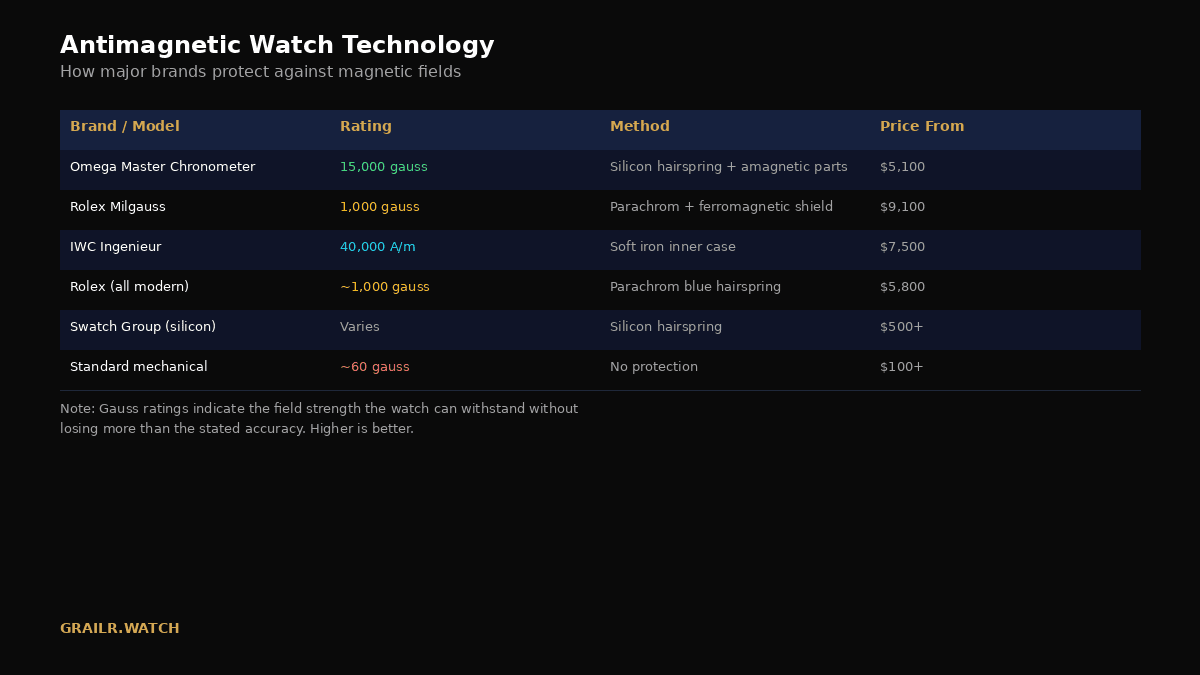
Rolex takes a different path. Its Milgauss, rated to 1,000 gauss, uses a ferromagnetic shield around the movement combined with the Parachrom blue hairspring, which is paramagnetic — highly resistant to magnetism, but not technically zero. Across the rest of the Rolex lineup, the Parachrom hairspring provides meaningful resistance (the brand claims up to 10 times more than conventional hairsprings) without a dedicated shield, but it does not match the 15,000-gauss rating of an Omega Master Chronometer.
Other notable antimagnetic approaches include the IWC Ingenieur, which historically used a soft iron inner case to shield the movement, and Tudor’s METAS-certified models like the Pelagos 39 and the new Northflag GMT, which use silicon balance springs in their Master Chronometer movements. Swatch Group supplies silicon hairsprings across many of its brands, including Tissot, Longines, and Hamilton, progressively filtering antimagnetic technology down to watches under $1,000.
If magnetism is a recurring concern — perhaps because you work around strong magnets or magnetic equipment — an antimagnetic watch removes the problem entirely. Our Omega Seamaster buying guide covers the full Master Chronometer lineup, and the watches that hold value guide includes several antimagnetic options with strong resale.
How to Prevent Magnetism
Prevention is simpler than the cure, and it costs nothing. The key principle is distance: magnetic field strength drops off with the cube of the distance, which means even a few centimetres of separation dramatically reduces exposure.
- Phone distance: keep your watch at least 5 cm from your phone. Avoid placing them on the same nightstand surface, and never rest a watch directly on a MagSafe charger.
- Laptop awareness: if you rest your wrist on the keyboard while typing, you are placing the watch directly over the laptop’s speaker magnets. Remove the watch or move it to the other wrist.
- Bag storage: never toss a watch into a bag with a magnetic clasp. Use a dedicated watch pouch or roll that keeps the timepiece separated from magnetic closures.
- Kitchen caution: remove your watch before cooking on an induction hob. The alternating magnetic field is strong enough to magnetize a movement from 30 cm away.
- Storage box: store watches in a wooden or leather box, not on top of electronics or near magnetic tools. A watch winder keeps automatic movements running and also provides a dedicated, magnetically neutral resting spot.
If you also maintain your own watches at home, our guide to winding a manual watch covers the other essential handling skill — proper crown technique that protects the keyless works and mainspring.
Frequently Asked Questions
How do I know if my watch is magnetized?
Can a magnetized watch damage the movement?
How much does a watch demagnetizer cost?
Will a phone magnetize my watch?
Do quartz watches get magnetized?
Are silicon hairspring watches immune to magnetism?
Related Guides
How to Wind a Manual Watch
Step-by-step crown technique for manual-wind movements.
Omega Seamaster Buying Guide
Every Seamaster model compared with Master Chronometer specs.
Citizen Eco-Drive Guide
Solar-powered movements that skip magnetism concerns entirely.
Watches That Hold Value
Which brands and models retain the most on resale.
The Bottom Line
A magnetized watch is one of the most common mechanical watch problems and, fortunately, one of the easiest to fix. A $15 demagnetizer and a compass are all you need to diagnose and resolve the issue at home in under a minute. For watches you care about deeply, a quick visit to a watchmaker costs next to nothing and gives you professional confirmation that the rate has returned to spec.
If magnetism is a recurring problem because of your environment or habits, consider an antimagnetic watch with a silicon hairspring — Omega’s Master Chronometer lineup, Tudor’s METAS-certified models, or even a Citizen Eco-Drive that bypasses the problem entirely with a quartz movement. Either way, magnetism is a solved problem — not a reason to worry about wearing your watch in the modern world.
Not Sure What Your Watch Is Worth?
Snap a photo and Grailr identifies the brand, model, and reference — then pulls live market prices so you know where you stand.
Scan Your Watch