IWC Schaffhausen Watches: Every Collection
Portugieser, Pilot’s Watches, Portofino and Ingenieur compared — with in-house movement specs, real pricing and resale data for 2026.
Price context: this guide includes indicative prices from its original publication period. They have not all been refreshed to current quotes. Use the linked primary sources for specifications and policies, and verify prices independently.

- IWC entry prices start at $4,700 (Portofino 34) and climb past $50,000 for precious-metal Portugiesers
- The in-house 69000 chronograph and 52000 automatic families power the flagship Portugieser and Big Pilot lines
- Resale retention ranges from 50–60% on Portofino to 70–85% on Big Pilot and Portugieser Chronograph
- Every IWC is built in one Schaffhausen facility — the only major Swiss brand concentrated in a single city
A Brief History of IWC Schaffhausen
IWC — International Watch Company — was founded in 1868 by Florentine Ariosto Jones, an American watchmaker from Boston who moved to Switzerland to combine American manufacturing efficiency with Swiss craftsmanship. He chose Schaffhausen, a small city on the Rhine in northeastern Switzerland, partly because its hydroelectric power could drive factory machinery. That decision defined the brand: more than 150 years later, every IWC watch is still built in that same city.
The early decades produced pocket watches for the American market. The first wristwatches appeared in the early 1900s. By the 1930s IWC had established the two design pillars it still stands on: the Special Pilot’s Watch (1936), a 55mm instrument built for military aviators, and the Portugieser (1939), a large, slim dress watch commissioned by two Portuguese merchants who wanted marine-chronometer accuracy in a wristwatch.
The Ingenieur arrived in 1955 with a soft-iron inner case to resist magnetic fields — the same principle Rolex later used in the Milgauss. The Portofino line launched in 1984 as a slim, elegant dress watch inspired by the Italian Riviera. Since 2000 IWC has belonged to Richemont, the luxury group that also owns Jaeger-LeCoultre, Cartier and A. Lange & Söhne.
Today IWC operates four active collections and maintains a dedicated movement manufacture in Schaffhausen for its in-house calibers. The brand occupies a distinctive space in the Swiss hierarchy: positioned alongside Omega, Breitling and Panerai by price, but with a design language that skews toward larger case sizes, cleaner dials and understated engineering. If you value legibility, case finishing and chronograph complications, IWC deserves a close look.
Portugieser: The Flagship Collection
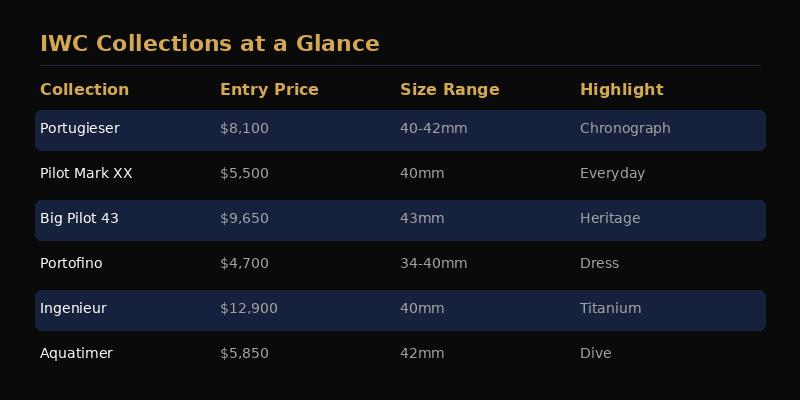
The Portugieser is IWC’s most recognizable and commercially important collection. Its defining features are a large, slim case (typically 40–42mm), thin applied indices, leaf-shaped or lance hands, and a railway-track minute chapter ring. The design has barely changed since 1939, and that visual continuity is a large part of its appeal.
The Portugieser Chronograph (ref. IW371605 in steel/blue dial, IW371609 in steel/silver dial) is the bestseller. It runs the in-house caliber 69355, a column-wheel chronograph with 46 hours of power reserve. At 41mm with a slim 13.1mm thickness, it wears like a dress watch that happens to time events. Retail starts at approximately $9,250 in stainless steel.
The Portugieser Automatic 40 (ref. IW358305) is the time-and-date entry point at around $8,100. It uses the caliber 82200, an in-house movement with Pellaton winding and a 60-hour power reserve. For collectors who want the Portugieser look without a chronograph, this is where to start.
Higher up the range, the Portugieser Perpetual Calendar in steel lists near $16,500 and runs the cal. 52615 with a seven-day power reserve and moon-phase display accurate to 577.5 years. In 18k red gold, the same watch crosses $30,000. The full Portugieser range on IWC’s site now includes a Minute Repeater and Tourbillon for collectors at the top end.
At Watches & Wonders 2026, IWC debuted the Portugieser Chronograph Ceratanium, a 1,500-piece limited edition in IWC’s proprietary ceramic-titanium alloy. It is the first fully blacked-out Portugieser and signals IWC’s push to bring advanced materials into the dress-watch space.
Pilot’s Watches: From Mark XX to Big Pilot
IWC’s aviation line is the broadest collection and the most accessible by price. It spans from the workhorse Mark XX at around $5,500 to the Big Pilot 43 at approximately $9,300 and specialty Le Petit Prince editions above that.
The Mark XX (ref. IW328203) is IWC’s entry-level steel watch. It runs the caliber 32111 (based on Sellita SW300 architecture, finished and regulated by IWC) with a 72-hour power reserve, date window, and soft-iron inner case for magnetic protection. At 40mm it wears comfortably on most wrists and has become the standard recommendation for buyers entering the brand.
The Big Pilot 43 (ref. IW329301) is the modern interpretation of the original 1940 Grosse Fliegeruhr. It uses the in-house caliber 82100 with Pellaton winding and a 60-hour power reserve. The oversized crown — originally designed for use with flight gloves — is instantly recognizable. The 43mm case makes it one of the smaller Big Pilots in history (earlier references measured 46mm), which has broadened its appeal considerably.
The Pilot’s Watch Chronograph 41 (ref. IW388103) bridges the gap at approximately $6,500 with the in-house 69385 chronograph movement. It is the most affordable IWC with an in-house chronograph, making it a strong alternative to the Portugieser Chrono for buyers who prefer a sportier aesthetic.
At Watches & Wonders 2026, IWC expanded the Le Petit Prince collection into the Pilot line with a white zirconium oxide ceramic Chronograph 41 (ref. IW389410) and a Mark XX in 18k 5N gold with a sunray blue dial. These limited and precious-metal editions tend to hold secondary-market value better than steel equivalents.
Portofino: IWC’s Dress Watch Line
Named after the Italian fishing village, the Portofino line is IWC’s thinnest and most affordable collection. It is designed as a pure dress watch — slim profile, clean dial, and proportions that work under a shirt cuff.
The Portofino Automatic 40 (ref. IW356523) starts at approximately $5,350 and runs the caliber 35111 with a 72-hour power reserve. At 40mm by 10.8mm, it is the slimmest IWC currently in production. Available in silver, blue and green dials with a Milanese mesh or leather strap.
The Portofino Automatic 34 (ref. IW357415) brings the price down to around $4,700 and targets smaller wrists. It uses the same 35111 caliber and comes in steel with diamond-set bezel options available. For 2026, IWC added a Portofino Automatic Day & Night 34 Le Petit Prince (ref. IW459806) — the first time the Le Petit Prince theme has appeared outside the Pilot’s Watches family.
The Portofino Chronograph 39 (ref. IW391502) at approximately $6,750 gives you an IWC chronograph in a compact dress-watch package, though it uses a Sellita-based caliber rather than IWC’s in-house 69000 family. If the movement provenance matters to you, step up to the Pilot’s Watch Chronograph 41 for a fully in-house alternative at a comparable price.
Ingenieur: The Engineer’s Watch
The Ingenieur is IWC’s luxury sports watch, occupying the same niche as the Royal Oak, Nautilus and Overseas. It debuted in 1955 with a soft-iron inner case to protect the movement from magnetic fields — a practical engineering solution that gave the collection its name.
The current Ingenieur Automatic 40 (ref. IW328901) runs the in-house caliber 32113 with 120 hours of power reserve, making it the longest-running non-complication in IWC’s lineup. At 40mm with an integrated bracelet in titanium or steel, it has the kind of proportioned restraint that the market has rewarded in competitors.
Retail starts at approximately $12,900 in steel, which positions it above the Portugieser Chronograph and directly against the Vacheron Constantin Overseas and Audemars Piguet Royal Oak in concept (though well below them in price). The titanium version (ref. IW328903) lists near $14,100 and saves roughly 30 grams on the wrist.
The Ingenieur has historically been the least commercially visible IWC collection, partly because earlier redesigns moved it away from the original Gérald Genta design language. The current generation returned to the five-bolt bezel and clean integrated-bracelet look, and secondary-market demand has responded accordingly. If you like the concept of a luxury sports watch but find the Royal Oak and Nautilus out of reach at $20,000+, the Ingenieur deserves a serious look.
In-House Movements Explained
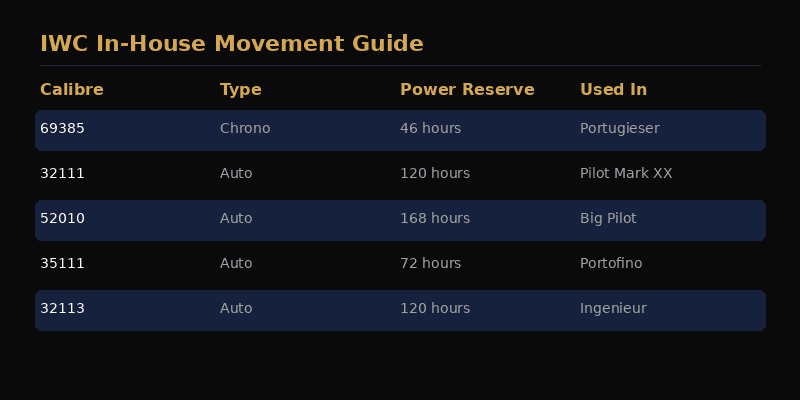
IWC operates a dedicated movement manufacture in Schaffhausen for its in-house calibers. The brand uses three main movement families alongside Sellita-based calibers for its entry-level pieces. Here is how they break down:
| Caliber Family | Type | Power Reserve | Used In |
|---|---|---|---|
| 69000 | Column-wheel chrono | 46 hours | Portugieser Chrono, Pilot Chrono 41 |
| 52000 | Automatic, Pellaton | 168 hours (7 days) | Portugieser Perpetual Calendar, Annual Cal. |
| 82000 | Automatic, Pellaton | 60 hours | Portugieser Auto 40, Big Pilot 43 |
| 32111 (Sellita) | Automatic | 72 hours | Mark XX, Pilot Auto 36 |
| 35111 (Sellita) | Automatic | 72 hours | Portofino Auto 34, Portofino Auto 40 |
The Pellaton winding system, used in the 52000 and 82000 families, is IWC’s signature automatic winding mechanism. It uses two pawls made from zirconium oxide ceramic that wind the mainspring in both directions of rotor travel. The ceramic components are virtually wear-free, which theoretically extends the service interval compared to conventional lever-winding systems. IWC recommends a full service every eight years for Pellaton-equipped movements, compared to five years for most competitors.
Pricing and Resale Across Collections
IWC’s pricing spans a wide range. The table below shows the entry point for each collection and what you can expect on the secondary market via Chrono24 for key references. Pre-owned prices reflect asking prices for complete sets in excellent condition, not completed sales.
| Model | Size | Retail | Pre-Owned | Retention |
|---|---|---|---|---|
| Portofino Auto 34 | 34mm | $4,700 | $2,600 | 55% |
| Portofino Auto 40 | 40mm | $5,350 | $3,000 | 56% |
| Pilot Mark XX | 40mm | $5,500 | $3,850 | 70% |
| Pilot Chrono 41 | 41mm | $6,500 | $4,500 | 69% |
| Portugieser Auto 40 | 40mm | $8,100 | $5,500 | 68% |
| Portugieser Chrono | 41mm | $9,250 | $7,000 | 76% |
| Big Pilot 43 | 43mm | $9,300 | $7,200 | 77% |
| Ingenieur Auto 40 | 40mm | $12,900 | $10,100 | 78% |
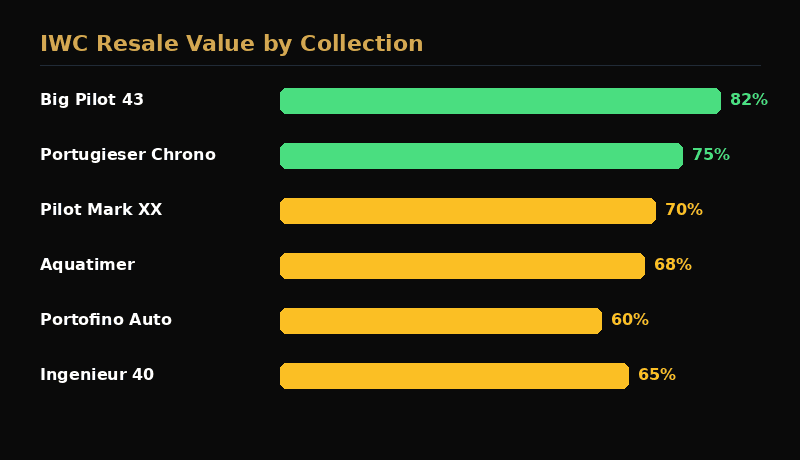
The pattern is clear: in-house movements and iconic designs hold value better. The Portugieser Chronograph and Big Pilot 43 sit above 75% retention because they are IWC’s most recognizable references with the strongest secondary demand. The Portofino line, while excellent as a dress watch, sees steeper depreciation because its Sellita-based movements and understated design attract fewer collectors. If resale matters to you, the Pilot’s Watch Chronograph 41 offers the best balance — in-house chronograph movement at the lowest price point in the lineup. Use Grailr’s scanner to check current asking prices before committing to any pre-owned purchase.
Check Any Watch Price in Seconds
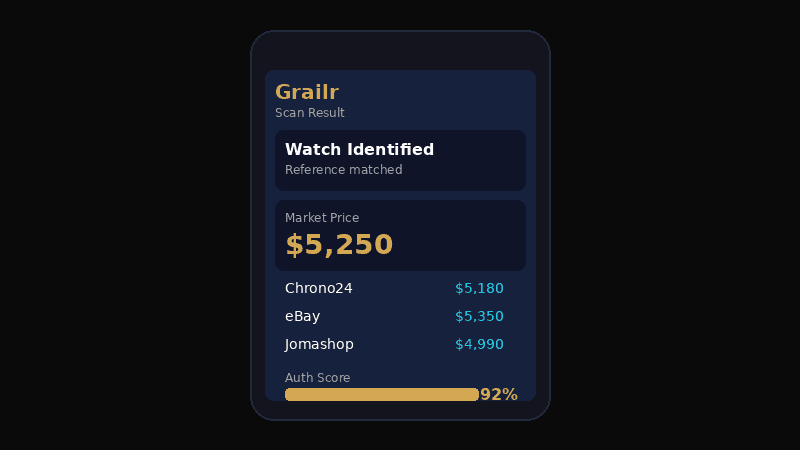
Grailr scans your watch photo and pulls live pricing from Chrono24, eBay, and Jomashop.
- AI identifies brand, model & reference number
- Live market prices from 3+ sources
- Authentication confidence score
Which IWC Should You Buy First?
Best Overall First IWC
Pilot Mark XX — $5,500
IWC’s sweet spot: strong heritage, 72-hour power reserve, 40mm versatile sizing, and the brand’s best bang for the dollar with 70% resale retention.
Best Value Entry
Portofino Auto 40 — $5,350
The thinnest IWC in production. Ideal for smaller wrists or buyers who want an understated dress watch from a serious manufacture.
Best for Collectors
Portugieser Chronograph — $9,250
IWC’s signature watch with an in-house column-wheel chronograph, 76% retention, and a design that has defined the brand for over 80 years.
Best Luxury Sport Watch
Ingenieur Auto 40 — $12,900
The closest thing to a Royal Oak at half the price. In-house movement, 120-hour reserve, integrated bracelet, and 78% secondary-market retention.
How IWC Compares to Competitors
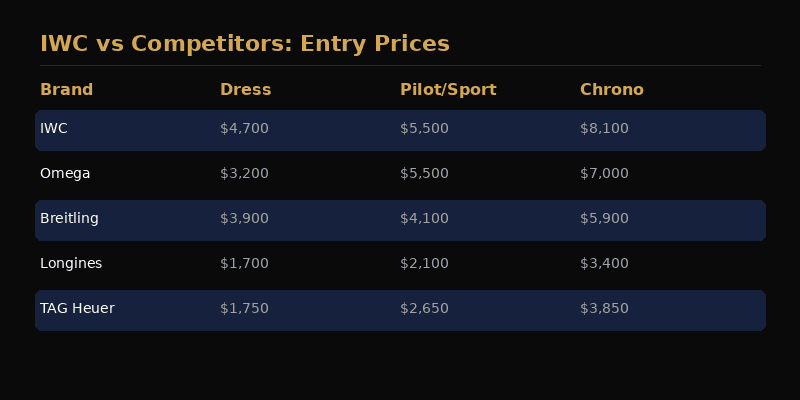
IWC shares shelf space with Omega, Breitling, Panerai and Tudor in the $5,000–$15,000 bracket. Each has a distinct identity. Omega offers stronger brand recognition and METAS certification. Breitling skews toward bold chronographs and aviation heritage. Panerai owns the cushion-case tool-watch niche. Tudor punches below its weight with in-house movements at lower price points.
IWC’s advantage is in its dress-watch complications. No competitor at this price point offers a seven-day perpetual calendar (Portugieser), a 120-hour integrated-bracelet sport watch (Ingenieur), or a column-wheel chronograph as thin as the Portugieser Chrono. The trade-off is resale: Omega Speedmasters and Rolex sport models generally hold value better, and IWC’s brand recognition outside watch circles is lower.
If you plan to appraise a watch before buying pre-owned, start with the Portugieser Chronograph or Big Pilot — both have strong enough secondary demand that fair-market pricing is easy to benchmark.
Frequently Asked Questions
What is the cheapest IWC watch you can buy new?
The Portofino Automatic 34 starts at around $4,700, making it the most affordable current-production IWC. For men's sizing, the Portofino Automatic 40 begins at approximately $5,350.
Are IWC watches in-house movements?
IWC uses a mix. The Portugieser Chronograph (cal. 69355), Big Pilot (cal. 52010), and Ingenieur use fully in-house movements. The Portofino and Mark XX use movements based on Sellita SW300 architecture, finished and regulated by IWC.
Do IWC watches hold their value?
IWC watches retain roughly 55-80% of retail depending on model. The Portugieser Chronograph and Big Pilot hold best at 70-85%. Entry-level Portofino models see more depreciation at 50-60%.
Is IWC better than Omega?
They serve different niches. IWC offers larger case sizes, Portuguese-inspired dress complications and aviation heritage. Omega delivers stronger brand recognition, better resale on sport models, and METAS certification. Both sit in the same $5,000-$15,000 bracket for most steel pieces.
What is the most popular IWC watch?
The Portugieser Chronograph (ref. IW371605 and IW371609) is IWC's bestseller and most recognizable design, followed closely by the Pilot's Watch Mark XX and the Big Pilot 43.
Where are IWC watches made?
All IWC watches are manufactured in Schaffhausen, Switzerland. The brand operates a single facility covering movement production, casing, testing and quality control. IWC also runs a dedicated movement factory in the same city for its in-house calibers.
Related Articles
The Bottom Line
IWC Schaffhausen makes watches for people who value engineering legibility over jewellery-grade finishing. The Portugieser Chronograph is the brand’s masterpiece and the strongest buy for collectors. The Mark XX is the logical entry point. The Ingenieur is the sleeper pick — a luxury sports watch with an in-house movement at a fraction of what Audemars Piguet or Patek Philippe charge for the same concept. Whatever you choose, you’re buying a watch built entirely in one Swiss city by a brand that has been doing this since 1868. That is not nothing.
Sources and price context
- IWC Portugieser collection page — Official specifications, caliber details and current retail pricing for every Portugieser reference.
- IWC watches on Chrono24 — Secondary-market listings used to benchmark pre-owned asking prices in this guide.
These primary sources support the specific specification and pricing points noted above. Prices and resale percentages elsewhere in this guide are indicative editorial figures, not a verified transaction dataset or guaranteed returns. Confirm the exact reference, region, condition and current quote before buying; asking prices are not completed-sale prices.