Omega Dark Side of the Moon: Models and Prices
Every variant of Omega’s all-ceramic Speedmaster — from the 2013 original that pioneered a fully black ceramic case to the 2026 Apollo 8 with its laser-ablated lunar caseback — with real retail and pre-owned prices.
By Grailr Watch Intelligence • October 2026 • 14 min read
Prices in this guide are indicative retail and asking prices gathered from authorized dealers, Chrono24, and manufacturer listings as of October 2026. They are not verified completed-sale prices and do not constitute an appraisal.
Key Takeaways
- The Dark Side of the Moon was the first watch with an entirely black ceramic case and bezel when it launched in 2013, and it remains one of the few full-ceramic chronographs at any price
- Current 2024–2026 models run the Caliber 3869 — a hand-wound Co-Axial Master Chronometer certified by METAS for 15,000-gauss magnetic resistance and 0/+5 sec/day accuracy
- Retail ranges from €12,000 to €15,900 (~$12,000–$15,900 USD) depending on variant; the Apollo 8 edition tops the range at ~$14,300
- Pre-owned original DSOTM models (Cal. 9300) trade at $7,000–$10,000, representing 58–83% retention against their original retail — strong for a non-Rolex sport watch
What Is the Dark Side of the Moon Collection
The Omega Speedmaster Dark Side of the Moon — universally abbreviated to DSOTM — is a family of 44.25 mm chronographs built entirely from zirconium oxide (ZrO₂) ceramic. Omega introduced the original in January 2013 at SIHH, and it was genuinely revolutionary: no Swiss manufacturer had produced a watch with a case, bezel, crown, and pushers all machined from a single ceramic material. The result was a Speedmaster that could not be scratched by anything short of diamond and would never fade, tarnish, or develop the micro-abrasions that dull a steel case within months of daily wear.
The collection’s name is a nod to the Speedmaster’s lunar heritage. The original Speedmaster Professional was the first watch worn on the Moon during Apollo 11 in 1969, and it has remained on NASA’s flight-qualified equipment list ever since. The “dark side” refers not to darkness but to the far side of the Moon — the hemisphere permanently facing away from Earth, first seen by human eyes during Apollo 8 in December 1968. Our Omega Speedmaster guide covers the full Moonwatch timeline if you want the broader history.
What made the DSOTM significant beyond its material was the statement it represented. In 2013 ceramic watches existed — Rado had been using ceramic since 1986, and Chanel’s J12 was well established — but nobody had built a chronograph this complex entirely from the material. Ceramic is extremely hard (1,200–1,500 Vickers, versus 180–220 for 316L steel) but also brittle: machining pusher pins, crown threads, and case flanges from it requires tooling and tolerances that most manufacturers were unwilling to attempt. Omega solved this by sintering the ZrO₂ powder at over 1,500°C and then machining each component individually, a process that takes roughly five times longer than milling the same part from steel.
The collection has expanded steadily since 2013. Omega has released variants in grey ceramic (the “Grey Side of the Moon”), with rose-gold accents (the “Sedna Black”), with heavy lume application (the “Pitch Black”), with faux-patina indices (the “Vintage Black”), and with a laser-ablated lunar caseback depicting the far side of the Moon (the Apollo 8 edition). Through all of them, the 44.25 mm black ceramic case and 50 m water resistance have remained constants.
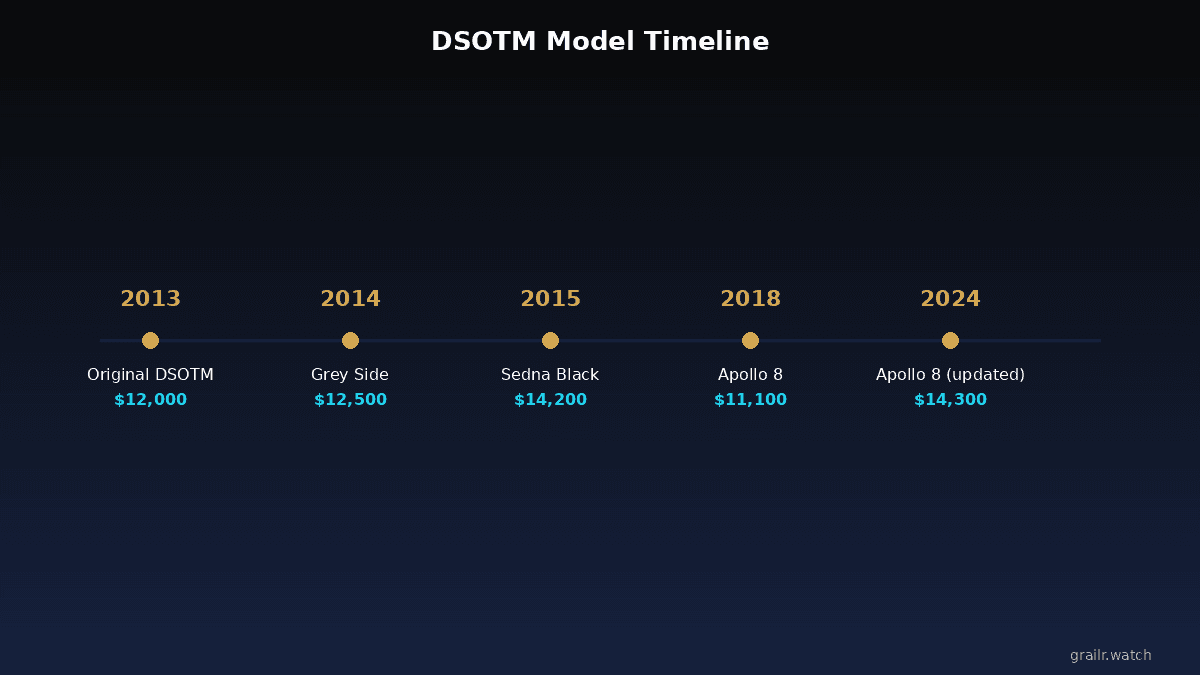
Illustration: DSOTM model timeline from the 2013 original to the 2026 Apollo 8 update
Every DSOTM Model from 2013 to 2026
Omega has released over a dozen DSOTM references across thirteen years. The table below covers every major variant, from the original “Black Black” to the current Apollo 8 production models. For a deeper look at how the DSOTM fits into the broader Speedmaster family, see our First Omega in Space guide.
| Model | Year | Caliber | Distinguishing Feature |
|---|---|---|---|
| DSOTM “Black Black” | 2013 | 9300 (auto) | Original: all-black ceramic, matte dial, first of its kind |
| Grey Side of the Moon | 2014 | 9300 (auto) | Grey ceramic case with sandblasted lunar-surface texture |
| DSOTM Sedna Black | 2014 | 9300 (auto) | 18K Sedna (rose) gold accents on bezel, hands, indices |
| DSOTM Pitch Black | 2015 | 9300 (auto) | Heavy Super-LumiNova on dial, hands, and bezel; glows bright green |
| DSOTM Vintage Black | 2016 | 9300 (auto) | Faux-patina Old Radium lume for a vintage aesthetic |
| Apollo 8 (original) | 2018 | 1869 (manual) | Laser-ablated caseback showing the Moon’s far side; skeletonised dial |
| DSOTM “Black Black” (updated) | 2024 | 3869 (manual) | Master Chronometer upgrade, Saturn V small-seconds hand in Grade 5 titanium |
| Apollo 8 (current) | 2024 | 3869 (manual) | Updated caliber with METAS certification; ref. 310.92.44.50.01.001 |
The most notable shift in the collection’s history came in 2024 when Omega transitioned the DSOTM from the Cal. 9300 automatic chronograph to the Cal. 3869 — a hand-wound movement derived from the Cal. 3861 used in the standard Moonwatch. This moved the DSOTM from a self-winding watch to a manual-wind piece, which some collectors saw as a purist upgrade (the original 1969 Moonwatch was hand-wound) and others found inconvenient. The trade-off: the 3869 carries METAS Master Chronometer certification, meaning each individual watch is tested for accuracy, magnetic resistance, and water resistance after full assembly — a standard the 9300-era DSOTM never met.
The 2024 models also introduced a patent-pending small-seconds hand shaped like the Saturn V rocket, machined from Grade 5 titanium. It is a small detail that photographs well and signals to other collectors that you are wearing a current-production DSOTM rather than an earlier reference.
A note on the MoonSwatch “Mission to the Moon”: Swatch and Omega’s 2022 collaboration produced eleven planet-themed bioceramic watches at $260 each, including a Moon variant in black and grey. It shares the Speedmaster dial layout and Moon branding, but it is a quartz watch in a plastic-ceramic blend — not a mechanical chronograph, and not zirconium oxide ceramic. It is an entirely separate product from the DSOTM collection discussed in this guide. If you are considering one as an entry point, it is a fun watch at $260, but it has no material or mechanical connection to the DSOTM and should not be confused with it. For context on limited-edition Speedmasters that do hold collector value, see our Silver Snoopy Award guide.
Specifications and Pricing
Every DSOTM shares the same 44.25 mm case diameter and 50 m water resistance, but the movements, dial treatments, and pricing vary considerably across generations. The table below compares the core specifications and both retail and pre-owned asking prices for the most traded variants.
| Model | Movement | PR | Retail | Pre-Owned |
|---|---|---|---|---|
| DSOTM Black Black (2013) | Cal. 9300 auto | 60h | ~$12,000 | $7,000–$9,500 |
| Grey Side of the Moon | Cal. 9300 auto | 60h | ~$12,600 | $6,700–$16,300 |
| Sedna Black | Cal. 9300 auto | 60h | ~$13,500 | $8,500–$11,000 |
| Pitch Black | Cal. 9300 auto | 60h | ~$12,000 | $7,500–$10,000 |
| Vintage Black | Cal. 9300 auto | 60h | ~$12,000 | $7,000–$9,000 |
| Apollo 8 (2018) | Cal. 1869 manual | 48h | ~$9,250 | $9,000–$11,000 |
| DSOTM Black Black (2024) | Cal. 3869 manual | 50h | €12,000 | $10,000–$12,000 |
| Apollo 8 (2024) | Cal. 3869 manual | 50h | ~$14,300 | $11,000–$13,000 |
Retail prices are from Omega’s published price lists and authorized dealer listings. Pre-owned ranges are asking prices from Chrono24 and dealer inventory as of October 2026 — not verified completed sales. The Grey Side’s wide pre-owned spread reflects the many variants and limited editions within that sub-family.
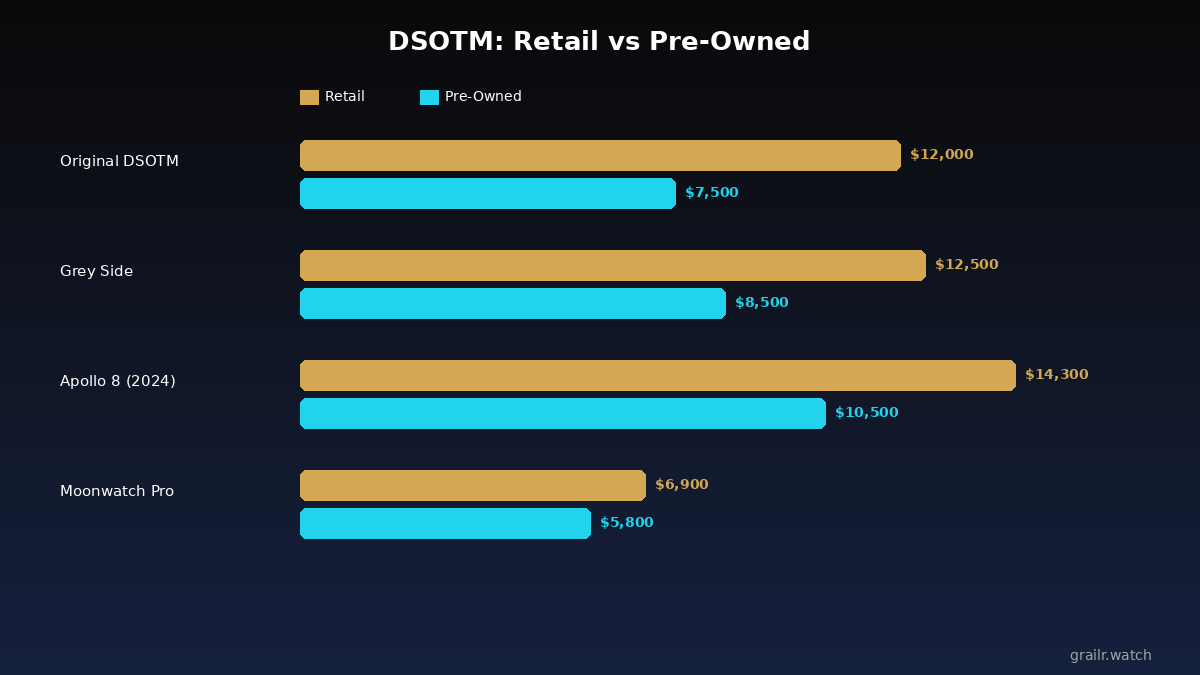
Illustration: retail vs pre-owned asking prices across the DSOTM family
Caliber 9300 vs Caliber 3869
The movement swap is the most significant technical change in the DSOTM’s history. The Cal. 9300 is an automatic (self-winding) chronograph with a column wheel, two barrels producing 60 hours of power reserve, and Omega’s Co-Axial escapement. It is a proven, well-regarded movement that powered the DSOTM for a decade. Its silicon balance spring provides reasonable magnetic resistance, though it was never formally METAS-certified.
The Cal. 3869 is a different animal. It is hand-wound, meaning you must wind it daily or every other day (50-hour power reserve). In return you get full METAS Master Chronometer certification: tested to 15,000 gauss, 0/+5 seconds per day accuracy after exposure to that magnetic field, and water resistance verified after the complete watch is assembled. The Co-Axial escapement with silicon balance spring carries over, but the certification standard is meaningfully higher. For a detailed breakdown of Co-Axial technology and the 3861 family of movements, our Speedmaster guide covers the technical fundamentals.
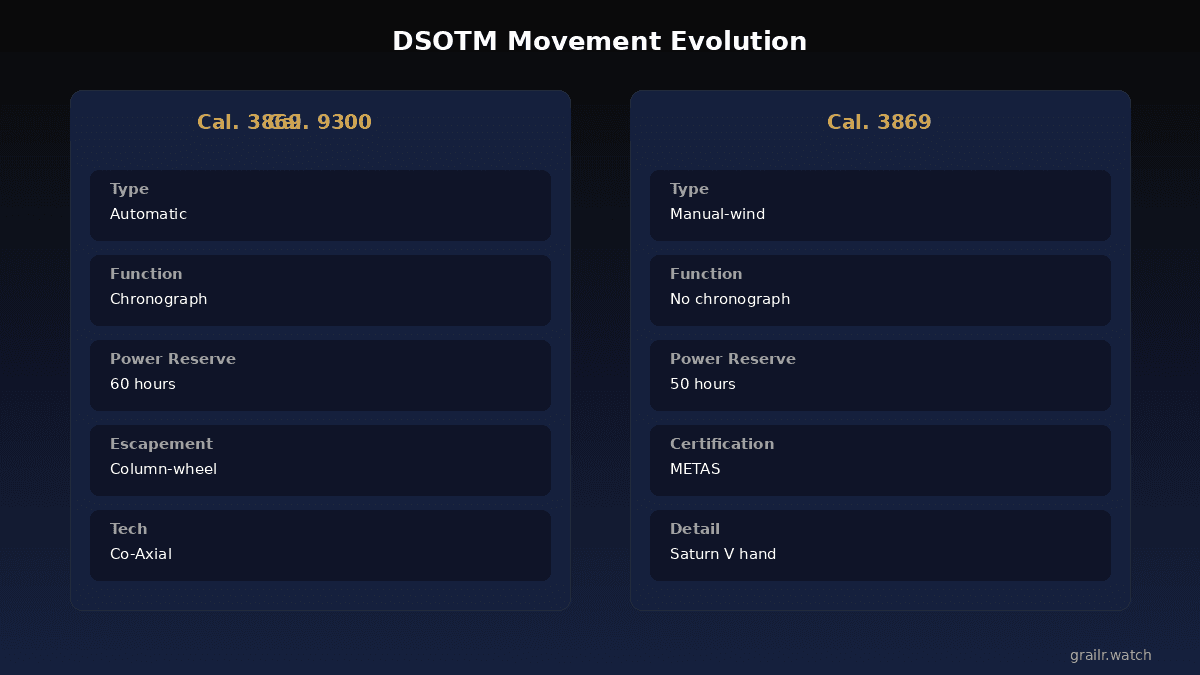
Illustration: Cal. 9300 (automatic, 60h PR) vs Cal. 3869 (manual, 50h PR, METAS-certified)
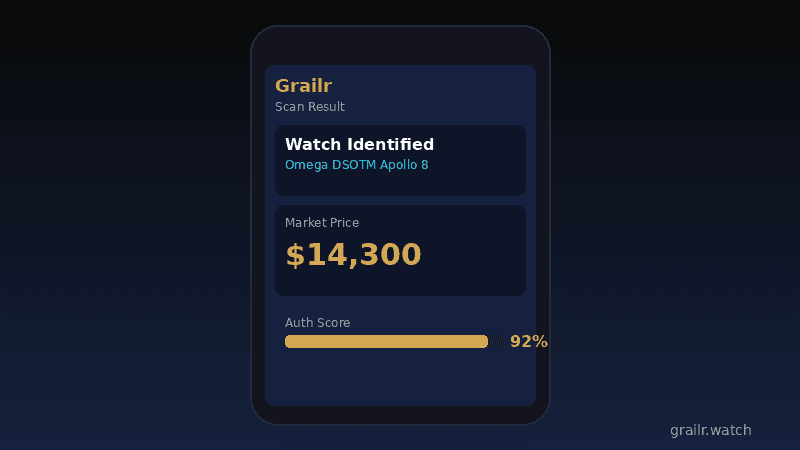
Check Any Watch Price in Seconds
Grailr scans your watch photo and pulls live pricing from Chrono24, eBay, and Jomashop.
- AI identifies brand, model & reference number
- Live market prices from 3+ sources
- Authentication confidence score
How the DSOTM Holds Value
The DSOTM occupies an interesting position in the secondary market. It is not a Rolex-level appreciator — no Omega is, with the exception of certain Speedmaster limited editions like the Silver Snoopy Award — but it holds value better than most Omega sport watches. Original 2013 DSOTM models that retailed around $12,000 now trade between $7,000 and $9,500 on major platforms, representing 58–79% retention after more than a decade. For a non-precious-metal chronograph, that is strong.
The Apollo 8 edition has been the strongest performer. Its laser-ablated caseback — a detailed topographical rendering of the Moon’s far side, visible through the skeletonised dial — gives it a visual distinction that other DSOTM variants lack. The 2018 Apollo 8 launched at approximately $9,250 and now trades between $9,000 and $11,000, meaning many examples have held or exceeded their original retail price. The updated 2024 Apollo 8 with Cal. 3869 retails at ~$14,300 and has not yet seen significant depreciation on the secondary market.
The Sedna Black also performs well. Its 18K Sedna gold accents give it precious-metal appeal at a fraction of a full-gold Speedmaster’s cost. Pre-owned examples trade between $8,500 and $11,000 against an original retail of approximately $13,500 — roughly 63–81% retention.
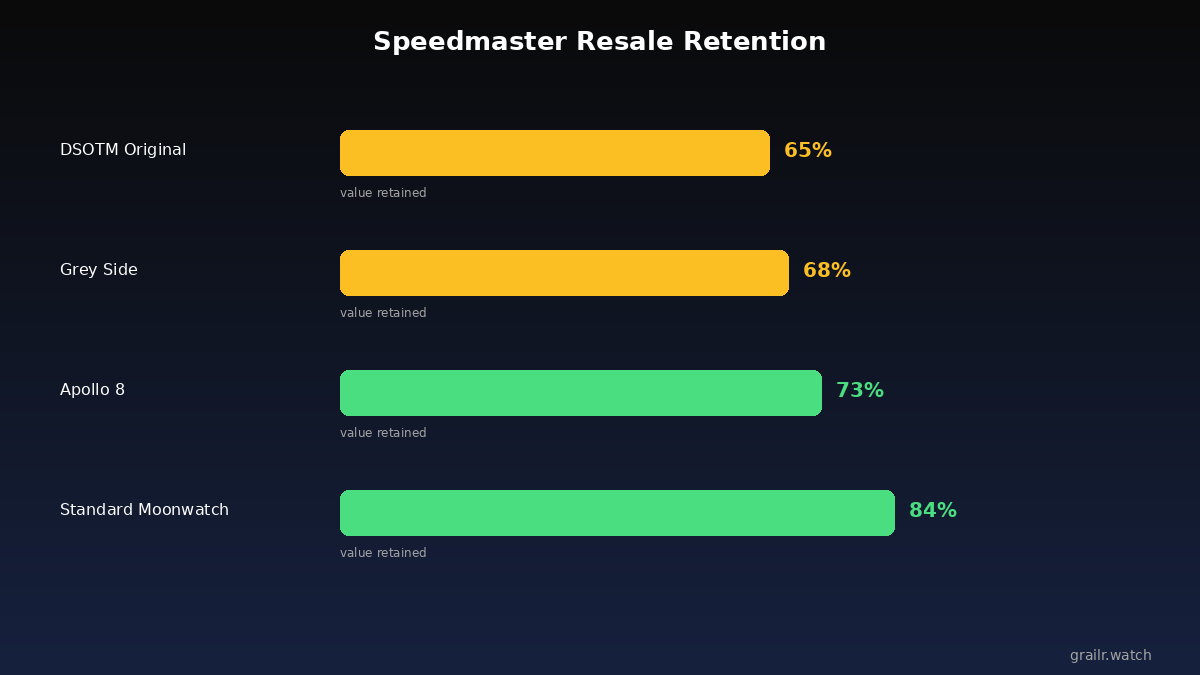
Illustration: approximate resale retention across DSOTM variants
The weakest performers are the Vintage Black and the original Black Black. Both are handsome watches, but they lack the visual distinctiveness of the Apollo 8’s caseback or the Sedna Black’s gold accents. The Vintage Black’s faux-patina lume divided collectors when it launched, and that ambivalence shows in its $7,000–$9,000 resale range.
One factor working in the DSOTM’s favour is durability. Ceramic does not show wear the way steel does. A ten-year-old steel Speedmaster will have desk-diving scratches, bracelet stretch, and polishing marks; a ten-year-old ceramic DSOTM looks essentially new. This narrows the condition gap between pre-owned and new, which supports resale values. It also means a pre-owned DSOTM is a better buy than a pre-owned steel Speedmaster in terms of cosmetic condition for the money.
Production numbers also play a role. Omega does not publish DSOTM production figures, but the collection is generally understood to be produced in smaller quantities than the standard Moonwatch. The ceramic manufacturing process is slower and more expensive than steel, which naturally limits output. According to Fratello Watches’ DSOTM collection guide, the original 2013 DSOTM was produced in significant numbers but still well below the standard Moonwatch’s annual volume. Lower supply relative to a strong Speedmaster collector base helps explain why depreciation has been modest. For a quick market check on any specific DSOTM reference, a Grailr scan pulls live asking prices from multiple platforms in seconds.
DSOTM vs Standard Moonwatch: Which to Buy
The DSOTM and the standard Moonwatch Professional are both Speedmasters, both chronographs, and both carry the Moon heritage — but they are aimed at different buyers. Here is the head-to-head comparison that matters.
Size. The DSOTM is 44.25 mm. The standard Moonwatch is 42 mm. That 2.25 mm difference sounds minor, but combined with the DSOTM’s thicker ceramic case (roughly 14.5 mm vs 13.2 mm for the steel Moonwatch), the DSOTM wears noticeably larger. Lug-to-lug length is approximately 51 mm, which can overhang wrists below 7″. If your wrist is under 7″, try one on at an authorized dealer before committing — the DSOTM can overwhelm a smaller wrist where the standard Moonwatch sits perfectly. The ceramic construction does make it lighter than you might expect given the dimensions, which helps wearability, but the visual footprint is substantial.
Material. Steel versus ceramic is the core differentiator. Steel develops character: scratches, patina, polishing history. Ceramic stays pristine. If you want a watch that ages with you, the steel Moonwatch is the better choice. If you want a watch that looks new a decade from now, the DSOTM is unbeatable.
Movement. Both the current DSOTM (Cal. 3869) and the current Moonwatch (Cal. 3861) are hand-wound, Co-Axial, and METAS-certified. They are closely related movements with similar performance specifications. The 3869 is essentially a 3861 modified for the DSOTM’s ceramic case architecture. Neither has an automatic winding option — if self-winding matters to you, look for a pre-owned DSOTM with the Cal. 9300.
Price. The steel Moonwatch hesalite starts at $6,300. The DSOTM starts at approximately €12,000 (~$12,000). The Apollo 8 edition tops out at ~$14,300. You are paying roughly double for the ceramic material, the larger case, and the limited-production status. Whether that premium is worth it depends on how much you value the material properties and the visual impact of an all-black ceramic chronograph.
Versatility. The standard Moonwatch is one of the most versatile watches ever made. It works with a suit, with a NATO strap on the weekend, and with a spacesuit (literally). The DSOTM is more of a statement piece. Its all-black ceramic construction leans sporty and modern. It pairs well with casual and smart-casual clothing but looks slightly out of place with formal business wear in a way the steel Moonwatch never does.
Strap options. The standard Moonwatch comes on a steel bracelet (or hesalite model with a steel bracelet) with the option of NATO straps. The DSOTM ships on nylon fabric, leather, or rubber straps — there is no ceramic bracelet option due to the brittleness constraints of machining ceramic links with deployment clasps. This means you lose the bracelet versatility that makes the standard Moonwatch such a chameleon. On the other hand, DSOTM owners often find that the all-black ceramic case looks striking against coloured NATO straps and aftermarket rubber, giving it a different kind of strap versatility.
The bottom line. If this is your first Speedmaster, buy the standard Moonwatch. It is the icon, it is more wearable, and it costs half as much. If you already own a Moonwatch and want a second Speedmaster that delivers something genuinely different, the DSOTM is one of the most compelling options in Omega’s catalogue. The Apollo 8 edition, with its laser-ablated lunar caseback, is the variant most likely to hold its value and the one that tells the most interesting story on the wrist. For more on Omega’s broader lineup, our Seamaster buying guide covers the dive-watch side of the brand.
Frequently Asked Questions
Is the Omega Dark Side of the Moon worth the price?
What movement does the current DSOTM use?
What is the difference between the Dark Side and Grey Side of the Moon?
Is the MoonSwatch Mission to the Moon the same as the DSOTM?
How much is a used Omega Dark Side of the Moon?
Is the DSOTM water resistant enough for swimming?
Related Articles
Omega Speedmaster Moonwatch Guide
The full Moonwatch buying guide: Cal. 3861, hesalite vs sapphire, pricing, and history.
Omega Speedmaster Silver Snoopy Award
The most collectible modern Speedmaster and why it trades above retail.
First Omega in Space
The Speedmaster that started the space connection: CK 2998 history and buying guide.
Omega Seamaster Buying Guide
Omega's dive watch lineup from the Aqua Terra to the Planet Ocean.
The Bottom Line
The Omega Speedmaster Dark Side of the Moon is one of the most technically ambitious watches in Omega’s lineup. Its all-ceramic construction solves the one complaint most steel-watch owners have — scratches — while delivering a Moonwatch-caliber chronograph movement with METAS Master Chronometer certification. The Apollo 8 edition, with its laser-ablated caseback, is the standout variant for both collectibility and visual impact.
At $12,000–$14,300 retail, it is not a casual purchase. But for Speedmaster enthusiasts looking for something beyond the standard steel Moonwatch, the DSOTM offers a genuinely different ownership experience — a chronograph that will look as sharp a decade from now as it does today.
Check Your DSOTM’s Value
Already own a Dark Side of the Moon? Grailr identifies your exact reference from a photo and pulls live asking prices from Chrono24, eBay, and dealer inventory. Takes about ten seconds.
Scan Your WatchSources
- Omega Official — Speedmaster Dark Side of the Moon Collection
- Fratello Watches — DSOTM Collection Guide
- Chrono24 market data, asking prices as of October 2026
- Omega published price lists, authorized dealer pricing, October 2026