Omega Watch Valuations: What Your Omega Is Worth
Retention rates for every Omega collection, the factors that raise or lower your watch’s value, and where to check real figures in 2026.
Price context: this guide includes indicative prices from its original publication period. They have not all been refreshed to current quotes. Use the linked primary sources for specifications and policies, and verify prices independently.

- Most Omega watches trade at 60–75% of retail on the secondary market, with Speedmasters at the top end and quartz models at the bottom.
- The Speedmaster Professional retains 70–75% of its retail price, the strongest in the Omega lineup.
- Box, papers and service history add 10–15% to resale price. Missing documentation is the biggest single value killer.
- Sought-after limited editions like the Silver Snoopy trade at two to three times retail — the exception, not the rule.
How Omega Valuation Works
Omega is the second-largest luxury watch brand by revenue, behind only Rolex. That scale means a deep secondary market with plenty of comparable sales — good news if you’re trying to figure out what your watch is worth. But “Omega” spans everything from a $2,500 quartz De Ville to a $50,000 Speedmaster Chrono Chime, and the resale curve is different for each.
The broad picture: most in-production Omega watches trade at roughly 60–75% of their retail price on the secondary market, with the brand sitting behind Rolex, Patek Philippe and Audemars Piguet in overall value retention. That range tightens or widens depending on three things: the collection (Speedmaster leads, Constellation and De Ville trail), the specific reference within it, and the condition of the individual watch.
Omega’s depreciation pattern follows a consistent curve. Most models lose the steepest portion of their value in the first two to three years after purchase — typically 25–40% — then level off. A Seamaster bought new in 2023 and kept in excellent condition will have lost most of its depreciation by now. That plateau is where the secondary market gets interesting for buyers and where sellers can predict what they’ll receive.
Before you look at any price table, you need your watch’s exact reference number. It’s typically engraved on the caseback or printed on the warranty card. Without it, any valuation is a guess. With it, you can check recent sold prices on platforms like WatchCharts and get a real figure within minutes.
Retention Rates by Collection
The table below summarises typical retention across Omega’s main collections. These are averages for current-production references in good to excellent condition with box and papers. Individual references vary, and discontinued models can sit above or below these ranges.
| Collection | Typical Retail | Pre-Owned Range | Retention |
|---|---|---|---|
| Speedmaster Moonwatch | $7,800 | $5,500–$5,850 | 70–75% |
| Seamaster Diver 300M | $5,700 | $3,800–$4,335 | 65–70% |
| Aqua Terra 41 | $6,300 | $4,500–$5,000 | ~75% |
| Planet Ocean 600M | $7,250 | $3,600–$4,700 | 50–65% |
| De Ville Prestige | $5,500 | $3,000–$3,500 | 55–65% |
| Constellation (quartz) | $4,000–$7,400 | $1,800–$2,750 | 35–50% |
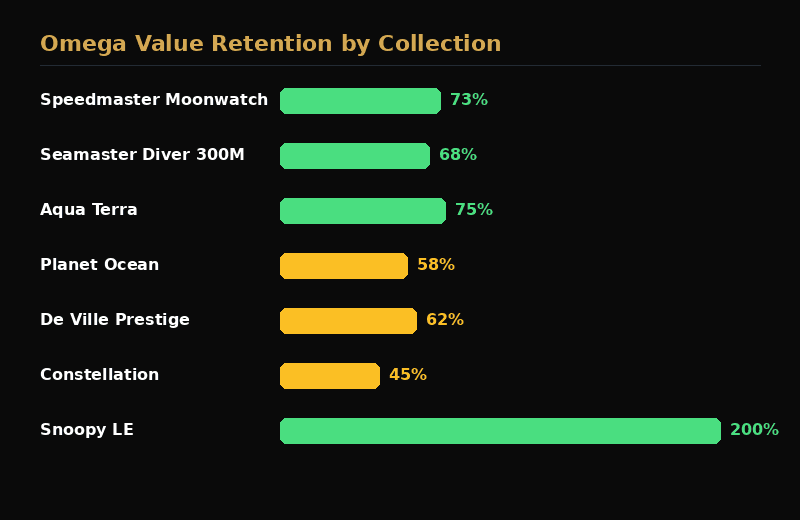
The Speedmaster’s dominance is no accident. It has the strongest brand story in watchmaking — the Moonwatch narrative — and a collector base that sustains demand well above what other Omega lines can manage. The Seamaster Diver 300M benefits from the James Bond association and from being Omega’s most recognisable sport watch. At the other end, quartz Constellations depreciate heavily because the secondary market discounts quartz movements sharply, and there’s no collector community propping up demand.
For a deeper look at how each Seamaster reference performs, see our Omega Seamaster Diver 300M guide and our broader Omega classic watches overview.
Factors That Move the Price
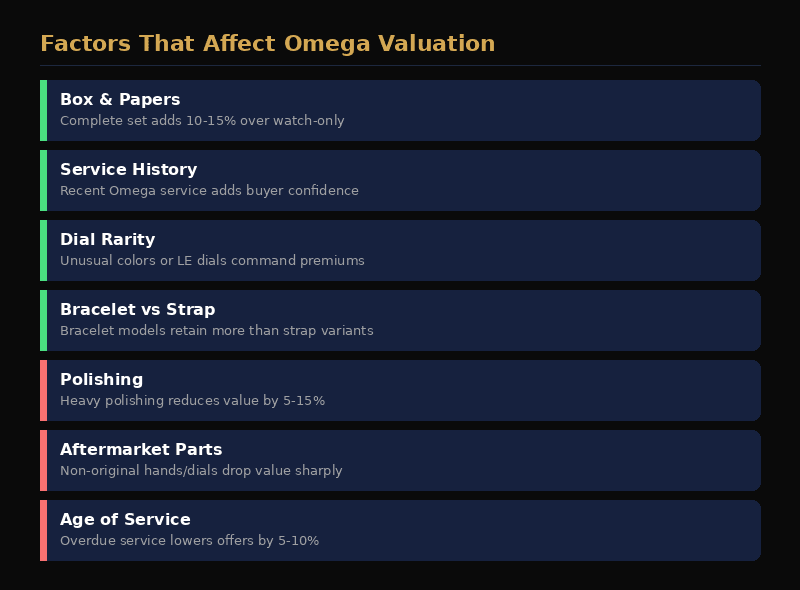
Two identical-looking Omega watches can trade at prices 20–30% apart. The difference comes down to a handful of concrete factors that any buyer or seller can check.
Condition
Condition is the single biggest variable after reference number. A watch graded “excellent” — original finish intact, crystal clean, bezel unmarked — will trade near the top of the range for its reference. Light desk-diving marks are expected and barely affect value. Deep scratches, dented cases and scratched crystals push the price toward the bottom of the range, sometimes below it. A watch that has been polished by a non-authorised service centre can also lose value because the case shape may be altered and original brushed finishes lost.
Box, Papers and Provenance
The warranty card is the most important accessory. Buyers on platforms like Chrono24 and eBay consistently pay 10–15% more for a complete set versus a watch-only listing. The original purchase receipt, hang tags, instruction booklet and even the outer packaging all contribute, though each additional item matters less than the one before. For limited editions, numbered cards and special presentation boxes can add more still.
Movement and Certification
Omega’s Co-Axial Master Chronometer movement — certified by METAS to withstand magnetic fields up to 15,000 gauss — commands a premium over older non-Master Chronometer calibres. A Seamaster with Calibre 8800 trades above a cosmetically identical older model running the 2500 or 8500. Buyers recognise the improved accuracy, service intervals and anti-magnetic protection. If you’re buying or selling, confirming the exact calibre via the reference number matters. Full specifications for each movement are listed on the Omega official site.
Dial Rarity and Configuration
Dial colour has a measurable effect. Unusual or discontinued dial colours — a green Aqua Terra, a racing-inspired Speedmaster dial — can trade at a 5–15% premium over standard black or blue variants. Bracelet models almost always trade above strap-only equivalents because the bracelet alone can represent $500–$1,000 in replacement cost.
| Factor | Impact on Value | Notes |
|---|---|---|
| Complete box & papers | +10–15% | Warranty card is the key document |
| Recent Omega service | +5–10% | Official service with two-year guarantee |
| Master Chronometer movement | +5–15% | Versus older non-METAS calibre |
| Bracelet vs. strap | +$500–$1,000 | Bracelet replacement cost sets the floor |
| Discontinued or rare dial | +5–15% | Green, grey, meteorite and LE dials |
| Heavy polish or case damage | −15–25% | Loss of original finish or case shape |
Speedmaster Valuation: A Deep Dive
The Speedmaster Professional Moonwatch is Omega’s flagship and the collection with the most predictable secondary-market behaviour. The current-production Hesalite reference (310.30.42.50.01.001) retails at $7,800 and trades pre-owned at roughly $5,500–$5,850, placing it at approximately 70–75% retention. The Sapphire Sandwich variant sits slightly lower at 65–75%, reflecting lower collector preference for the display caseback over the classic Moonwatch aesthetic.
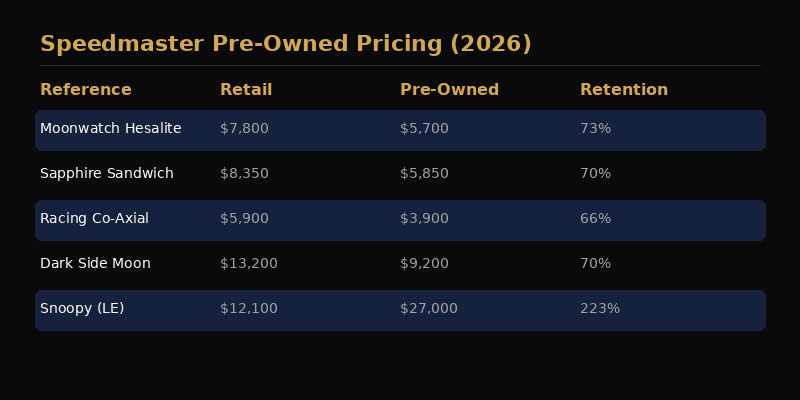
The real outliers are the limited editions. The Silver Snoopy Award 50th Anniversary (310.32.42.50.02.001) retails at $12,100 but trades on the secondary market at roughly $25,000–$30,000 — more than double its retail price. The earlier 2003 and 2015 Snoopy editions command similar or higher premiums depending on condition. For the full breakdown of all three Snoopy editions, see our Omega Snoopy Speedmaster guide.
Apollo anniversary models, Ultraman editions and other numbered limited runs also tend to hold above standard retail, though the premium varies. The key variable is production quantity: anything under 2,000 pieces with a compelling backstory tends to appreciate. Standard numbered editions of 5,000 or more may hold retail but rarely exceed it.
Vintage Speedmasters are a separate market. Pre-Moon references (CK 2998, 105.003, 145.012) have appreciated significantly over the past decade, with clean examples of the reference 105.003 — the first watch qualified by NASA for spaceflight — trading above $50,000 at auction. Valuing a vintage Speedmaster requires specialist knowledge; condition, dial originality and service history all matter more than they do for modern watches.
Check Any Watch Price in Seconds
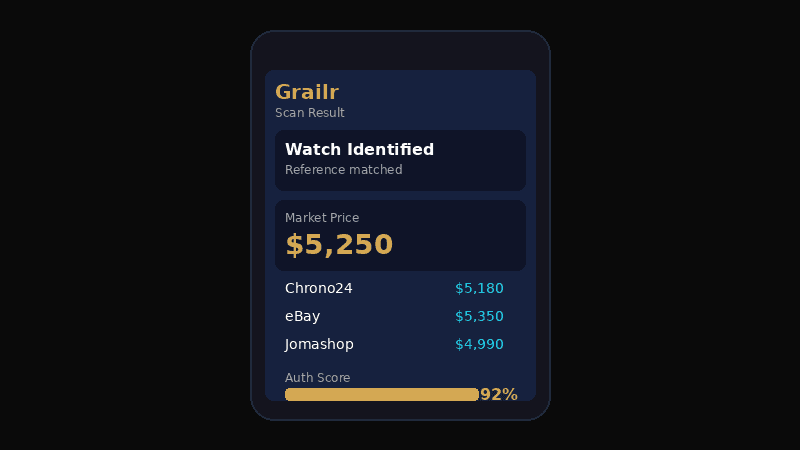
Grailr scans your watch photo and pulls live pricing from Chrono24, eBay, and Jomashop.
- AI identifies brand, model & reference number
- Live market prices from 3+ sources
- Authentication confidence score
Seamaster and Aqua Terra Values
The Seamaster Diver 300M is Omega’s best-selling collection and the second-strongest line for resale value. The standard steel reference (210.30.42.20.01.001) retails at approximately $5,700 and shows a median pre-owned market price near $4,335 as of mid-2026, putting retention at roughly 65–70%. The wave-dial ceramic-bezel design introduced in 2018 holds better than the older sword-hands generation, and 007-branded editions — particularly the No Time to Die titanium — trade at a premium over standard references.
The Aqua Terra is Omega’s versatile dress-sport line and arguably the most undervalued in the range. The 41mm steel on bracelet retails around $6,300 and trades pre-owned at $4,500–$5,000, putting it at roughly 75% retention. The teak-pattern dial and Master Chronometer certification give it strong fundamentals, but it lacks the Speedmaster’s storytelling or the Diver 300M’s Bond cachet, keeping demand — and thus prices — somewhat lower. For buyers, that makes it a value play; for sellers, expect less than you might hope.
The Planet Ocean 600M sits at the bottom of the Seamaster family for retention: 50–65% of retail. The 43.5mm case is large by current standards, and the $7,250 retail price puts it in direct competition with Tudor, Breitling and TAG Heuer watches that hold value better relative to their cost. Pre-owned Planet Oceans in the $3,600–$4,700 range represent strong buying opportunities, but sellers should expect a bigger hit than on other Omega sport watches.
At the furthest end of the depreciation curve sit the De Ville Prestige and quartz Constellation lines. The De Ville Prestige 434.10.40.20.03.001 retails at $5,500 but shows a market price near $3,417 — roughly 62% retention. Quartz Constellations can drop as low as 35–50% of retail, with the diamond-set reference 111.25.26.60.55.001 showing a $2,743 market price against $7,400 retail. These are fine watches, but the secondary market treats quartz movements and dressier styling harshly. For more on navigating the used luxury market, see our guide to buying second-hand luxury watches.
Where to Check Omega Prices
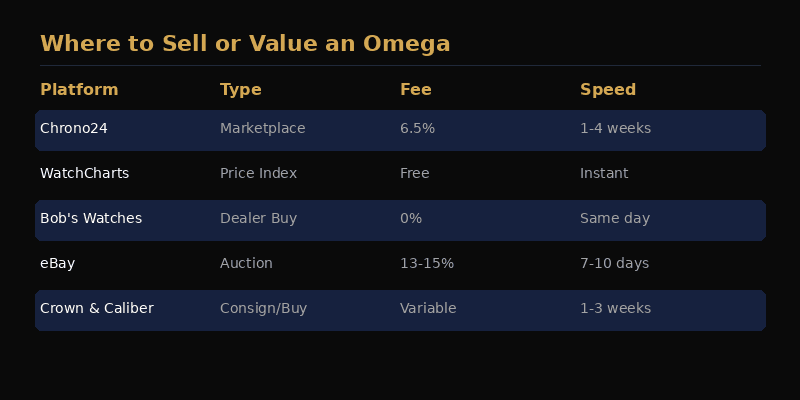
Knowing what your Omega is worth starts with checking real transaction data, not asking prices. Here are the most reliable sources and what each one is best for.
WatchCharts
Aggregates sold prices from Chrono24, eBay, and dealer sites. Best for tracking price trends over time and finding the current median market price for a specific reference. Free tier covers basic data; premium unlocks historical charts.
Chrono24 Sold Listings
The largest watch marketplace. Filter by reference, condition, and “sold” to see what buyers actually paid, not what sellers hope for. Active listings are asking prices and typically sit 5–10% above real transaction values.
eBay Completed Sales
Use the “Sold Items” filter. eBay prices tend to run 5–15% below Chrono24 because the platform charges higher seller fees and attracts more bargain-oriented buyers. Useful as a floor estimate.
Grailr Scan
Upload a photo and Grailr identifies the reference, then pulls live prices from multiple sources in one view. It’s a fast starting point — not a certified appraisal, but enough to anchor a conversation with a dealer or buyer.
Certified Appraisal
For insurance, estate or legal purposes you need a written appraisal from a certified appraiser (ISA, ASA or AAA in the US). Expect to pay $50–$150 per watch. The appraised “replacement value” is typically higher than the market price you’d receive if selling.
The best approach is to triangulate. Check the reference on WatchCharts for the median, verify with Chrono24 sold listings for recent transactions, and use eBay as a floor. If the numbers don’t agree, look at condition and completeness differences between listings. A $500 spread between two sales of the same reference almost always comes down to box-and-papers, bracelet condition, or one seller accepting a lower price for a faster sale.
Frequently Asked Questions
How much is my Omega watch worth?
Most Omega watches trade at 60–75% of their original retail price on the pre-owned market. The exact value depends on the reference number, condition, and whether you have the original box and papers. Popular Speedmaster models can retain 70–75%, while quartz Constellation models may drop to 35–50%. Check your specific reference on WatchCharts or Chrono24 sold listings for a current figure.
Do Omega watches hold their value better than TAG Heuer?
Generally, yes. Omega’s Co-Axial Master Chronometer movements, stronger brand recognition, and the Speedmaster’s collector following give most Omega references a 5–15 percentage-point edge in retention over comparable TAG Heuer models. The main exception is the TAG Heuer Monaco, which has its own collector premium.
Which Omega collection holds its value best?
The Speedmaster Professional leads at 70–75% retention, followed by the Seamaster Diver 300M at 65–70%. The Aqua Terra sits around 75% thanks to strong demand relative to supply. Limited editions like the Silver Snoopy can trade above retail. The De Ville and quartz Constellation lines retain the least.
How much does an Omega Speedmaster depreciate?
A standard Speedmaster Moonwatch depreciates roughly 25–30% from retail in the first two to three years, then stabilises. The Hesalite reference trades around $5,500–$5,850 against a $7,800 retail price. Special editions like the Silver Snoopy 50th Anniversary trade at two to three times their $12,100 retail price.
Does having box and papers affect Omega resale value?
Yes. A complete set — box, papers, warranty card and purchase receipt — typically adds 10–15% over a watch-only listing. The warranty card is the single most valuable document. For limited editions, the numbered card and special presentation box can add further premium. Missing everything can cost you hundreds or even thousands on higher-value models.
Where can I get my Omega watch valued?
For a quick market check, use WatchCharts (median market data), Chrono24 sold listings (actual transactions) or Grailr’s photo scan (pulls live prices from multiple sources). For insurance or estate purposes, a certified appraiser (ISA, ASA or AAA) provides a formal written valuation, typically at $50–$150 per watch.
The Bottom Line
Omega watch valuations come down to three things: which collection (Speedmaster leads, quartz Constellation trails), which reference (limited editions and Master Chronometer movements hold better), and completeness (box, papers and service history add 10–15%).
The brand as a whole sits in the second tier of value retention behind Rolex, Patek Philippe and Audemars Piguet — but that’s not a criticism. It means that buyers get more watch for their money on the secondary market, and sellers can predict their returns within a narrow range once they know their reference.
Start with your reference number, check WatchCharts for the current median, verify against Chrono24 sold listings, and adjust for your watch’s condition and completeness. That will get you within 5% of the real number. For insurance or estate purposes, pay for a certified appraisal. And if you want a fast starting estimate, scan your watch with Grailr to pull live prices in seconds.
Related Guides
Find Out What Your Watch Is Worth
Upload a photo and Grailr identifies the brand, model and reference, then pulls live market prices from multiple sources.
Scan Your Watch