Omega Classic Watches: Every Collection and Price
Speedmaster, Seamaster, Constellation and De Ville — the four Omega classic watch families compared with real pricing, movement specs and buying advice for 2026.
Price context: this guide includes indicative prices from its original publication period. They have not all been refreshed to current quotes. Use the linked primary sources for specifications and policies, and verify prices independently.

- Omega’s four classic collections — Speedmaster, Seamaster, Constellation, De Ville — span $3,200 to $10,900 at retail
- Every current model carries METAS Master Chronometer certification: ±0/+5 sec/day and 15,000-gauss magnetic resistance
- Pre-owned Omegas typically sell 20–40% below retail, though Speedmaster and Seamaster Diver demand is rising
- The Seamaster Diver 300M is the strongest everyday pick; the Speedmaster Professional is the collector’s choice
What Makes an Omega “Classic”
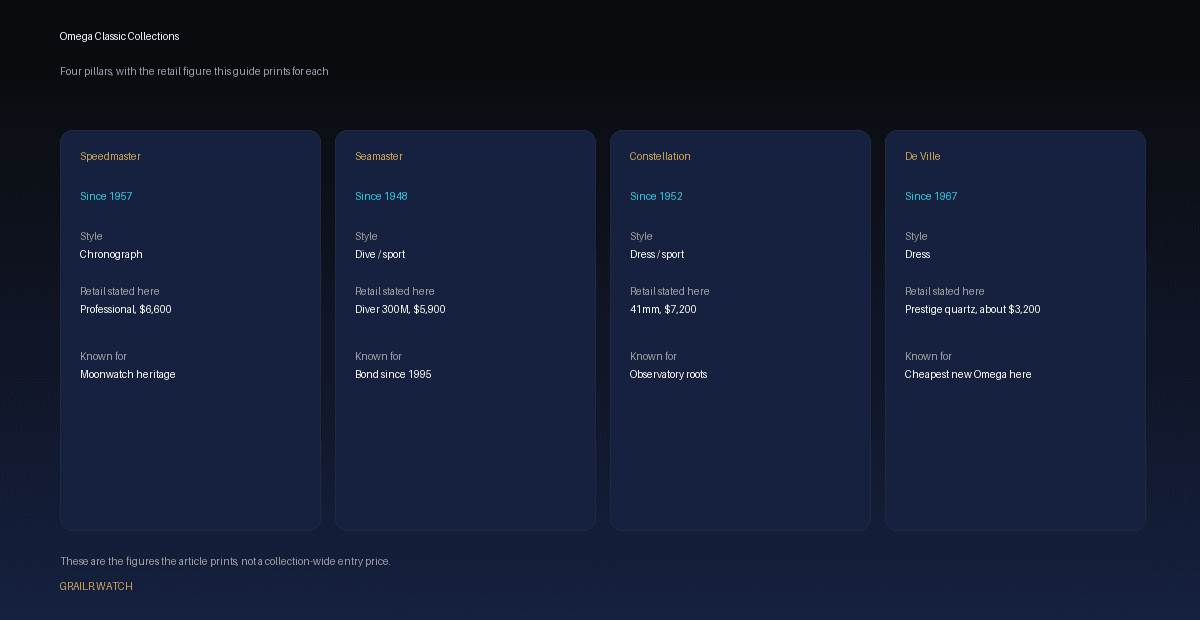
Omega has produced hundreds of references since its founding in 1848, but four families define what collectors and buyers mean when they say omega classic watches. The Speedmaster debuted in 1957. The Seamaster dates to 1948. The Constellation launched in 1952. The De Ville separated from the Seamaster line in 1967. Each has been in continuous production for decades — not revived, not rebooted, but refined generation after generation.
What ties them together is Omega’s Master Chronometer standard. Every current model across all four collections is certified by METAS (the Swiss Federal Institute of Metrology) to ±0/+5 seconds per day, withstand 15,000 gauss of magnetic force, and meet water-resistance claims on the finished watch — not just the bare movement.
That means whether you spend $3,200 on a De Ville Prestige or $10,900 on a Constellation in precious metal, the movement certification is the same. The difference is case material, finishing, complication level and market positioning. This guide breaks down what you actually get in each family and what each costs in 2026.
Speedmaster: The Moonwatch Legacy
The Speedmaster Professional Moonwatch is the most famous chronograph ever made. NASA flight-qualified it in 1965 for the Gemini programme, and it reached the lunar surface on Buzz Aldrin’s wrist during Apollo 11 in 1969. That heritage alone would make it collectible. The fact that Omega still produces it in a recognisable form — 42mm steel case, hesalite crystal, manual-wind movement — makes it a living link to mid-century watchmaking.
The current reference runs the Caliber 3861, a column-wheel chronograph with a Co-Axial escapement and 50-hour power reserve. It is METAS Master Chronometer certified. Retail is approximately $6,600, and pre-owned examples in good condition trade between $5,200 and $5,800 — a retention rate of roughly 80–88%.
Beyond the core Moonwatch, the Speedmaster family includes the Speedmaster ’57 (a co-axial automatic chronograph in a vintage-inspired case at around $7,900), the Dark Side of the Moon in ceramic (from roughly $10,500), and limited editions such as the Silver Snoopy Award editions, which trade at significant premiums on the secondary market.
For most buyers looking for an omega classic watch with serious collector credibility, the standard Moonwatch Professional in steel with the hesalite crystal is the reference to start with. It is the purest expression of what the Speedmaster has been for nearly seven decades.
Seamaster: From Bond to Everyday
The Seamaster family is Omega’s broadest collection. It includes everything from the entry-level Aqua Terra (a time-and-date sports watch comparable to a Rolex Datejust) to the Diver 300M (the James Bond watch since 1995) and the Planet Ocean (a 600m-rated dive tool).
The Seamaster Diver 300M is the volume leader. At roughly $5,900 retail for the steel model on bracelet, it uses the Caliber 8800 with a 55-hour power reserve. The ceramic bezel with a laser-engraved diving scale, the helium escape valve and the 300-metre water resistance are carried over from the Bond-era originals but refined with modern materials. Pre-owned prices sit between $4,500 and $5,200, and Bob’s Watches reports that sold prices on this reference rose about 13% year over year through mid-2026.
The Aqua Terra starts at approximately $6,300 for the 38mm and $6,800 for the 41mm. It runs the Caliber 8900 with a 60-hour power reserve and Master Chronometer certification. The teak-pattern dial, inspired by the wooden decks of sailing yachts, gives it a dressy personality that works with a suit or a polo shirt. Pre-owned examples range from $4,200 to $5,500 depending on configuration.
The Planet Ocean occupies the top of the Seamaster range, starting around $7,200 for the 39.5mm and climbing above $8,500 for the 43.5mm chronograph. It uses the Caliber 8900 or 9900 and is rated to 600 metres. For most buyers who don’t need that depth rating, the Diver 300M is the smarter purchase — same Master Chronometer certification, lower entry price and stronger secondary-market liquidity.
Constellation: The Dressy Icon
The Constellation is Omega’s answer to the Rolex Datejust — a dress-sport watch with an integrated bracelet, a date window and enough polish to wear under a French cuff. The hallmark design elements are the “claws” (also called “griffes”) on the case flanks, originally introduced in 1982 to hold the sapphire crystal in place. They’ve remained on every generation since.
The current Constellation 41mm runs the Caliber 8900 with a 60-hour power reserve and Master Chronometer certification. Retail pricing ranges from approximately $7,200 for the steel model to $10,900 for steel-and-gold configurations. The watch is available in a wide range of dial colours including silver, blue, green and black, plus options in Sedna gold and full gold.
Historically, the Constellation has been less popular on the pre-owned market than the Seamaster or Speedmaster. Buyers in the dress-watch segment tend to rotate pieces more often, and steel Constellations can dip 30–40% below retail on the secondary market. That’s a potential advantage for buyers who want the omega classic watch aesthetic of an integrated-bracelet design without paying Datejust prices. The Constellation collection guide on Hodinkee provides additional context on the various references.
Vintage Constellations, particularly the “Pie Pan” dials from the 1950s and 1960s, have a dedicated collector following. These trade between roughly £2,000 and £8,000 depending on condition, dial variant and provenance. The observatory medallion on the caseback — still present on modern references — is a nod to the Constellation’s original positioning as Omega’s most accurate series.
De Ville: Overlooked Value
The De Ville is the entry point to the Omega classic watch range and, in many ways, its best-kept secret. The De Ville Prestige starts at approximately $3,200 for the quartz model and $3,800 for the Co-Axial automatic. That makes it the most affordable path into Omega ownership with a current-production model and a full manufacturer warranty.
Pre-owned De Ville Prestige models trade between $1,800 and $2,800, which puts them in Tissot and Longines territory on price while delivering Omega finishing, the Co-Axial escapement and a movement with roots in the same technology found in the Speedmaster. The De Ville Trésor steps up to $5,000–$6,500 and uses the manually wound Caliber 8929, a slim movement that allows for a thinner case profile suited to formal wear.
At the top of the De Ville family sit the Hour Vision and Tourbillon, which push into haute horlogerie territory at $8,000–$30,000+. These are niche pieces. For most buyers, the De Ville Prestige Co-Axial at $3,800 or a pre-owned example under $3,000 is the smart money — it gets you into Omega’s classic watchmaking tradition at a price that leaves room for a service fund.
The trade-off is resale. De Ville models lose more of their retail value than Seamasters or Speedmasters, with pre-owned prices often 40–50% below original retail on older references. If you plan to keep the watch, that depreciation is irrelevant. If you plan to trade up in a few years, start with a Seamaster instead.
Price Comparison: Every Omega Classic Collection
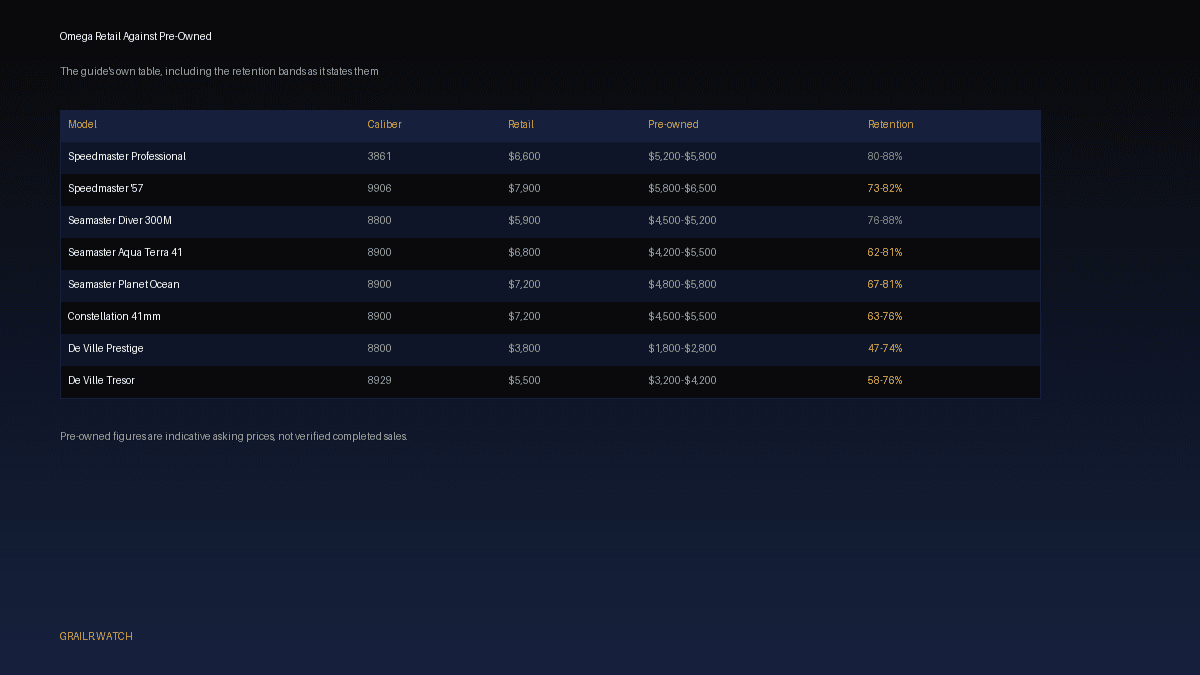
The following table compares entry-level references in each of Omega’s four classic watch families. Prices are approximate 2026 figures in USD. Pre-owned ranges reflect recent dealer and marketplace listings for watches in good to excellent condition.
| Model | Caliber | Retail | Pre-Owned | Retention |
|---|---|---|---|---|
| Speedmaster Professional | 3861 | $6,600 | $5,200–$5,800 | 80–88% |
| Speedmaster ’57 | 9906 | $7,900 | $5,800–$6,500 | 73–82% |
| Seamaster Diver 300M | 8800 | $5,900 | $4,500–$5,200 | 76–88% |
| Seamaster Aqua Terra 41 | 8900 | $6,800 | $4,200–$5,500 | 62–81% |
| Seamaster Planet Ocean | 8900 | $7,200 | $4,800–$5,800 | 67–81% |
| Constellation 41mm | 8900 | $7,200 | $4,500–$5,500 | 63–76% |
| De Ville Prestige | 8800 | $3,800 | $1,800–$2,800 | 47–74% |
| De Ville Trésor | 8929 | $5,500 | $3,200–$4,200 | 58–76% |
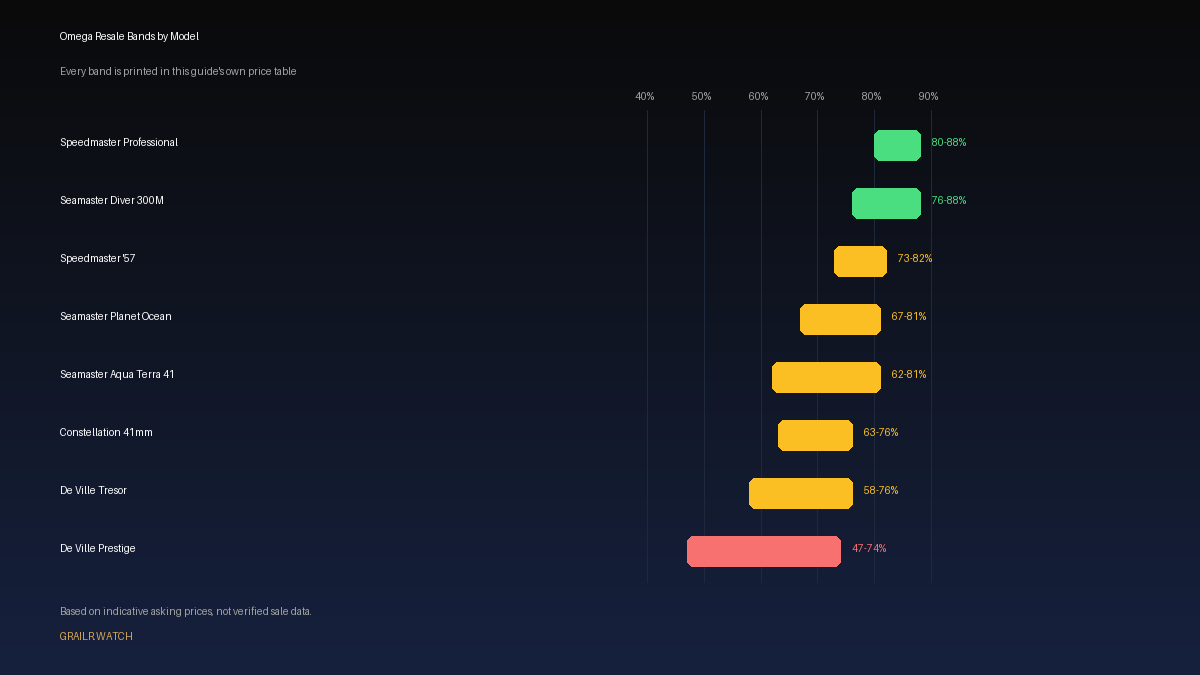
Retention percentages are calculated from typical pre-owned asking prices divided by current retail. Actual sale prices may differ. Confirm prices independently before purchasing.
Resale Value and Investment Reality
Omega sits in a different resale tier than Rolex. Where most steel Rolex sport models trade at or above retail, most Omega classic watches sell for 20–40% below their new price on the secondary market. This is not a defect — it’s a reflection of Omega’s higher production volumes and wider retail availability. It also means buying pre-owned is often the smarter move.
According to WatchCharts data from October 2026, average pre-owned market values across the brand are approximately $11,461 for the Speedmaster (inflated by high-value vintage and limited editions), $4,703 for the Seamaster family and $5,361 for the Aqua Terra specifically. Bob’s Watches’ sold-price data through mid-2026 shows Seamaster Diver 300M prices up about 13% year over year and Speedmaster Moonwatch prices up about 9%. Both are watches that hold value better than the broader luxury-watch market.
Vintage Omega classic watches are a separate market. Pre-moon Speedmaster Professional references from the 1960s trade between $20,000 and $45,000 depending on dial, bezel insert and provenance. Vintage Seamaster 300 references from the same era can reach $15,000–$25,000. At the affordable end, 1960s and 1970s Constellation “Pie Pan” dials sit between roughly £2,000 and £8,000 — which makes them one of the most accessible entry points into serious vintage collecting. For a deeper dive, see the vintage Omega buying guide.
Movement Technology: Co-Axial and Master Chronometer
Omega’s technical identity rests on two pillars: the Co-Axial escapement and the Master Chronometer certification. The Co-Axial escapement, developed by the late George Daniels and adopted by Omega in 1999, reduces the sliding friction found in a traditional Swiss lever escapement. The practical benefit is longer service intervals — Omega recommends every 5–8 years instead of the traditional 3–5.
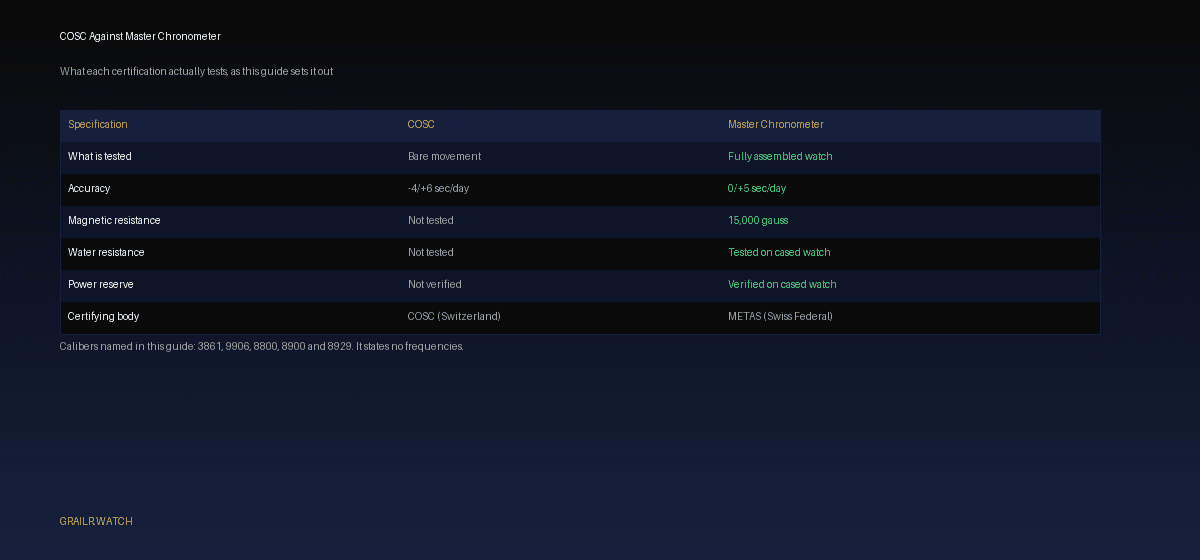
Master Chronometer certification, introduced in 2015, goes beyond the industry-standard COSC chronometer test. COSC tests the bare movement; METAS tests the fully assembled watch. The resulting tolerances are tighter (±0/+5 sec/day versus COSC’s −4/+6), and the testing includes magnetic resistance to 15,000 gauss, water resistance, power reserve validation and accuracy in multiple positions on the wrist.
| Specification | COSC | Master Chronometer |
|---|---|---|
| What is tested | Bare movement | Fully assembled watch |
| Accuracy | −4/+6 sec/day | ±0/+5 sec/day |
| Magnetic resistance | Not tested | 15,000 gauss |
| Water resistance | Not tested | Tested on cased watch |
| Power reserve | Not verified | Verified on cased watch |
| Certifying body | COSC (Switzerland) | METAS (Swiss Federal) |
Every current Omega classic watch across all four collections carries METAS certification. That includes the entry-level De Ville Prestige Co-Axial at $3,800. It is the broadest deployment of this certification standard in the industry — no other brand certifies its full lineup to these tolerances at this price range.
How to Buy: AD vs Pre-Owned
Unlike Rolex, Omega classic watches are generally available at authorized dealers without a waitlist. Walk into an Omega boutique or an AD that carries the brand, and you can typically try on and purchase any model from stock. This availability is one of Omega’s advantages — you don’t need a purchase history or a relationship to buy the watch you want.
The pre-owned market offers savings of 20–40% below retail on most references. For the best Omega watches for men, that means a Seamaster Diver 300M for $4,500 instead of $5,900, or a Speedmaster Professional for $5,200 instead of $6,600. Buy from established pre-owned dealers such as Bob’s Watches, Crown & Caliber or Watchfinder, which offer authentication guarantees and limited warranties.
1. Verify the Serial and Reference
Every Omega has a serial number engraved on the caseback or between the lugs. Cross-reference it with Omega’s records (call their customer service) to confirm the model, production date and warranty status.
2. Check the Warranty Card
Modern Omega watches (post-2018) come with a five-year warranty. The warranty card should match the serial number on the watch. A missing or mismatched card reduces pre-owned value by roughly 10–15%.
3. Inspect the Bracelet and Clasp
Omega bracelets are expensive to replace — $500 to $1,200 depending on the model. Check for excessive stretch in the links, scoring on the clasp and that all links are present. Stretched bracelets are the most common deduction on pre-owned evaluations.
4. Scan Before You Buy
Use Grailr’s scanner to photograph any listing and suggest the model, check fair market pricing and get a suggested identification. Check the result against the seller documentation and an independent inspection.
Frequently Asked Questions
What is the cheapest Omega classic watch you can buy new?
The De Ville Prestige quartz starts at around $3,200, making it the most affordable new Omega classic watch in 2026. The cheapest mechanical option is the De Ville Prestige Co-Axial at approximately $3,800.
Do Omega watches hold their value?
Most Omega watches sell for 20-40% below retail on the secondary market. The Speedmaster Professional and Seamaster Diver 300M hold value best, with pre-owned prices rising roughly 9-13% year over year according to Bob's Watches sold data through mid-2026.
Which Omega collection is the best investment?
The Speedmaster Professional Moonwatch has the strongest collector demand and broadest resale market. Vintage Speedmaster references from the pre-moon era can trade for $20,000-$45,000, and even modern references retain 80-85% of retail.
What is the difference between COSC and Master Chronometer?
COSC certification tests the bare movement for accuracy within -4/+6 seconds per day. Master Chronometer certification by METAS tests the fully assembled watch to tighter tolerances of 0/+5 seconds per day, plus magnetic resistance to 15,000 gauss, water resistance, and power reserve.
Is a used Omega Seamaster worth buying?
Yes. Pre-owned Seamaster Diver 300M models typically sell for $4,500-$5,200, saving 15-25% over the $5,900 retail price. Ensure you buy from a reputable dealer and verify the warranty card and serial number before purchasing.
How often does an Omega watch need servicing?
Omega recommends servicing every 5-8 years for Co-Axial movements. The Co-Axial escapement reduces friction compared to traditional lever escapements, extending service intervals. A full service from Omega costs approximately $750-$1,000 depending on the caliber.
Related Articles
The Bottom Line
Omega’s four classic watch families offer something for every buyer, from the $3,200 De Ville Prestige to the collector-grade Speedmaster Professional. The Seamaster Diver 300M is our top recommendation for everyday wear — it balances heritage, build quality, water resistance and resale value better than anything else in the range. The Speedmaster Professional is the collector’s pick, with decades of lunar heritage and rising secondary-market demand. Buy what speaks to you, verify the reference and serial number, and check the market price before you commit.
Sources and price context
- Omega Master Chronometer certification — Explains METAS testing protocol, accuracy tolerances and magnetic resistance standards.
- Hodinkee Omega Constellation collection guide — Editorial reference covering Constellation history, design evolution and current references.
These primary sources support the specific specification and history points noted above. Prices and resale percentages elsewhere in this guide are indicative editorial figures, not a verified transaction dataset or guaranteed returns. Confirm the exact reference, region, condition and current quote before buying; asking prices are not completed-sale prices.