Rolex Air-King Buying Guide: Everything You Need to Know About the 126900
The most accessible steel Rolex sports watch — history, specs, real pricing, and what to look for before you buy.
Price context: this guide includes indicative prices from its original publication period. They have not all been refreshed to current quotes. Use the linked primary sources for specifications and policies, and verify prices independently.

- The Air-King 126900 retails for ~$8,150 and trades at $8,200–$8,500 pre-owned — near retail parity, rare for a steel Rolex
- It is widely considered the most obtainable steel Rolex sports watch at authorized dealers today
- Cal. 3230 delivers a 70-hour power reserve, ±2 sec/day accuracy, and the Chronergy escapement
- The 2022 update added crown guards, yellow accents, and anti-reflective sapphire coating over the 116900
- Indicative 12-month appreciation of ~11.5%, with fair market value around $8,497–$8,626
A Brief History of the Rolex Air-King
The Air-King name first appeared in 1945, when Rolex introduced a family of watches honouring the Royal Air Force pilots who had served in the Second World War. That original “Air” collection included the Air-Lion, the Air-Tiger, the Air-Giant, and the Air-King. Of the four, only the Air-King survived beyond the 1950s — a testament to how well the name resonated even after the post-war moment that created it had passed.
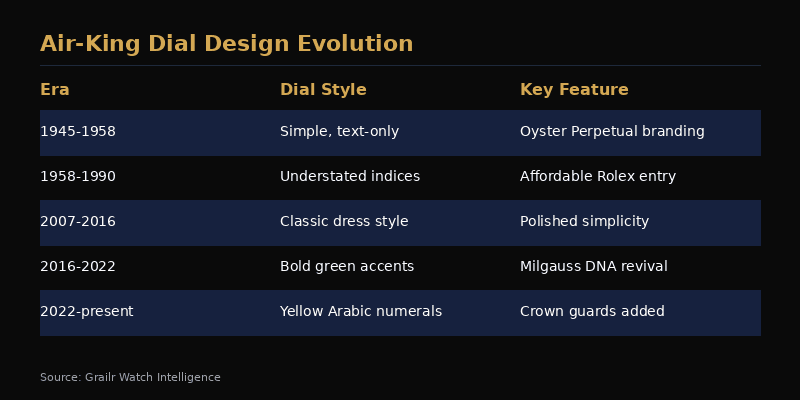
For decades the Air-King occupied a quiet corner of the Rolex catalog. The Ref. 5500 family, produced from 1958 through the late 1990s, established the template: a compact 34–36mm case, understated dials without date complications or elaborate bezels, and mechanical movements that were reliable rather than headline-grabbing. It was the watch Rolex fans bought when they wanted a Rolex on the wrist without the sport-model premium or the waitlist politics, and it earned a devoted following precisely because it never tried to be more than that.
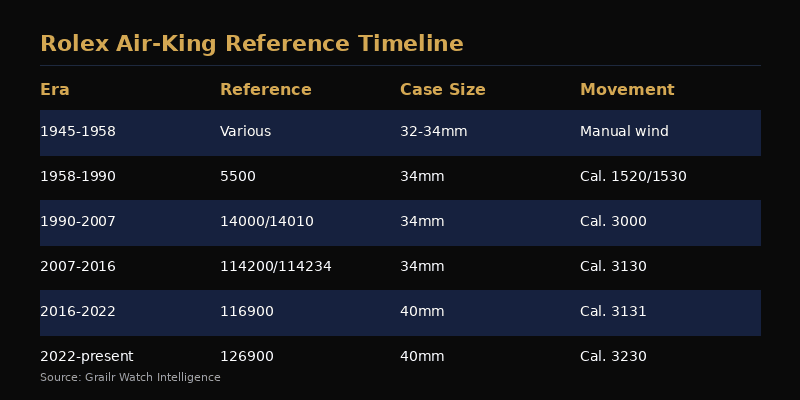
That changed dramatically in 2016 when Rolex reintroduced the Air-King as the Ref. 116900 — a 40mm steel sports watch with a bold, aviation-inspired dial featuring oversized Arabic numerals at 3, 6, and 9, a minutes-scale track borrowed from cockpit instruments, and green accents that made it impossible to confuse with anything else in the lineup. It was polarizing from the start: some collectors loved the unapologetic dial design, while others found it too busy for a brand built on restraint. The watch found its footing regardless, earning a devoted niche audience that appreciated its willingness to be different in a catalog that prizes uniformity.
In 2022 Rolex replaced the 116900 with the current Ref. 126900, refining rather than reinventing what the previous reference had established. The green accents gave way to yellow, a colour that reads warmer against the matte black dial and recalls the yellow seconds hand of Rolex’s partnership with the Bloodhound land-speed-record car. Crown guards appeared for the first time, the bracelet was updated with a more refined end-link profile, and the movement jumped a full generation from the Cal. 3131 to the Cal. 3230. Taken together, the changes amounted to the most comprehensive update the Air-King name had received since it was reborn six years earlier — and the result is a watch that has quietly become one of the most compelling values in the entire current Rolex catalog.
Ref. 126900: Full Specifications
The current Air-King is a 40mm Oystersteel watch that sits at 12mm thick with a 47mm lug-to-lug measurement — dimensions that make it wear comfortably on wrists from roughly 6.5 to 7.5 inches without the wrist overhang that some 41–42mm sport models can produce. Its defining visual feature remains the matte black dial with oversized yellow Arabic numerals at 3, 6, and 9, yellow “AIR-KING” text below the crown logo, and a minute scale around the outer edge that traces the watch’s aviation heritage back to the cockpit instruments that inspired the 2016 relaunch.
| Specification | Detail |
|---|---|
| Reference | 126900 |
| Case Material | Oystersteel (904L) |
| Case Diameter | 40mm |
| Thickness | 12mm |
| Lug-to-Lug | 47mm |
| Water Resistance | 100 metres / 330 feet |
| Crystal | Sapphire with anti-reflective inner coating |
| Crown | Triplock with protective guards |
| Bracelet | Oyster with Easylink 5mm extension |
| Dial | Matte black, yellow Arabic numerals (3/6/9) |
| Lume | Chromalight (blue glow) |
| Movement | Cal. 3230 |
| Power Reserve | 70 hours |
| Frequency | 28,800 bph (4 Hz) |
| Accuracy | ±2 sec/day (Superlative Chronometer) |
| MSRP (2026) | ~$8,150 USD |
Under the dial sits Rolex’s Caliber 3230, a movement shared with the Oyster Perpetual line. The 3230 brings a 70-hour power reserve — long enough to sit on a nightstand from Friday evening to Monday morning and still be running — along with the Chronergy escapement, which is 15% more energy-efficient than its predecessor, and a Syloxi silicon hairspring that resists magnetic fields and shocks better than traditional metal alloys. The movement beats at 28,800 vibrations per hour (4 Hz), the industry-standard frequency that balances accuracy against power consumption, and uses Rolex’s paramagnetic blue Parachrom hairspring in combination with the silicon Syloxi for improved shock resistance.
Paired with the Superlative Chronometer certification, the 3230 guarantees accuracy of ±2 seconds per day after casing, tighter than the COSC standard of −4/+6 seconds. This is the same movement architecture found in the current Explorer and Oyster Perpetual — proven, modern, and serviceable by any Rolex-certified watchmaker. The Chromalight lume on the hands and hour markers glows blue rather than the traditional green of Super-LumiNova, and Rolex claims it lasts up to twice as long as standard luminous material, a benefit that is genuinely useful in low-light reading situations. For a detailed look at Rolex specifications, Rolex’s own Air-King product page provides the complete factory spec sheet.
126900 vs 116900: What Changed
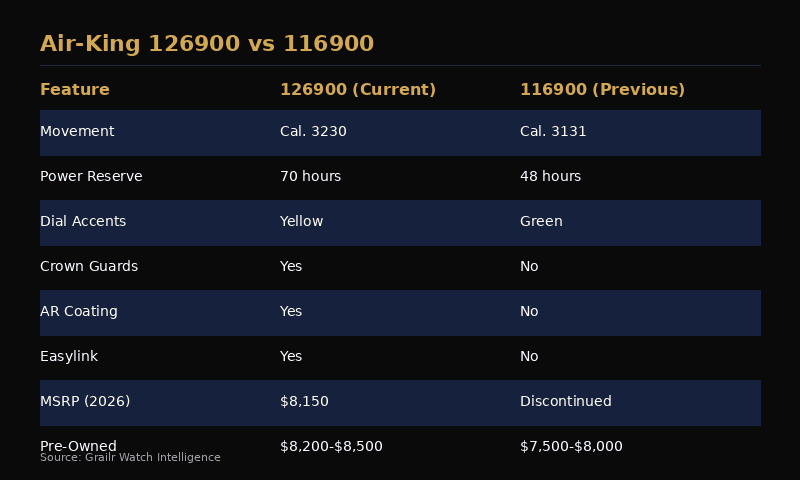
On the surface, the update from 116900 to 126900 looks like a subtle refresh. Both are 40mm steel sports watches with the same general dial layout. But the differences run deeper than accent colour, and they matter for anyone deciding between a used 116900 and the current reference.
| Feature | Ref. 126900 (2022–) | Ref. 116900 (2016–2022) |
|---|---|---|
| Accent Colour | Yellow | Green |
| Movement | Cal. 3230 | Cal. 3131 |
| Power Reserve | 70 hours | 48 hours |
| Crown Guards | Yes (Triplock) | No |
| Anti-Reflective Coating | Inner sapphire surface | None |
| Escapement | Chronergy (silicon) | Traditional (Parachrom) |
| Bracelet | Updated Oyster with Easylink | Oyster (different end links) |
| MSRP (at launch) | $7,600 (2022) | $6,200 (2016) |
The movement upgrade is the headline change. The Cal. 3230’s 70-hour reserve versus the 3131’s 48 hours means the 126900 can handle a full weekend off the wrist without losing time — a practical advantage for anyone who rotates between watches. The Chronergy escapement and Syloxi hairspring also bring improved magnetic resistance and energy efficiency. Crown guards on the 126900 protect the winding crown against side impacts, addressing one of the 116900’s few genuine vulnerabilities. And the anti-reflective coating on the inner sapphire surface noticeably improves legibility in bright light, reducing the glare that the 116900’s untreated crystal sometimes produced at steep viewing angles.
Pre-owned 116900s currently trade between $7,000 and $7,500, roughly $1,000 below the current reference. That gap makes the 116900 a viable option if you prefer the green-accented aesthetic or want the lowest entry price into the modern Air-King lineage. For a deeper look at where both references sit against other Rolex entry points, see our best entry-level Rolex guide.
Pricing and Market Position
The Air-King 126900 sits in an unusual position in the steel Rolex sports lineup: it is one of the few references that trades at or just barely above its $8,150 retail price on the secondary market. Current asking prices cluster between $8,200 and $8,500 — a 0–4% premium — which stands in stark contrast to the Submariner, GMT-Master II, and Daytona, where secondary-market premiums routinely reach 20–60% above retail. This near-parity pricing creates a distinct value proposition: you can buy the watch at or near retail, wear it without the depreciation anxiety that accompanies most luxury purchases, and sell it later for close to what you paid.
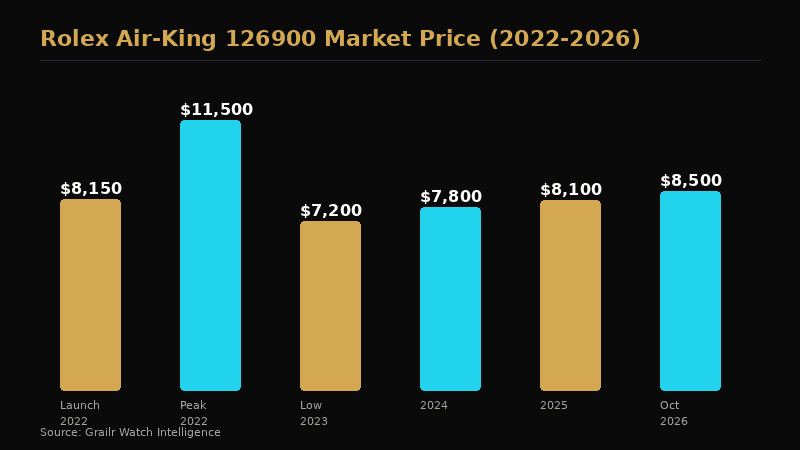
Indicative data suggests the 126900 has appreciated roughly 11.5% over the past 12 months, with fair market value estimates landing around $8,497–$8,626. That appreciation reflects genuine demand growth as collectors and first-time buyers discover what was once considered the “forgotten” Rolex sport model, but it also reflects the broader upward trend in the secondary Rolex market since mid-2025. Do not treat an 11.5% trailing return as a forward-looking projection — the watch market is not a stock index, and past performance is exactly that. The Air-King’s moderate premium also means less downside risk than watches trading at 40–60% over retail; a correction in the broader market would pull a Daytona or Pepsi GMT down much harder in absolute dollar terms than a watch barely above its list price.
What makes the Air-King’s market position genuinely attractive is not the appreciation but the availability. While a Submariner or GMT can require months or years on a waitlist, the Air-King is routinely reported as the steel Rolex sports watch most likely to be sitting in an authorized dealer’s case when you walk in. That accessibility, combined with near-retail secondary pricing, means the Air-King is one of the few Rolex models where the buying experience itself is not a barrier — no purchase-history requirements, no lengthy “relationship building,” and no pressure to accept an unwanted watch to demonstrate loyalty. According to Bob’s Watches’ Air-King market analysis, the 126900 occupies the sweet spot between genuine Rolex sports-watch credibility and realistic dealer availability.
Check Any Watch Price in Seconds
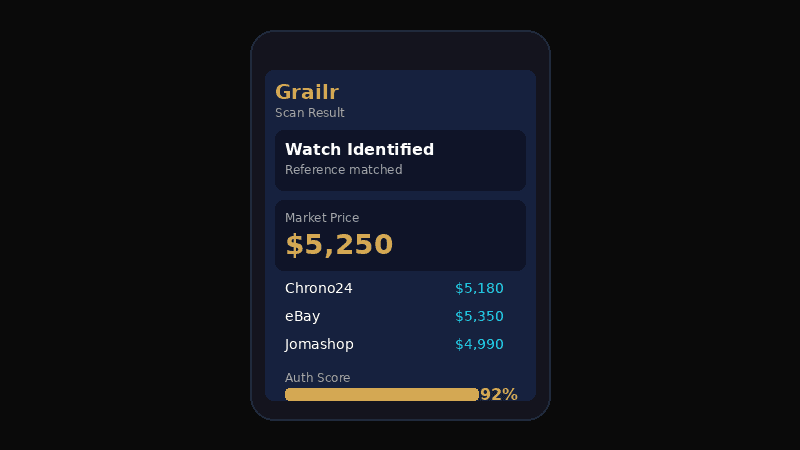
Grailr scans your watch photo and pulls live pricing from Chrono24, eBay, and Jomashop.
- AI identifies brand, model & reference number
- Live market prices from 3+ sources
- Authentication confidence score
Air-King vs Oyster Perpetual vs Explorer
The Air-King 126900 occupies a unique middle ground in Rolex’s time-only steel sports lineup. It is larger and bolder than the Oyster Perpetual, more accessible than the Explorer, and stylistically distinct from both. Understanding how the three compare helps clarify what you are actually buying when you choose one over the others.
The Oyster Perpetual is Rolex’s purest time-only watch — clean dial, simple indices, no date, no pretense of being a sport or tool watch. It is offered in 28mm, 31mm, 34mm, 36mm, and 41mm sizes, retails from $5,800 to $6,550, and uses the same Cal. 3230 as the Air-King in its 41mm version. It is the dressier choice, the one that disappears under a shirt cuff.
The Explorer sits between the two in character. Its 3-6-9 dial layout shares functional DNA with the Air-King, but the Explorer renders it in a classically restrained way — smaller, applied numerals rather than the Air-King’s oversized, painted yellow ones. At $7,350 for both the 36mm (124270) and 40mm (224270), it is less expensive than the Air-King and carries one of the strongest heritage stories in all of watchmaking. On the secondary market it trades slightly below retail at $6,800–$7,400, a less-than-retail position that differs from the Air-King’s near-parity pricing.
Choose the Air-King if you want the boldest dial presence, genuine aviation heritage, and the easiest path to an authorized-dealer purchase. Choose the Explorer if you want a subtler, more versatile aesthetic with the deepest brand story. Choose the Oyster Perpetual if design minimalism and variety of case sizes matter more than a sport-watch identity.
From a movement perspective, all three share the Cal. 3230 in their current-production 40–41mm variants, so accuracy, power reserve, and service intervals are identical. The differences are entirely about design language, bracelet feel, and what the watch signals on your wrist. The Air-King is the conversation starter; the Explorer is the quiet classic; the Oyster Perpetual is the blank canvas. None of them is objectively better — the right choice depends on what you want the watch to do for you beyond telling time.
5 Tips Before You Buy an Air-King
1. Try It On — the Dial Is Polarizing
The Air-King’s dial is more divisive in person than in photographs. The oversized yellow numerals, the minutes-scale track, and the “AIR-KING” text create a busy visual composition that some buyers love and others find overwhelming. See it on your wrist before committing; many dealers will let you try on a display model even without a purchase-history relationship, since the Air-King’s availability is usually better than other steel sport references.
2. Buy New If You Can Find It
With secondary-market prices at a 0–4% premium over retail, the value argument for buying pre-owned is weaker than with most Rolex models. If an authorized dealer has one in stock, buying new gets you the full five-year Rolex warranty and the certainty of an untouched watch at close to the same price as a used one.
3. Verify the Easylink Extension on a Pre-Owned Example
The Oyster bracelet’s Easylink 5mm comfort extension allows fine-tuning without removing links. On a pre-owned 126900, check that the extension deploys and locks cleanly — a stiff or jammed Easylink clasp is uncommon but annoying to service, and it is one of the details sellers rarely photograph or mention in a listing.
4. Scan Before You Send Payment
Use Grailr’s free scanner to photograph the listing and get a suggested model identification alongside live pricing from multiple marketplaces. It is a starting point for due diligence, not proof of authenticity — pair it with an independent inspection before you transfer funds.
5. Keep the Full Set
Box, papers, warranty card, and hang tags matter at resale. A full-set Air-King typically commands $300–$500 more than a watch-only example, a spread that has widened as the secondary market has matured. If you are buying pre-owned, factor the set completeness into what you offer; if you are buying new, keep everything.
Who Should Buy a Rolex Air-King
The Air-King is best suited for buyers who want a genuine steel Rolex sports watch without the waitlist drama and secondary-market inflation that define the Submariner, GMT-Master, and Daytona experience. It rewards people who appreciate bold dial design over conservative restraint — the kind of buyer who finds the Explorer’s 3-6-9 dial understated and the Oyster Perpetual’s simplicity a step too far in the other direction. The minutes-scale track and oversized numerals are not mistakes; they are the entire point, and the watch is at its best when worn by someone who chose it because of the dial, not in spite of it.
It is also a strong choice for first-time Rolex buyers. At $8,150, it is more expensive than the 36mm Explorer or Oyster Perpetual but meaningfully cheaper than the $10,250 Submariner or the $15,000+ secondary-market Daytona. More importantly, you can actually walk into an authorized dealer and buy one without spending months on a waitlist or building a purchase history first. For many people, that accessibility is the deciding factor — and the near-retail secondary pricing means you are not paying a penalty for the privilege of buying a Rolex at a Rolex dealer.
The Air-King is less well suited for buyers who want a versatile, go-with-everything watch. Its bold dial does not disappear under a dress shirt the way an OP or Datejust does, and its aviation-inspired aesthetic reads as deliberately sporty in a way that may clash with formal settings. If versatility across casual and dressy contexts is your priority, the Explorer or Datejust will serve you better.
Collectors who already own a Submariner or GMT-Master and want something different from the same brand will find the Air-King a genuinely refreshing addition. It does not overlap with a dive watch or a travel watch in function or aesthetic; it occupies its own lane entirely. The 100m water resistance is more than adequate for swimming and rain, even if it falls short of the 300m ratings on Rolex’s dedicated dive watches. And at 40mm by 12mm thick, it wears lighter and sits flatter on the wrist than the Submariner’s 41mm by 12.5mm case, making it the easier daily-wear option despite the less robust depth rating. The Air-King does not compete with those watches — it complements them, which is exactly why it works as a second or third Rolex in a growing collection.
Frequently Asked Questions
How much does a Rolex Air-King 126900 cost in 2026?
The Air-King 126900 has an MSRP of approximately $8,150. On the secondary market, pre-owned examples trade between roughly $8,200 and $8,500, a 0-4% premium over retail that makes it one of the few Rolex sports watches trading near parity with its list price.
What is the difference between the Air-King 126900 and the 116900?
The 126900 (2022-present) features yellow accents, the Cal. 3230 with 70-hour power reserve, an anti-reflective sapphire coating, and crown guards. The 116900 (2016-2022) used green accents, the Cal. 3131 with 48-hour reserve, no anti-reflective coating, and no crown guards.
Is the Rolex Air-King a good first Rolex?
Yes. It is the most realistically available steel Rolex sports watch at authorized dealers, with a distinctive design at a lower price point than the Submariner or GMT-Master II. Its near-retail secondary pricing means you lose very little if you decide to sell it later.
Does the Rolex Air-King hold its value?
The Air-King 126900 has appreciated roughly 11.5% over the past 12 months and trades at or slightly above its retail price on the secondary market. While this is strong, it trails the premiums seen on Submariners and Daytonas, and future performance is not guaranteed.
Is the Air-King considered a pilot's watch?
The Air-King carries aviation heritage in its name, which dates back to 1945 when Rolex created the Air family to honour RAF pilots. The modern 126900 retains minutes-scale markings that nod to cockpit instruments, but it is a general-purpose sports watch rather than a dedicated pilot's tool.
Can I buy a Rolex Air-King at an authorized dealer without a waitlist?
The Air-King is widely regarded as the most obtainable steel Rolex sports watch at authorized dealers. While availability varies by location and dealer, wait times are significantly shorter than for the Submariner, Daytona, or GMT-Master II, and many buyers report walking in and finding one in stock.
Related Articles
The Bottom Line
The Rolex Air-King 126900 is the steel Rolex sports watch that does not ask you to jump through hoops. No months-long waitlist, no purchase-history games, no 30% secondary-market markup — just a well-built 40mm watch with a genuinely distinctive dial, a modern 70-hour movement, and pricing that lets you buy without feeling like you overpaid. It is not the most versatile Rolex (the Explorer and Datejust do that job better) and it is not the most prestigious (that conversation starts at Submariner and goes up), but it may be the most honest value in the current steel lineup. If the dial speaks to you, it is hard to find a reason not to buy one.
Found an Air-King You Like?
Grailr uses a photo to suggest a watch identity and an indicative price estimate, with active eBay listings where available. Check the exact reference and condition independently; a photo scan cannot authenticate a watch.
Get an Indicative EstimateSources and price context
- Rolex Air-King product page — Official specifications for case dimensions, movement, water resistance, and bracelet details.
- Bob’s Watches Air-King guide — Secondary-market pricing context and reference-by-reference history.
These primary sources support the specifications and history noted above. Prices and appreciation percentages elsewhere in this guide are indicative editorial figures, not a verified transaction dataset or guaranteed returns. Confirm the exact reference, region, condition and current quote before buying; asking prices are not completed-sale prices.