Rolex Deepsea James Cameron: The D-Blue Guide
Every Deepsea D-Blue reference compared — the Ringlock system explained, real market pricing, and practical buying advice for 2026.
Price context: this guide includes indicative prices from its original publication period. They have not all been refreshed to current quotes. Use the linked primary sources for specifications and policies, and verify prices independently.
- The Deepsea D-Blue commemorates James Cameron’s 2012 solo dive to 10,908 m in the Mariana Trench
- Three references span 2008 to present: 116660 (Cal. 3135), 126660 and 136660 (Cal. 3235, 70 h power reserve)
- The patented Ringlock system — steel ring, 5.5 mm crystal, titanium caseback — enables a 3,900 m depth rating
- Current retail is approximately $14,800; pre-owned D-Blue examples trade between $13,000 and $17,000
Why the D-Blue Exists: Cameron’s Dive
On 26 March 2012, filmmaker James Cameron climbed into the Deepsea Challenger submersible and descended alone to Challenger Deep — the deepest surveyed point in the ocean at 10,908 metres (35,787 ft) in the Mariana Trench. Strapped to the submersible’s robotic arm was an experimental Rolex Deepsea Challenge prototype, a watch rated to 12,000 metres that survived the crushing pressure and returned to the surface running perfectly.
Two years later Rolex translated that achievement into a production watch. The Deepsea D-Blue dial debuted in 2014 on reference 116660, with a gradient that fades from bright blue at twelve o’clock to jet black at six — a visual metaphor for the descent from sunlit shallows into the abyss. It was the first Rolex ever to use a gradient dial, and the connection to Cameron’s expedition gave it a story no competitor could replicate. National Geographic documented the expedition extensively.
The “James Cameron” nickname is not official Rolex nomenclature. Rolex calls it the Sea-Dweller Deepsea with a D-Blue dial. But on forums, in dealer listings, and across the secondary market, “James Cameron” is the universal shorthand — and it commands a consistent premium over the all-black-dial version. That celebrity endorsement is reinforced by Tiger Woods, who wears a Deepsea D-Blue regularly on the golf course, putting the watch in front of millions of television viewers every tournament.
Every Reference Compared: 116660, 126660, 136660
The Deepsea has gone through three reference generations since its 2008 launch. Each upgrade brought a better movement and subtle case refinements, but the core identity — 44 mm Oystersteel case, Ringlock system, 3,900 m water resistance — has never changed.
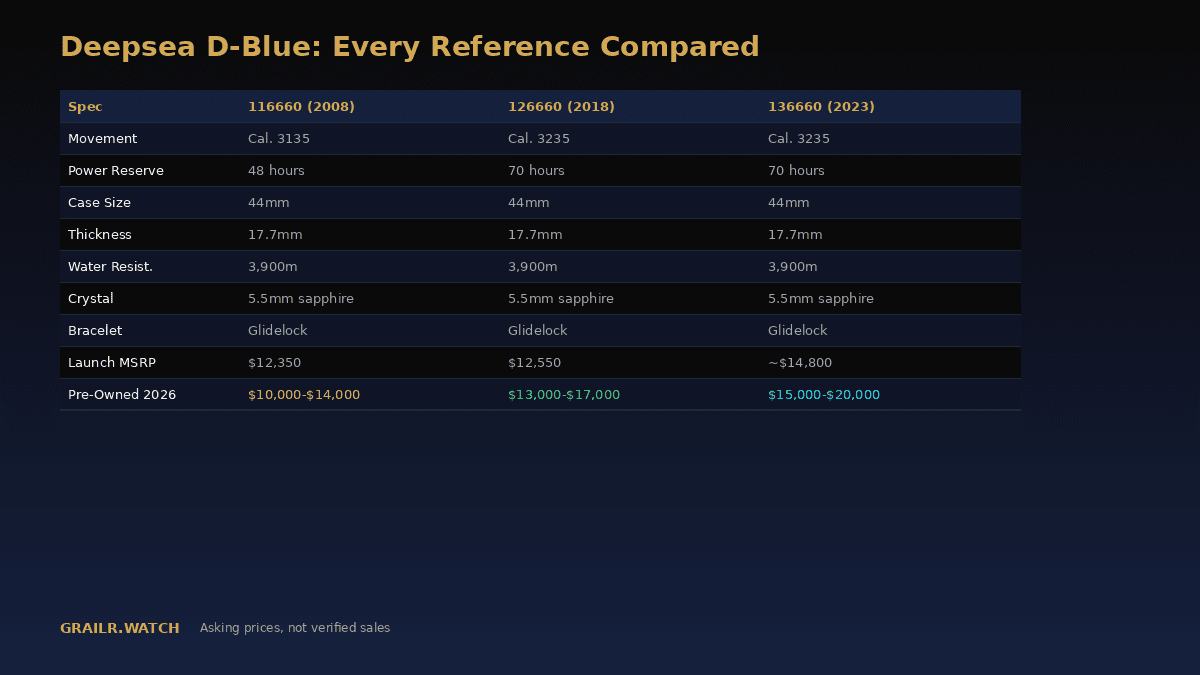
| Spec | 116660 (2008–2018) | 126660 (2018–2022) | 136660 (2023–present) |
|---|---|---|---|
| Caliber | 3135 | 3235 | 3235 |
| Power reserve | 48 h | 70 h | 70 h |
| Case diameter | 44 mm | 44 mm | 44 mm |
| Thickness | 17.7 mm | 17.7 mm | 17.7 mm |
| Water resistance | 3,900 m | 3,900 m | 3,900 m |
| Lume | Chromalight | Chromalight (improved) | Chromalight (latest) |
| D-Blue dial? | From 2014 | Yes | Yes |
| Bracelet | Oyster + Glidelock | Oyster + Glidelock | Oyster + Glidelock |
| Launch MSRP | $11,350 | $12,550 | ~$14,800 |
The 116660 was the original Deepsea, launched at Baselworld 2008 with the all-black dial. The D-Blue gradient version arrived in 2014 on the same reference and immediately became the more desirable of the two. The Cal. 3135 inside was proven and reliable, but its 48-hour power reserve felt dated against Omega’s 60-hour Co-Axial movements.
Rolex addressed that in 2018 with the 126660, swapping in the Caliber 3235 — the same movement found in the Datejust 41 and Explorer. The 70-hour power reserve was the headline, but the Chronergy escapement and optimised barrel also improved accuracy and shock resistance. The case received slimmer lugs that helped the 44 mm case sit better on smaller wrists.
The 136660, introduced in 2023, is an incremental update. Dial printing is slightly sharper, the Chromalight indices have been refined, and some collectors report a fractionally different D-Blue gradient. Mechanically it is identical to the 126660. Most buyers choose between the two based on price and availability rather than technical differences.
Inside the Ringlock System
The Deepsea’s party trick is its 3,900-metre depth rating — thirteen times deeper than the Submariner and more than enough for saturation diving operations. That extreme rating comes from the patented Ringlock system, a three-part architecture that distributes pressure across the entire case rather than concentrating it on a single gasket.
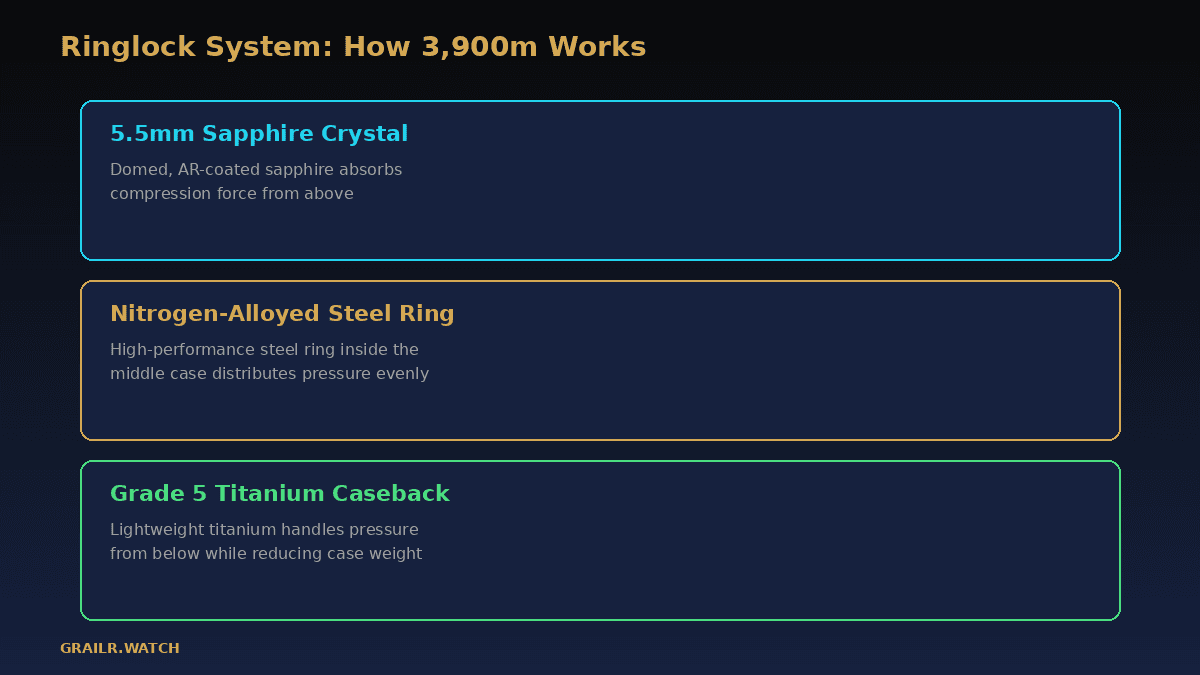
Crystal
A 5.5 mm thick domed sapphire crystal — more than twice the thickness of a Submariner crystal. It resists the equivalent of three tonnes of pressure.
Steel Ring
A nitrogen-alloyed stainless steel compression ring sits inside the case middle, absorbing and distributing the force transmitted from the crystal to the caseback.
Titanium Caseback
A Grade 5 titanium caseback is lighter and more corrosion-resistant than steel. It completes the pressure vessel and carries the “RING LOCK SYSTEM” engraving.
The system explains the Deepsea’s thickness. At 17.7 mm, the watch is substantially thicker than a Submariner (13.2 mm) or Sea-Dweller 4000 (14.7 mm). That thickness is the engineering trade-off for 3,900 m resistance, and it is the single biggest factor that makes the Deepsea a polarizing watch. Some wearers love the wrist presence; others find it unwieldy under a shirt cuff.
A helium escape valve at nine o’clock allows helium molecules that have permeated the seals during saturation diving to escape safely during decompression. Without it, the crystal could pop off as trapped helium expands. In practice, fewer than one percent of Deepsea owners ever need it — but it is a reminder that this is a genuine professional instrument, not a desk diver.
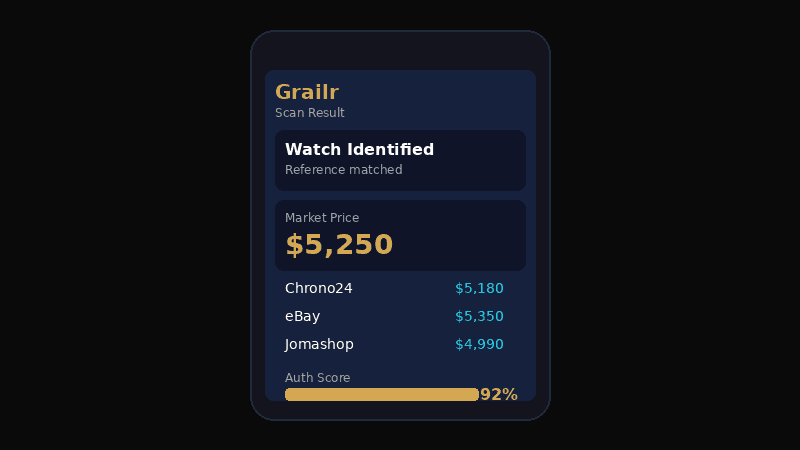
Check Any Watch Price in Seconds
Grailr scans your watch photo and pulls live pricing from Chrono24, eBay, and Jomashop.
- AI identifies brand, model & reference number
- Live market prices from 3+ sources
- Authentication confidence score
MSRP vs Real Market Pricing
Unlike the Daytona or GMT-Master II, the Deepsea does not trade at a massive premium above retail. It is one of the most accessible professional Rolex models on the secondary market, partly because its 44 mm size limits the audience and partly because Rolex keeps production relatively steady.
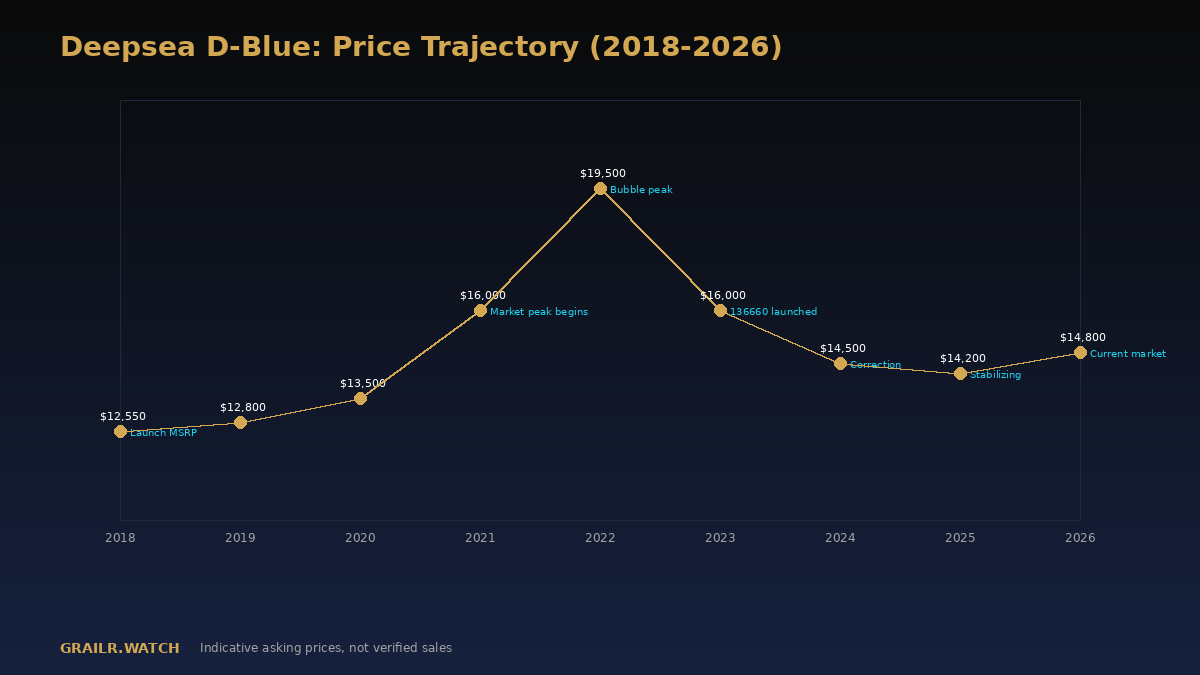
The D-Blue dial consistently trades at a $1,000–$2,000 premium over the all-black dial. That premium has held since 2014, proving that the Cameron connection has real, lasting market value. If you are buying strictly for value retention, the D-Blue is the safer choice.
| Reference | Dial | MSRP (at launch) | Pre-owned (2026) | Retention |
|---|---|---|---|---|
| 116660 | Black | $11,350 | $10,500–$12,500 | ~95% |
| 116660 | D-Blue | $11,350 | $12,000–$14,500 | ~110% |
| 126660 | Black | $12,550 | $12,000–$14,000 | ~97% |
| 126660 | D-Blue | $12,550 | $13,000–$17,000 | ~106% |
| 136660 | Black | ~$14,800 | $13,500–$15,000 | ~95% |
| 136660 | D-Blue | ~$14,800 | $14,500–$17,500 | ~100% |
These are indicative asking prices from dealer and marketplace listings, not verified completed sales. Use Grailr’s appraisal tool or cross-reference sold listings on Chrono24 and eBay before making an offer. Prices vary by box-and-papers completeness, service history, and bracelet condition.
How to Buy a Deepsea D-Blue
The Deepsea is more available than most steel professional Rolex models. Authorised dealers carry it, and wait times are measured in months rather than years. That said, demand for the D-Blue dial outpaces the black dial, so expect to wait longer — or pay a modest secondary-market premium.
On the secondary market, the Deepsea D-Blue benefits from a well-established collector base. Pre-owned pieces with a full set — box, warranty card, hang tags, and booklets — sell faster and at higher prices than watch-only listings. If you are buying from a private seller rather than an authorised dealer or reputable grey-market platform, insist on seeing the warranty card under UV light to confirm its authenticity. Counterfeit cards have become increasingly common at the five-figure price point.
1. Try It On First
At 44 mm wide and 17.7 mm thick, the Deepsea wears larger than almost any other Rolex. Visit an AD and try it on your wrist before committing. If it overwhelms you, the Sea-Dweller 4000 offers similar heritage in a slimmer package.
2. Decide on Reference
The 126660 offers the best value: same Cal. 3235 as the 136660 but typically $1,000–$2,000 cheaper on the secondary market. The 116660 is for collectors who want the original Deepsea or prefer the Cal. 3135 for its simpler service profile.
3. Check the Glidelock
The Glidelock extension system on the Oyster bracelet allows 26 mm of micro-adjustment without tools. On pre-owned examples, inspect the Glidelock clasp for wear marks and ensure it clicks firmly at each position. A loose Glidelock is a red flag for heavy use or tampering.
4. Scan Before You Buy
Use Grailr’s scanner to photograph any listing and confirm the reference, check comparable market pricing, and receive an authentication confidence score. A photo scan is not proof of authenticity — always request independent inspection for five-figure purchases.
5. Verify Box, Papers, and Service
A complete set with box, warranty card, and hang tags commands a $500–$1,500 premium over a watch-only sale. A recent Rolex service (within five years) adds confidence and saves you the $800–$1,200 service cost down the line. Ask the seller for a dated service invoice and confirm that the caseback sticker, if present, matches the serial number on the case between the lugs at the 6-o’clock side.
Deepsea vs Sea-Dweller 4000: Which One?
The most common question from buyers considering a Deepsea is whether they should save money and wrist real estate by choosing the Sea-Dweller 4000 (ref. 126600) instead. Both are professional dive watches with helium escape valves and serious depth ratings, but the experience on the wrist is dramatically different.
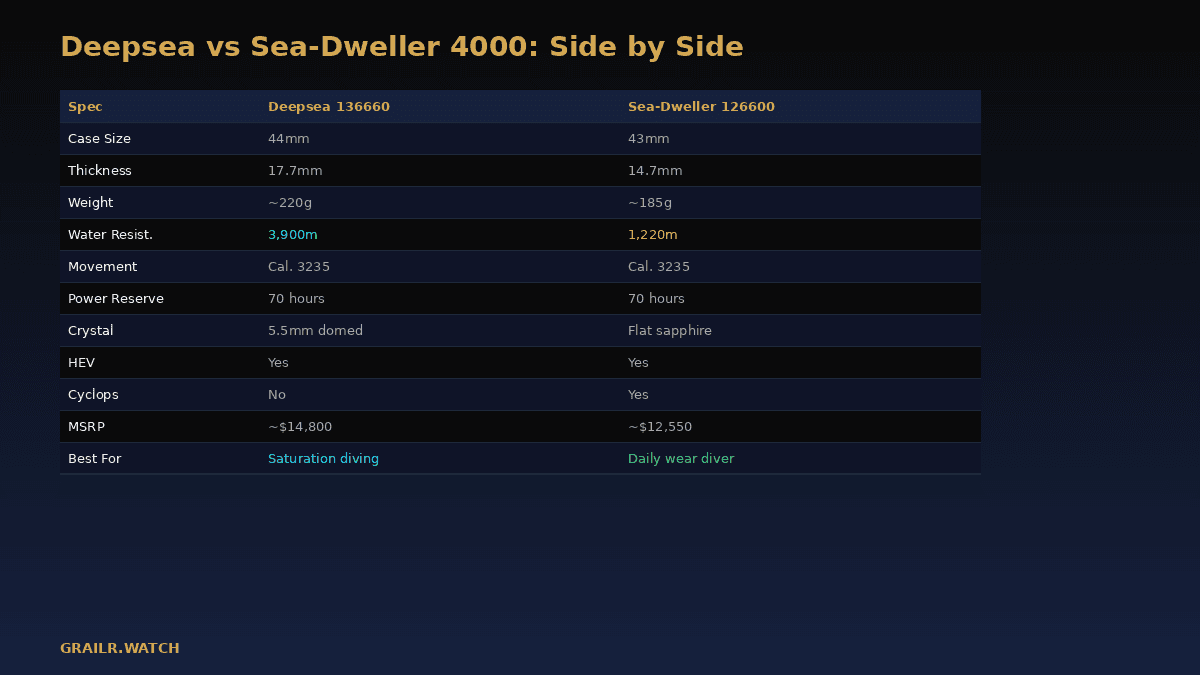
| Spec | Deepsea 136660 | Sea-Dweller 126600 |
|---|---|---|
| Case size | 44 mm | 43 mm |
| Thickness | 17.7 mm | 14.7 mm |
| Water resistance | 3,900 m | 1,220 m |
| Caliber | 3235 | 3235 |
| Power reserve | 70 h | 70 h |
| HEV | Yes | Yes |
| Cyclops | No | Yes |
| D-Blue dial option | Yes | No |
| Ringlock system | Yes | No |
| MSRP | ~$14,800 | ~$12,350 |
| Best for | Maximum depth, wrist presence | Everyday wearability, shirt-cuff fit |
If you want the D-Blue dial, the choice is made — only the Deepsea offers it. If you are open to a black dial, the Sea-Dweller 4000 is three millimetres thinner and sits dramatically flatter on the wrist. The Cyclops magnifier on the Sea-Dweller date window divides opinion: some find it practical, others feel it spoils the dive-watch aesthetic.
For pure investment potential, the Deepsea D-Blue has outperformed the Sea-Dweller 4000 on the secondary market over the last five years. But both are professional instruments that hold their value well compared to dress watches. Buy the one that fits your wrist and your lifestyle.
Frequently Asked Questions
Why is the Rolex Deepsea D-Blue called the James Cameron?
Rolex introduced the D-Blue gradient dial in 2014 to commemorate director James Cameron’s record-setting solo dive to Challenger Deep in March 2012. The blue-to-black gradient represents the descent from sunlit ocean to total darkness at 10,908 metres.
How much does a Rolex Deepsea D-Blue cost?
The current 136660 D-Blue retails for approximately $14,800. Pre-owned 126660 D-Blue examples trade between $13,000 and $17,000 depending on year, condition, and whether box and papers are included.
What is the difference between the 126660 and 136660?
Both use the Caliber 3235 with a 70-hour power reserve. The 136660 introduced in 2023 features minor case refinements, updated dial printing, and improved Chromalight indices. The changes are subtle enough that most buyers choose based on price and availability.
Is the Rolex Deepsea too big for most wrists?
At 44 mm wide and 17.7 mm thick, the Deepsea wears large. It fits wrists of 7 inches and above comfortably. If you find it overwhelming, the Sea-Dweller 4000 at 43 mm and 14.7 mm thick offers the same heritage in a slimmer package.
Does the Rolex Deepsea hold its value?
The D-Blue dial version retains roughly 90 to 100 percent of retail on the secondary market. The all-black dial trades at a slight discount. Neither depreciates as steeply as dress-watch Rolexes, but neither commands the premium of a Daytona or GMT-Master II.
Can you actually dive with a Rolex Deepsea?
Yes. The Deepsea is rated to 3,900 metres and has a helium escape valve for saturation diving. It exceeds the requirements of any recreational or professional dive. That said, most owners never take it deeper than a swimming pool.
Related Articles
The Bottom Line
The Rolex Deepsea D-Blue is one of the few modern Rolex models with a genuine origin story — not a marketing campaign, but a world-record dive to the deepest point on Earth. Its 44 mm case and 17.7 mm thickness are not for everyone, and that polarisation is part of the appeal. If you want a Rolex that looks and feels like no other watch in the lineup, the D-Blue delivers. The 126660 is the sweet spot for buyers who want the Cal. 3235 without paying the 136660 premium. Try it on, identify the exact reference, and let the wrist decide.
Considering a Deepsea?
Grailr uses a photo to suggest a watch identity and an indicative price estimate, with active eBay listings where available. Check the exact reference and condition independently; a photo scan cannot authenticate a watch.
Scan a Watch NowSources and price context
- Rolex Sea-Dweller collection — Official specifications, materials, and depth-rating details for the current Deepsea lineup.
- National Geographic: James Cameron Mariana Trench dive — Original expedition reporting on the 2012 Challenger Deep solo descent.
These primary sources support the specific history, specification or policy points noted above. Prices and resale percentages elsewhere in this guide are indicative editorial figures, not a verified transaction dataset or guaranteed returns. Confirm the exact reference, region, condition and current quote before buying; asking prices are not completed-sale prices.