Rolex Turn-O-Graph: Every Reference and Price
The Thunderbird that came before the Submariner — every reference from the 1953 original to the 2011 finale, with real prices, movement specs and collecting advice.
Price context: this guide includes indicative pre-owned prices from its original publication period. They have not all been refreshed to current quotes. Use the linked primary sources for specifications and policies, and verify prices independently.

- The Turn-O-Graph (1953) was Rolex’s first rotating-bezel watch — the direct ancestor of the Submariner and GMT-Master
- Nicknamed “Thunderbird” after the USAF aerobatic squadron that adopted it as standard issue
- Every reference is 36mm — discontinued in 2011, never revived at a larger size
- Pre-owned prices range from around $5,000 for a vintage ref. 1625 to $60,000+ for the rare 6202
A Brief History of the Turn-O-Graph
Before the Submariner, before the GMT-Master, Rolex put a rotating bezel on the Datejust. The result was the Turn-O-Graph, reference 6202, introduced in 1953. It was the brand’s first serially produced watch with a rotating bezel — a tool-watch complication that would define Rolex’s professional line for the next seventy years.
The original ref. 6202 looked remarkably like the early Submariner. Both shared the same Oyster case, the same size, and a similar bezel design. The difference was intent: the Submariner was aimed at divers, while the Turn-O-Graph was marketed as an elapsed-time tool for pilots and professionals. Its bidirectional bezel could track a second time zone, time a meeting, or mark a departure.
The watch earned its famous nickname when the United States Air Force Thunderbirds aerobatic squadron adopted it as their standard-issue timepiece. In the North American market, Rolex sold it under the name “Thunderbird” for decades — a rare case of a military connection creating an official product name rather than a collector’s shorthand.
After its debut year, Rolex absorbed the Turn-O-Graph into the Datejust family. It gained the Datejust’s date window and Cyclops lens, lost its sport-watch pretensions, and settled into a quieter role as the dressed-up Datejust with the rotating bezel. That identity — half tool watch, half dress watch — would define it for the rest of its life. Rolex produced it continuously from 1953 to 2011, through eight major reference generations, before quietly discontinuing it.
Complete Reference Guide
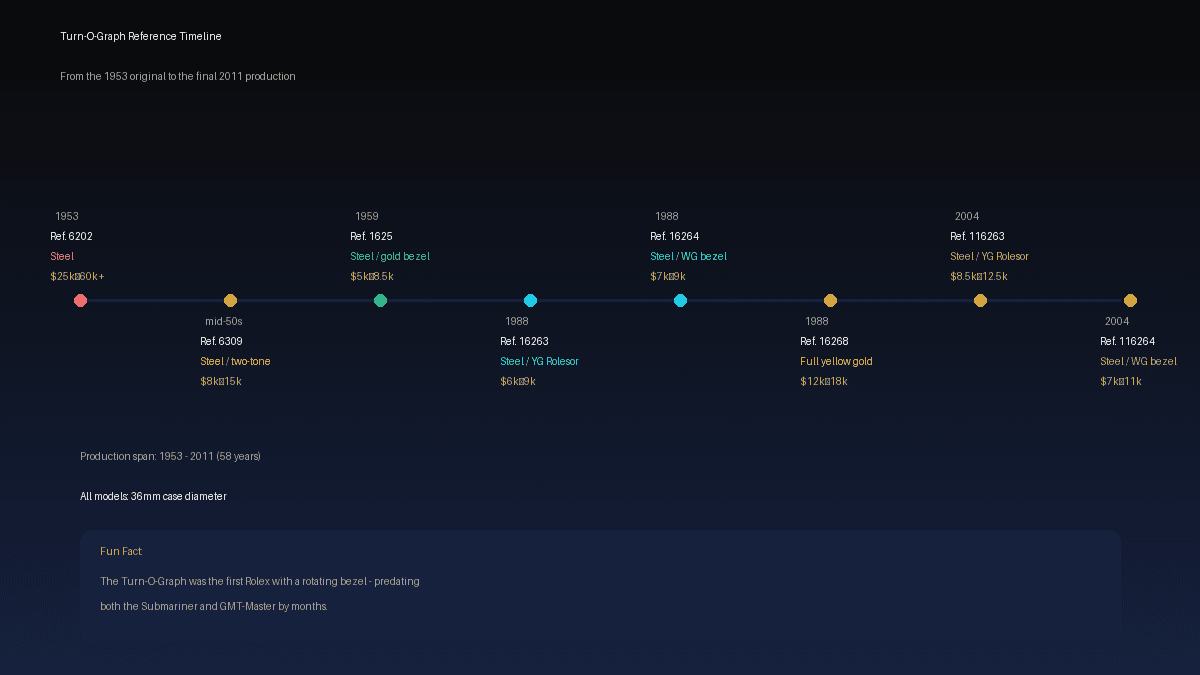
The Turn-O-Graph spanned eight major references over 58 years. Early models are prized for their sport-watch DNA and connection to the Submariner lineage. Later references became increasingly refined Datejust variants with two-tone Rolesor builds. Here is every generation in chronological order.
Ref. 6202 (1953 – 1954)
The original and the rarest. The ref. 6202 is a steel-only watch with a coin-edge rotating bezel, honeycomb dial, and pencil hands. It shares its case architecture with the first Submariner ref. 6204, and early examples are nearly indistinguishable at a glance. The movement is a Cal. 1030 automatic — a bubbleback-era caliber with a 28mm diameter. Only produced for about two years, the 6202 is the most sought-after Turn-O-Graph and commands prices from $25,000 to over $60,000 depending on dial condition and provenance.
Ref. 6309 (Mid-1950s)
A transitional reference that moved the Turn-O-Graph away from its sport-watch origins. The 6309 adopted the Datejust’s fluted bezel profile — now engine-turned for grip — and introduced two-tone configurations. Production was short, making these uncommon on the secondary market.
Ref. 1625 (1959 – 1988)
The longest-running and most accessible vintage Turn-O-Graph. Produced for nearly thirty years, the ref. 1625 came in steel with a gold or white gold engine-turned bezel. It ran the Cal. 1560 and later the Cal. 1570, both robust automatic movements with 26 jewels and a 48-hour power reserve. The long production run means examples are relatively plentiful, with pre-owned prices typically falling between $5,000 and $8,500. Early examples with gilt dials carry a premium.
| Reference | Years | Size | Material | Movement | Approx. Price |
|---|---|---|---|---|---|
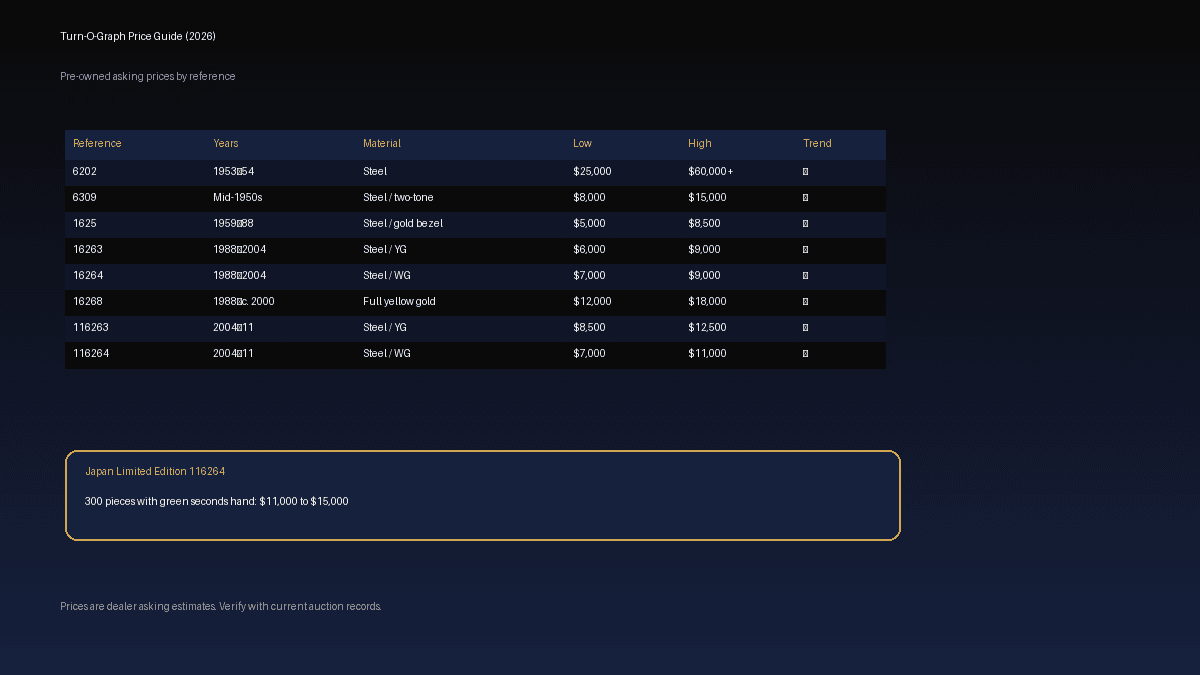
| 6202 | 1953–1954 | 36mm | Steel | Cal. 1030 | $25,000–$60,000+ |
| 6309 | Mid-1950s | 36mm | Steel / Two-tone | Cal. 1065 | $8,000–$15,000 |
| 1625 | 1959–1988 | 36mm | Steel / Gold bezel | Cal. 1560 / 1570 | $5,000–$8,500 |
| 16263 | 1988–2004 | 36mm | Steel / YG Rolesor | Cal. 3135 | $6,000–$9,000 |
| 16264 | 1988–2004 | 36mm | Steel / WG bezel | Cal. 3135 | $7,000–$9,000 |
| 16268 | 1988–c. 2000 | 36mm | Full yellow gold | Cal. 3135 | $12,000–$18,000 |
| 116263 | 2004–2011 | 36mm | Steel / YG Rolesor | Cal. 3135 | $8,500–$12,500 |
| 116264 | 2004–2011 | 36mm | Steel / WG bezel | Cal. 3135 | $7,000–$11,000 |
Ref. 16263, 16264 & 16268 (1988 – 2004)
The sapphire-crystal generation. These references replaced the acrylic crystal with sapphire, upgraded the movement to the Cal. 3135 with its free-sprung Microstella regulation, and refined the case finishing. The ref. 16263 used yellow gold for the bezel, crown, and center bracelet links (the Rolesor combination). The ref. 16264 paired a white gold engine-turned bezel with a full steel case. The ref. 16268 was the rare full yellow gold variant.
Dial options expanded during this period: champagne, black, white, and blue were standard, with rarer tapestry, Jubilee, and serti (diamond-set) dials available. Bracelet choices included Jubilee and Oyster, with solid outer links replacing the earlier folded links during the production run. These are the most accessible “modern” Turn-O-Graphs, with the 16264 trading between $7,000 and $9,000 for a well-kept example.
Ref. 116263 & 116264 (2004 – 2011)
The final generation. Rolex updated the case finishing, introduced a Maxi dial with larger luminous indices, and kept the Cal. 3135. The ref. 116263 paired steel with yellow gold Rolesor and typically trades between $8,500 and $12,500. The ref. 116264 in steel with a white gold bezel sits slightly lower, with market estimates around $7,000 to $11,000.
A notable outlier is the Japan Limited Edition 116264, limited to 300 pieces with a distinctive green seconds hand. These routinely fetch $11,000 to $15,000 and are among the most collectible modern Turn-O-Graphs.
Movement Evolution
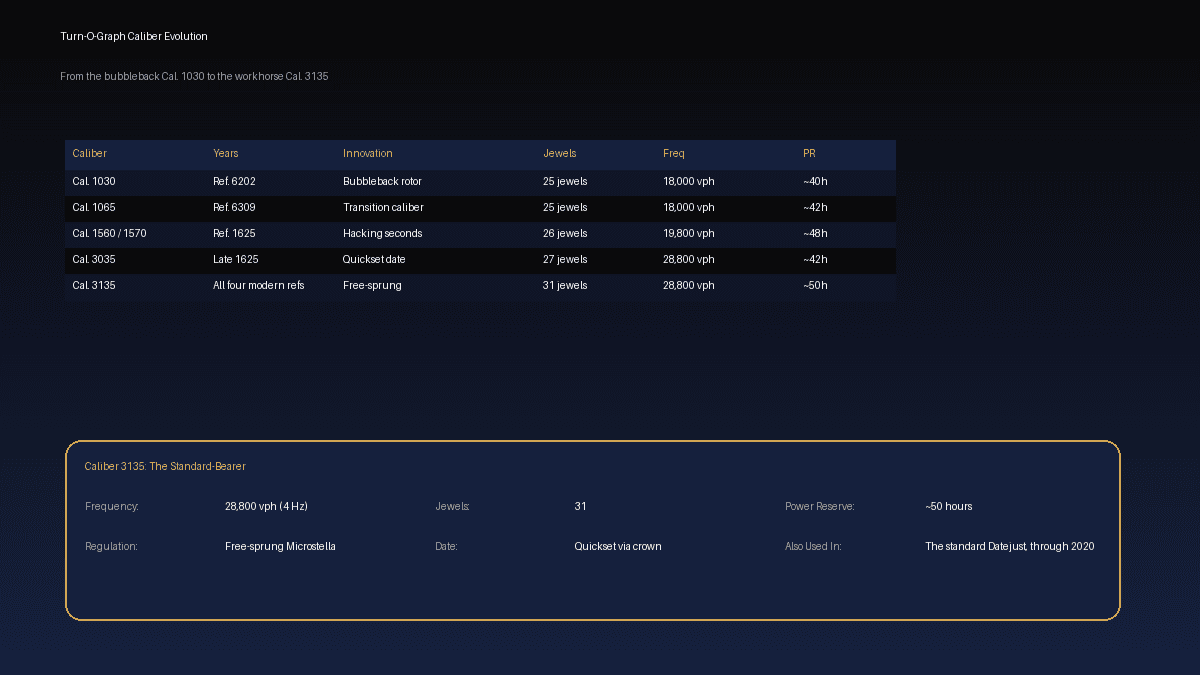
The Turn-O-Graph’s 58-year production run spanned four distinct movement generations, tracking Rolex’s broader caliber evolution from bubbleback automatics to the modern 3100 series.
| Caliber | Used In | Frequency | Jewels | Power Reserve | Key Feature |
|---|---|---|---|---|---|
| Cal. 1030 | Ref. 6202 | 18,000 vph | 25 | ~40 hrs | Bubbleback rotor |
| Cal. 1065 | Ref. 6309 | 18,000 vph | 25 | ~42 hrs | Transition caliber |
| Cal. 1560 / 1570 | Ref. 1625 | 19,800 vph | 26 | ~48 hrs | Hacking seconds |
| Cal. 3035 | Late 1625 | 28,800 vph | 27 | ~42 hrs | Quickset date |
| Cal. 3135 | 16263 / 16264 / 116263 / 116264 | 28,800 vph | 31 | ~50 hrs | Free-sprung Microstella |
The Cal. 3135 is the movement most buyers will encounter. It ran unchanged from 1988 through the 2011 discontinuation — a testament to its reliability. It features a free-sprung Parachrom hairspring (in later production), 31 jewels, and ±2 seconds per day accuracy under COSC certification. The standard Datejust used the same caliber through 2020, so parts supply and service knowledge remain excellent.
Pre-Owned Pricing
The Turn-O-Graph sits in a sweet spot of the vintage and neo-vintage Rolex market. It carries the Rolex name, genuine historical significance, and the dressy appeal of a Datejust, but it has never attracted the speculative frenzy of Submariners or Daytonas. That makes it one of the more rational buys in the Rolex catalogue — prices reflect condition, rarity, and desirability rather than hype cycles.
Entry Point: Ref. 1625 — $5,000 to $8,500
The most affordable way into Turn-O-Graph ownership. The thirty-year production run means plenty of examples exist, and the vintage two-tone aesthetic has strong appeal on a 36mm wrist. Early gilt-dial examples and pristine “tropical” dials push toward the top of the range.
Mid-Range: Ref. 16264 / 116264 — $7,000 to $11,000
The white gold bezel on steel case combination is the most popular modern Turn-O-Graph configuration. WatchCharts estimates the 116264 market value at approximately $7,973 as of October 2026. Dealer asking prices range from $6,850 for older examples to $11,000 for Bucherer Certified Pre-Owned pieces with full documentation.
Collector Tier: Ref. 6202 — $25,000 to $60,000+
The 1953 original is a museum piece. Its shared DNA with the first Submariner gives it a provenance story that appeals to serious Rolex collectors. Dial condition and originality drive pricing — a perfect honeycomb dial can push well past $60,000.
Compared to vintage Rolex sport models, the Turn-O-Graph offers substantially better value. A 1960s Submariner ref. 5513 starts around $12,000 to $15,000 for a well-worn example. A 1960s Turn-O-Graph ref. 1625 in similar condition starts at $5,000 — and both run the same Cal. 1570 movement.
Buying Tips and Red Flags
1. Check the Bezel Insert
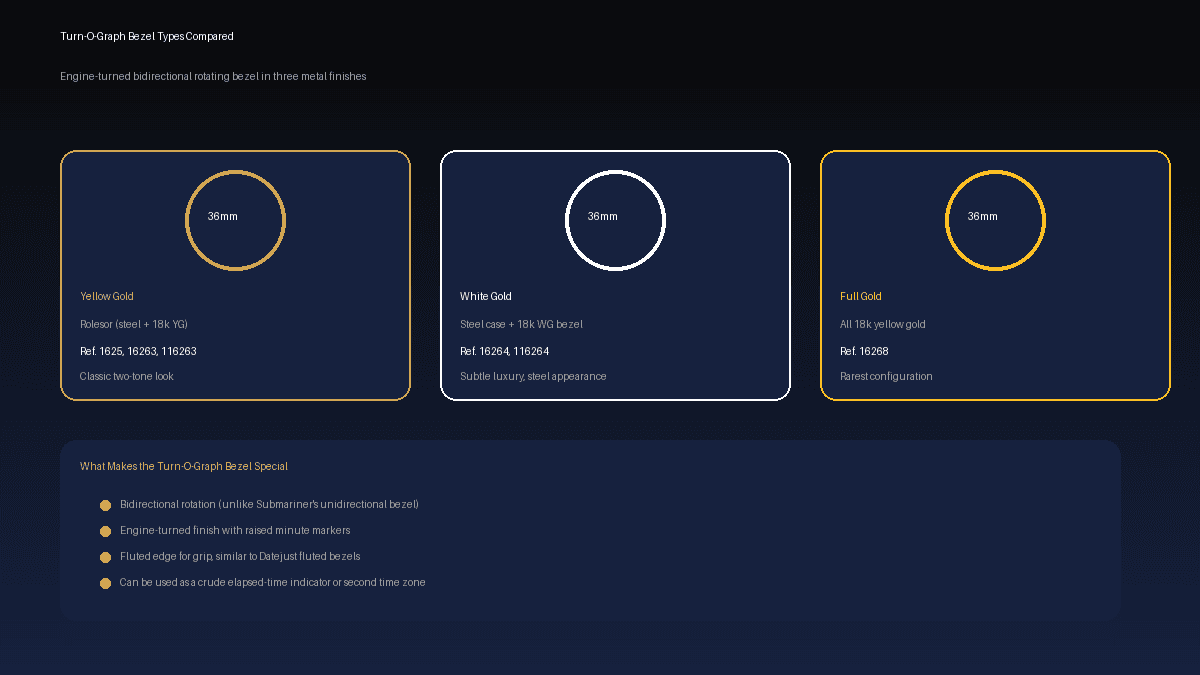
The engine-turned bezel is the Turn-O-Graph’s defining feature. On vintage references, check for worn or polished-flat ridges — a heavily smoothed bezel suggests significant age or mishandling. Replacement bezels exist, but an original bezel in good condition adds value. On two-tone models, verify the gold colour matches the crown and bracelet links.
2. Verify the Dial Is Original
Redials are common on 30-year-old Rolex watches. On the ref. 1625, look for the correct font size on “TURN-O-GRAPH” or “THUNDERBIRD” text, consistent lume plot patina across all indices, and the correct Rolex coronet proportions for the production year. Service dials from Rolex are factory-correct but reduce collector value compared to fully original dials.
3. Bracelet Stretch Matters
Jubilee bracelets on older Turn-O-Graphs are prone to stretch. Early references used folded links that wore faster than the solid end-links introduced during the 16263 era. A severely stretched bracelet costs $1,500+ to replace with a genuine Rolex part. Factor this into your offer price.
4. Use Grailr Before You Buy
Photograph any listing with Grailr’s scanner to get a suggested identification and indicative market price. Cross-reference the result with the seller’s stated reference number. A mismatch between the dial, bezel, and stated reference is a red flag worth investigating.
5. Service History Is King
A recently serviced Cal. 3135 runs like new and costs $600–$800 to service at an independent watchmaker. An unserviced movement from 2004 may still run within spec, but budget for a service. Full box and papers add 10–15% to the sale price on modern references but matter less on vintage 1625s, where few sets survive.
The Turn-O-Graph’s 36mm size is part of its appeal for collectors who prefer classic proportions. If you want a larger Rolex with modern sizing, the Oyster Perpetual 41 or Explorer 40 are better fits. But for a wrist that suits 36mm, few Rolex models offer as much history per dollar.
Frequently Asked Questions
What is the Rolex Turn-O-Graph?
The Turn-O-Graph is a Datejust variant with a bidirectional rotating bezel. Introduced in 1953 as ref. 6202, it was Rolex’s first serially produced rotating-bezel watch and the direct ancestor of the Submariner.
Why is it called the Thunderbird?
The United States Air Force Thunderbirds aerobatic squadron adopted the Turn-O-Graph as their standard-issue timepiece. In the North American market, Rolex sold it under the name Thunderbird for decades.
When was the Turn-O-Graph discontinued?
Rolex discontinued the Turn-O-Graph in 2011 with references 116263 (steel and yellow gold) and 116264 (steel and white gold). It has not been revived.
How much does a Rolex Turn-O-Graph cost?
Prices vary widely by reference. Vintage ref. 1625 models start around $5,000, while the final 116264 trades between $7,000 and $11,000. The rare 1953 ref. 6202 can reach $60,000 or more.
What size is the Rolex Turn-O-Graph?
Every Turn-O-Graph reference measures 36mm in diameter. Rolex never produced a larger version, which is part of its vintage charm.
Is the Turn-O-Graph a good investment?
The Turn-O-Graph has appreciated steadily since discontinuation. Collectors value its historical importance as the first Rolex with a rotating bezel, and its comparatively low entry price makes it accessible relative to sport Rolex models.
Related Articles
The Bottom Line
The Turn-O-Graph is one of the most historically significant Rolex models most people have never heard of. It introduced the rotating bezel that would define the Submariner, GMT-Master, and every Rolex professional watch that followed. Its 36mm case, dressy-sport character, and comparatively modest pricing make it an outstanding entry into vintage and neo-vintage Rolex collecting. Whether you start with a $5,000 ref. 1625 or hunt for the rare 6202, you’re buying a piece of genuine horological history — not just a watch, but the watch that started it all.
Sources and price context
- BeckerTime: Review of the Rolex Turn-O-Graph ref. 16263 — Covers the 16263 reference in detail with movement specs, bracelet variants and pricing context.
- WatchProSite: Rolex Datejust Thunderbird Vintage Overview — Detailed vintage reference guide covering the early 6202, 6309 and 1625 generations with historical context.
These primary sources support the specific history, specification or policy points noted above. Prices and resale figures elsewhere in this guide are indicative editorial figures drawn from dealer listings and price-tracking platforms, not a verified transaction dataset or guaranteed returns. Confirm the exact reference, region, condition and current quote before buying; asking prices are not completed-sale prices.