Rolex Wimbledon Dial: Every Reference and What They Actually Cost
The complete guide to every Wimbledon dial Datejust — from the all-steel 36mm to the 41mm Everose Rolesor, with retail prices, pre-owned premiums and practical buying advice.
Price context: this guide includes indicative prices from its original publication period. They have not all been refreshed to current quotes. Use the linked primary sources for specifications and policies, and verify prices independently.
- The Wimbledon dial is a slate grey sunray finish with green-outlined Roman numerals, inspired by Rolex’s role as Wimbledon’s Official Timekeeper since 1978
- Seven current references span $8,150 (36mm steel) to $17,300 (41mm Everose Rolesor), all running the Calibre 3235 with a 70-hour power reserve
- Pre-owned steel Wimbledon models trade 4–6% above retail — unusual for a Datejust — and command $1,000–$3,000 over non-Wimbledon equivalents
- Both 36mm and 41mm sizes are available in steel, White Rolesor, Yellow Rolesor, and (41mm only) Everose Rolesor
- The dial debuted in 2009 on ref. 116333 and has become one of the most sought-after Datejust configurations
What Is the Wimbledon Dial?
The “Wimbledon dial” is a collector term — not an official Rolex designation — for a specific Datejust dial configuration: a slate grey sunray-finished surface with oversized Roman numeral hour markers outlined in bright green. The green is a direct nod to the iconic colour of The Championships at Wimbledon, where Rolex has served as Official Timekeeper since 1978.
Unlike most Datejust dials that use applied stick or baton indices, the Wimbledon version mixes Roman numerals at 3, 6, and 9 with stick markers at the remaining hours. The Romans are printed in black with a fine green border, creating a subtle contrast that becomes more visible in direct sunlight. On the grey sunray base, the overall effect is restrained enough for business wear yet distinctive enough to stand out in a lineup of silver, black, or blue Datejust dials.
Rolex introduced this dial in 2009 on the Datejust II reference 116333, a 41mm Yellow Rolesor model. Since then it has migrated across the entire Datejust range and survived the Datejust II’s discontinuation in 2016, a testament to its popularity. Today it is offered in both the 36mm and 41mm Datejust across four material grades.
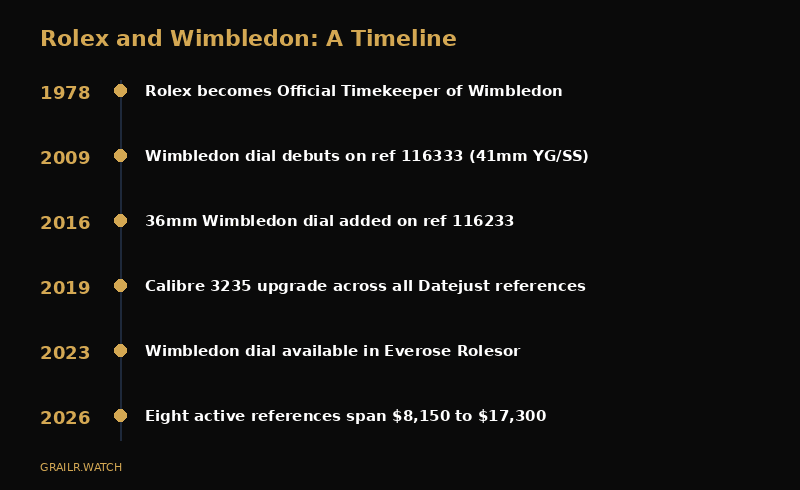
The Rolex–Wimbledon partnership timeline and dial evolution
Rolex and Wimbledon: A Brief History
The relationship between Rolex and The Championships began in 1978, when Rolex became the Official Timekeeper of Wimbledon. It was one of the brand’s earliest tennis partnerships and predates its current associations with the Australian Open, Roland-Garros, and the US Open. For nearly five decades, every match clock, scoreboard, and on-court timer at the All England Lawn Tennis Club has carried the Rolex crown.
The partnership deepened beyond timekeeping. Rolex became a sponsor of the Wimbledon broadcast, its crown logo a fixture on Centre Court. Roger Federer, a Rolex ambassador since 2001, won eight of his record Wimbledon titles wearing or associated with the brand. Current ambassadors like Carlos Alcaraz continue that tradition. The relationship made a Wimbledon-themed dial a natural extension of the brand’s identity rather than a marketing afterthought.
In 2009, Rolex formalised the connection with a dial designed specifically to reference the tournament. The original Wimbledon dial appeared on ref. 116333, a Datejust II in Yellow Rolesor (steel and 18ct yellow gold). Its slate grey background and green-trimmed Romans were unlike anything else in the catalogue. By 2016, when the Datejust II was replaced by the current 41mm Datejust, Rolex carried the Wimbledon dial across to the new references — and extended it to the 36mm for the first time.
Every Current Wimbledon Reference
As of 2026, Rolex offers the Wimbledon dial across seven references in two case sizes and four material combinations. Every current reference runs the Calibre 3235 — Rolex’s latest-generation movement with a 70-hour power reserve, Chronergy escapement, and Superlative Chronometer certification to ±2 seconds per day. All are rated to 100 metres of water resistance.
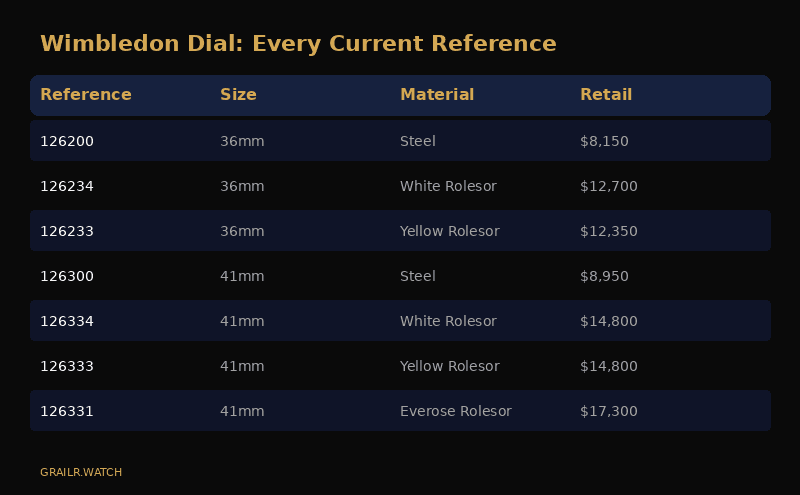
All seven current Wimbledon dial references at a glance
36mm References
The 36mm Datejust is the classic dress-watch size, worn by everyone from presidents to collectors who prefer a more restrained presence on the wrist. Three material grades are available with the Wimbledon dial:
- Ref. 126200 — Oystersteel, smooth bezel, Oyster bracelet. Retail $8,150. The entry point to the Wimbledon dial.
- Ref. 126234 — Oystersteel case with 18ct white gold fluted bezel (White Rolesor), Jubilee bracelet. Retail $12,700.
- Ref. 126233 — Oystersteel case with 18ct yellow gold fluted bezel and centre links (Yellow Rolesor), Jubilee bracelet. Retail $12,350.
41mm References
The 41mm Datejust is the more popular size today, offering greater wrist presence without moving into oversized territory. Four material grades carry the Wimbledon dial:
- Ref. 126300 — Oystersteel, smooth bezel, Oyster bracelet. Retail $8,950. The most accessible 41mm Wimbledon.
- Ref. 126334 — Oystersteel with 18ct white gold fluted bezel (White Rolesor), Jubilee bracelet. Retail $14,800. The best-selling Wimbledon configuration.
- Ref. 126333 — Oystersteel with 18ct yellow gold fluted bezel and centre links (Yellow Rolesor), Jubilee bracelet. Retail $14,800. The direct descendant of the original 2009 dial.
- Ref. 126331 — Oystersteel with 18ct Everose gold fluted bezel and centre links (Everose Rolesor), Jubilee bracelet. Retail $17,300. The warmest and most luxurious Wimbledon variant.
What Does Rolesor Mean?
Rolesor is Rolex’s trademarked name for a two-tone combination of Oystersteel and precious metal. The bezel and centre bracelet links are gold; the outer case and outer bracelet links remain steel. White Rolesor pairs steel with 18ct white gold. Yellow Rolesor uses 18ct yellow gold. Everose Rolesor uses Rolex’s proprietary 18ct pink gold alloy, which resists fading over time thanks to a small platinum addition.
Retail and Pre-Owned Pricing
One of the most notable aspects of the Wimbledon dial is its secondary market behaviour. While most Datejust configurations trade at or slightly below retail on the pre-owned market, Wimbledon dial models consistently trade at a premium. Steel references trade 4–6% above their retail price, and across all materials, the Wimbledon dial commands $1,000–$3,000 more than an equivalent Datejust with a different dial. This is unusual for a time-only dress watch and speaks to genuine collector demand.
| Reference | Size | Material | Retail | Pre-Owned |
|---|---|---|---|---|
| 126200 | 36mm | Steel | $8,150 | $8,500–$8,650 |
| 126234 | 36mm | White Rolesor | $12,700 | $13,200–$13,800 |
| 126233 | 36mm | Yellow Rolesor | $12,350 | $12,800–$13,500 |
| 126300 | 41mm | Steel | $8,950 | $9,300–$9,500 |
| 126334 | 41mm | White Rolesor | $14,800 | $15,400–$16,200 |
| 126333 | 41mm | Yellow Rolesor | $14,800 | $15,200–$15,800 |
| 126331 | 41mm | Everose Rolesor | $17,300 | $17,800–$18,500 |
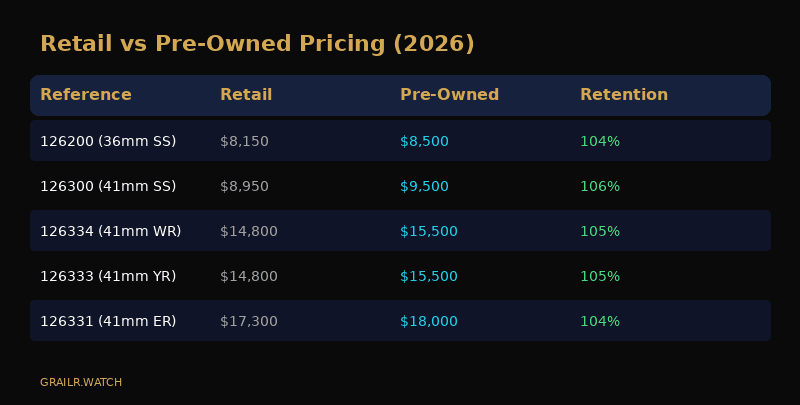
Retail versus pre-owned pricing across all seven Wimbledon references
The premium is most pronounced on the steel references, where availability is tightest and entry cost is lowest. The 41mm steel ref. 126300 regularly appears on dealer sites at $9,300–$9,500 in unworn condition — roughly 4–6% above its $8,950 retail price. On the Rolesor models the premium narrows in percentage terms but remains significant in absolute dollars, typically $500–$1,400 above retail. Keep in mind that these are asking prices from dealers and marketplaces, not verified completed sales. Actual transaction prices may differ. Use Grailr’s indicative appraisal to check current estimates for a specific reference.
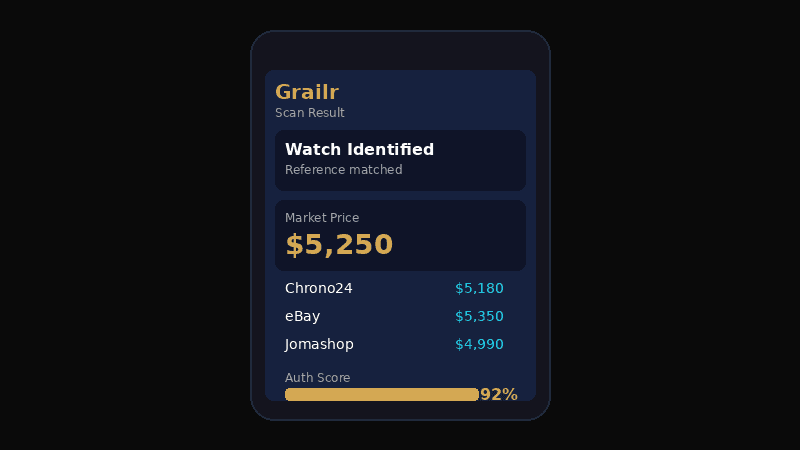
Check Any Watch Price in Seconds
Grailr scans your watch photo and pulls live pricing from Chrono24, eBay, and Jomashop.
- AI identifies brand, model & reference number
- Live market prices from 3+ sources
- Authentication confidence score
How to Choose: Size, Bezel and Bracelet
With seven references to choose from, the decision comes down to three variables: case size, bezel style, and bracelet type. Here is how each choice affects the look and feel on the wrist.
36mm vs 41mm
The 36mm Datejust is the original size and remains the preferred choice for wrists under approximately 17 cm (6.7 inches). It sits close to the wrist, slips under a shirt cuff effortlessly, and carries a slightly dressier character. The 41mm — introduced as the Datejust II in 2009 and refined in 2016 — offers more wrist presence without crossing into sport-watch territory. On wrists between 17 cm and 20 cm, the 41mm is the more popular choice and generally photographs better on camera. Both sizes house the same Calibre 3235 movement, so there is no difference in accuracy, power reserve, or reliability.
Smooth vs Fluted Bezel
On the Wimbledon dial, the bezel choice makes a significant visual difference. The smooth bezel (available only on the all-steel 126200 and 126300) gives a more understated, modern look. The fluted bezel (standard on all Rolesor models) catches light and adds a layer of luxury. With the Wimbledon dial’s already distinctive green-and-grey colour scheme, the smooth bezel keeps the overall presentation subtle, while the fluted bezel leans into Datejust tradition.
Oyster vs Jubilee Bracelet
The Oyster bracelet has flat three-piece links and a sportier, more robust appearance. The Jubilee bracelet uses five-piece links that create a more refined, flowing look on the wrist. On the Wimbledon dial references, the steel models come on the Oyster bracelet, while all Rolesor models ship on the Jubilee. Collectors often describe the Jubilee as the “proper” Datejust look, though this is entirely a matter of taste.
| Feature | Steel (126200/126300) | White Rolesor | Yellow Rolesor | Everose Rolesor |
|---|---|---|---|---|
| Bezel | Smooth (steel) | Fluted (white gold) | Fluted (yellow gold) | Fluted (Everose gold) |
| Bracelet | Oyster | Jubilee | Jubilee | Jubilee |
| Centre links | Steel | Steel | Yellow gold | Everose gold |
| Movement | Cal. 3235 | Cal. 3235 | Cal. 3235 | Cal. 3235 |
| Water resistance | 100m | 100m | 100m | 100m |
| Power reserve | 70 hours | 70 hours | 70 hours | 70 hours |
A practical note: if you are buying a Wimbledon dial as your primary everyday watch, the steel models on the Oyster bracelet are lighter and more scratch-resistant in daily wear. If you want the classic Datejust look with the light-catching fluted bezel and Jubilee bracelet, a Rolesor model is the traditional choice. Both paths lead to the same dial, the same movement, and the same Wimbledon character. For a broader look at how the Datejust lineup compares, see our full Datejust buying guide.
Value Retention and Investment Outlook
The Datejust has always been Rolex’s volume seller, and most Datejust dial variants trade at or slightly below retail on the secondary market. The Wimbledon dial is the exception. Its consistent above-retail premiums on the steel models and minimal depreciation on the Rolesor models make it one of the stronger-performing Datejust configurations.
Several factors drive this. First, the Wimbledon dial is one of relatively few Datejust dials with a backstory — its connection to a major sporting event gives it cachet beyond simple aesthetics. Second, the green-and-grey colour combination is visually unique within the Rolex catalogue and does not compete directly with other popular dial colours like blue, black, or champagne. Third, the dial has never been discontinued or redesigned since its 2009 debut, building a track record of continuity that collectors value.
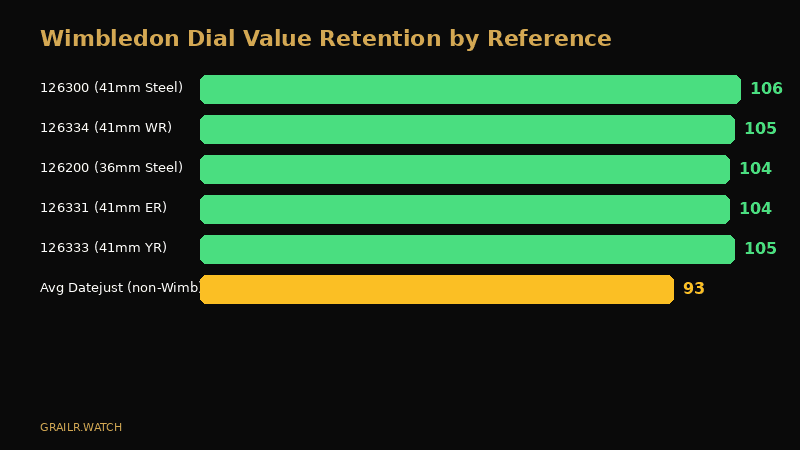
Wimbledon dial value retention compared with standard Datejust configurations
That said, a Datejust is not a Submariner or Daytona. Even with the Wimbledon premium, the absolute dollar appreciation on these watches is modest compared with sport-model Rolex references. If you buy a steel Wimbledon Datejust at $8,950 retail and sell it two years later for $9,400, that $450 gain is before dealer fees, shipping, insurance, and opportunity cost. These are watches to buy because you want to wear them, with value retention as a welcome side effect rather than a primary strategy. For more on Rolex resale dynamics, see our guide to investing in Rolex watches.
The biggest risk to Wimbledon dial values would be a discontinuation followed by a replacement with a different tennis-themed dial, or a significant production increase that floods the market with supply. Neither appears imminent — Rolex has held the Wimbledon timekeeping contract for 48 years, and the current dial design has survived two generation changes without alteration — but no future outcome is guaranteed.
Buying Tips for Wimbledon Dial Datejust
Whether you are visiting an authorised dealer or shopping the pre-owned market, these practical tips will help you navigate the Wimbledon dial purchase.
1. Try Both Sizes
The 36mm and 41mm Wimbledon dials look different on the wrist than they do in photos. The green Roman numerals scale with the dial, so the 41mm version has slightly larger, more readable markers. Visit an authorised dealer to try both before committing, even if you think you know your preferred size from other watches. Rolex cases wear larger than their millimetre rating suggests due to the lugs and crown guards.
2. Check the Dial in Sunlight
The Wimbledon dial’s sunray finish and green-outlined numerals look dramatically different under artificial light versus direct sunlight. In a showroom, the grey can appear almost flat; outdoors, the sunray catch transforms the entire personality of the watch. Ask to step outside the boutique — any good AD will accommodate this request.
3. Understand the Rolesor Premium
The jump from the steel ref. 126300 at $8,950 to the White Rolesor ref. 126334 at $14,800 is $5,850 — a 65% increase for a white gold bezel and Jubilee bracelet. The bezel is visually striking, but white gold looks similar to steel from a distance. Yellow and Everose Rolesor are more visually distinct. Consider whether the fluted bezel alone justifies the price difference, or whether a different Rolex model entirely might be a better use of the extra $5,000–$8,000.
4. Scan Before You Buy Pre-Owned
If you are purchasing from a dealer, marketplace, or private seller, use Grailr’s free scanner to photograph the listing and get a suggested identification and indicative price estimate. This is a starting point for due diligence, not a substitute for professional authentication. Compare the reference number, serial, and documentation against the seller’s claims independently.
5. Watch for Discontinued References
The previous-generation Wimbledon dial references (116333, 116233, 116201, and 116231) used the older Calibre 3135 with a 48-hour power reserve. These trade for less than the current-generation models but remain excellent watches. If budget is a concern, a pre-owned 116333 in good condition offers the same dial aesthetic with a proven movement, typically at $2,000–$4,000 less than the current ref. 126333.
6. Factor in Servicing Costs
A Rolex service interval is approximately every 10 years and costs $800–$1,200 for a standard Datejust at a Rolex service centre. Rolesor models cost slightly more due to the precious-metal components. This is a modest ongoing cost relative to the watch’s value, but worth factoring into the total cost of ownership — particularly if you are comparing the Wimbledon Datejust against non-Rolex alternatives.
Frequently Asked Questions
What makes the Wimbledon dial different from a standard Datejust dial?
The Wimbledon dial is a slate grey sunray-finished dial with oversized Roman numerals outlined in green. The green outlines reference Wimbledon's signature colour, distinguishing it from regular grey or slate Datejust dials that use silver or white hour markers.
Is the Rolex Wimbledon dial available on an all-steel Datejust?
Yes. The Wimbledon dial is available on both the 36mm ref. 126200 and the 41mm ref. 126300, which are full Oystersteel models with smooth bezels. These are the most affordable Wimbledon dial references at $8,150 and $8,950 respectively.
How much does a Rolex Wimbledon dial cost?
Retail prices range from $8,150 for the 36mm steel (ref. 126200) to $17,300 for the 41mm Everose Rolesor (ref. 126331). Pre-owned Wimbledon dials typically trade at a $1,000 to $3,000 premium over non-Wimbledon equivalents.
Why is it called the Wimbledon dial?
The dial takes its nickname from The Championships at Wimbledon. Rolex has been Official Timekeeper of Wimbledon since 1978, and the green-outlined Roman numerals echo the tournament's iconic dark green colour. Rolex does not use the name officially; it is a collector term.
Do Wimbledon dials hold their value better than other Datejust dials?
Generally yes. Pre-owned Wimbledon dial models trade at a consistent $1,000 to $3,000 premium over non-Wimbledon Datejust equivalents in the same material and size. Steel Wimbledon models trade 4 to 6 percent above retail, which is unusual for a Datejust.
Should I choose the 36mm or 41mm Wimbledon dial?
The 36mm suits wrists under about 17 cm (6.7 inches) and works well as a dress watch. The 41mm is the more popular size for everyday wear on wrists from 17 cm to 20 cm. Both share the same Calibre 3235 movement and 70-hour power reserve, so the decision is about wrist size and personal preference.
Related Articles
The Bottom Line
The Wimbledon dial is one of the few Datejust configurations with a genuine story behind it — nearly five decades of Rolex timekeeping at the most prestigious tennis tournament in the world, expressed as a slate grey dial with green-outlined Romans that is unlike anything else in the catalogue. Whether you choose the accessible $8,150 steel at 36mm or the luxurious $17,300 Everose Rolesor at 41mm, you are getting the same Calibre 3235 movement, the same 100-metre water resistance, and the same Superlative Chronometer certification.
The secondary market premium is a bonus, not a reason to buy. Choose the Wimbledon dial because the aesthetic speaks to you, pick the size and material that fit your wrist and budget, and wear it with confidence. If you want to check a specific reference’s current market position first, run it through Grailr before visiting the dealer.
Considering a Wimbledon Dial?
Grailr uses a photo to suggest a watch identity and an indicative price estimate, with active listings where available. Check the exact reference and condition independently; a photo scan cannot authenticate a watch.
Scan a Watch NowSources and price context
- Rolex Datejust collection — Official specifications, reference numbers, and retail pricing for the current Datejust lineup including Wimbledon dial configurations.
- Rolex and Wimbledon partnership — Official overview of the Rolex–Wimbledon timekeeping relationship from The All England Lawn Tennis Club.
These primary sources support the specific history, specification, and partnership details noted above. Prices and resale figures elsewhere in this guide are indicative editorial figures, not a verified transaction dataset or guaranteed returns. Confirm the exact reference, region, condition, and current quote before buying; asking prices are not completed-sale prices.