What Condition Actually Costs You: Scratches, Polished Cases, Box & Papers
Every condition factor that moves a watch’s resale price — from hairline scratches to heavy polishing, missing boxes to replaced parts — explained with real percentages and specific examples.
Price context: this guide includes indicative prices from its original publication period. They have not all been refreshed to current quotes. Use the linked primary sources for specifications and policies, and verify prices independently.

- Light surface scratches cost under 5% of resale value, but deep dents or nicks can cut it by up to 50%
- Over-polishing removes metal and can reduce value by 15–30%; reshaped lugs on vintage Rolex drop 20–40%
- A complete set (box, papers, warranty card) adds 10–25% to resale price depending on brand and model
- A mint, unpolished, full-set watch can sell for 30–50% more than the same reference with heavy wear or replacement parts
- Non-original dials, hands, or bezels slash value by 30–50%, making part originality the single largest binary factor
Why Condition Is the Biggest Price Lever
If you have ever browsed pre-owned watch listings, you have seen the same reference number priced at wildly different levels. A Rolex Submariner 126610LN might be listed at $12,500 from one dealer and $9,800 from another — same model, same year, same dial colour. The variable that explains most of that gap is not the dealer’s margin. It is condition.
Condition is the single most controllable factor in a watch’s resale value. You cannot change a model’s production run or its secondary-market demand, but you can choose whether to wear it with care, whether to have it polished, and whether to keep the box and papers. Every one of those choices has a measurable price consequence — sometimes in the hundreds, sometimes in the tens of thousands.
A Rolex Submariner 126610LN graded Mint can sell for $1,500–$3,000 more than the identical reference graded Very Good. Scale that to a Patek Philippe Nautilus or a vintage Daytona and the spread can reach five figures. A complete set in mint unpolished condition has been documented selling for 30–50% more than the same reference with heavy wear or replacement parts.
Understanding exactly how each condition factor moves the price is the difference between buying smart and overpaying — or between selling for what your watch is worth and leaving thousands on the table. This guide breaks every factor down, starting with the grading language the industry actually uses.
The Condition Grading Scale Explained
There is no single universal grading standard across the watch industry. Chrono24 uses one scale, Bob’s Watches uses another, and independent dealers often grade by eye with no published criteria at all. That inconsistency is itself a risk factor: a watch one dealer calls “Excellent” might be “Very Good” at another. Always examine photographs and, where possible, the physical watch before relying on a single word.
That said, the five-tier scale below captures the general language most platforms and dealers use. Knowing where a watch falls on this spectrum — and what each tier typically means for price — is the foundation for every negotiation.
| Grade | Description | Typical Price Impact |
|---|---|---|
| Unworn / Mint | No visible wear; stickers or tags may still be attached. Appears as it left the factory. | Baseline (highest) |
| Excellent | Very minor marks visible only under magnification. Worn sparingly; all original parts. | 0–5% below Mint |
| Very Good | Light scratches on case, clasp, or bracelet. Normal signs of regular use. | 5–15% below Mint |
| Good | Moderate scratches, small dents, bracelet stretch. May have had a polish. | 15–30% below Mint |
| Fair | Heavy wear, deep scratches, significant dents, replaced parts, or non-functioning components. | 30–50% below Mint |
These tiers are editorial summaries based on common dealer usage. Individual platforms define their own criteria, and no industry body enforces a single scale.
Scratches, Dents, and Surface Wear
Not all wear is created equal. The difference between “lived-in character” and “damaged goods” comes down to depth, location, and repairability — and the market prices each one differently.
Light Surface Scratches
Hairline scratches on the case sides, clasp, and bracelet links are the normal footprint of regular wear. On polished surfaces they show more readily; on brushed or matte finishes they tend to blend. These light marks typically reduce resale value by under 5% and are often removable with a professional service polish — though whether that polish is wise is a separate question (more on that below).
For most modern watches from mainstream brands, light surface scratches are expected and priced in at the “Excellent” or “Very Good” tier. Buyers accept them. Dealers accept them. They are the cost of actually wearing a watch rather than storing it in a safe.
Significant Damage: Nicks, Deep Dents, and Gouges
Deep dents in the case, nicks on the bezel, or gouges across the lugs are a different category entirely. This level of damage can require re-polishing or even metalwork to address, and the repair itself may not fully restore the original geometry. Significant physical damage can reduce resale value by up to 50%, particularly on watches where case shape is a defining feature.
A dent on the caseback of a Seamaster is cosmetic. A dent on the bezel of a Submariner is structural to the design. Location matters because buyers evaluate damage relative to the watch’s visual identity: a scratch on the side of a Datejust case is less damaging than one across its polished bezel.
When evaluating a watch with visible damage, ask yourself two questions. First, can a certified service centre repair it without removing material or altering the case shape? Second, does the current asking price reflect the cost of that repair? If the answer to either is no, the watch is overpriced for its condition. Grailr’s appraisal tool can help you establish what a comparable example in better condition is actually trading for, so you know the real gap.
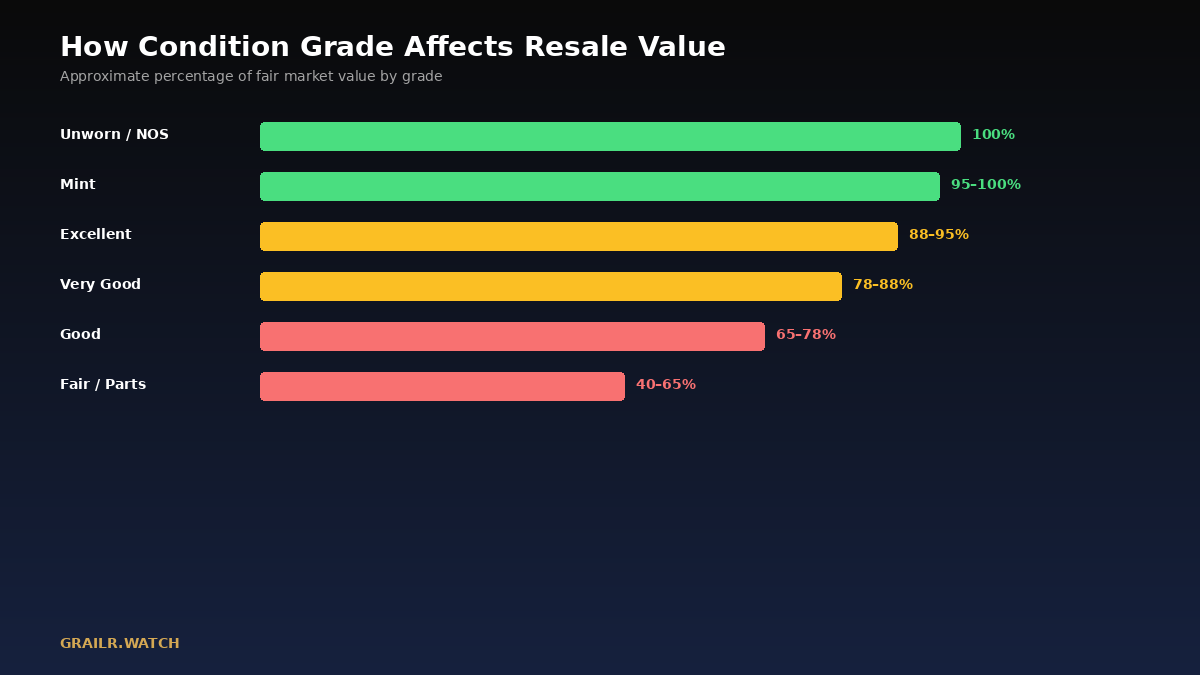
Indicative value impact by condition factor — editorial estimates based on common market observations
The Polishing Trap: When “Fixing” a Watch Destroys Value
Polishing a watch case is like sanding wood: it removes material to create a smooth surface. Every polish takes off a thin layer of metal, and those layers do not grow back. On a modern watch with generous case thickness, a single professional polish is unlikely to be visible. But repeated polishes accumulate, and the effects are permanent.
Over-polishing can reduce a watch’s value by 15–30%. The damage is not always obvious to a casual observer, but experienced buyers and dealers spot it immediately: softened edges where there should be crisp chamfers, rounded lugs that were originally sharp, and a case profile that looks subtly “melted” compared to an unpolished example. Under a loupe, over-polished surfaces show uneven grain and micro-pitting that no amount of further polishing can remove.
The penalty is harshest on vintage Rolex. Collectors of references like the 5513 Submariner, 1675 GMT-Master, and 6263 Daytona prize sharp, unpolished lugs as a sign that the watch has survived intact. Heavy polishing or reshaped lugs on these models can cut 20–40% from the price — potentially tens of thousands of dollars on a reference that already commands a six-figure premium.
The trap is that polishing often seems like the right move. A watch looks tired, a dealer offers to “freshen it up,” and suddenly the scratches are gone. But in many cases the scratches were less damaging to value than the polish that removed them. A lightly scratched but unpolished Submariner is worth more than the same Submariner with perfect surfaces but rounded lugs.
When Is Polishing Acceptable?
A single, light professional polish on a modern watch (post-2000) with deep scratches can be reasonable if the case geometry is preserved and the work is done by a brand-certified service centre. Avoid any polish on vintage watches, limited editions, or references where unpolished condition carries a documented premium. When in doubt, leave it alone — you can always polish later, but you can never un-polish.
Check Any Watch Price in Seconds
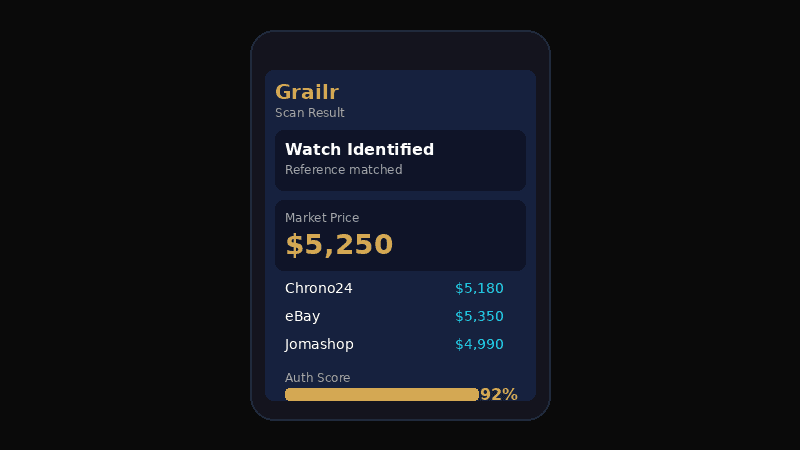
Grailr scans your watch photo and pulls live pricing from Chrono24, eBay, and Jomashop.
- AI identifies brand, model & reference number
- Live market prices from 3+ sources
- Authentication confidence score
Replaced Parts and Originality
Part originality is where the biggest value cliffs live. A watch can have perfect external condition and still carry a massive discount if its dial, hands, bezel insert, or crown have been replaced with non-original components. On collectible references, replaced parts can reduce value by 30–50% even when the replacements are genuine manufacturer service parts.
Why? Because collectors are buying a specific configuration as it left the factory. A vintage Rolex Submariner 5513 with its original matte dial and matching patinated lume plots tells a story of survival. Replace that dial with a service dial from a later decade, and the story changes. The watch still runs identically, but its collector value drops significantly because the replacement part is not the one that sat in the same case for 40 years.
The same principle applies to modern watches, though the premiums are smaller. A current-production Omega Speedmaster with its factory-installed hesalite crystal is worth more than one where the crystal was swapped for an aftermarket sapphire. Factory crystals are preferred by the market because they confirm the watch has not been modified, and aftermarket replacements introduce uncertainty about what else might have been changed.
Common Replaced Parts and Their Impact
- Dial: A non-original dial is the single most damaging replacement. Service dials, “aftermarket upgraded” dials, and re-lumed dials all carry heavy penalties. On vintage Rolex, an original tritium dial with matching serial-range lume can be worth thousands on its own.
- Hands: Replaced hands are less obvious than a replaced dial but equally damaging to collectors. Mismatched lume colour between hands and dial indices is a telltale sign.
- Bezel insert: On models like the Submariner and GMT-Master, the bezel insert is a signature design element. A faded original insert is often worth more than a crisp replacement because the patina confirms age and originality.
- Crystal: Factory crystals are always preferred. Aftermarket sapphire replacements on watches that shipped with hesalite or acrylic reduce value and signal possible unrecorded service history.
- Crown: A non-original crown is less visible but raises the same authenticity concern. If the crown was replaced, what else was changed during the same service?
Before buying any pre-owned watch, ask the seller to confirm every component’s originality in writing. If you are buying online, authenticate the watch independently before committing. Even well-intentioned sellers may not know their watch has been serviced with non-original parts at some point in its history.
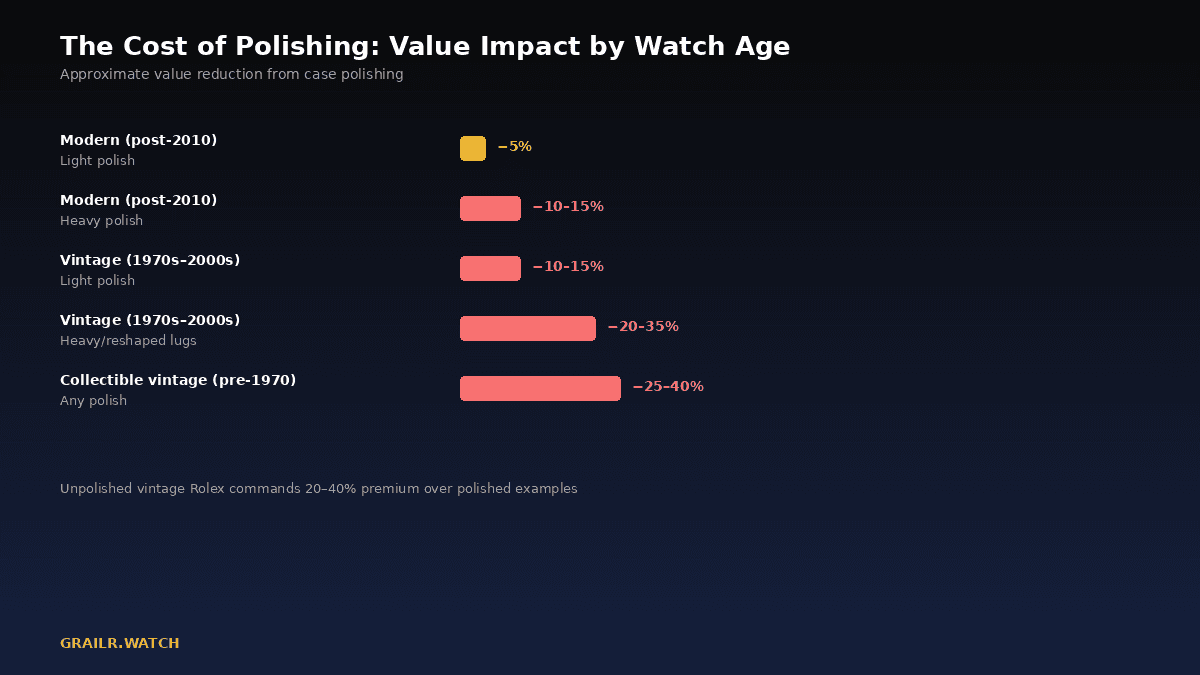
Sharp original lugs versus rounded, over-polished lugs — the difference collectors pay a premium for
Bracelet, Crystal, and Other Overlooked Factors
Beyond the headline condition categories, several less-discussed factors contribute to a watch’s overall grade — and its price.
Bracelet Stretch
Bracelet stretch — the loosening of links and pins through years of wear — is one of the most common forms of degradation on pre-owned watches. It affects wearability directly: a stretched bracelet rattles on the wrist, does not sit flush, and feels cheap even on an expensive watch. Bracelet stretch degrades the watch’s overall grade and can reduce value by 5–15%, with vintage hollow-link bracelets hit hardest.
On modern watches with solid-link bracelets (like the Rolex Oyster or Omega integrated bracelet), stretch is less of an issue but still occurs over decades of daily wear. Pin and tube replacement can tighten a bracelet, but the fix is only partial if the link holes themselves have worn oval.
Crystal Condition
A scratched sapphire crystal is almost always replaceable with a factory part, and the cost is modest relative to the watch’s value. Acrylic crystals on vintage watches are also replaceable, though originality purists prefer the original crystal with its accumulated scratches. The real issue is a chipped or cracked crystal, which suggests an impact event that may have damaged the movement, water-resistance gaskets, or dial beneath.
Service History
A documented service history from an authorized service centre is a plus, not a minus. It shows the watch has been maintained to manufacturer standards, the gaskets and worn components have been replaced on schedule, and the watch’s time-keeping should still be within specification. However, a service can also introduce non-original parts — Rolex’s own Certified Pre-Owned programme addresses this by guaranteeing authenticity and providing a separate two-year warranty. Always ask what was replaced during each service and request the invoices.
Lume Condition
On vintage watches, the luminous material on the dial and hands develops a patina over time — turning from white to cream, then to brown, and in some cases to a rich coffee tone. Matching patina between dial and hands (called “matching plots”) is highly desirable and commands a premium. Re-lumed dials and hands are treated as replaced parts and carry the same value penalty. Modern watches with Super-LumiNova or Chromalight do not develop significant patina, so lume condition is mainly a concern for pre-2000 references.
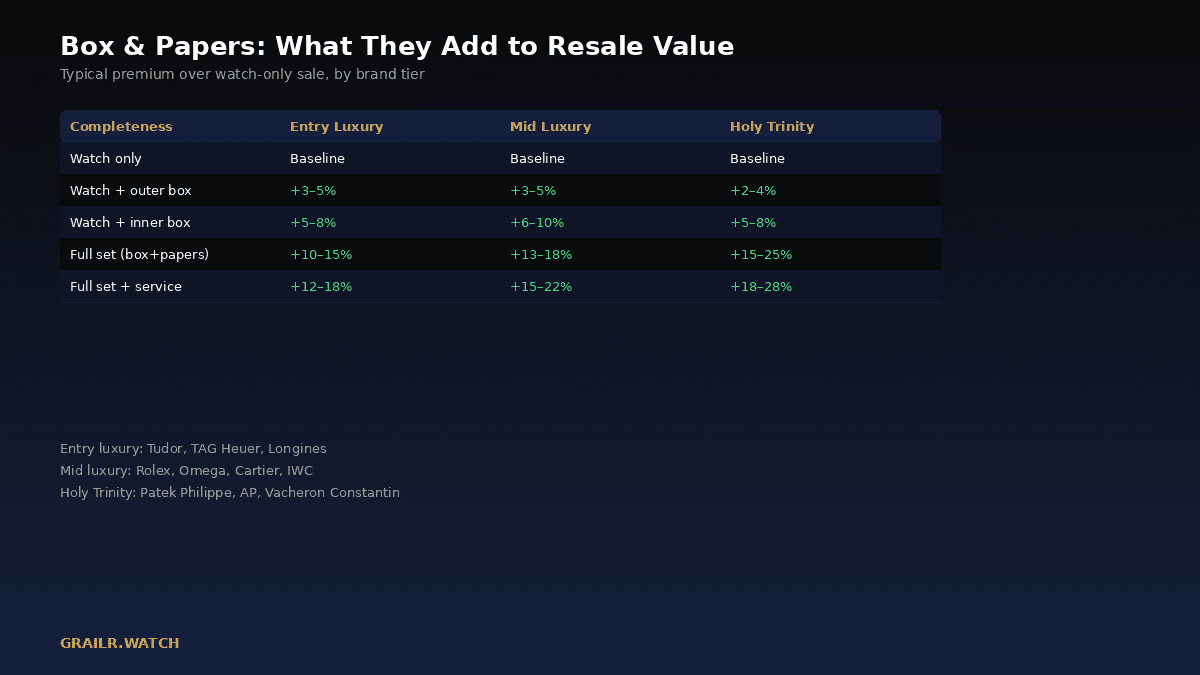
A full set with original box, warranty card, and hangtags versus a watch-only presentation
How to Assess Condition Before You Buy
Whether you are shopping in person at a dealer or evaluating listings online, a consistent inspection routine prevents expensive surprises. The checklist below covers the factors that matter most to resale value — and that sellers most commonly gloss over.
1. Examine the Case Under Strong Light
Tilt the watch under a bright LED or natural sunlight. Scratches, dents, and polishing evidence are most visible when light catches the surface at a low angle. Pay special attention to the lugs, bezel, and case sides — the areas most prone to contact damage and most likely to be polished.
2. Check the Bracelet for Stretch
Hold the bracelet by the watch head and let it hang. A tight bracelet holds a gentle curve; a stretched one sags and rattles. Flex individual links — they should move smoothly with minimal side-to-side play. Vintage hollow-link bracelets are especially susceptible.
3. Verify Part Originality
Compare the dial, hands, bezel insert, and crown to reference photos of the specific production year and variant. Look for mismatched lume colour between hands and indices, printing inconsistencies, and bezels that are too crisp for the watch’s stated age. When buying online, ask the seller to photograph the dial under UV light — re-lumed parts glow differently from original luminous material.
4. Request Service Records
Ask for invoices from every service the watch has undergone. Cross-reference the service dates with the parts listed. If a service replaced the dial or hands, that information should be reflected in the price. Missing service history is not necessarily a red flag, but it means you cannot verify what has been changed.
5. Get an Independent Estimate
Before committing, use Grailr’s scanner to photograph the watch and pull live comparable pricing. Comparing the seller’s asking price to actual market data for the same reference in similar condition is the fastest way to confirm whether the deal is fair. For a deeper breakdown, Grailr’s identification tool can confirm the reference number and give you a confidence score.
The best protection against overpaying for condition is information. Understand what each grade means, know the specific red flags for the reference you are buying, and always compare prices across multiple sources before making a decision. A watch that looks perfect in one photograph can reveal its history under closer inspection — and that history is what determines its real value.
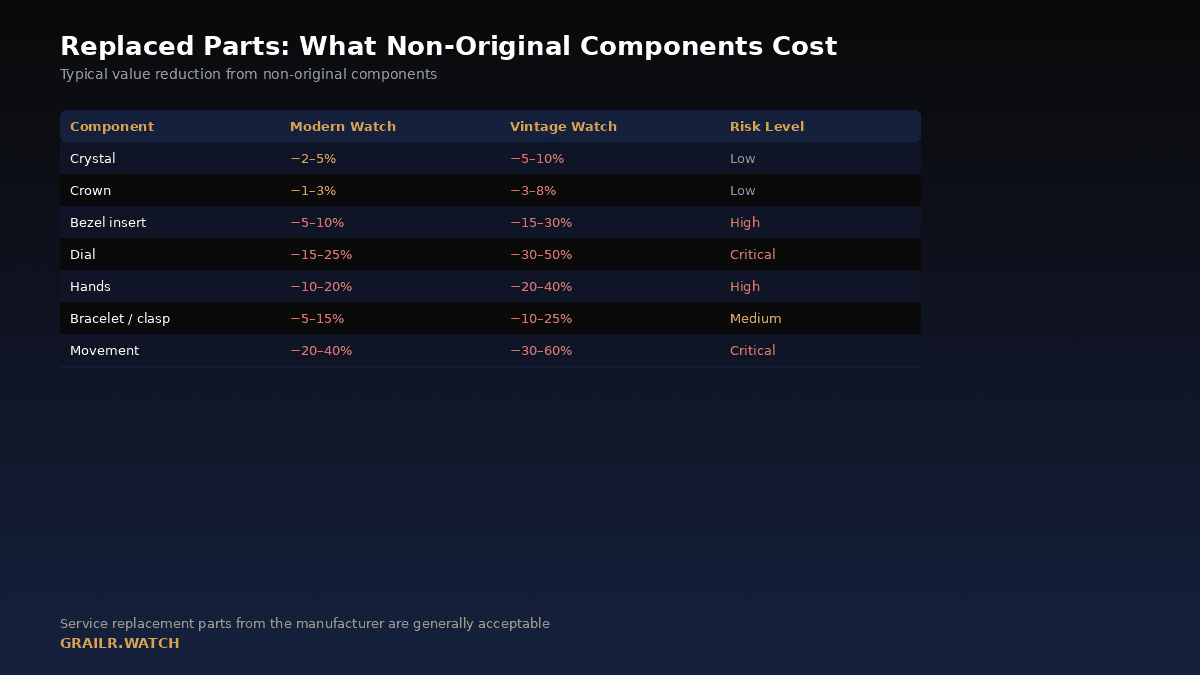
Value impact of non-original parts by component — editorial estimates based on market observations
Frequently Asked Questions
How much does condition affect watch value?
Condition is one of the largest single factors in watch resale value. Light surface scratches may reduce value by under 5%, while significant damage can cut it by up to 50%. A complete set in mint, unpolished condition can sell for 30-50% more than the same reference with heavy wear or replacement parts.
Does polishing a watch reduce its value?
Yes. Over-polishing can reduce a watch's value by 15-30%. Every polish removes metal from the case, and on vintage Rolex models where sharp, unpolished lugs are prized, heavy polishing or reshaped lugs can cut 20-40% from the price. A light professional polish on a modern watch is less damaging, but collectors generally prefer original surfaces.
How much do box and papers add to watch value?
Having the original box, papers, warranty card, and hangtags typically adds 10-25% to resale value, depending on the brand and model. On highly collectible references the premium can be even larger, particularly for vintage watches where original paperwork is rare.
What is the standard watch condition grading scale?
The most common scale runs from Unworn/Mint (no visible wear), through Excellent (very minor signs of wear), Very Good (light scratches or marks), Good (moderate wear), to Fair (heavy wear or damage). There is no single universal standard, so grading varies between dealers and platforms.
Do replacement parts affect watch resale value?
Significantly. Non-original dials, hands, bezel inserts, or crystals can reduce a watch's value by 30-50% depending on the model. Collectors pay a premium for all-original components, especially on vintage references where original tritium dials or faded bezels carry their own market value.
Is it worth buying a watch in less-than-perfect condition?
It depends on the watch and the discount. A modern sports watch in Very Good condition can represent genuine value if the price reflects the wear. However, buying a watch with replaced parts or heavy polishing requires extreme caution — the discount must offset the permanent reduction in collectibility and future resale potential.
Related Articles
The Bottom Line
Condition is not a detail — it is the detail. Two identical references can trade at prices separated by thousands or even tens of thousands of dollars based purely on surface wear, polish history, part originality, and the completeness of the original set. Understanding exactly how each factor moves the price lets you buy smarter, sell higher, and avoid the most expensive mistakes in the pre-owned market.
The short version: keep your watches unpolished, keep every original accessory, never replace parts with non-original components, and if you are buying pre-owned, inspect the condition as carefully as you verify the authenticity. The watch that looks “good enough” in a listing photo may be hiding a polish job, a replaced dial, or a stretched bracelet that none of the listing text mentions. Your best defence is knowledge — and the data to back it up.
Know What Your Watch Is Worth
Grailr uses a photo to suggest a watch identity and an indicative price estimate, with active listings where available. Check the exact reference and condition independently; a photo scan cannot authenticate a watch.
Get a Free EstimateSources and Price Context
- Bob’s Watches condition grading scale — One of the most widely referenced condition grading systems for pre-owned Rolex watches.
- Rolex Certified Pre-Owned programme — Explains Rolex’s own authentication process, servicing standards, and the separate two-year guarantee for CPO watches.
These primary sources support the specific condition-grading and programme details noted above. Percentages and price impacts elsewhere in this guide are indicative editorial figures based on common market observations, not a verified transaction dataset. Confirm the exact reference, condition, and current quote before buying or selling; asking prices are not completed-sale prices.