Antique Watches for Men: A Collecting Guide
Pocket watches, trench watches and the earliest wristwatches — what they cost, how to spot fakes, and where to buy safely.
Price context: this guide includes indicative prices from its original publication period. They have not all been refreshed to current quotes. Use the linked primary sources for specifications and policies, and verify prices independently.

- Common American pocket watches (Hamilton, Waltham, Elgin) sell for $100–$500; railroad-grade examples reach $500–$2,000
- WWI trench watches range from $300 to $3,000 depending on maker and provenance
- Redials are the single biggest risk — an original dial can be worth more than the rest of the watch combined
- Auction houses with published sold prices are the safest buying channel for first-time collectors
What Counts as an Antique Watch
The watch trade draws a loose but useful line. Antique generally means pre-1960 and often pre-World War II. Vintage covers the 1960s through the 1990s — the era of vintage wristwatches most collectors start with. This guide focuses on the older end: pocket watches, trench watches, Art Deco pieces, and the earliest self-winding wristwatches.
Why does the distinction matter? Antique watches face entirely different risks than their younger counterparts. Parts suppliers for a 1940s Omega Seamaster still exist. Finding a correct balance staff for an 1890s Waltham Riverside requires a specialist. Dials were hand-painted or printed on enamel, not applied with machine-cut indices — so a redial is harder to detect and far more damaging to value.
The reward is access to watchmaking at a level of hand-finishing that no modern production watch can match at the same price. A $400 railroad-grade Hamilton from 1920 has a movement with hand-adjusted timing in five positions, polished steel components, and a level of craft that would cost thousands in a new Swiss watch today.
Eras and Categories: Pocket Watches to Early Wristwatches
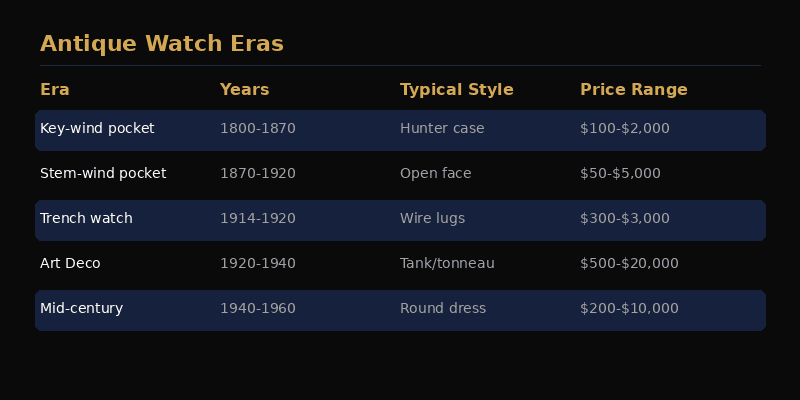
Antique men’s watches fall into four broad categories, each with its own collector base, price range, and set of pitfalls.
Pocket Watches (1700s–1950s)
The longest-lived category. American railroad-grade pocket watches from Hamilton, Waltham, and Elgin are the entry point for most collectors. These 16-size and 18-size movements were regulated to strict railroad standards — lever-set, adjusted to five positions, and rated to gain or lose no more than 30 seconds per week. Common examples in working condition sell for $100–$500. Gold-filled cases command $200–$800, while solid 14K gold cases push into the $800–$2,000 range.
European pocket watches occupy a different tier. A basic Swiss keywind from the mid-1800s might sell for $150–$400. Patek Philippe open-face pocket watches start around $5,000 for simpler models and reach six figures for complicated examples at auction. The Henry Graves Supercomplication, a Patek pocket watch with 24 complications, sold for $24.4 million in 2014 — the most expensive watch ever sold at that time.
Trench Watches (1914–1920s)
World War I forced the wristwatch into existence for men. Officers needed to coordinate attacks without fumbling a pocket watch, so jewellers soldered wire lugs onto small pocket-watch movements and strapped them to the wrist. These “trench watches” had white enamel dials, radium-painted numerals, and often a hinged metal grille over the crystal for protection. Unsigned examples sell for $300–$800. Pieces from named makers like Omega, Longines, or IWC in documented military condition reach $1,500–$3,000. Watches with verified provenance — a named officer, a regiment, a specific campaign — command premiums of 50–200% over comparable pieces without documentation.
Art Deco Wristwatches (1920s–1940s)
The interwar period produced some of the most beautiful watches ever made. Rectangular and tonneau cases, sector dials with contrasting colour registers, and stepped bezels defined the era. Cartier popularised the Tank in 1917, though production examples from the 1920s now sell for $10,000–$50,000 at auction. More accessible Art Deco pieces from Longines, Omega, and Hamilton start at $400–$1,500 for steel cases in reasonable condition.
Early Automatic Wristwatches (1930s–1950s)
Rolex introduced the Oyster Perpetual rotor in 1931, and competitors followed throughout the 1930s and 1940s. Early vintage Rolex Bubbleback models (Ref. 2940, 3131, 3372) used a half-rotor mechanism and are recognisable by their thick, domed casebacks. Bubblebacks in decent condition start around $2,500–$5,000. The Omega Seamaster CK 2577, introduced in 1948 with an automatic bumper movement, sells for $800–$2,500. These early automatics represent the transition point where pocket-watch craftsmanship met the wristwatch form factor — and many remain surprisingly wearable at 32–35mm.
The Key Makers and What They Cost
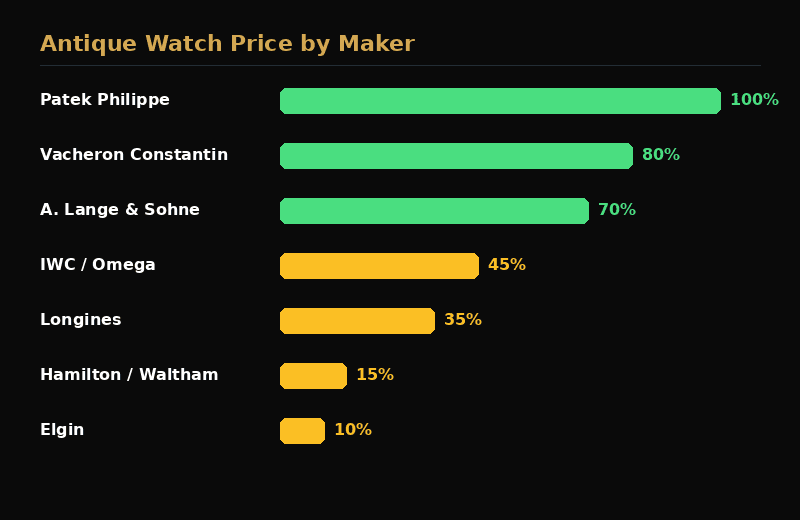
The maker determines more of an antique watch’s value than almost any other single factor. Here is how the major names break down by typical asking prices at auction and through specialist dealers.
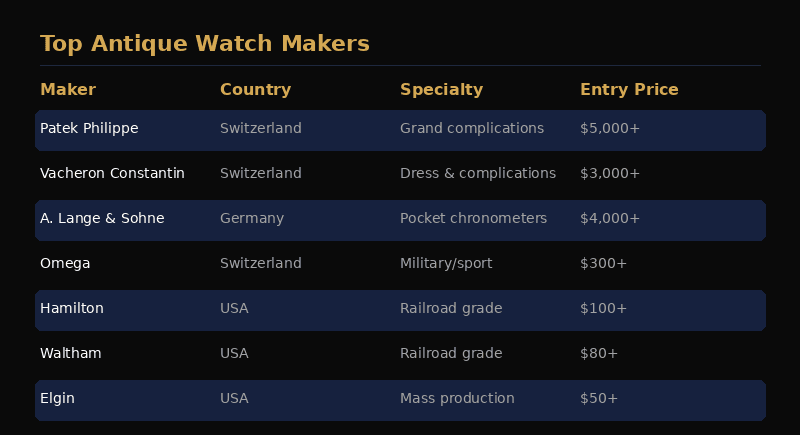
| Maker | Country | Pocket Watch Range | Wristwatch Range | Collector Demand |
|---|---|---|---|---|
| Patek Philippe | Switzerland | $5,000–$500,000+ | $8,000–$200,000+ | Very High |
| Vacheron Constantin | Switzerland | $3,000–$150,000 | $5,000–$80,000 | High |
| A. Lange & Söhne | Germany | $2,000–$50,000 | Rare pre-war | High |
| Omega | Switzerland | $300–$5,000 | $500–$15,000 | Strong |
| Longines | Switzerland | $200–$3,000 | $400–$8,000 | Strong |
| IWC | Switzerland | $500–$10,000 | $1,000–$20,000 | Strong |
| Hamilton | USA | $100–$2,000 | $200–$3,000 | Moderate |
| Waltham | USA | $80–$1,500 | $150–$1,500 | Moderate |
| Elgin | USA | $60–$1,000 | $100–$800 | Moderate |
Pricing Tiers: $100 to $500,000
Antique watches offer genuine craftsmanship at nearly every budget. Here is what each tier buys you in terms of maker, condition, and complications.
| Price Tier | What You Get | Example | Typical Condition |
|---|---|---|---|
| $100–$500 | American pocket watch, basic Swiss keywind, unsigned trench watch | Elgin B.W. Raymond 16s, Waltham Vanguard | Running, may need service |
| $500–$2,000 | Railroad-grade gold-filled pocket watch, signed trench watch, early automatic | Hamilton 992B, Omega trench watch, early Bulova | Good to excellent, recently serviced |
| $2,000–$10,000 | Named Swiss pocket watch, Art Deco wristwatch, early Rolex or Omega | Longines sector dial, Rolex Bubbleback, IWC pocket watch | Excellent, original dial preferred |
| $10,000–$50,000 | Complicated Swiss pocket watch, rare Art Deco, early Cartier | Vacheron minute repeater, Cartier Tank 1920s, Patek open-face | Excellent to museum, full provenance |
| $50,000+ | Grand complications, historically significant pieces, named collections | Patek perpetual calendar pocket watch, A. Lange grand complication | Museum grade, auction pedigree |
Prices are indicative ranges based on recent auction results and dealer listings. Condition, originality, provenance and market timing all affect final sale prices. Appraisal approaches that work for modern Rolex need significant adjustment for antique pieces.
Authentication: Spotting Redials, Replacement Parts and Fakes
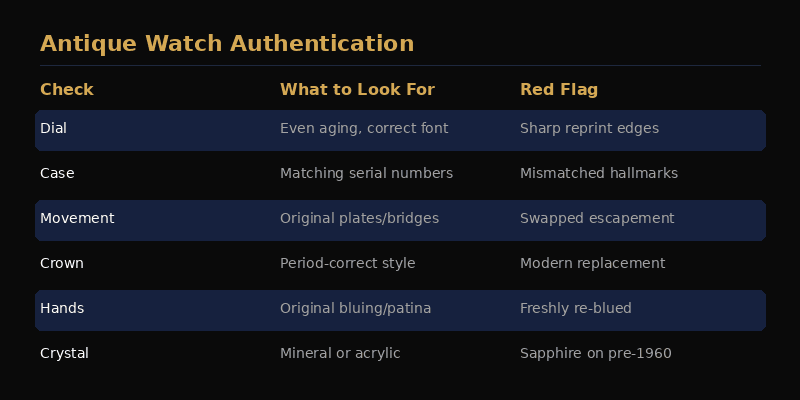
Antique watch fraud is more common than most new collectors expect. The three biggest risks are redials (a repainted dial passed off as original), married watches (a movement placed in a non-matching case), and outright fakes (a cheap movement with a prestige maker’s name engraved on it).
Dial Checks
The dial is the most frequently altered component. On an original enamel dial, the surface should be smooth and glassy with fine age-related hairline cracks called “crazing.” Printed dials should show even ink density and consistent font weight. A redial often has paint that sits higher than the surrounding surface, fonts that do not match period catalogues, and edges where the colour bleeds at index boundaries. Under magnification, an original dial’s printing looks slightly embedded; a redial sits on top.
Movement and Case Agreement
Every legitimate antique watch has serial numbers on both the movement and the case. These should match the maker’s production records for the same date range. A Hamilton 992B movement from 1942 should sit in a case from the early 1940s, not a case with a serial number from 1920. The National Association of Watch and Clock Collectors (NAWCC) maintains serial number databases for most major American makers.
Hands, Crowns and Crystals
Replacement hands are common and often acceptable if the replacements are period-correct. Non-original crowns reduce value but rarely ruin a watch. Replacement crystals are expected — original glass crystals rarely survive a century. The key question is whether any replacement part was used to misrepresent the watch as something it is not.
Red Flags Checklist
- Dial looks too clean for the stated age — likely a redial
- Movement serial number and case serial number are decades apart
- Case hallmarks do not match the stated metal content
- Seller refuses to provide caseback photos or movement shots
- Price is significantly below comparable auction results — too good to be true usually is
If you are spending more than $1,000, consider having the watch examined by a specialist before purchase. Many auction houses provide condition reports; specialist dealers affiliated with the NAWCC or the British Horological Institute offer independent assessments.
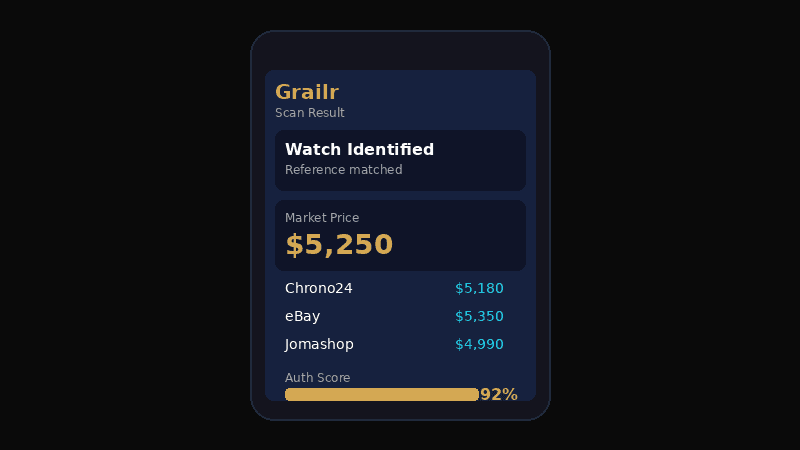
Check Any Watch Price in Seconds
Grailr scans your watch photo and pulls live pricing from Chrono24, eBay, and Jomashop.
- AI identifies brand, model & reference number
- Live market prices from 3+ sources
- Authentication confidence score
Where to Buy Antique Watches Safely
Auction Houses
Christie’s, Sotheby’s, and Bonhams run dedicated watch auctions several times a year. The advantage is published condition reports, photography of the movement, and a hammer guarantee that the item is authentic. Buyer’s premium typically adds 20–26% to the hammer price. Smaller regional auction houses like Fellows in Birmingham and Antiquorum in Geneva offer thinner competition and sometimes better prices.
Specialist Dealers
Dealers affiliated with the NAWCC, the Antiquarian Horological Society, or similar trade bodies stake their reputation on correct identification. Expect to pay a 15–30% premium over auction results, but you gain a return period, usually a detailed description of condition, and often a recent service. For vintage Omega and other Swiss brands, Omega’s own heritage department can sometimes verify provenance for significant pieces.
Estate Sales and Antique Fairs
Estate sales occasionally surface exceptional pieces at below-market prices, particularly in areas without a strong local collector community. The risk is higher: no condition report, no guarantee, and sometimes heirs who do not know what they have — in both directions. NAWCC regional chapter meetings and shows such as the National Watch & Clock Museum events in Columbia, Pennsylvania, attract knowledgeable sellers.
Online Platforms
eBay remains the largest source of antique watches by volume but demands the most buyer expertise. Use sold listings, not asking prices, as your pricing reference. Chrono24 carries fewer antique pieces but offers an escrow service. For high-value purchases above $5,000, an in-person examination or an independent pre-purchase inspection is worth the cost.
Caring for an Antique Watch
Antique watches are not daily wearers in the modern sense. Even water-resistant cases from the 1940s should be kept dry — gaskets degrade, and no watchmaker can guarantee a 70-year-old case seal. Store pocket watches on their sides, not standing on the crown, to prevent uneven wear on the mainspring barrel pivot. Wristwatches should sit in a padded watch box or travel case, away from magnetic fields.
Service intervals depend on use. A watch kept in a collection and wound occasionally can go five to ten years between services. A watch worn regularly should be serviced every three to five years by a watchmaker experienced with antique movements. Modern lubricants work well in antique calibres, but the watchmaker should verify compatibility with any surviving original gaskets or pallet stones.
The single most important care rule: do not polish the case. Original case finishing, whether brushed, engine-turned, or mirror-polished, is part of the watch’s history. A heavy polish removes metal, softens edges, and can erase hallmarks and engravings. Collectors and dealers can spot a polished case immediately, and it reduces value.
Frequently Asked Questions
How much is an antique pocket watch worth?
Most common American pocket watches from Hamilton, Waltham and Elgin sell for $100 to $500. Railroad-grade examples in good condition reach $500 to $2,000. Swiss makers like Patek Philippe start around $5,000 and can exceed $500,000 for complicated pieces.
What is the difference between antique and vintage watches?
In the watch trade, antique generally refers to pieces made before 1960 and often before World War II. Vintage typically covers the 1960s through the 1990s. The distinction matters because antique watches face different authentication challenges including redials, case replacements and non-original movements.
Are trench watches valuable?
WWI-era trench watches range from $300 to $3,000 depending on maker, condition and provenance. Officer's watches with enamel dials and wire lugs in original condition are the most sought after.
How can I tell if an antique watch dial is original?
Look for consistent ageing across the entire surface. Original dials show even patina, with text and indices that sit slightly below or flush with the surface. Redials often have paint sitting on top of the dial, inconsistent fonts, and edges that bleed where masking was imprecise.
Where is the best place to buy antique watches?
Established auction houses like Christie's, Sotheby's and Bonhams offer authentication guarantees and published sale results. Specialist dealers affiliated with trade bodies such as the NAWCC provide expertise. Estate sales and antique fairs can offer better prices but require more buyer knowledge.
Should I restore or preserve an antique watch?
Preservation almost always protects value better than restoration. Polishing cases removes original finishing and reduces collector interest. A sympathetic service that replaces only broken parts and preserves the original dial is the safest approach for watches you plan to keep or resell.
Related Articles
The Bottom Line
Antique men’s watches offer a level of hand-finishing and mechanical artistry that modern mass production cannot match at the same price. A $400 railroad-grade Hamilton gives you a movement regulated to five positions with hand-polished steel — craftsmanship that would cost thousands new. The key is buying carefully: learn to spot redials, verify serial numbers, buy from reputable sources, and resist the urge to polish away history. Start with American pocket watches to build your eye, then work up to Swiss and European pieces as your confidence grows.
Sources and price context
- Christie’s auction results for antique pocket watches — Recent sale prices for Swiss and American antique pocket watches.
- NAWCC — National Association of Watch and Clock Collectors — Serial number databases, regional chapter events and collector resources.
These primary sources support the specific history, specification or policy points noted above. Prices and ranges elsewhere in this guide are indicative editorial figures, not a verified transaction dataset or guaranteed returns. Confirm the exact maker, condition and current market before buying; asking prices are not completed-sale prices.