Bulova Accutron: Every Collection and Price
From the $1,290 Legacy to the $4,850 Spaceview Evolution — every modern Accutron collection compared with movement specs, pricing and buying advice.
Price context: this guide includes indicative prices from its original publication period. They have not all been refreshed to current quotes. Use the linked primary sources for specifications and policies, and verify prices independently.
- Accutron ranges from the $1,290 Legacy to the $5,850 Spaceview 314 titanium re-edition
- The NS30 electrostatic movement — the world’s first — powers most modern Spaceview models at ±5 sec/month
- Vintage 1960s tuning-fork Accutrons sell from $300 to $3,000+ depending on condition and reference
- The Spaceview DNA at roughly $3,300 is the sweet spot for most buyers wanting the electrostatic movement
A Brief History of Accutron
In 1960 Bulova launched the Accutron, the first watch to replace a traditional balance wheel with an electronically driven tuning fork. The caliber 214 vibrated at 360 Hz — far faster than any mechanical escapement — and delivered accuracy of roughly ±2 seconds per day. It hummed rather than ticked, and NASA trusted it enough to put it on the instrument panels of early spacecraft and satellites.
The tuning-fork movement dominated Bulova’s lineup through the 1960s and into the 1970s. When quartz oscillators arrived from Japan, the tuning fork became obsolete almost overnight. Bulova continued making conventional quartz watches under the Accutron name, but the engineering that made the brand famous was shelved for nearly fifty years.
In 2020 Citizen — which acquired Bulova in 2008 — relaunched Accutron as a standalone luxury brand with an entirely new movement: the NS30, the world’s first electrostatic energy caliber. The open-dial Spaceview design returned, the turbines replaced the tuning fork, and a name that once changed watchmaking was given a second act.
How the Electrostatic Movement Works
The NS30 caliber at the heart of most modern Accutron models does not use a quartz crystal, a mainspring or a rotor. Instead, two micro-turbines spin inside the movement, generating electrostatic energy that is stored in a capacitor. That capacitor powers an integrated circuit and a stepping motor, which drive the hands. The turbines are visible through the dial — a deliberate design choice that echoes the original Spaceview’s exposed tuning fork.
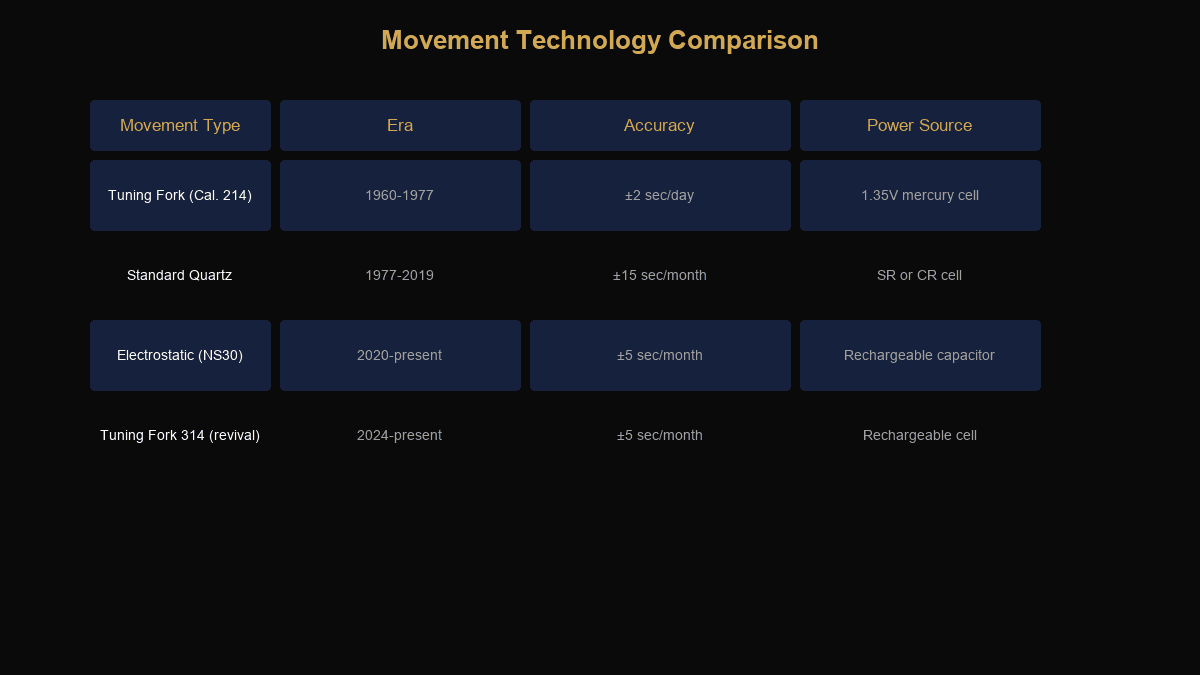
Accuracy sits at approximately ±5 seconds per month, which places the NS30 between a standard quartz movement (±15 sec/month) and a high-accuracy quartz like the Bulova Precisionist (±10 sec/year). The movement runs on a rechargeable power cell rather than a disposable battery, and Accutron states a full charge lasts several months.
| Movement Type | Era | Accuracy | Power Source |
|---|---|---|---|
| Tuning Fork (Cal. 214) | 1960–1977 | ±2 sec/day | 1.35V mercury cell |
| Standard Quartz | 1977–2019 | ±15 sec/month | SR or CR cell |
| Electrostatic (NS30) | 2020–present | ±5 sec/month | Rechargeable capacitor |
| Tuning Fork 314 (revival) | 2024–present | ±5 sec/month | Rechargeable cell |
Every Current Accutron Collection
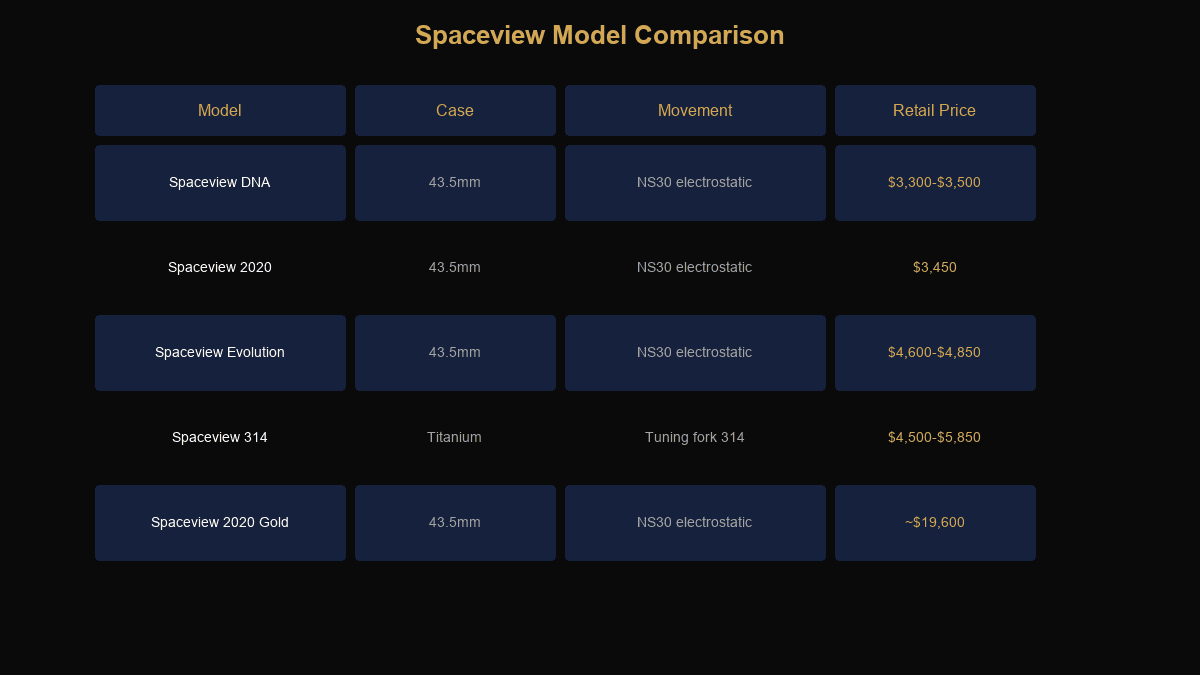
Spaceview 2020 ($3,450)
The flagship that relaunched the brand. A 43.5mm stainless-steel case frames a fully transparent dial through which the twin electrostatic turbines are visible. The minute track floats on a sapphire ring, and the crown at 2 o’clock controls the time while a pusher at 4 o’clock activates a “dead seconds” power-reserve indicator. Water resistance is 30 metres — enough for handwashing, not for swimming.
Dial colours include smoke grey, green and black. A limited-edition deluxe box set pushed past $4,000, and a solid-gold version (2ES7A001, 60 pieces) listed at roughly $19,600 — effectively a collector’s piece rather than a production model.
Spaceview Evolution ($4,600 – $4,850)
Launched in February 2026, the Spaceview Evolution adds forged-carbon dial elements to the open-worked design. The carbon pieces frame the turbines and give the otherwise airy dial a more structured, technical look. Four references are available at launch, all running the same NS30 caliber.
The Evolution is the most expensive electrostatic-movement Accutron in regular production. If you want the open-turbine look but prefer a lower price, the DNA delivers the same movement in a slightly more restrained package.
Spaceview DNA ($3,300 – $3,500)
The DNA takes the electrostatic movement and wraps it in a case that leans closer to a conventional watch. The skeleton dial still shows the turbines, but the surrounding architecture is denser than the 2020 or Evolution. Case diameter is 43.5mm in steel, with rubber or leather strap options.
At $3,300 the DNA is the most affordable way to own the NS30 in a Spaceview-style package. It shares the same ±5 sec/month accuracy and rechargeable power cell as its pricier siblings. For most buyers who want the electrostatic experience without the highest price, this is the model to consider.
Spaceview 314 ($4,500 – $5,850)
The 314 is a different animal entirely. Instead of the electrostatic NS30, it revives the tuning-fork technology that made Accutron famous in 1960 — updated for modern manufacturing. The titanium case keeps weight down, and the open dial lets you see the fork vibrating at the same 360 Hz that powered the original. Pricing varies by dealer and region; expect to pay between $4,500 and $5,850 depending on the reference.
If the historical connection matters to you more than the novelty of the electrostatic system, the 314 is the modern Accutron to buy. It hums, it vibrates, and it links directly to the watch that went to space.
Legacy ($1,290 – $1,550)
The entry point. The Legacy collection uses conventional quartz movements rather than the electrostatic or tuning-fork calibers, so it lacks the visual drama of the Spaceview lines. What it offers instead is the Accutron name at a price that sits between mainstream Bulova and the Spaceview tier.
Twelve styles are available, each limited to 600 individually numbered pieces. Designs range from clean dress watches with applied indices to models with textured dials and date windows. The limited-edition numbering adds a collector angle, though the conventional movement means the Legacy competes directly with Swiss quartz watches from Longines, Tissot and TAG Heuer in the same price band.
Astronaut Reissue
Announced alongside updated Bulova Lunar Pilot chronographs, the Astronaut reissue honours the Accutron Astronaut that accompanied NASA pilots in the 1960s. Pricing and full specifications are still filtering through dealers. The original Astronaut was one of the first watches certified for space flight, and the reissue is expected to carry a tuning-fork or electrostatic movement in a case that references the 1960s design language.
Complete Pricing Table
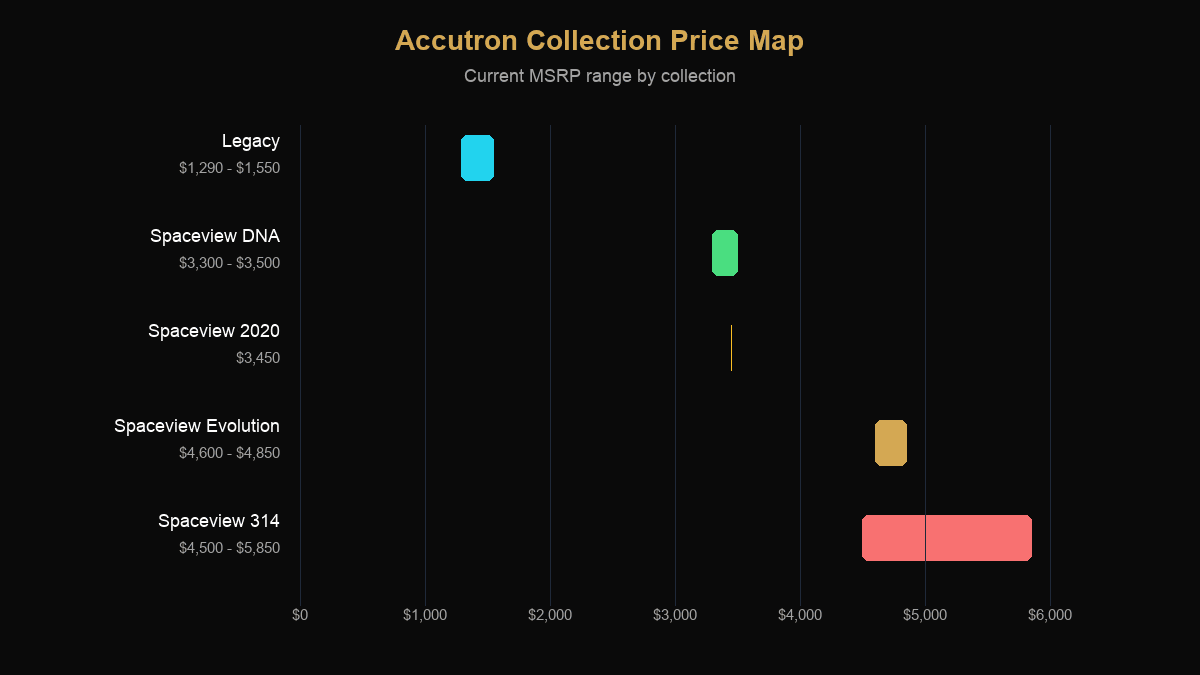
The table below lists indicative retail prices for every current Accutron line. Dealer discounts are uncommon on Accutron — unlike mainstream Bulova, which is heavily discounted at authorised retailers. Pre-owned prices vary widely because the brand is still young and secondary-market volume is thin.
| Collection | Movement | Case Size | Retail Price | Est. Pre-Owned |
|---|---|---|---|---|
| Legacy | Quartz | Various | $1,290–$1,550 | $500–$800 |
| Spaceview DNA | NS30 Electrostatic | 43.5mm | $3,300–$3,500 | $1,500–$2,200 |
| Spaceview 2020 | NS30 Electrostatic | 43.5mm | $3,450 | $1,600–$2,400 |
| Spaceview Evolution | NS30 Electrostatic | 43.5mm | $4,600–$4,850 | Limited data |
| Spaceview 314 | Tuning Fork (revival) | Titanium | $4,500–$5,850 | Limited data |
| Spaceview 2020 Gold | NS30 Electrostatic | 43.5mm | ~$19,600 | 60 pieces, rarely traded |
Vintage Accutron: What to Know Before You Buy
The original tuning-fork Accutrons (1960–1977) are among the most collectible American watches ever made. The Spaceview, with its exposed movement visible through the dial, is the most recognised model, but Bulova produced dozens of case styles across men’s and women’s ranges. Prices start at around $300 for a non-running example in rough condition and climb past $3,000 for a fully serviced Spaceview in excellent shape with original papers.
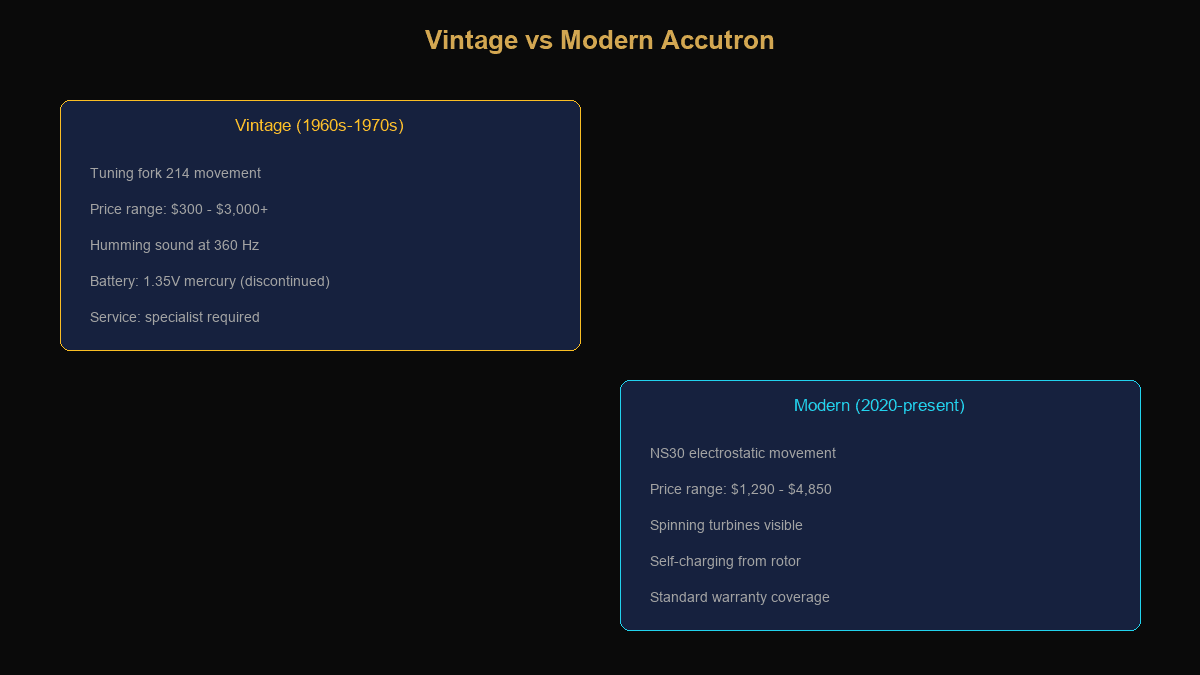
The biggest challenge with vintage Accutrons is servicing. The original 1.35-volt mercury cells were banned in most countries decades ago. Modern replacements exist — silver-oxide cells with voltage adapters — but fitting them requires a watchmaker who knows the caliber. Coils can fail, and replacement parts are increasingly scarce. Budget $150 to $400 for a proper service from a specialist.
Condition matters enormously. A vintage Accutron with a refinished dial, a replacement crown or a polished case loses 30 to 50 percent of its value compared to an all-original example. If you’re buying sight-unseen, ask for macro photographs of the dial printing, the caseback engravings and the movement. Watches that hold value tend to be the ones that survive in original condition, and vintage Accutrons are no exception.
Spaceview (1960s)
$800–$3,000+
The iconic open-dial model. Price depends heavily on case metal, dial originality and whether the movement runs. Gold-filled cases command a premium over steel.
Astronaut (1960s)
$600–$2,500
The dual-time model used by NASA pilots. Internal rotating bezel tracks a second time zone. Rarer than the Spaceview but less visually dramatic.
Standard Dress Models
$300–$800
Dozens of case styles with closed dials. Less collectible than the Spaceview or Astronaut, but the same caliber 214 or 218 movement inside.
Deep Sea (1960s–1970s)
$500–$1,800
Bulova’s diver-rated tuning-fork watch. Rarer than dress models and increasingly sought by dive-watch collectors.
Buying Advice: Which Accutron Should You Get?
Best Value: Spaceview DNA ($3,300)
If you want the electrostatic movement and the open-turbine spectacle at the lowest price, the DNA is the one to buy. It shares the NS30 caliber with models costing $1,500 more and delivers the same ±5 sec/month accuracy. The skeleton dial is slightly less open than the 2020 or Evolution, but the movement is identical.
Best for Collectors: Spaceview 314 ($4,500–$5,850)
The tuning-fork revival is the most historically significant modern Accutron. If the humming fork is what drew you to the brand, this is the model that connects directly to 1960. The titanium case is a bonus — lightweight and comfortable on the wrist.
Entry Point: Legacy ($1,290–$1,550)
The Legacy gets you the Accutron name and a limited-edition number, but not the movement that justifies the brand’s premium positioning. At this price you’re competing with Swiss quartz from Longines and Tissot that offer better resale. Consider whether the numbered edition matters enough to offset that.
Vintage Pick: 1960s Spaceview ($800–$3,000)
For the history alone, nothing in the modern range competes. A working 1960s Spaceview with an original dial is a conversation starter that appreciates over time. Factor in $200–$400 for a specialist service and buy from a seller who can show the movement running. Use Grailr’s identification tool to confirm the reference before you commit.
How Accutron Compares to the Competition
The electrostatic movement is genuinely novel, but it does not exist in a vacuum. At $3,300 to $4,850, the Spaceview range overlaps with established Swiss brands offering mechanical movements, better resale value and wider service networks. Here is how the key models stack up.
$3,300
Accutron Spaceview DNA
NS30 electrostatic, 43.5mm, ±5 sec/month. Novel movement but limited resale market.
$3,100–$3,400
Oris Aquis Date (41.5mm)
Sellita SW200-1, 300m WR, established resale market. No novel movement, but proven reliability.
$3,200–$3,600
Longines Spirit 40mm
L888.4 COSC chronometer, silicon hairspring, 72-hour reserve. Strong brand recognition and better resale.
The honest case for Accutron is not price-per-spec; it is the experience of owning something mechanically unlike anything else on the market. If that matters to you, the DNA or 2020 deliver it. If you prioritise long-term value retention, the Swiss alternatives above are safer. Check current market values before buying either way.
Frequently Asked Questions
What is the Accutron electrostatic movement?
Introduced in 2020, the Accutron electrostatic energy movement (caliber NS30) uses twin turbines powered by electrostatic energy rather than a traditional quartz oscillator or mainspring. The turbines are visible through the open dial and deliver accuracy of roughly ±5 seconds per month.
Is Accutron the same brand as Bulova?
Accutron was originally a Bulova product line launched in 1960. In 2020 Citizen, which owns Bulova, relaunched Accutron as a standalone luxury brand with its own electrostatic movement. The two brands share parent ownership but have separate collections, pricing tiers and dealer networks.
How much does an Accutron Spaceview cost?
The Spaceview DNA starts at about $3,300, the Spaceview 2020 at $3,450, the Spaceview Evolution at $4,600 to $4,850, and the Spaceview 314 titanium re-edition ranges from roughly $4,500 to $5,850. Vintage 1960s Spaceview models sell from about $300 to $3,000 depending on condition.
Do Accutron watches hold their value?
Modern Accutron models typically trade at 40 to 60 percent of retail on the secondary market, similar to most mid-range Swiss and Japanese watches. Vintage tuning-fork Accutrons from the 1960s have appreciated steadily because of their historical significance and limited surviving examples in working condition.
What is the cheapest Accutron you can buy new?
The Accutron Legacy collection starts at approximately $1,290. Each of its twelve styles is limited to 600 individually numbered pieces, making it the most accessible entry point into the modern Accutron range.
Can you still service a vintage Accutron tuning-fork watch?
Yes, but not through Bulova or Citizen service centres. Independent watchmakers who specialise in vintage Accutron tuning-fork movements can source replacement cells and coils. Expect to pay $150 to $400 for a full service depending on the caliber and parts availability.
Related Articles
The Bottom Line
Accutron occupies a unique position in watchmaking: it is the only brand building an electrostatic movement, the only one reviving the tuning fork, and it carries a space-age heritage that few Swiss houses can match. The Spaceview DNA at $3,300 is the sweet spot — the full NS30 experience at the lowest price. The 314 is the collector’s choice for anyone who wants the hum. And if you have the patience for vintage, a 1960s Spaceview with an original dial is one of the most distinctive watches you can wear for under $2,000. Scan any Accutron with Grailr to check its identity and current market value before you buy.
Sources and price context
- Accutron official collections — Current lineup, specifications and retail pricing for all Accutron models.
- Accutron Spaceview Evolution launch (Time and Watches, Feb 2026) — Forged-carbon dial details, NS30 movement specifications and launch pricing.
These primary sources support the specific specification and pricing points noted above. Prices and resale estimates elsewhere in this guide are indicative editorial figures, not a verified transaction dataset or guaranteed returns. Confirm the exact reference, region, condition and current quote before buying; asking prices are not completed-sale prices.