Bulova Precisionist Buying Guide: Every Model and Price
The 262 kHz movement that beats eight times faster than standard quartz — every current model compared with real pricing, accuracy data and buying advice.
Price context: this guide includes indicative prices from its original publication period. They have not all been refreshed to current quotes. Use the linked primary sources for specifications and policies, and verify prices independently.

- The Precisionist’s 262 kHz crystal is rated at ±10 seconds per year — roughly 30 times more accurate than standard quartz
- Retail prices range from about $350 for the Lunar Pilot to $1,295 for the Precisionist X, with a $3,950 limited edition
- The smooth sweeping seconds hand rivals a mechanical watch without the servicing cost
- Pre-owned values sit between $150 and $500 — plan to wear it, not flip it
What Makes the Precisionist Different
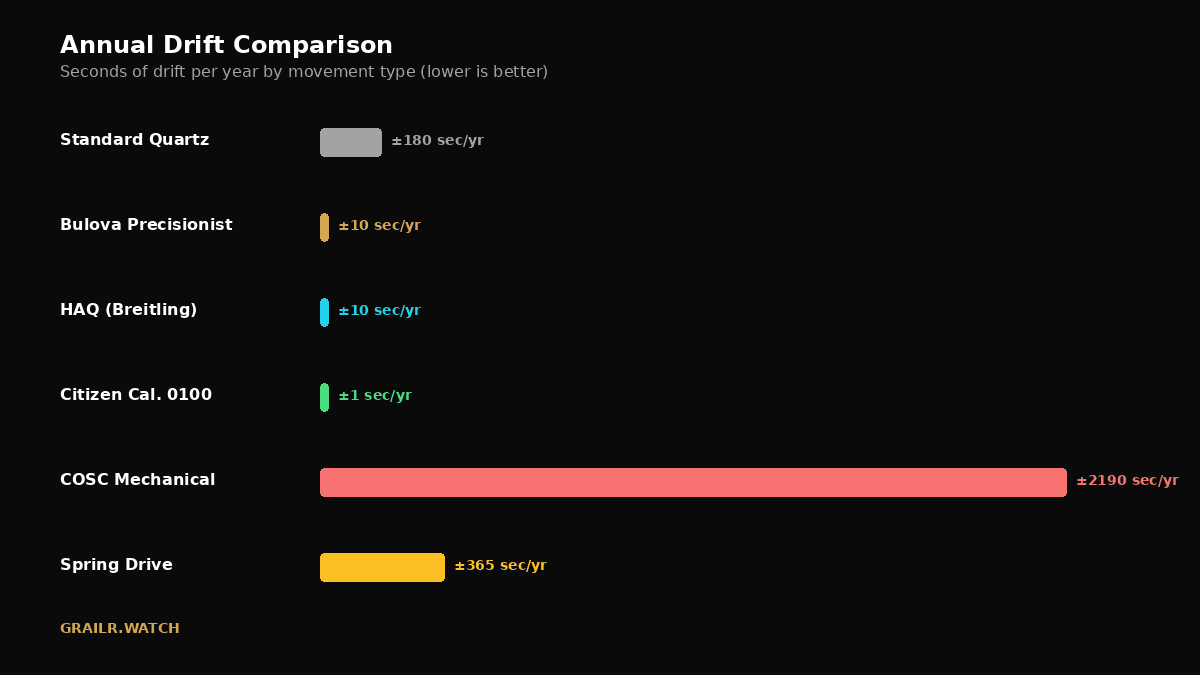
The Precisionist’s party trick is frequency. A standard quartz crystal vibrates at 32,768 Hz. The Precisionist’s three-prong crystal runs at 262,144 Hz — exactly eight times faster. That higher frequency divides each second into finer slices, which delivers two visible benefits: the seconds hand sweeps in a continuous motion rather than ticking in one-second jumps, and the timekeeping is rated at approximately ±10 seconds per year instead of the ±15 seconds per month that standard quartz manages.
In practical terms, the sweep looks almost identical to what you see on a Seiko Spring Drive or a high-beat mechanical, except the Precisionist costs a fraction of either. The technology debuted in 2010, and the line has been in continuous production since, making it one of Bulova’s signature offerings alongside the broader Bulova collection.
The trade-off is battery life. Running a crystal at eight times the standard frequency draws more power, so most Precisionist watches deliver 2–3 years per cell rather than the 5+ years typical of regular quartz. That is still cheaper than servicing a mechanical movement, and the accuracy gap is enormous: a COSC-certified Swiss automatic is allowed ±4 to −6 seconds per day, which means the Precisionist’s annual drift is less than what a certified mechanical might lose in a single day.
Every Current Precisionist Model
Bulova’s Precisionist line spans four main families: the Lunar Pilot chronograph with its Apollo 15 heritage, the Icon series built for water resistance, the Precisionist X with its octagonal case, and a selection of classic Precisionist references in simpler dress-sport configurations. Not every Bulova chronograph uses the 262 kHz crystal — the Marine Star and Classic Diamond lines, for instance, run on standard quartz and lack the signature smooth sweep.
Lunar Pilot (from $350)
The Lunar Pilot is Bulova’s flagship Precisionist model, commemorating the chronograph worn by astronaut Dave Scott during the Apollo 15 mission in 1971. The reference 96B251 is the most popular variant: a 45mm steel case with sapphire crystal, a black dial with three chronograph sub-registers, and both a leather strap and a nylon NATO included in the box. It’s rated to 50 metres of water resistance and delivers the full 1/10th-of-a-second chronograph resolution that the 262 kHz movement enables.
Variants include the 96A225 (polished case, NATO strap, no date), the 98A186 (43mm black ion-plated case, blue lume), and the 96B258 (steel bracelet, butterfly clasp, AR-coated sapphire). All share the same UHF movement. Among affordable watches, the Lunar Pilot stands out for offering genuine space heritage at a price point most Swiss brands can’t match.
Icon Precisionist (from $450)
The Icon series pushes the line into dive-tool territory. The 98B228 and 96B175 both carry 300-metre water resistance, curved mineral crystals, carbon-fibre dial textures and the full 1/1000th-of-a-second chronograph complication. These are heavy watches — the two-tone 98B228 weighs over 260 grams — and they wear their size on the wrist. If you want a Precisionist for actual water sports, the Icon is the only option rated beyond 50 metres.
Precisionist X ($1,295 – $3,950)
Launched in 2020 to celebrate the Precisionist’s tenth anniversary, the X collection introduced an octagonal 44.5mm case with Damascus steel inserts. The standard models retail for $1,295, while the limited edition with an 18-carat yellow gold insert was capped at 100 pieces and priced at $3,950. At 17.5mm thick, the X wears like a statement piece. The movement is the same 262 kHz unit with the 1/1000th-second chronograph, wrapped in a far more premium package.
Classic Precisionist ($350 – $675)
The blue-dial 96B349 (44.5mm tonneau, 300m WR, curved sapphire) and the 98B356 Series X chronograph (two-tone, sapphire, 50m) round out the current catalogue. These models sit between the Lunar Pilot and the X collection in both price and design ambition. The 96B349 deserves particular attention: its tonneau case is more distinctive than the standard Lunar Pilot, and the 300-metre water resistance puts it on the same footing as the Icon line.
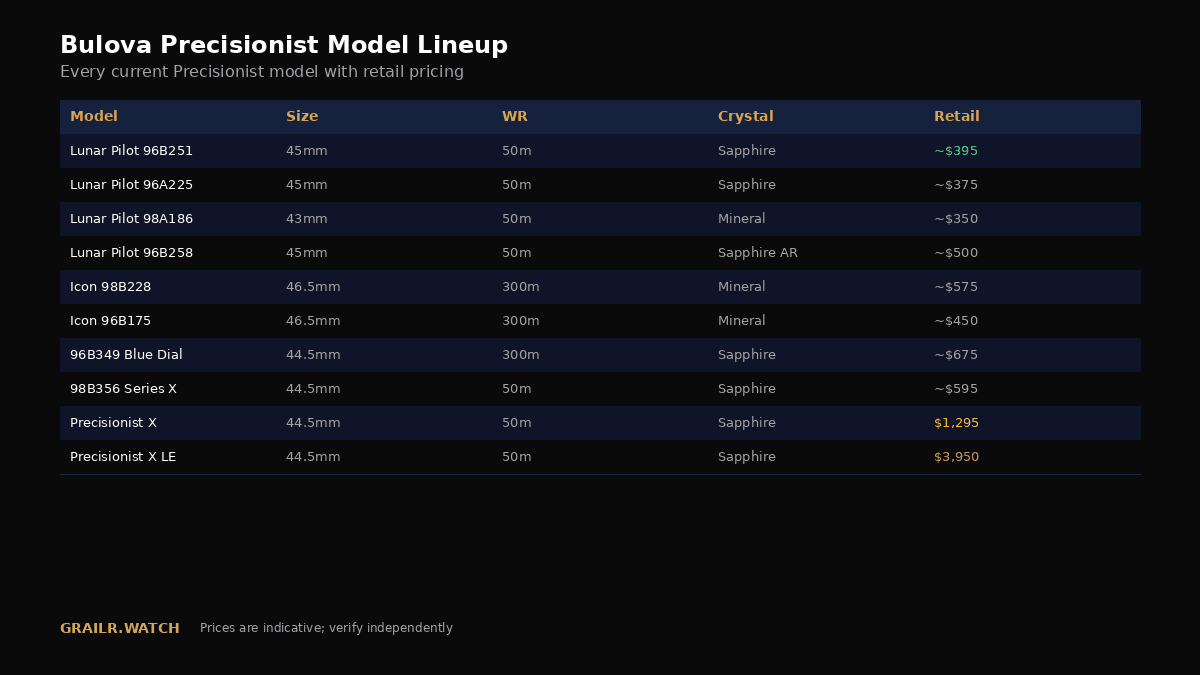
Complete Model Comparison
| Model | Size | WR | Crystal | Retail |
|---|---|---|---|---|
| Lunar Pilot 96B251 | 45mm | 50m | Sapphire | ~$395 |
| Lunar Pilot 96A225 | 45mm | 50m | Sapphire | ~$375 |
| Lunar Pilot 98A186 | 43mm | 50m | Mineral | ~$350 |
| Lunar Pilot 96B258 | 45mm | 50m | Sapphire (AR) | ~$500 |
| Icon 98B228 | 46.5mm | 300m | Mineral | ~$575 |
| Icon 96B175 | 46.5mm | 300m | Mineral | ~$450 |
| 96B349 Blue Dial | 44.5mm | 300m | Sapphire | ~$675 |
| 98B356 Series X | 44.5mm | 50m | Sapphire | ~$595 |
| Precisionist X | 44.5mm | 50m | Sapphire | $1,295 |
| Precisionist X LE | 44.5mm | 50m | Sapphire | $3,950 |
Accuracy: How the Precisionist Compares
The Precisionist occupies an unusual position in the accuracy hierarchy. It is significantly more precise than standard quartz, cheaper than thermocompensated quartz (HAQ) or the most accurate watches on the market, and orders of magnitude better than any mechanical movement. Here’s how the numbers stack up:
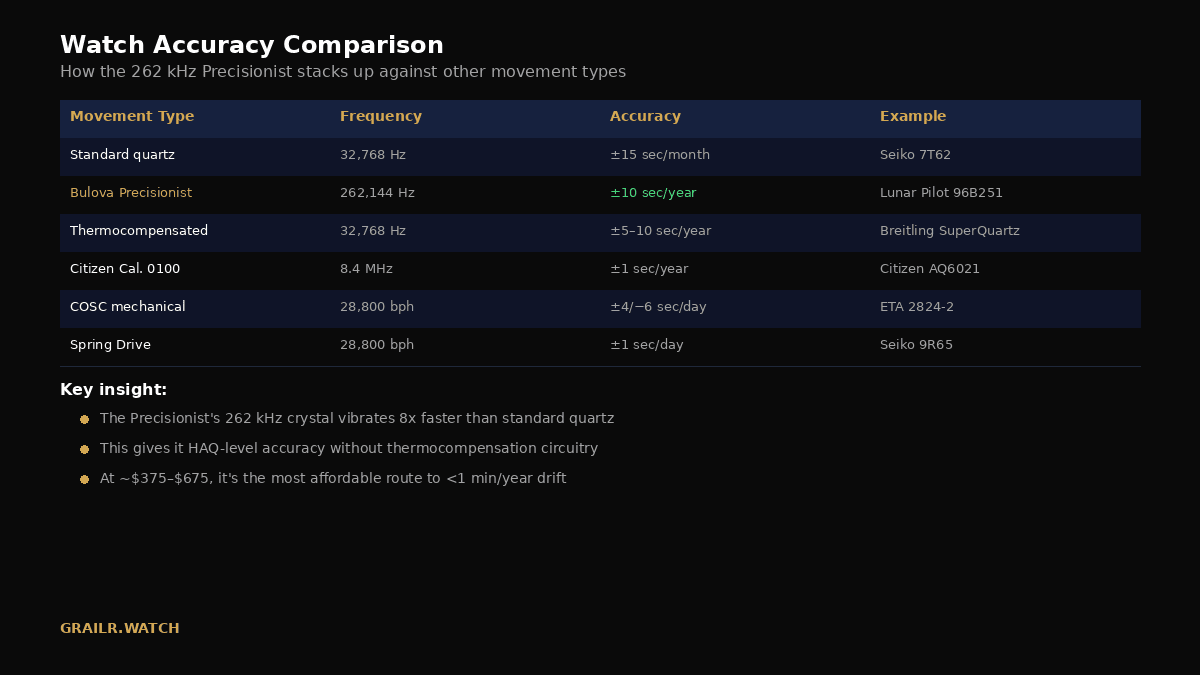
| Movement Type | Frequency | Rated Accuracy | Example |
|---|---|---|---|
| Standard quartz | 32,768 Hz | ±15 sec/month | Seiko 7T62 |
| Bulova Precisionist | 262,144 Hz | ±10 sec/year | Lunar Pilot 96B251 |
| Thermocompensated (HAQ) | 32,768 Hz | ±5–10 sec/year | Breitling SuperQuartz |
| Citizen Caliber 0100 | 8.4 MHz | ±1 sec/year | Citizen AQ6021 |
| COSC mechanical | 28,800 bph | ±4/−6 sec/day | ETA 2824-2 |
| Spring Drive | 28,800 bph | ±1 sec/day | Seiko 9R65 |
Owner-reported results are encouraging. One 96B251 gained just 4 seconds over 60 days. A 96A225 lost 1.5 seconds in three months. A 98A186 lost 2 seconds over six months. These figures beat the official spec by a wide margin, though individual results vary with temperature exposure and crystal tolerance. The Precisionist’s accuracy sits in the same neighbourhood as far more expensive thermocompensated movements, without the thermocompensation hardware or the price tag.
Check Any Watch Price in Seconds
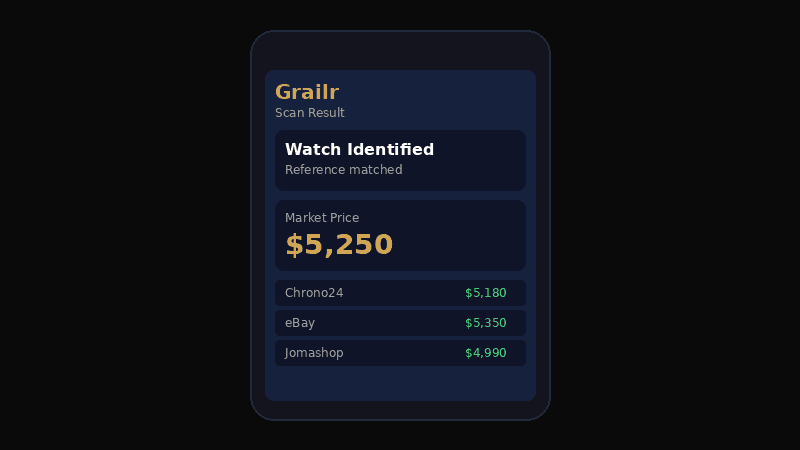
Grailr scans your watch photo and pulls live pricing from Chrono24, eBay, and Jomashop.
- AI identifies brand, model & reference number
- Live market prices from 3+ sources
- Authentication confidence score
Pricing and Resale Value
The Precisionist occupies a sweet spot in the budget watch market: priced high enough to use quality materials (sapphire crystals, solid bracelets, 300m water resistance on some models), but low enough that it competes directly with entry-level Swiss automatics from Hamilton and Tissot.
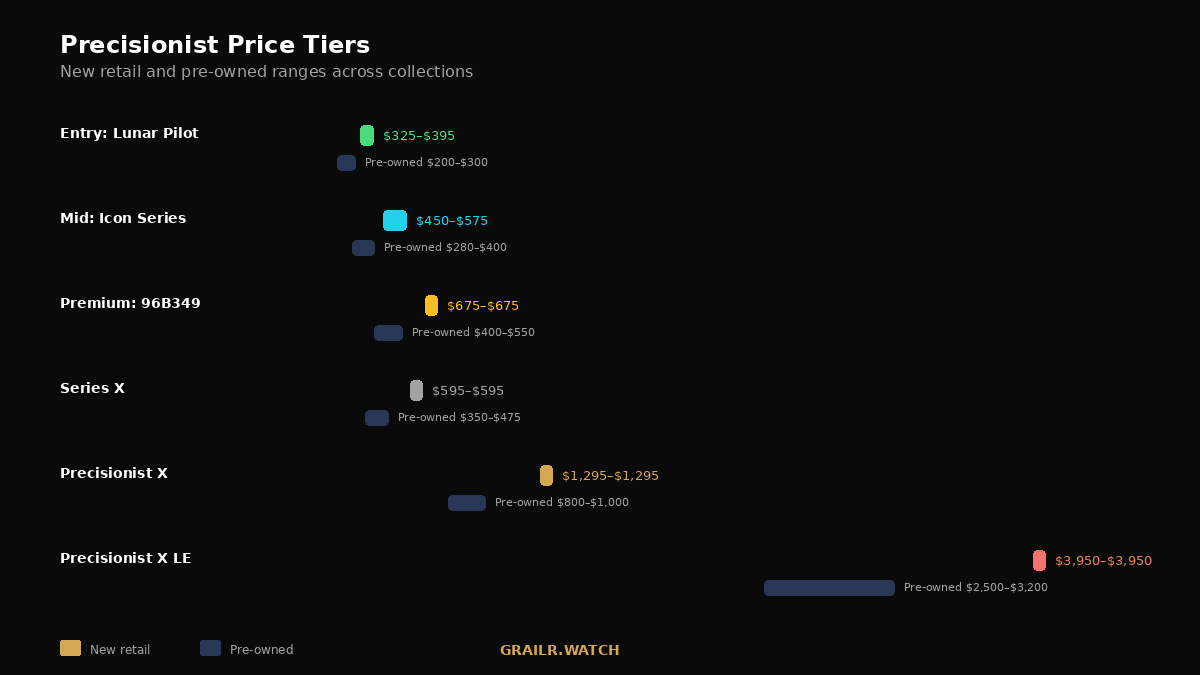
Retail prices range from approximately $350 for the entry-level Lunar Pilot 98A186 to $675 for the 96B349 blue-dial tonneau, with the Precisionist X pushing to $1,295 and its limited edition to $3,950. Grey-market discounts are common on the lower-end models: the Lunar Pilot 96B251 frequently appears on Amazon and discount retailers for $300–$380, well below its listed retail.
On the secondary market, pre-owned Precisionists trade for roughly 40–60% of their retail price. Fair market values tracked across eight references range from about $216 to $712. The Lunar Pilot 96B251 holds the strongest position, driven by its space heritage and enthusiast following — expect to pay $200–$350 for a used example in good condition. Icon models can be found for $150–$300 pre-owned, which represents strong value given their 300-metre water resistance.
If resale matters to you, the Precisionist is not a value holder. These are watches to wear and enjoy at a reasonable price, not to store in a safe. For watches that hold their value, look to the Swiss brands — but expect to pay three to five times more up front.
Buying Tips and What to Avoid
1. Confirm It’s Actually a Precisionist
Not every Bulova chronograph uses the 262 kHz movement. The Marine Star 96B272 and Classic Diamond 96D138 look similar but run on standard quartz with a ticking seconds hand. Check for the “Precisionist” branding on the dial or confirm the reference number before buying. Use Grailr’s identification tool to verify the exact model from a photo.
2. Try It On — These Run Large
Most Precisionists are 44–46.5mm with significant case thickness (the X collection is 17.5mm thick). The 43mm Lunar Pilot 98A186 is the most manageable option for smaller wrists. The tonneau-shaped 96B349 wears slightly smaller than its 44.5mm specification suggests due to its curved profile.
3. Buy Grey Market for the Best Price
The Lunar Pilot 96B251 regularly sells for $300–$380 on Amazon and discount retailers, which is 15–25% below Bulova’s listed retail. You lose the AD warranty, but Bulova’s quartz movements are inexpensive to service or replace.
4. Check Battery Before Buying Pre-Owned
A Precisionist drains its cell in 2–3 years. If you’re buying used, ask when the battery was last replaced. An old cell can cause the seconds hand to jump in 2-second increments — Bulova’s low-battery indicator. A fresh battery is a $15–$30 fix at any watchmaker, so this isn’t a deal-breaker, but it’s good to know going in.
5. Don’t Confuse the Sweep with Spring Drive
The Precisionist’s smooth sweep looks similar to a Seiko Spring Drive on the wrist, but the technology is fundamentally different. The Precisionist is battery-powered quartz; the Spring Drive is a mainspring-powered hybrid. Both produce beautiful motion, but the Precisionist costs $350 against $5,000+ for a Spring Drive.
Alternatives Worth Considering
At the Precisionist’s price point, the competition is fierce. The Citizen Eco-Drive Promaster series offers solar-powered convenience with no battery changes, though it can’t match the Precisionist’s accuracy or sweep. The Tissot PRX Powermatic 80 at $375–$475 gives you a Swiss automatic with 80-hour power reserve, but it runs ±5 seconds per day. The Casio Oceanus S100, around $300–$450, adds radio-controlled timekeeping and solar power for perfect accuracy, though it lacks the Precisionist’s analogue charm.
Best Overall Precisionist
Lunar Pilot 96B251 — ~$395
Space heritage, sapphire crystal, two straps in the box, and the most popular Precisionist by far. The one to buy if you’re choosing blind.
Best for Water Sports
96B349 Blue Dial — ~$675
300m water resistance, sapphire crystal, and a distinctive tonneau case. The most capable Precisionist with a modern design.
Best Value Pre-Owned
Icon 96B175 — ~$200 used
300m WR, carbon-fibre dial, full chronograph. Used prices around $200 make it the cheapest route to serious Precisionist specs.
Best for Smaller Wrists
Lunar Pilot 98A186 — ~$350
At 43mm with a black ion-plated case, it’s the most wearable Precisionist for wrists under 7 inches.
Frequently Asked Questions
How accurate is a Bulova Precisionist watch?
Bulova rates the Precisionist at approximately ±10 seconds per year. Owner reports suggest many examples run within 2–4 seconds over several months, making it one of the most accurate non-thermocompensated quartz movements available.
What makes the Precisionist different from regular quartz?
The Precisionist uses a three-prong crystal vibrating at 262,144 Hz — eight times higher than the 32,768 Hz standard. The higher frequency divides time into finer increments, producing both greater accuracy and a smooth sweeping seconds hand instead of the typical one-second tick.
How long does a Precisionist battery last?
Most Precisionist models deliver 2 to 3 years of battery life. That is shorter than a standard quartz watch (typically 5+ years) because the higher-frequency crystal draws more power. The bracelet-equipped 96B258 has been reported at 3+ years.
Is the Bulova Lunar Pilot a true Precisionist?
Yes. The Lunar Pilot 96B251 and its variants (96A225, 98A186, 96B258) all use the 262 kHz Precisionist movement with the smooth sweeping seconds hand. The Lunar Pilot is Bulova’s flagship Precisionist model, commemorating the watch worn during the Apollo 15 mission.
Do Bulova Precisionist watches hold their value?
Pre-owned Precisionist models typically sell for $150–$500 depending on reference and condition, representing roughly 40–60% of their retail price. The Lunar Pilot 96B251 holds value best due to its space heritage and strong collector following.
Are all Bulova chronographs Precisionist watches?
No. Bulova sells several chronograph lines that use standard quartz movements. The Marine Star 96B272 and Classic Diamond 96D138, for example, lack the 262 kHz crystal and smooth sweep. Only models specifically branded Precisionist or using the UHF 262 kHz movement qualify.
Related Articles
The Bottom Line
The Bulova Precisionist is one of the best values in watchmaking: genuine high-frequency accuracy, a sweeping seconds hand that rivals movements costing ten times more, and prices that start under $400. It won’t hold its value like a Rolex or even a Tissot, but it delivers an experience that no other watch at this price can match. The Lunar Pilot 96B251 is the one to buy for most people — real space heritage, sapphire crystal, and the full Precisionist experience for the price of a dinner for two. If you want 300-metre water resistance, look at the 96B349 or the Icon 96B175 on the secondary market. And if you want the movement in a premium package, the Precisionist X is worth the stretch.
Thinking About a Precisionist?
Use Grailr to photograph any listing, confirm the model, and check whether the price is fair before you buy.
Scan a Watch NowSources and price context
- Bulova Precisionist collection page — Official specifications and current retail pricing for the Precisionist lineup.
- How the Bulova Precisionist Works — HowStuffWorks — Technical explanation of the 262 kHz three-prong crystal and accuracy comparisons.
These primary sources support the specific specification and technology points noted above. Prices elsewhere in this guide are indicative editorial figures from authorized retailers and grey-market sources as of October 2026. They are not verified completed sales. Confirm the exact reference, condition and current quote before buying.