Bulova Super Seville Guide: History, Specs and Prices
The 1970s Day-Date homage that Bulova brought back with Precisionist technology — every reference, vintage and modern, with real pricing and buying advice.
Price context: this guide includes indicative prices from its original publication period. They have not all been refreshed to current quotes. Use the linked primary sources for specifications and policies, and verify prices independently.

- The modern Super Seville uses Bulova’s Precisionist 262 kHz movement — accurate to ±10 seconds per year
- Current retail ranges from $695 (steel) to $750 (two-tone), often discounted to $500–$560
- The 37.5 mm TV-shaped cushion case honours the 1970s original, which was itself a Rolex Day-Date homage
- Vintage automatics trade from $200 to $650; rare gem-index examples reach $1,100+
A Brief History of the Bulova Super Seville
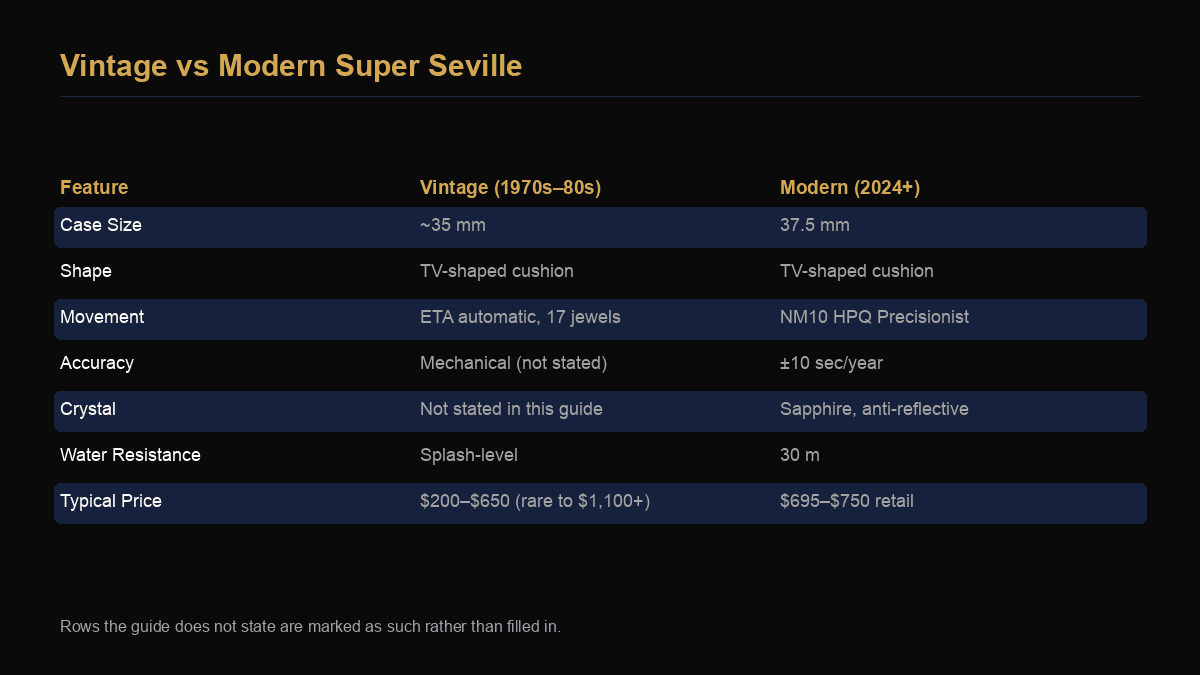
The Super Seville first appeared in the late 1970s during a period when Bulova — then owned by Loews Corporation before its acquisition by Citizen in 2008 — was competing hard in the affordable dress-watch segment. The name “Seville” had already been used on a line of slim quartz models, but the Super Seville was something bolder: a cushion-cased automatic with a day-date window and a fluted bezel that made no secret of its inspiration from the Rolex Day-Date.
The original was powered by Swiss ETA automatic movements with 17 jewels, cased in stainless steel or gold-plated steel, and measured roughly 35 mm across — generous by 1970s standards. The TV-shaped cushion case, sometimes called a “tonneau cushion,” gave it a distinctive silhouette that set it apart from the round dress watches dominating the era. A president-style bracelet, applied indices, and an arched day window completed the look.
Production ran through the 1980s and early 1990s across multiple references. Some models swapped the automatic for quartz, others added gemstone hour markers, and at least one line used a two-tone gold-and-steel combination. The Super Seville was never a luxury watch by price — it sold for under $300 new — but it offered a convincing dress-watch aesthetic that punched well above its cost. By the mid-1990s the name had quietly retired.
Fast-forward to 2024. Bulova, now under Citizen’s umbrella, revived the Super Seville as part of its broader heritage push alongside the Lunar Pilot and the Precisionist collection. The new model keeps the TV-shaped case and the fluted bezel but replaces the ETA automatic with Bulova’s own 262 kHz Precisionist quartz — a movement accurate to ±10 seconds per year with a continuous-sweep seconds hand that mimics mechanical motion.
The Modern Precisionist Lineup
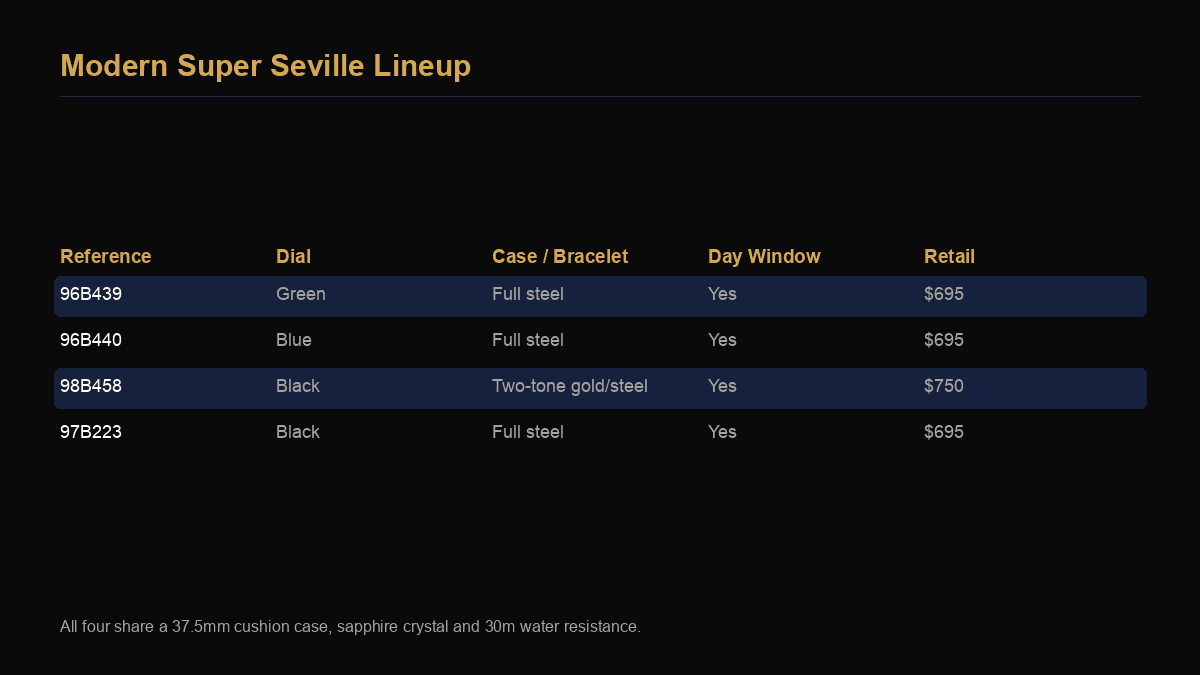
Bulova launched the modern Super Seville with a small but focused collection. Each reference shares the same 37.5 mm stainless-steel cushion case, sapphire crystal with anti-reflective coating, coin-edge fluted bezel, and 30 m water resistance. The differences are dial colour and bracelet finish.
| Reference | Dial | Case/Bracelet | Day Window | Retail |
|---|---|---|---|---|
| 96B439 | Green | Full steel | Yes | $695 |
| 96B440 | Blue | Full steel | Yes | $695 |
| 98B458 | Black | Two-tone gold/steel | Yes | $750 |
| 97B223 | Black | Full steel | Yes | $695 |
The 96B439 green dial is the most popular reference — its deep, sunburst green plays off the gold-toned indices and hands in a way that channels vintage character without looking dated. The blue 96B440 is the subtler option, pairing a gradient blue sunburst with polished steel indices. Both use applied Roman numeral markers at 12 and 6 o’clock, with stick indices elsewhere.
The 98B458 two-tone adds a gold-plated centre-link pattern to the bracelet and a gold fluted bezel, pushing the Day-Date homage further. It is the most divisive model — some collectors love the retro boldness; others find it heavy-handed. At $750 it carries a $55 premium over the steel variants.
All four references share the same case dimensions, lug width (20 mm), and clasp. The president-style bracelet — with its polished centre links and brushed outer links — is integrated into the case design, which means aftermarket strap swaps require an end-link adapter. The sapphire crystal sits slightly recessed beneath the coin-edge bezel, giving the watch a compact, jewel-like appearance on the wrist.
Inside the 262 kHz Precisionist Movement
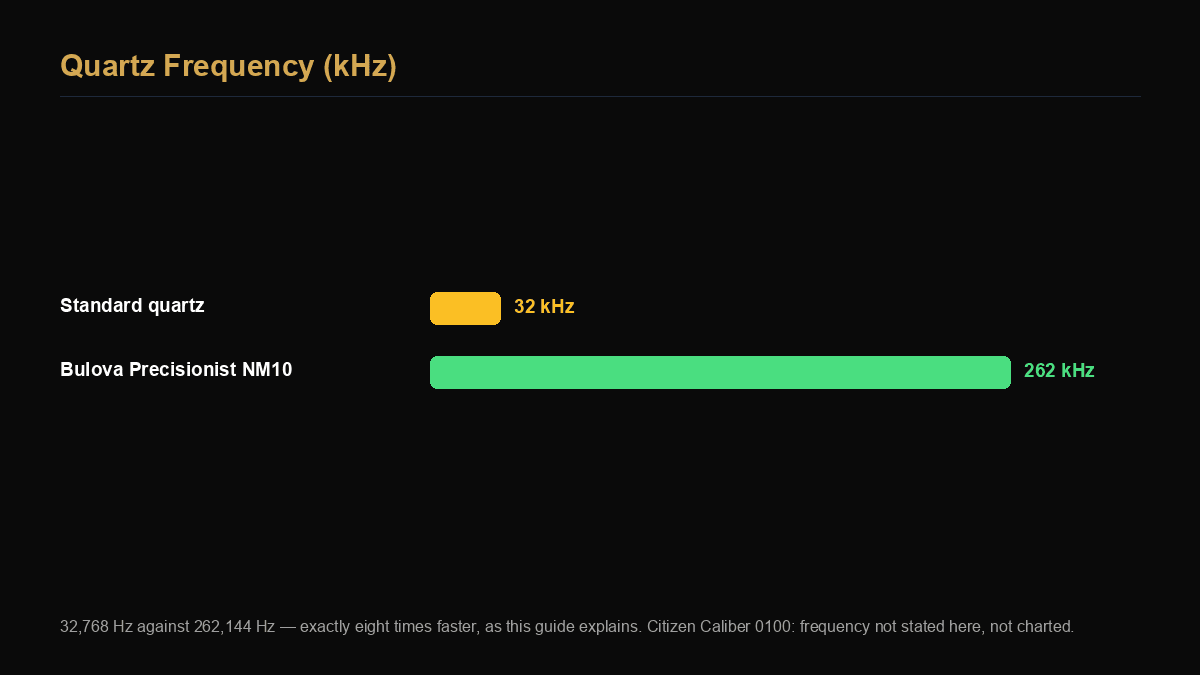
The heart of the modern Super Seville is Bulova’s NM10 HPQ Precisionist calibre. Where a standard quartz crystal oscillates at 32,768 Hz, the Precisionist runs at 262,144 Hz — exactly eight times faster. This higher frequency delivers accuracy of ±10 seconds per year, compared with the ±15 seconds per month that most quartz watches manage. In practical terms, you can set it on January 1st and expect it to be within 10 seconds of perfect by December 31st.
The visible payoff is the seconds hand. At 262 kHz the hand sweeps in a continuous motion rather than ticking once per second. It is not truly continuous — the hand steps 16 times per second — but the effect is smooth enough that most people cannot see the individual steps. It looks like a mechanical watch, and that bridge between quartz precision and mechanical romance is the Precisionist’s entire selling point.
The trade-off is battery life. The higher oscillation frequency draws more current than a standard quartz, so battery changes come every two to three years rather than the three-to-five-year cycle typical of cheaper quartz movements. The NM10 uses a standard SR626SW cell, and battery replacement at a jeweller runs $15–$30 — trivial relative to the mechanical servicing costs of an automatic watch at the same price point.
For context, the Citizen Caliber 0100 pushes accuracy to ±1 second per year using an AT-cut crystal and a thermocompensation algorithm, but it starts at $3,600. The Seiko 9F quartz family manages ±10 seconds per year as well, but that movement sits inside Grand Seiko cases priced from $2,400. The Precisionist achieves comparable accuracy at a fraction of the cost by using a higher-frequency crystal instead of thermocompensation.
Check Any Watch Price in Seconds
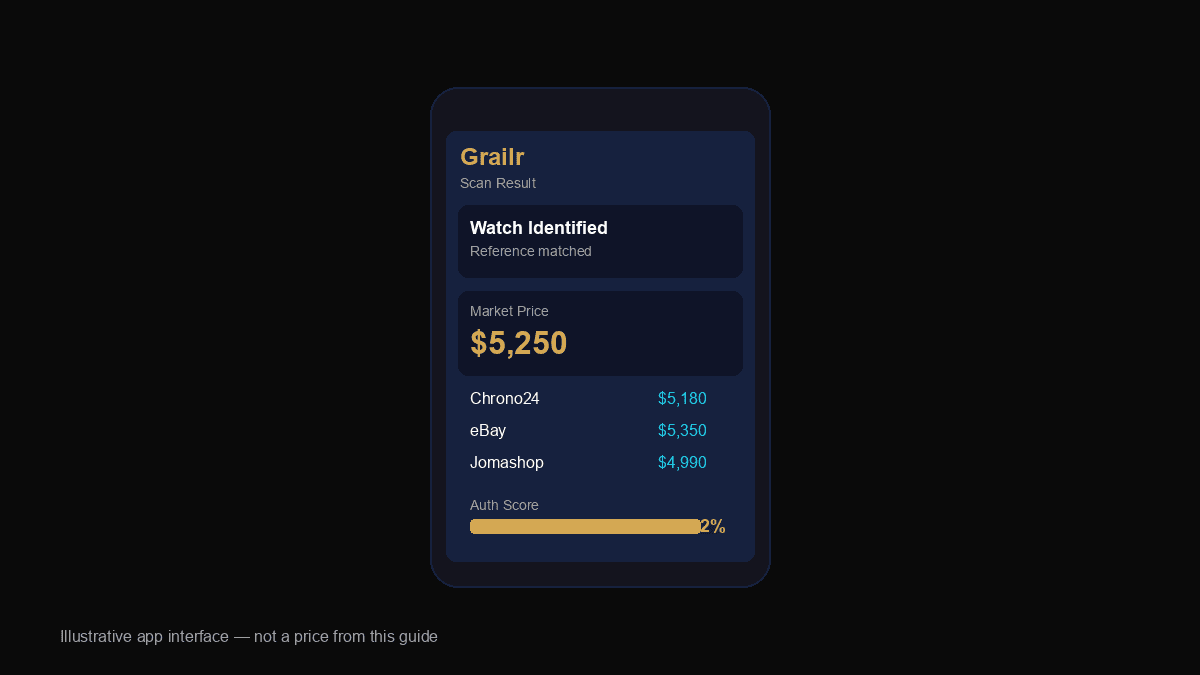
Grailr scans your watch photo and pulls live pricing from Chrono24, eBay, and Jomashop.
- AI identifies brand, model & reference number
- Live market prices from 3+ sources
- Authentication confidence score
Collecting the Vintage Super Seville
The vintage Super Seville occupies a sweet spot in the affordable-vintage market: recognisable enough to attract attention, inexpensive enough that condition matters more than investment. Prices range from $200 to $650 for standard Day-Date automatics in good condition, with outliers above $1,100 for pristine 1970s examples with original gem-set indices and intact president-style bracelets.
The key variables are the bracelet and the case finish. Many vintage examples were daily-worn for decades, and the soft stainless steel of the 1970s cases polished easily. A heavily polished case with rounded edges and thinned lugs drops value significantly. The president-style bracelet is especially important — it stretches over time, and replacements that match the original profile are hard to source. A complete, unpolished example with a tight bracelet commands a 30–50% premium over a polished example with a stretched band.
| Era | Movement | Case Size | Typical Price | Notes |
|---|---|---|---|---|
| Late 1970s | ETA auto, 17J | 35 mm | $400–$1,100+ | Most collectible; gem-index variants highest |
| Early 1980s | ETA auto, 17J | 35 mm | $250–$650 | More common; watch for polished cases |
| Mid-1980s | Quartz | 35 mm | $150–$350 | Less sought-after than automatics |
| Late 1980s–90s | Quartz / Auto | 35–36 mm | $200–$400 | Two-tone variants available |
If you’re buying vintage, inspect the day wheel carefully. The arched day window at 12 o’clock is the most distinctive feature, and a misaligned or cracked day disc suggests a non-original replacement part. Check that the day text is centred in the aperture and that the font matches period-correct Bulova examples. The date window at 3 o’clock should show a flat, white disc with black numerals — aftermarket date wheels with coloured backgrounds are a red flag.
Servicing a vintage Super Seville automatic typically costs $150–$250 at an independent watchmaker, since the ETA movements are common and parts are still available. Factor that into any purchase of an un-serviced example. For help estimating what a specific example is worth, Grailr’s appraisal tool can provide an indicative value based on a photo.
Pricing: New and Pre-Owned
The modern Super Seville retails for $695 (steel) to $750 (two-tone), but street prices are considerably lower. Authorised retailers regularly discount the steel models to $521–$560, and the two-tone to around $600. This is typical of Bulova — the brand sets MSRPs that leave room for dealer margin, and discounts of 20–25% are common.
Pre-owned prices for the modern reissue sit in the $350–$500 range, reflecting the typical 30–40% depreciation that quartz watches experience. Unlike mechanical watches from brands such as Rolex or Tudor, the Super Seville is not a value-retention play. It is a wearing watch: buy it because you like the design and the technology, not as an investment.
One thing to watch: some third-party retailers list “regular” prices of $995 before applying a discount to $695 or lower. That $995 is not a genuine previous retail price — it is marketing. The actual MSRP from Bulova’s own site is $695 for the steel models. Don’t let a fabricated “was” price convince you that a standard retail-price purchase is a deal.
How It Compares to Alternatives
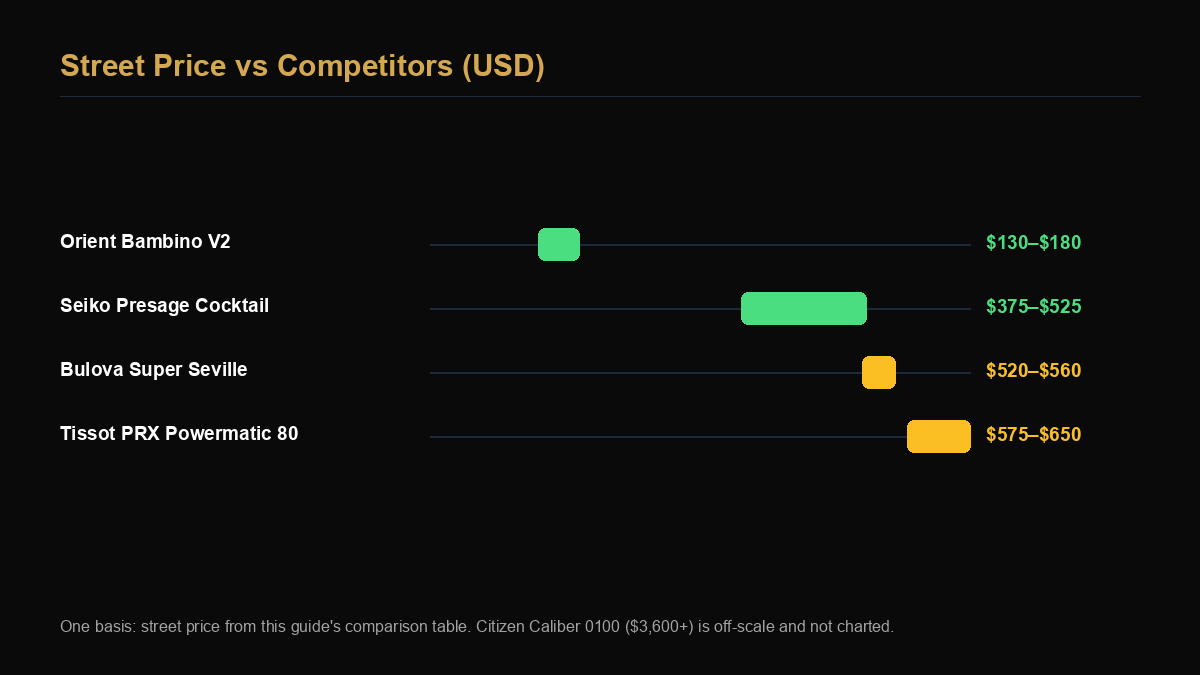
The Super Seville sits in a crowded segment. Here is how it stacks up against the watches most likely to appear on the same shortlist.
| Watch | Movement | Size | Street Price | Key Advantage |
|---|---|---|---|---|
| Bulova Super Seville | NM10 Precisionist | 37.5 mm | $520–$560 | ±10 sec/year accuracy, sweeping hand |
| Tissot PRX Powermatic 80 | Powermatic 80 | 40 mm | $575–$650 | Swiss automatic, 80h reserve |
| Seiko Presage Cocktail | 4R35/4R36 | 40.5 mm | $375–$525 | Textured dials, automatic |
| Orient Bambino V2 | F6724 | 40.5 mm | $130–$180 | Cheapest automatic dress watch |
| Citizen Caliber 0100 | 0100 | 35.1 mm | $3,600+ | ±1 sec/year, AT-cut crystal |
The Tissot PRX is the most direct competitor in feel if not in shape. Both are retro-styled sub-$700 watches with integrated bracelets, but the PRX uses a Swiss automatic movement while the Super Seville uses quartz. If you value the idea of a mechanical heart and don’t mind lower accuracy (±25 seconds per day versus ±10 per year), the PRX is the pick. If accuracy and a slimmer profile matter more, the Super Seville wins.
The Seiko Presage Cocktail Time offers automatic movement charm and arguably more adventurous dial textures at a lower price. But it is a round 40.5 mm watch — if you specifically want the cushion-case, president-bracelet Day-Date aesthetic, Seiko has nothing in the range. That vintage DNA is the Super Seville’s unique selling point.
Buying Advice
Buy discounted, not at MSRP
The Super Seville almost never sells at its $695 list price. Check authorised retailers such as Jared, Macy’s, and Amazon for typical discounts of 20–25%. Paying more than $560 for a steel model means you overpaid.
Try it on first if possible
The 37.5 mm measurement is case-edge to case-edge, but the cushion shape and integrated bracelet make it wear closer to 39–40 mm. People with wrists under 6.5 inches may find the proportions ideal; larger wrists may feel it runs small. Bulova is widely stocked at department stores, so trying one is easy.
Green dial (96B439) is the one to get
If you only buy one Super Seville, make it the green. The sunburst green catches light differently at every angle, and the warm gold indices give it the most vintage character of the four references. The blue is handsome but less distinctive; the two-tone is divisive.
Vintage: prioritise bracelet condition
A stretched or replaced bracelet kills the look of a vintage Super Seville. Budget for the watch plus a potential $100–$150 for a NOS or tight-condition replacement bracelet if the one on the watch is loose. An unpolished case with a tight bracelet is more desirable than a minty dial on a floppy band.
Don’t expect resale value
Quartz watches in the sub-$700 range depreciate 30–40% immediately. The Super Seville is a wearing watch, not a value-retention play. Buy it because you like it, wear it without worry, and enjoy the accuracy.
Frequently Asked Questions
Is the Bulova Super Seville a good watch?
Yes. The modern Super Seville pairs the Precisionist 262 kHz movement with a sapphire crystal and solid build for under $700. It offers quartz accuracy within 10 seconds per year and a sweeping seconds hand that mimics a mechanical watch.
What movement does the Bulova Super Seville use?
The modern reissue uses the NM10 HPQ Precisionist movement running at 262 kHz, eight times faster than standard quartz. Vintage originals from the 1970s and 1980s used ETA automatic movements with 17 jewels.
How much is a vintage Bulova Super Seville worth?
Vintage automatics typically sell for $200 to $650 depending on condition and bracelet originality. Rare 1970s Day-Date examples with gem indices can reach $1,100 or more.
Is the Bulova Super Seville water resistant?
The modern version is rated to 30 metres, suitable for splashes and rain but not swimming. Vintage originals had similar splash-level ratings.
What size is the Bulova Super Seville?
The modern reissue measures 37.5 mm with a TV-shaped cushion case. Vintage originals were 35 mm. Both wear slightly larger than their listed sizes due to the cushion case geometry.
How accurate is the Bulova Precisionist movement?
Bulova rates the NM10 at plus or minus 10 seconds per year, making it one of the most accurate non-thermocompensated quartz movements available. Standard quartz runs at plus or minus 15 seconds per month.
Related Articles
The Bottom Line
The Bulova Super Seville is one of the best sub-$600 watches you can buy if you value accuracy, vintage design, and a sweeping seconds hand. The 262 kHz Precisionist movement runs circles around standard quartz, the TV-shaped case is unlike anything else at the price, and the sapphire crystal protects a genuinely attractive dial. It is not a mechanical watch and it will not hold its value — but at a real-world price of $520, it doesn’t need to. Wear it, enjoy the craftsmanship, and save the investment anxiety for something else.
Own a Super Seville?
Scan it with Grailr to get an indicative value estimate and see how it compares to current market listings. A photo scan is not proof of authenticity — verify independently.
Scan a Watch NowSources and price context
- Bulova Super Seville collection page — Official specifications, reference numbers and retail pricing for all current models.
- Citizen Caliber 0100 collection — Specifications for the ±1 second/year thermocompensated quartz movement used as a benchmark comparison.
These primary sources support the specific specification and pricing points noted above. Prices and market estimates elsewhere in this guide are indicative editorial figures, not a verified transaction dataset or guaranteed values. Confirm the exact reference, condition and current quote before buying; asking prices are not completed-sale prices.