H. Moser & Cie Watches: Every Collection and Price
Endeavour, Streamliner, Pioneer and Heritage compared — with in-house caliber specs, real pricing and resale data for 2026.
Price context: this guide includes indicative prices from its original publication period. They have not all been refreshed to current quotes. Use the linked primary sources for specifications and policies, and verify prices independently.

- H. Moser & Cie starts at roughly $15,000 (Heritage) and reaches six figures for Perpetual Calendar and Tourbillon pieces
- Every caliber is made in-house in Schaffhausen, including escapement components and hairsprings via Precision Engineering AG
- Annual production is roughly 2,000 pieces, which supports strong secondary-market retention of 70–85%
- The Streamliner integrated-bracelet line is the most sought-after, with some references trading at or above retail
Brand History: 1828 to the Modern Revival
Heinrich Moser founded his watchmaking company in Schaffhausen, Switzerland, in 1828. His early business supplied movements to the growing Swiss watch industry and built a reputation for precision that attracted clients across Europe and Russia. By the mid-nineteenth century, Moser watches were among the most respected timepieces produced in the German-speaking part of Switzerland.
The brand faded after Heinrich Moser’s death and the consolidation of the Swiss watch industry in the twentieth century. Its modern chapter began in 2005, when the MELB Holding group revived the name under CEO Edouard Meylan. The new H. Moser & Cie committed to full vertical integration from the start: in-house movements, in-house escapements and in-house hairsprings — a level of self-sufficiency that only a handful of luxury watch brands can match.
Today the company produces roughly 2,000 watches per year from its Schaffhausen manufacture. That low volume is deliberate: it keeps demand above supply and gives the brand freedom to experiment without mass-market pressure. If you’ve seen a watch dial made of Swiss cheese or a concept piece mocking industry tropes, that was H. Moser & Cie making a point about what independent watchmaking can do.
What Makes H. Moser & Cie Different
Three things set H. Moser & Cie apart from the larger Swiss houses: the fumé dial, the in-house manufacture and the minimalist design philosophy.
The fumé dial is H. Moser’s visual signature. Created by smoking lacquer in layers, each dial shows a sunburst gradient that shifts from a lighter centre to a darker rim. The effect changes with every angle and light condition, and no two dials are exactly alike. Moser didn’t invent the technique, but it popularised it so thoroughly that “fumé dial” is now nearly synonymous with the brand.
On the mechanical side, H. Moser & Cie owns Precision Engineering AG, a subsidiary that manufactures escapement components and hairsprings. The hairspring is the single most critical element in a mechanical watch’s accuracy, and very few brands make their own. Rolex, Patek Philippe, Swatch Group (via Nivarox) and Moser are essentially the full list at scale. This vertical integration means every HMC-designated caliber is genuinely in-house from balance spring to barrel.
The design philosophy strips away what most Swiss brands consider essential. Many H. Moser dials omit a logo entirely — the Concept pieces carry nothing but hands and indices. Applied numerals, date windows and brand text are absent. The idea is that the watch should be recognised by its design language alone, not by a printed name. This approach polarises collectors: those who value restraint consider it the purest expression of haute horlogerie, while others find the dials too bare for the price.
Every H. Moser & Cie Collection Compared
Endeavour
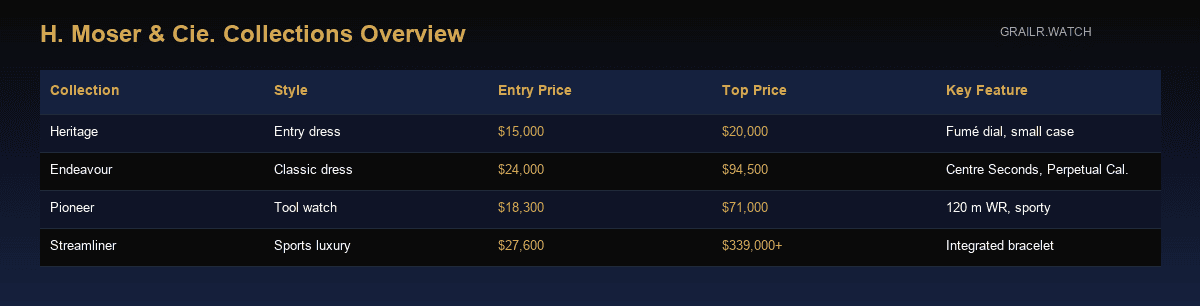
The Endeavour is H. Moser’s classic dress-watch line and the collection most closely associated with the fumé dial. It includes the Centre Seconds, Small Seconds, Perpetual Calendar and Tourbillon. Case sizes range from 38mm to 42mm, and most references use 18k gold cases, though steel options have expanded in recent years. The Endeavour Centre Seconds in steel sits around $24,000–$32,000, while the Perpetual Calendar Concept reaches $94,500. Water resistance is a modest 30 metres — this is a dress watch, not a diver.
Streamliner
Launched in 2020, the Streamliner is H. Moser’s entry into the integrated-bracelet sports-watch category alongside the Royal Oak, Nautilus and Overseas. The cushion-shaped case flows into the bracelet without visible lugs, and the triple-blade folding clasp sits nearly flush against the wrist. Available in 40mm, 34mm and 28mm, the Streamliner now spans from two-hand time-only models at $27,600 to Tourbillon references above $300,000. The Flyback Chronograph at around $59,300 is the collection’s best seller. Water resistance is 120 metres across the line.
Pioneer
The Pioneer is H. Moser’s tool watch. It pairs a more angular case with a screw-down crown and 120 metres of water resistance — the same rating as the Streamliner but in a more utilitarian design. The Centre Seconds starts at roughly $18,300 in steel, making it one of the more accessible ways into the brand. The Pioneer Tourbillon, at around $71,000, adds a flying tourbillon at six o’clock. The collection suits buyers who want Moser’s in-house calibers and fumé finishing in a watch that can handle weekend adventures.
Heritage
The Heritage line is H. Moser’s entry point. With smaller cases and simpler complications, prices start around $15,000–$20,000. The Heritage pieces use the same in-house movements as the other collections but in a more compact, traditional package. If you want a genuine H. Moser & Cie on the wrist without crossing $20,000, this is where to look.
Complete Pricing Breakdown
H. Moser & Cie sits in the high end of independent watchmaking. Entry prices overlap with brands like Jaeger-LeCoultre, but the top-end Tourbillon and Perpetual Calendar pieces compete with A. Lange & Söhne and F.P. Journe. Here is the full range as of late 2026.
| Collection | Entry Model | Entry Price | Top Model | Top Price |
|---|---|---|---|---|
| Heritage | Centre Seconds | ~$15,000 | Small Seconds | ~$20,000 |
| Pioneer | Centre Seconds (steel) | $18,300 | Tourbillon | ~$71,000 |
| Endeavour | Centre Seconds (steel) | ~$24,000 | Perpetual Calendar Concept | $94,500 |
| Streamliner | Two Hands (steel) | $27,600 | Tourbillon | $339,000+ |
2026 Retrograde Seconds Launch
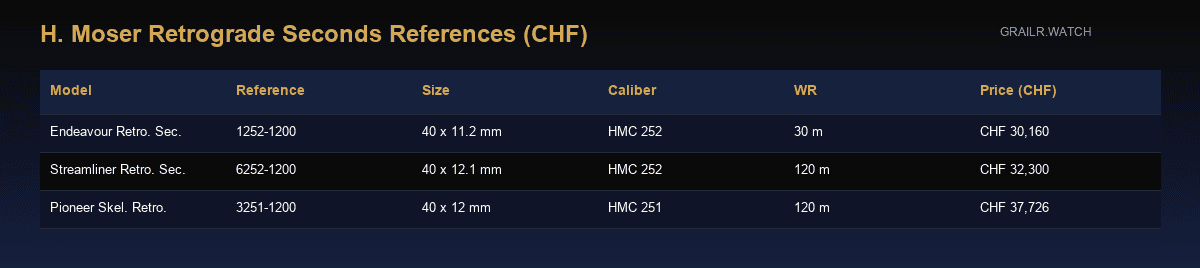
H. Moser & Cie’s headline release for 2026 brought the Agenhor 30-second retrograde seconds module across three collections simultaneously. The complication uses a hand that sweeps through a 30-second arc before snapping back to its starting position — a visual effect that is far more dramatic on the wrist than a standard running seconds. All three pieces share a 40mm steel case, 21,600 vph frequency and a three-day power reserve.

| Model | Reference | Size | Caliber | WR | Price (CHF) |
|---|---|---|---|---|---|
| Endeavour Retrograde Seconds | 1252-1200 | 40 × 11.2 mm | HMC 252 | 30 m | CHF 30,160 |
| Streamliner Retrograde Seconds | 6252-1200 | 40 × 12.1 mm | HMC 252 | 120 m | CHF 32,300 |
| Pioneer Skeleton Retrograde Seconds | 3251-1200 | 40 × 12 mm | HMC 251 | 120 m | CHF 37,726 |
The Pioneer Skeleton commands the highest price because its skeletonised dial and bridges require more hand-finishing. The Endeavour is the thinnest at 11.2mm total height (9.9mm without the crystal), making it the dressiest option. The Streamliner sits in the middle with its integrated bracelet and midnight blue fumé dial.
Resale Value and Market Position
H. Moser & Cie’s limited production — roughly 2,000 pieces per year — supports better resale retention than most brands in this price range. Pre-owned Centre Seconds models from the Endeavour and Pioneer collections typically trade at 70–85 percent of retail, which is comparable to the retention rates of watches that hold value well like A. Lange & Söhne and Vacheron Constantin.
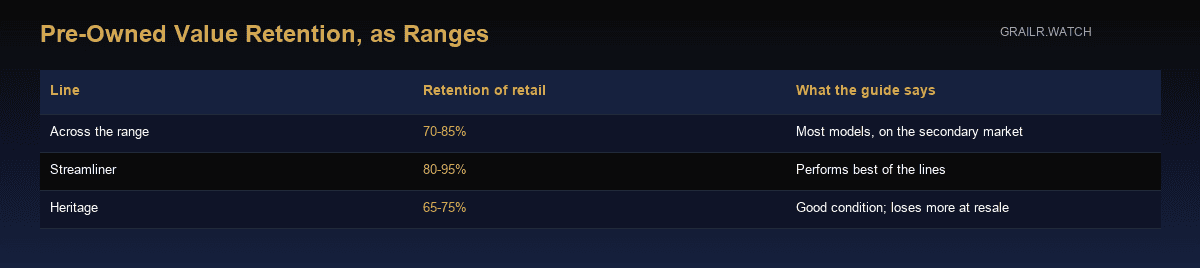
The Streamliner is the standout. Demand for integrated-bracelet sports watches has pushed certain Streamliner references to trade at or above their original retail price on the secondary market. The Flyback Chronograph and the Perpetual Calendar are the strongest performers, partly because waiting times at authorised dealers can stretch to a year or more.
The Heritage and Pioneer Centre Seconds models lose more at resale — expect 65–75 percent for a Heritage piece in good condition. That said, these are still better numbers than what most fashion-brand watches achieve, and the in-house movement with Moser’s own hairspring is a genuine differentiator that sustains collector interest.
How to Buy an H. Moser & Cie Watch
1. Authorised Dealers
H. Moser & Cie sells through a selective network of authorised dealers, including Bucherer, The 1916 Company (WatchBox), and independent boutiques. Walk-in availability varies: Heritage and Pioneer Centre Seconds models are easier to find, while Streamliner pieces often require a waitlist.
2. Pre-Owned Market
Chrono24, WatchBox and specialist dealers carry pre-owned H. Moser watches. Expect to save 15–30 percent versus retail on Endeavour and Pioneer pieces. Streamliner discounts are smaller or nonexistent. Always verify the serial number, movement finish and dial condition before purchasing — fumé dials are delicate and difficult to refinish if damaged.
3. Scan Before You Commit
Use Grailr’s scanner to photograph any listing and get a suggested identification and indicative price estimate. Check the result against dealer documentation and an independent inspection — a photo scan is not proof of authenticity.
Frequently Asked Questions
What is the cheapest H. Moser & Cie watch?
The Heritage line starts around $15,000 to $20,000, making it the most accessible entry. The Pioneer Centre Seconds in steel begins at roughly $18,300.
Are H. Moser movements made in-house?
Yes. Every HMC caliber is manufactured in Schaffhausen. The company also owns Precision Engineering AG, which produces escapement components and hairsprings used across all collections.
Do H. Moser watches hold their value?
Most models retain 70 to 85 percent of retail on the secondary market. The Streamliner line performs best, with some references trading at or above retail due to limited production of roughly 2,000 pieces per year.
What is a fumé dial?
A fumé dial uses a sunburst gradient that transitions from a lighter centre to a darker edge, created by smoking the lacquer surface. H. Moser & Cie popularised this technique and it has become one of the brand's visual signatures.
How does H. Moser compare to A. Lange & Söhne?
Both are independent manufactures with in-house movements. Lange focuses on German silver finishing and complications like the Datograph chronograph. Moser emphasises minimalism and the fumé aesthetic. Moser entry prices start lower at around $15,000 versus Lange's roughly $25,000.
Which H. Moser collection is best for everyday wear?
The Pioneer and Streamliner are the best choices. The Pioneer offers 120 metres of water resistance in a tool-watch design, while the Streamliner pairs an integrated bracelet with a sportier profile and the same 120-metre rating.
Related Articles
The Bottom Line
H. Moser & Cie is not a brand you stumble into — you arrive there after learning enough about watchmaking to care about hairsprings, escapements and the difference between a movement that’s assembled in-house and one that’s truly manufactured there. The Heritage and Pioneer Centre Seconds offer genuine Moser craftsmanship from $15,000 to $20,000, which is competitive with far less vertically integrated brands. The Streamliner competes with the Royal Oak and Nautilus on design and surpasses them on movement exclusivity. Resale retention across the range sits between 80% and 95%, which reflects the collector community’s confidence in both the product and the brand’s production discipline. If the fumé dial and minimalist philosophy speak to you, Moser is one of the few independent houses that can deliver this level of manufacturing depth without compromise.
Sources and price context
- H. Moser & Cie Endeavour collection — Official collection page with model specifications and design philosophy.
- Monochrome Watches — 2026 Retrograde Seconds launch — Reference numbers, caliber details and launch prices for all three retrograde models.
- Bucherer US — H. Moser & Cie listings — Current authorised-dealer pricing for Endeavour, Pioneer, Streamliner and Heritage collections.
These primary sources support the specific specification and pricing points noted above. Prices and resale percentages elsewhere in this guide are indicative editorial figures, not a verified transaction dataset or guaranteed returns. Confirm the exact reference, region, condition and current quote before buying; asking prices are not completed-sale prices.