How to Insure a Watch: Costs, Providers and Coverage
Everything you need to know about protecting a watch collection from theft, damage, and loss — with real premium data, provider comparisons, and step-by-step guidance for any price point.
Price context: this guide includes indicative insurance premiums and watch values from its original publication period. Confirm current quotes directly with each provider before purchasing a policy.
- Standard homeowners and renters policies cap jewelry claims at roughly $1,500 and exclude common risks like accidental damage and mysterious disappearance
- Specialty watch insurance typically costs 1–2% of the insured value per year — about $100–$200 for a $10,000 watch
- Agreed-value policies lock in a guaranteed payout with no depreciation disputes at claim time
- Leading providers include Hodinkee (Chubb), Jewelers Mutual, BriteCo, Lavalier, and Zillion — premiums can vary 30%+ for the same watch
- Keep receipts, professional appraisals, and serial-number photos updated every 2–3 years to avoid being underinsured
Why Homeowners Insurance Falls Short
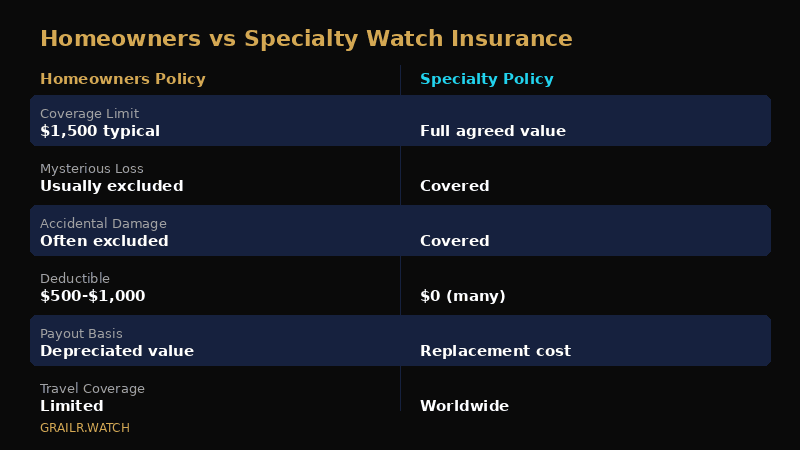
Most watch owners assume their timepiece is protected under a homeowners or renters policy. Technically, it is — but the coverage is almost certainly inadequate. Standard HO-3 homeowners policies cap “unscheduled” jewelry claims at approximately $1,500. Some policies set the limit even lower, at $1,000. That might cover a basic quartz watch. It will not cover an Omega Seamaster, a Tudor Black Bay, or any Rolex.
Even when a claim falls within the limit, your standard homeowners deductible applies — often $1,000 or more — and the payout is based on depreciated value rather than replacement cost. A watch you bought for $5,000 three years ago might be valued at $3,500 by the adjuster, regardless of what it would cost to replace on the secondary market today.
Worse, homeowners policies typically do not cover several common watch-loss scenarios: mysterious disappearance (you set the watch down and it vanished), accidental damage (knocked off a table or scratched against a doorframe), and loss while traveling internationally. These exclusions matter, because accidental damage and mysterious disappearance account for a significant share of watch insurance claims.
You can add a “scheduled personal property” rider to your homeowners policy for a specific watch, which raises the coverage limit. But the rider premium is frequently higher than a standalone specialty policy, the coverage may still exclude certain perils, and — critically — a claim on your homeowners policy is reported to the CLUE database (Comprehensive Loss Underwriting Exchange), which can affect your premium at renewal. Standalone watch insurance avoids that entirely.
Agreed Value vs Actual Cash Value
This is the single most important distinction in watch insurance. The two main policy types handle payouts very differently, and choosing the wrong one can cost you thousands of dollars at claim time.
| Feature | Agreed Value | Actual Cash Value |
|---|---|---|
| Payout basis | Pre-agreed amount at policy inception | Current market value minus depreciation |
| Depreciation applied | No | Yes |
| Market-value disputes | None — amount is fixed | Common at claim time |
| Premium cost | Slightly higher | Slightly lower |
| Best for | Watches that hold or gain value | Rapidly depreciating items |
| Offered by | Hodinkee, Jewelers Mutual, BriteCo | Most homeowners riders |
With an agreed-value policy, you and the insurer establish the watch’s replacement cost when the policy begins. If your watch is insured for $15,000 and suffers a covered total loss, you receive $15,000 — no depreciation adjustment, no market-value argument, no prolonged negotiation. This is the standard among specialty watch insurers and is strongly recommended for any timepiece worth more than a few thousand dollars.
With an actual cash value policy, the insurer pays whatever the watch is deemed to be worth at the time of loss, minus depreciation. A watch you insured at $8,000 might only pay out $5,500 if the adjuster applies five years of depreciation. This approach is more common in homeowners riders and general property policies. For watches — which can appreciate as well as depreciate — it introduces unnecessary uncertainty. Always choose agreed-value coverage when available.
How to Insure a Watch: Step by Step
Whether you own a single dress watch or a ten-piece collection, the process follows the same four steps. Taking the time to do each one properly can save you thousands in premiums and ensure a smooth claim if you ever need one.
Step 1: Establish the Insured Value
Set the insured value at replacement cost — what a comparable example would cost on the secondary market today, not what you originally paid. If your watch has appreciated, insuring at the purchase price leaves you underinsured. If it has depreciated, insuring at the purchase price means you’re paying premiums on phantom value. Grailr technology can provide an indicative value estimate as a starting point.
Step 2: Gather Documentation
Collect your purchase receipt or dealer invoice, original papers and warranty card, photographs (front, back, serial number, clasp), and — for pre-owned watches valued above $5,000–$10,000 — a professional appraisal from a certified horological appraiser (ASA or ISA credentials). Some providers require an appraisal; others, like Hodinkee, only require one above $100,000. Regardless of provider policy, a current appraisal strengthens any claim. If you need help verifying what you own, see our guide on how to authenticate a luxury watch.
Step 3: Compare Providers and Quotes
Request quotes from at least three providers. Premiums can vary 30% or more for the same watch, depending on the insurer, your location, and the deductible you choose. Look beyond price: compare what is covered (mysterious disappearance, accidental damage, worldwide travel), whether the policy is agreed-value, and how claims are settled (cash payout vs repair-first). The provider comparison below covers the leading options.
Step 4: Review the Value Over Time
Watch market values move. A Rolex Submariner insured at $9,000 in 2022 might need to be insured at $12,000 in 2026. Refresh appraisals every 2–3 years, compare annual quotes, and adjust the insured value when the market shifts. An outdated policy — whether too high or too low — costs you money either way. Our watch condition and value guide explains how condition affects resale.
What Does Watch Insurance Cost?
The general rule: expect to pay 1–2% of the insured value per year for a standalone specialty policy. That percentage can drop below 1% with higher deductibles, multi-watch discounts, or home-safe storage. Higher-risk profiles or exceptionally expensive watches can push premiums to 3–5%, though that is uncommon for most collectors.
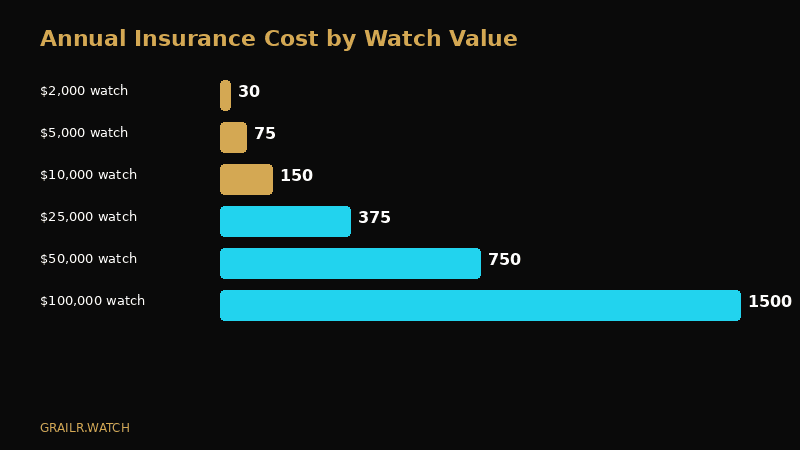
$5,000 Watch
$50–$100/yr
Tudor Black Bay, Longines Spirit, or pre-owned Omega Seamaster
$10,000 Watch
$100–$200/yr
Rolex Submariner, Omega Speedmaster, or Grand Seiko Spring Drive
$25,000 Watch
$250–$500/yr
Rolex Daytona, Cartier Santos, or IWC Portugieser Perpetual Calendar
$50,000+ Watch
$500–$1,000+/yr
Patek Philippe Nautilus, AP Royal Oak, or precious-metal Rolex
To put that in perspective: insuring a $10,000 watch costs roughly $8–$17 per month — less than most streaming subscriptions. Many specialty policies also offer $0 deductible options, meaning the full insured value is paid out with no out-of-pocket expense on a claim. Choosing a $250 deductible instead can lower annual premiums by 15–25%.
Security discounts: several providers reduce premiums for watches stored in a UL-rated home safe when not worn. Installing a quality watch safe can cut your premium by 5–15% and, more importantly, reduces the chance you ever need to file a claim. Multi-watch policies also typically offer volume discounts for collections of three or more pieces.
Check Any Watch Price in Seconds
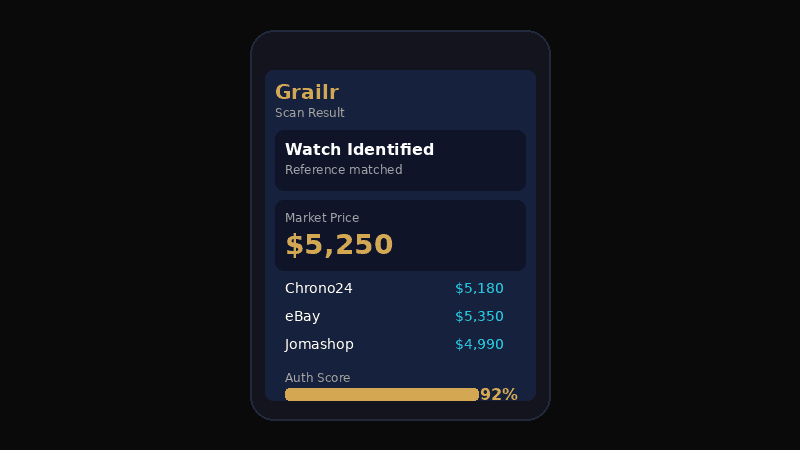
Grailr scans your watch photo and pulls live pricing from Chrono24, eBay, and Jomashop.
- AI identifies brand, model & reference number
- Live market prices from 3+ sources
- Authentication confidence score
Top Watch Insurance Providers Compared
The specialty watch insurance market has grown significantly in recent years, giving collectors more options than ever. Here is how the leading providers compare at a $10,000 insured value. For a Rolex-specific breakdown, see our dedicated Rolex watch insurance guide.
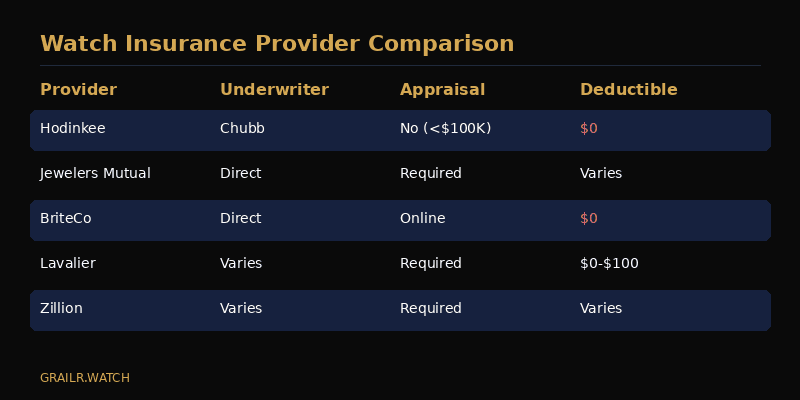
| Provider | Annual Premium ($10K) | Deductible | Underwriter | Best For |
|---|---|---|---|---|
| Hodinkee Insurance | ~$140–$180/yr | $0 or $250 | Chubb | Digital-first collectors; no appraisal under $100K |
| Jewelers Mutual | ~$160–$200/yr | $0, $100, or $250 | Jewelers Mutual (direct) | Established collectors; repair-first option |
| BriteCo | ~$120–$190/yr | $0 | Various A-rated | Appraisal included in some plans |
| Lavalier | ~$120–$160/yr | $0 | Various A-rated | Fast online quoting |
| Zillion | ~$100–$150/yr | $0 | Various A-rated | Often the lowest quoted premium |
A few provider-specific notes worth highlighting:
- Hodinkee Insurance is underwritten by Chubb, one of the world’s largest property-casualty insurers. Policies are all-risk and agreed-value, and claims are paid in cash, giving you freedom to choose your own replacement. Hodinkee can pay up to 150% of the insured value if replacement cost has risen since the policy started.
- Jewelers Mutual has been insuring jewelry and watches since 1913 — over a century of specialization. They offer a “repair first” option that can be more practical than a cash settlement if your watch is damaged rather than lost. They require a professional appraisal for all pieces.
- BriteCo, Lavalier, and Zillion are newer specialty entrants that typically offer competitive premiums and streamlined digital quoting. All three provide all-risk, agreed-value coverage with $0 deductible options. They are worth including in any quote comparison.
All premiums above are indicative estimates at $10,000 insured value. Your actual rate depends on your location, watch model, storage arrangements, and personal risk factors. Always request a direct quote before purchasing.
The Claims Process
Nobody plans on filing a claim, but understanding the process before you need it makes the experience far less stressful. Here is what a typical watch insurance claim looks like with a specialty provider.
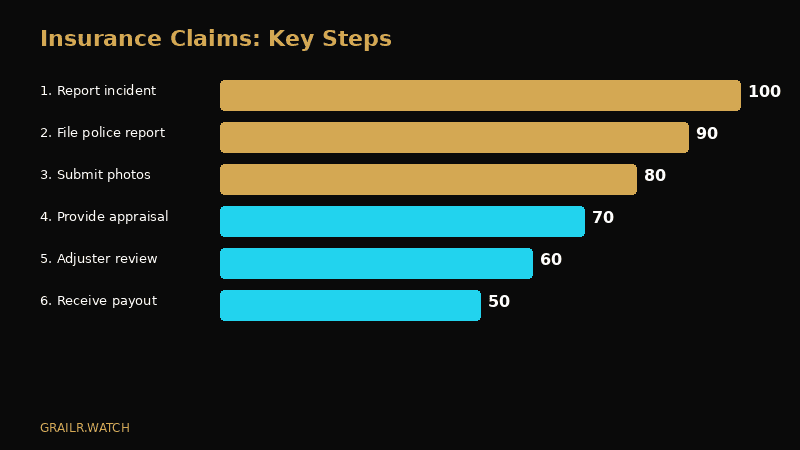
1. Report the Loss Immediately
Contact your insurer as soon as possible — most policies require notification within 24–72 hours. For theft, file a police report first; many providers require a report number before processing the claim. If the watch was lost while traveling, also notify the hotel, airline, or local authorities.
2. Gather Your Documentation
Have these ready: your policy number, the most recent appraisal or purchase receipt, photographs of the watch (front, back, serial number), the police report number (for theft), and a written description of what happened. The more complete your file, the faster the process moves.
3. Adjuster Review
The insurer assigns an adjuster who reviews your claim, documentation, and police report. For high-value claims (typically $25,000+), an independent investigation may be conducted. This is standard procedure for large payouts, not an indication of suspicion.
4. Settlement
On an agreed-value policy, the payout is the insured amount minus any deductible. Cash-settlement providers let you choose where to source the replacement; repair-first providers like Jewelers Mutual may coordinate the repair directly. Typical turnaround from initial report to settlement is 2–6 weeks for straightforward claims.
A key consideration: standalone specialty watch insurers generally do not report claims to loss-history databases like the CLUE report. That means filing a watch insurance claim will not affect your homeowners or renters premium at renewal. Specialized providers also typically do not raise your rate after a single claim. This is one of the strongest arguments for standalone coverage over a homeowners rider.
Frequently Asked Questions
How much does watch insurance cost?
Specialty watch insurance typically costs 1-2% of the insured value per year. A $10,000 watch costs roughly $100-200 annually. Higher-risk profiles or watches worth six figures can reach up to 5% in some cases. Many specialty providers offer $0 deductible options.
Does homeowners insurance cover my watch?
Standard homeowners and renters policies typically cap unscheduled jewelry claims at around $1,500. They also apply deductibles, pay depreciated value rather than replacement cost, and often exclude mysterious disappearance, accidental damage, and international travel losses. A standalone specialty policy provides broader coverage at a competitive price.
What is agreed-value watch insurance?
Agreed-value coverage locks in a guaranteed payout when the policy begins. If your watch is insured for $15,000 and is a total loss, you receive $15,000 — no depreciation disputes. This is the standard for specialty watch insurers like Hodinkee and Jewelers Mutual.
Do I need an appraisal to insure a watch?
It depends on the provider and insured value. Hodinkee requires a formal appraisal only above $100,000. Most providers accept a purchase receipt for new watches and request an appraisal for pre-owned pieces valued above $5,000-$10,000. Regardless of requirements, a current appraisal strengthens any future claim.
Which watch insurance provider is best?
There is no single best provider. Hodinkee Insurance (Chubb) is popular for digital-first collectors and requires no appraisal under $100K. Jewelers Mutual has insured jewelry since 1913 and offers repair-first options. BriteCo, Lavalier, and Zillion are strong specialty options with competitive premiums. Always compare at least three quotes.
Will filing a watch insurance claim raise my homeowners premium?
If you insure through a homeowners rider, yes — the claim appears on your CLUE report and can affect your homeowners premium at renewal. Standalone specialty watch policies generally do not report to loss-history databases and do not raise rates after a claim. This is a key advantage of standalone coverage.
Related Articles
The Bottom Line
A quality watch is one of the few personal items worth more than it costs to insure many times over. At 1–2% of the watch’s value per year, the premium is trivial compared to the asset at risk. Start by getting quotes from two or three providers, choose an agreed-value policy with worldwide coverage and a deductible that matches your risk tolerance, and keep your appraisal current. Whether you own a $3,000 Tudor or a $50,000 Patek Philippe, the math is the same: a small annual premium removes a large financial risk. If you want to know what your watch is worth before requesting a quote, Grailr’s appraisal tool can give you an indicative starting point.
Know Your Watch’s Value Before You Insure
Grailr technology identifies your watch from a photo and provides an indicative value estimate with live market data. Use it as a starting point before requesting an appraisal or insurance quote.
Scan a Watch NowSources and price context
- Chubb Valuables Coverage — Describes Chubb’s agreed-value personal article coverage, which underwrites Hodinkee Insurance watch policies.
- Jewelers Mutual Jewelry Insurance — Outlines coverage options, deductible tiers, and claims processes from this century-old specialty insurer.
These primary sources support the provider and coverage details noted above. Premium figures are indicative editorial estimates based on published rate ranges and may vary by location, watch model, and individual risk profile. Confirm current quotes directly with each provider before purchasing a policy. Asking prices referenced for watch values are not completed-sale prices.