Is Rolex Publicly Traded? Ownership Explained
Rolex has no stock ticker, no shareholders, and no annual report. Here is exactly who owns the company, how it got that way, and what it means for prices and collectors.
Revenue figures cited below are third-party estimates, not audited Rolex financials. Rolex SA does not publish accounts. Use the linked primary sources for verification.

- Rolex is not publicly traded on any stock exchange — you cannot buy Rolex stock
- The Hans Wilsdorf Foundation, a Geneva charitable trust, owns 100% of Rolex SA
- Third-party estimates put 2025 wholesale revenue at ~CHF 11 billion (~$12.5 billion)
- Competitors like Swatch Group, Richemont and LVMH are all publicly traded — Rolex and Patek Philippe are the major exceptions
The Short Answer
No, Rolex is not publicly traded. You cannot buy Rolex stock on the New York Stock Exchange, the SIX Swiss Exchange, the London Stock Exchange, or any other market. There is no ticker symbol, no share price, and no prospectus. Rolex SA is a private company headquartered in Geneva, Switzerland, and every single share is held by one entity: the Hans Wilsdorf Foundation.
This makes Rolex an outlier among the world’s largest watchmakers. Its biggest competitors — Swatch Group (Omega, Longines, Breguet), Richemont (Cartier, IWC, Jaeger-LeCoultre) and LVMH (TAG Heuer, Hublot, Zenith) — all trade on public exchanges with quarterly earnings calls, annual reports and investor presentations. Rolex publishes none of that.
The closest parallel in luxury watches is Patek Philippe, which is also privately held by the Stern family. But Patek is far smaller than Rolex by revenue and production volume. Rolex stands alone as the world’s largest watchmaker by estimated revenue, entirely outside the reach of public investors.
The Hans Wilsdorf Foundation
Hans Wilsdorf founded Rolex in London in 1905 and moved its headquarters to Geneva in 1919. He ran the company as a private owner for decades. When his wife Florence died in 1944, Wilsdorf had no heirs. Rather than sell the company or take it public, he created the Hans Wilsdorf Foundation on 1 August 1945 — a Swiss charitable foundation registered in Carouge, in the canton of Geneva.
Wilsdorf transferred all of his Rolex shares to the foundation over the following years. By 1960, the transfer was complete. When Wilsdorf died later that year, there was no estate sale, no succession battle, and no IPO. The foundation owned everything, and it still does.
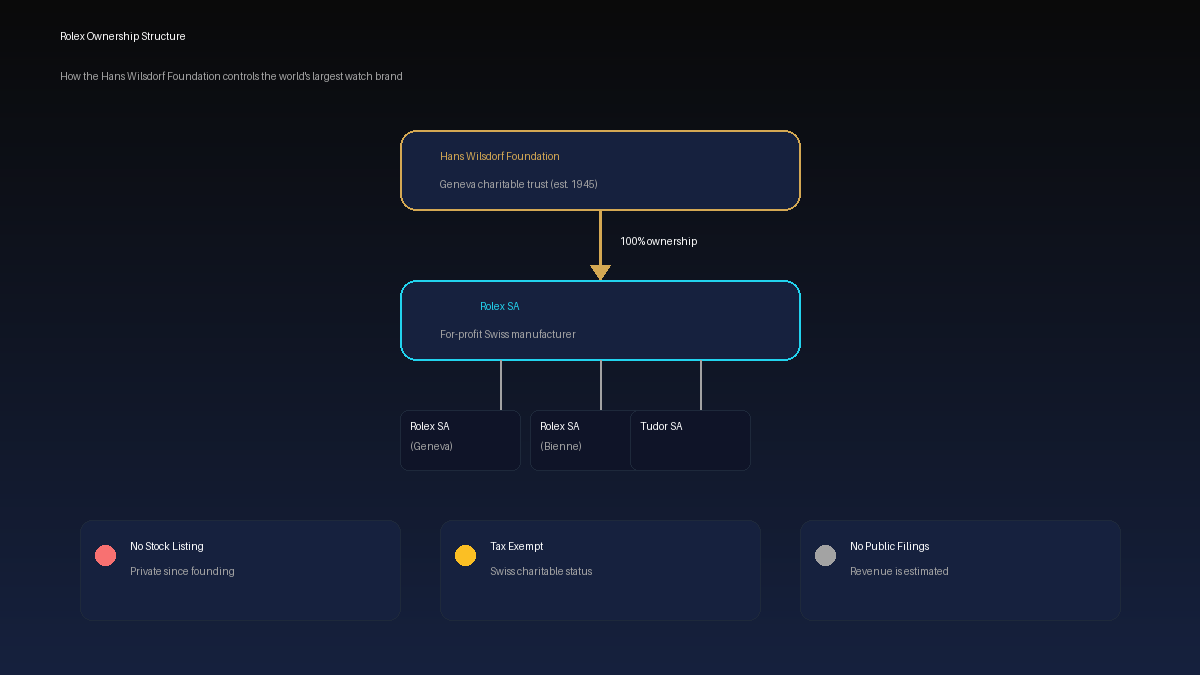
The foundation’s charter is irrevocable under Swiss law. There is no mechanism to sell the shares, distribute them to new owners, or list them on an exchange. This is not a family holding company where heirs might eventually disagree and sell — it is a legal structure specifically designed so that Rolex can never be sold. As European Business Magazine put it, the foundation is “the owner that cannot sell.”
The foundation’s board oversees Rolex SA at the highest level and appoints its senior leadership, but it does not interfere in day-to-day operations. Rolex’s CEO runs the company with operational independence — a structure closer to a family trust than a public board, but without the family.
How the Ownership Structure Works
The legal chain is straightforward. The Hans Wilsdorf Foundation sits at the top. It wholly owns Rolex SA, the Geneva-based holding company. Rolex SA in turn controls the manufacturing subsidiaries, including the production facilities in Bienne, Plan-les-Ouates, Chêne-Bourg and Acacias. The Tudor brand is also part of the group — Montres Tudor SA is a subsidiary of Rolex SA.
Under Swiss foundation law, the Hans Wilsdorf Foundation is exempt from corporate taxes. This does not mean Rolex SA itself pays no taxes — the operating company is a standard Swiss société anonyme (SA) and is subject to ordinary corporate taxation on its profits. But the dividends that flow up to the foundation are received by a tax-exempt charitable entity.
| Entity | Type | Role | Disclosure |
|---|---|---|---|
| Hans Wilsdorf Foundation | Swiss charitable foundation | Ultimate owner, 100% of Rolex SA shares | Minimal — no public filings required |
| Rolex SA | Swiss société anonyme | Holding company, all operations | No published accounts |
| Rolex manufacturing subsidiaries | Swiss subsidiaries | Watch, movement, case, dial and bracelet production | No published accounts |
| Montres Tudor SA | Swiss subsidiary | Tudor brand operations | No published accounts |
The practical result: Rolex has no quarterly earnings pressure, no activist investors demanding cost cuts, and no obligation to explain its pricing, production volumes or investment plans to anyone outside the foundation. This is fundamentally different from how Swatch Group or Richemont operate, where analysts, fund managers and retail investors scrutinize every earnings call. It is also one of the reasons Rolex watches cost what they do — the company can invest in long-horizon projects without explaining the short-term cost to shareholders.
Rolex Revenue: What We Know
Since Rolex publishes no financial statements, all revenue figures are third-party estimates. The two most widely cited sources are Morgan Stanley’s annual Swiss watch industry report (produced with LuxeConsult) and the Federation of the Swiss Watch Industry (FH) export data.
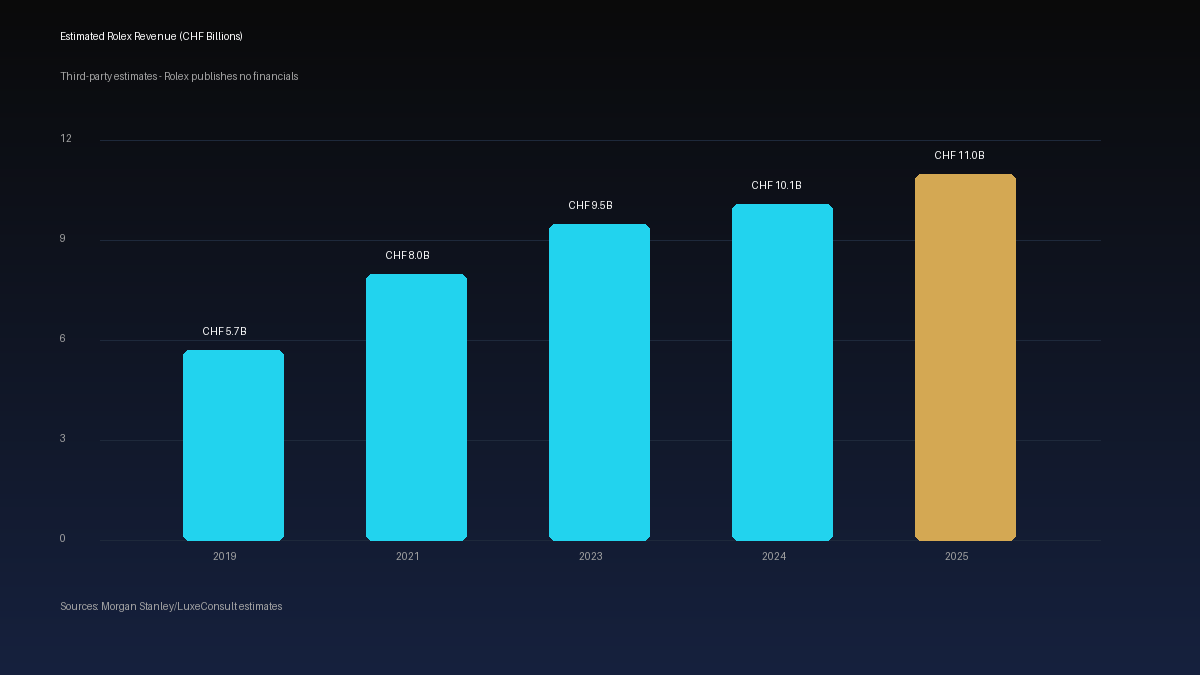
The Morgan Stanley/LuxeConsult report for 2025 estimates Rolex’s wholesale revenue at approximately CHF 11 billion, with an implied retail value near CHF 16 billion (~$18 billion). That figure represents roughly 33% of the entire Swiss watch industry by estimated revenue — meaning Rolex alone accounts for about one in every three Swiss francs the industry earns.
European Business Magazine reported that in 2025, Rolex produced fewer watches than the previous year yet generated more revenue than at any point in its history. This aligns with Rolex’s long-standing approach of restricting supply to maintain pricing power — a strategy only possible because no public shareholders can demand volume growth.
| Year | Est. Wholesale Revenue | Est. Retail Value | Est. Market Share | Source |
|---|---|---|---|---|
| 2019 | CHF 5.7B | CHF 8.5B | ~25% | Morgan Stanley |
| 2021 | CHF 8.0B | CHF 12.0B | ~29% | Morgan Stanley |
| 2023 | CHF 9.5B | CHF 14.2B | ~31% | Morgan Stanley |
| 2024 | CHF 10.1B | CHF 15.1B | ~31% | Morgan Stanley/LuxeConsult |
| 2025 | CHF 11.0B | CHF 16.0B | ~33% | Morgan Stanley/LuxeConsult |
All figures are third-party estimates. Rolex does not confirm, deny or comment on them.
Public vs Private Watch Companies
Among the world’s top watch groups, Rolex’s private status is the exception, not the rule. Here is how the major players stack up. If you are thinking of investing in watches as assets, understanding the corporate structure behind each brand helps explain pricing behaviour, production decisions and long-term supply.
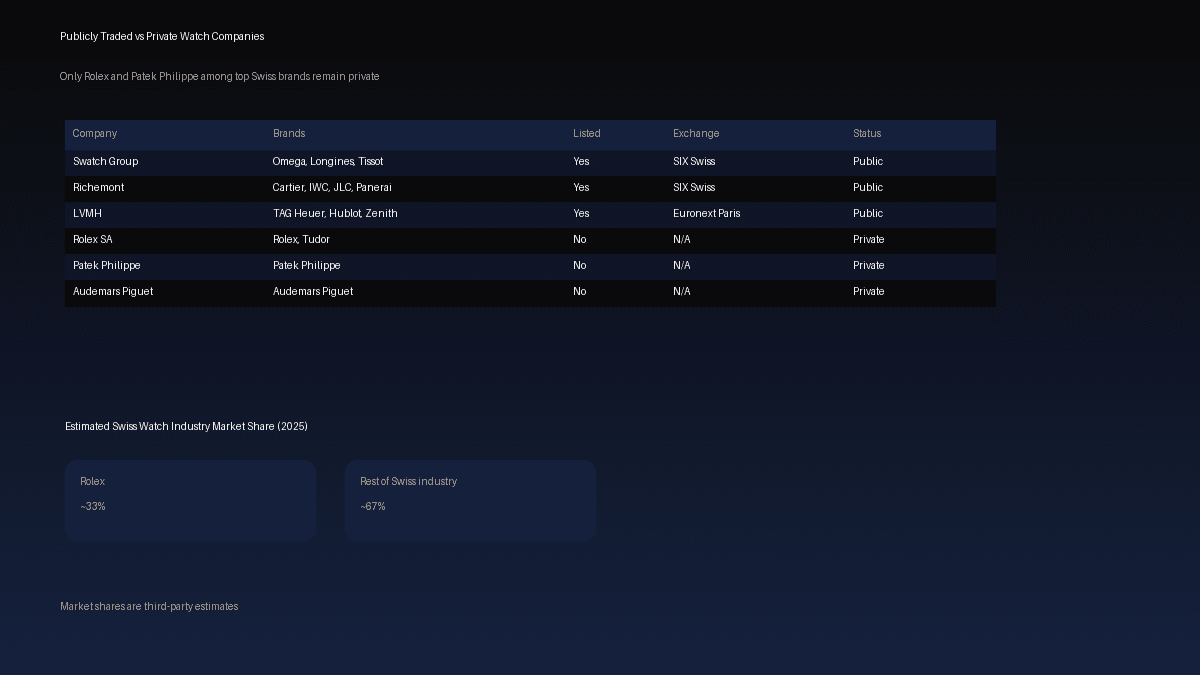
| Group | Key Watch Brands | Public/Private | Exchange |
|---|---|---|---|
| Rolex Group | Rolex, Tudor | Private | — |
| Swatch Group | Omega, Longines, Breguet, Tissot, Hamilton | Public | SIX Swiss |
| Richemont | Cartier, IWC, Jaeger-LeCoultre, Panerai, Vacheron Constantin | Public | SIX / Euronext |
| LVMH | TAG Heuer, Hublot, Zenith, Bulgari | Public | Euronext Paris |
| Patek Philippe | Patek Philippe | Private | — |
| Audemars Piguet | Audemars Piguet | Private | — |
| Citizen Watch Co. | Citizen, Bulova, Frederique Constant | Public | Tokyo (TSE) |
The difference matters for buyers. Publicly traded groups face pressure to grow earnings every quarter. That can mean price increases, broader distribution, or licensing deals to hit revenue targets. Rolex does the opposite: it famously restricts production, limits dealer allocations, and raises prices only once or twice a year. That discipline is easier when no analyst is asking you to justify slower growth on a conference call.
Why Private Ownership Matters for Buyers
Rolex’s private structure has several direct effects on anyone buying, selling or collecting watches.
Supply Control
Rolex produces an estimated 1.1–1.2 million watches per year — a volume that has barely changed despite exploding demand. A public company would face enormous pressure to ramp up production. The foundation faces none. This manufactured scarcity is the single biggest driver of Rolex secondary market premiums on popular models.
Long-Term Investment
Rolex spent over a decade and several hundred million francs building new production facilities in Bulle and expanding Plan-les-Ouates. A public company would need to explain a decade-long capital outlay to shareholders each quarter. The foundation can simply approve it and wait.
Pricing Stability
Rolex typically raises retail prices once per year in a single global adjustment. Compare this to Richemont, where Cartier’s recent US price increase on 21 May 2026 came partway through the year after a separate European adjustment. Quarterly earnings pressure can accelerate price hike cycles.
No Hostile Takeover Risk
When LVMH acquired Tiffany, analysts immediately asked what would happen to its watch brands. Swatch Group has faced activist investor campaigns. These scenarios are structurally impossible with Rolex. The foundation cannot be bought, merged or leveraged out of existence.
For buyers wondering what a Rolex is actually worth on the secondary market, tools like Grailr’s appraisal scanner provide indicative price estimates based on current listings. The private ownership structure means you will never get a P/E ratio or earnings-per-share figure for Rolex — but you can still check what the market is paying for any specific reference.
Where the Profits Go
The Hans Wilsdorf Foundation’s charitable mandate means that profits from Rolex SA ultimately fund philanthropic work. The foundation supports causes in education, social welfare, culture, and the environment. It does not publish a detailed annual giving report, so the exact scale of its philanthropy is not publicly known.
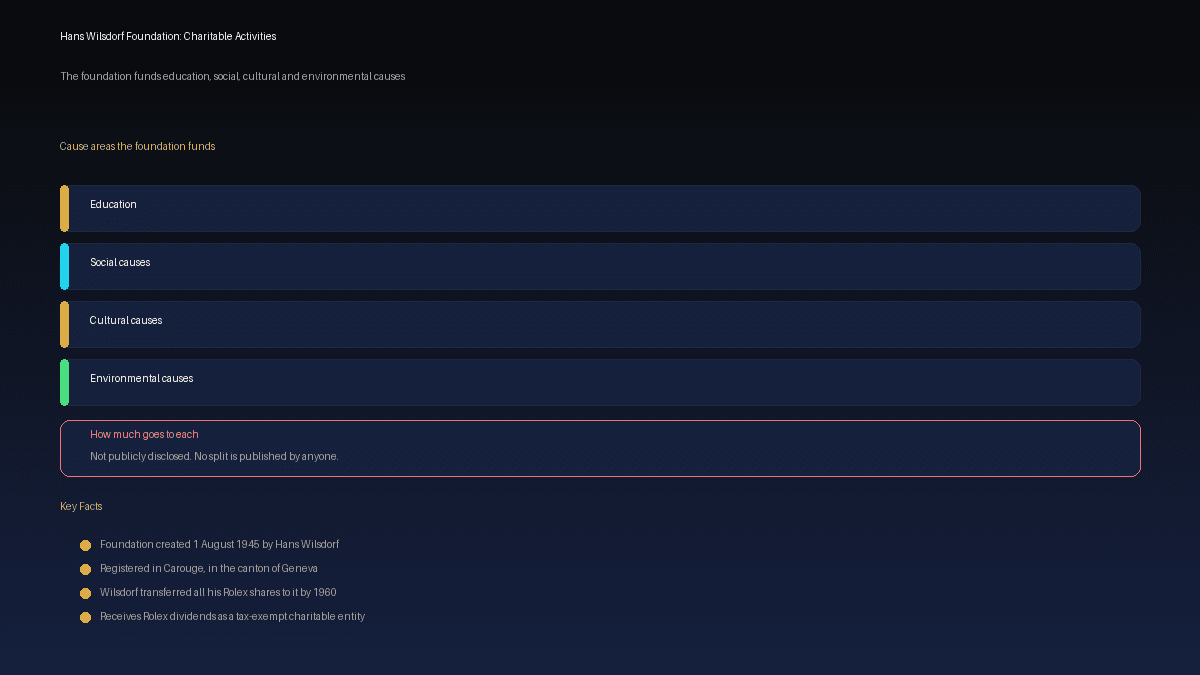
What is documented: the foundation has made grants to organisations including WWF Schweiz (CHF 20,000 in 2025, per the Fundraiso database), and it supports Geneva-based educational and social programmes. Beyond the foundation itself, Rolex runs the Rolex Awards for Enterprise, a programme that has funded over 150 projects in conservation, science and cultural preservation since 1976, and the Rolex Mentor and Protégé Arts Initiative, which pairs emerging artists with established masters.
It is worth noting what this does not mean. Rolex SA is not a non-profit. It manufactures watches for profit, pays its employees competitive salaries, and operates like any other luxury goods company. The charitable status sits at the foundation level, not the operating company. Buying a Rolex does not constitute a charitable donation, and the tax exemption benefits the foundation, not the buyer.
The structure does mean that Rolex’s profits can never be extracted by a private owner, distributed to shareholders, or used for a leveraged buyout. Every franc of profit either stays in the business or flows to the foundation’s charitable work. That permanence is part of what Wilsdorf intended when he set it up in 1945, and it has held for over 80 years.
Frequently Asked Questions
Can you buy Rolex stock?
No. Rolex SA is wholly owned by the Hans Wilsdorf Foundation, a private charitable trust registered in Geneva. There is no stock ticker, no shares on any exchange, and no way for outside investors to buy equity in the company.
Who owns Rolex?
The Hans Wilsdorf Foundation owns 100% of Rolex SA. Hans Wilsdorf, Rolex's founder, established the foundation in 1945 after the death of his wife Florence and transferred all of his shares to it by 1960.
Is Rolex a non-profit?
Rolex SA is a for-profit company that manufactures and sells watches at a profit. Its owner, the Hans Wilsdorf Foundation, is a charitable foundation exempt from Swiss corporate taxes. The foundation funds education, social, cultural and environmental causes with proceeds from Rolex.
How much revenue does Rolex make?
Rolex does not publish financial statements. Third-party estimates from Morgan Stanley and LuxeConsult put 2025 wholesale revenue at approximately CHF 11 billion, with an implied retail value near CHF 16 billion and a market share of about 33% of the Swiss watch industry.
Why does Rolex not go public?
The Hans Wilsdorf Foundation's charter keeps ownership permanent. There are no shareholders to pressure for quarterly earnings, no board seeking a liquidity event, and no mechanism to sell shares. This structure lets Rolex invest in decades-long production capacity without disclosing financials.
Are any luxury watch brands publicly traded?
Yes. Swatch Group (Omega, Longines) trades on the SIX Swiss Exchange. Richemont (Cartier, IWC, Jaeger-LeCoultre) trades on SIX and Euronext. LVMH (TAG Heuer, Hublot) trades on Euronext Paris. Among the top Swiss watchmakers, only Rolex, Patek Philippe and Audemars Piguet remain fully private.
Related Articles
The Bottom Line
Rolex is not publicly traded, cannot be bought on any stock exchange, and almost certainly never will be. The Hans Wilsdorf Foundation’s irrevocable ownership means the company will remain private as long as Swiss law holds. For watch buyers, this is arguably good news: it means Rolex can prioritise long-term brand health over quarterly returns, invest in multi-decade production plans, and restrict supply without explaining itself to analysts. Whether you are buying your first Rolex or evaluating a vintage reference, understanding the company behind the crown helps explain why these watches behave differently on the secondary market than any other luxury brand.
Sources and context
- Moneyhouse — Rolex SA company record — Swiss commercial register entry for Rolex SA, confirming its legal form and registration.
- European Business Magazine — Rolex Foundation: The Owner That Cannot Sell — Background on the Hans Wilsdorf Foundation’s structure and its effect on Rolex’s business strategy.
Revenue figures, market share and production estimates are compiled from publicly available third-party analyses (Morgan Stanley, LuxeConsult). Rolex SA does not publish financial statements or confirm external estimates. The charitable foundation’s grant data is sourced from the Fundraiso database. Verify all figures independently before relying on them.