Why Are Rolex Watches So Expensive?
Seven real factors behind the price tag — from proprietary steel alloys and in-house movements to controlled supply and brand heritage.
Price context: this guide includes indicative prices from its original publication period. They have not all been refreshed to current quotes. Use the linked primary sources for specifications and policies, and verify prices independently.
- Rolex manufactures virtually every component in-house across four Swiss facilities — movements, cases, dials, crystals and even its own gold alloys
- 904L Oystersteel costs more to machine than the 316L most competitors use, adding genuine material cost to each watch
- Every movement passes both COSC certification (±4–6 sec/day) and Rolex’s own Superlative Chronometer test (±2 sec/day)
- Estimated production of ~1.2 million watches per year is deliberately held below global demand, sustaining both retail pricing and secondary-market premiums
1. Vertical Integration: Rolex Makes Everything
Most watch companies buy components from specialist suppliers. Rolex does not. It operates four manufacturing facilities in Switzerland — in Geneva, Plan-les-Ouates, Bienne and Chêne-Bourg — and produces virtually every component under its own roof. That includes movements, cases, bracelets, dials, crystals, ceramic bezel inserts, springs, and even proprietary gold alloys like Everose and yellow Rolex gold.
This level of vertical integration is extremely expensive to build and maintain. It requires dedicated foundries, chemical laboratories, clean-room assembly lines, and thousands of skilled workers. A Rolex overview of their watchmaking process describes the company’s in-house approach to case machining, gemstone setting and bracelet fabrication. Where competitors outsource dial printing or case production, Rolex carries the overhead of doing it all internally.
The payoff is total quality control. Every part meets Rolex’s own tolerances, which can be tighter than industry standards. It also means Rolex is not exposed to supply chain disruptions the way brands relying on third-party suppliers are. The trade-off is higher fixed costs per watch — costs that are built into the retail price.
2. 904L Oystersteel vs 316L
Walk into almost any watch brand’s factory and you’ll find 316L stainless steel on the production line. It’s the industry default — durable, affordable, and well-understood. Rolex, however, switched to 904L steel for its entire steel lineup in 2003 and branded it Oystersteel.
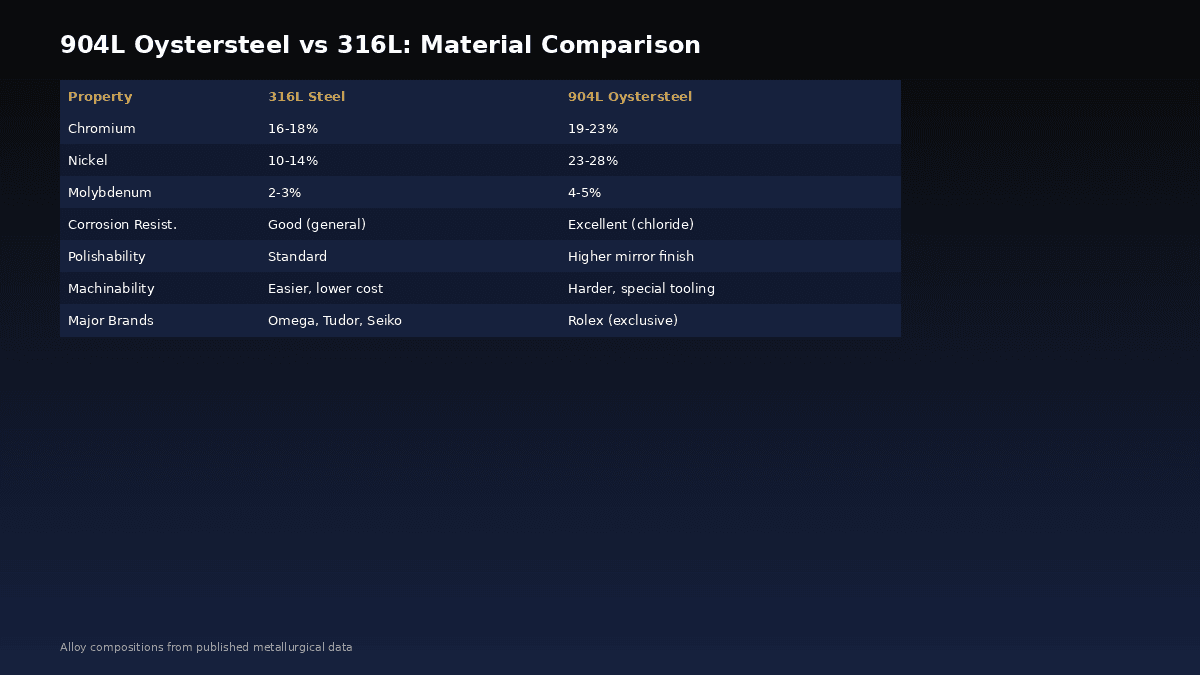
The difference is chemical composition. 904L contains higher levels of chromium, nickel and molybdenum than 316L, giving it superior resistance to chloride corrosion — particularly from saltwater and chlorine. It also takes and holds a higher polish, which is why a Rolex bracelet has that distinctive mirror-like finish. An in-depth comparison of 316L and 904L steel in watches details how the alloy compositions diverge and what each trade-off means for the end product.
| Property | 316L Steel | 904L Oystersteel |
|---|---|---|
| Chromium | 16–18% | 19–23% |
| Nickel | 10–14% | 23–28% |
| Molybdenum | 2–3% | 4–5% |
| Corrosion Resistance | Good (general purpose) | Excellent (chloride/saltwater) |
| Polishability | Standard | Higher mirror finish |
| Machinability | Easier, lower cost | Harder, specialised tooling |
| Watch Brands Using It | Omega, Tudor, Seiko, most brands | Rolex (exclusive in major brands) |
The harder machinability of 904L is a real cost factor. Rolex had to invest in entirely new tooling and machining processes to work with it, and the alloy wears through cutting tools faster than 316L. That said, raw steel is a relatively small fraction of a finished watch’s value — the manufacturing process accounts for far more than the material itself.
3. In-House Movements and Superlative Chronometer Testing
Every modern Rolex runs an in-house movement. The brand does not buy calibres from ETA, Sellita or any other third-party movement maker — it designs, produces and assembles them all in Bienne. Current-generation movements like the Cal. 3230, 3235 and 4131 share a standardised 70-hour power reserve and Rolex’s Chronergy escapement, an energy-efficient design that contributes to both accuracy and longevity.
Before a movement leaves the factory, it goes through two rounds of certification. First, the raw movement is sent to COSC (Contrôle Officiel Suisse des Chronomètres), the Swiss testing body, which certifies it at ±4 to ±6 seconds per day across multiple positions and temperatures over 15 days. Most Swiss brands stop here. Rolex does not.
After COSC certification, the movement is cased — assembled into the full watch — and then undergoes Rolex’s own Superlative Chronometer testing, which tightens the tolerance to ±2 seconds per day. This second round tests the complete watch, not just the movement, under conditions that simulate real wear. The green seal on a Rolex hangtag signifies this dual certification.
Running two separate certification programmes, one of them entirely proprietary, costs money that most brands avoid. It also means Rolex rejects or reworks any movement that does not meet the tighter standard, adding to effective per-unit costs. The result is a watch that is, on paper, twice as accurate as the standard Swiss chronometer requirement.
Check Any Watch Price in Seconds
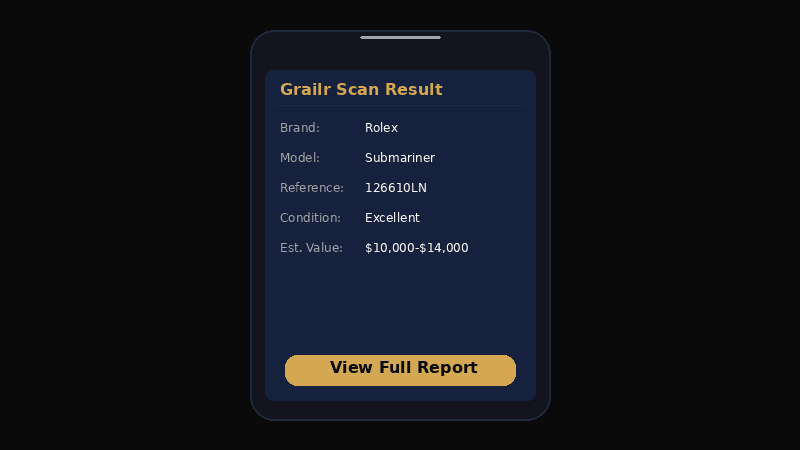
Grailr scans your watch photo and pulls live pricing from Chrono24, eBay, and Jomashop.
- AI identifies brand, model & reference number
- Live market prices from 3+ sources
- Authentication confidence score
4. Controlled Supply and Waitlists
Rolex is estimated to produce roughly 1.2 million watches per year. That sounds like a lot — and it makes Rolex the largest Swiss watch brand by revenue — but it is deliberately below global demand. Walk into an authorised dealer today and ask for a Submariner, Daytona or GMT-Master II and you’ll be placed on a waitlist that can stretch from months to years.
This supply constraint is not an accident. Rolex could almost certainly produce more watches by expanding facilities or adding shifts, but it chooses not to. Controlled scarcity sustains the brand’s positioning: when demand consistently exceeds supply, the product maintains both its price and its perceived exclusivity.
The downstream effect is visible on the secondary market. Steel sport models like the Daytona and GMT-Master regularly trade above their retail prices, sometimes by thousands of dollars. Even entry-level models like the Oyster Perpetual 41 have traded at a premium. That secondary-market strength feeds back into retail demand — buyers know a Rolex is unlikely to lose money, which makes them more willing to pay the asking price.
5. Precious Metal Costs
A significant portion of the Rolex catalogue uses 18-karat gold or 950 platinum. Rolex does not buy finished precious-metal components; it operates its own foundry in Plan-les-Ouates where it casts and refines its own gold alloys. The three proprietary alloys — yellow gold, Everose (a rose gold with added platinum for fade resistance) and white gold — are formulated to Rolex’s own specifications.
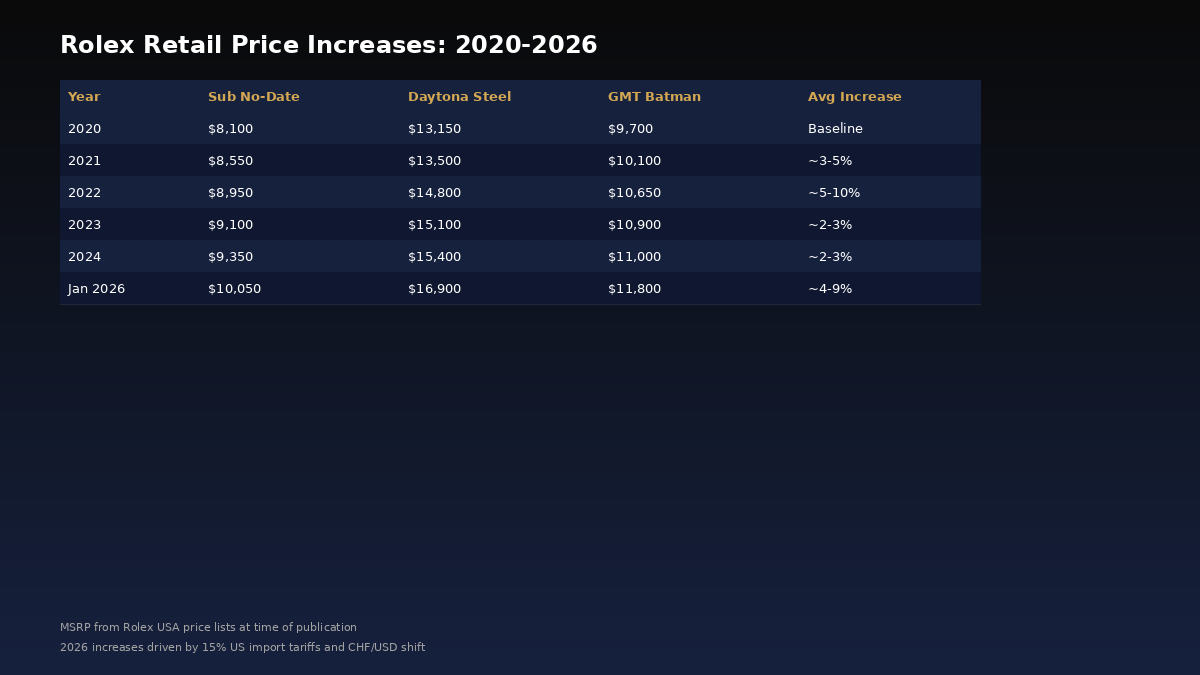
Gold prices have roughly doubled over the past three years, and that is reflected directly in retail pricing. Rolex implemented a second price increase in June 2026 that targeted gold models specifically, adding approximately 5% on top of the January increase. A yellow-gold Day-Date 40 that opened 2026 at around $40,250 was repriced to roughly $42,300 by mid-year.
Platinum models cost even more. The Daytona in 950 platinum retails above $80,000, driven by both the raw metal cost and the difficulty of machining platinum, which is harder and denser than gold. A watch case that takes an hour to machine in steel may take several hours in platinum, adding significant labour cost.
6. Brand Heritage and Marketing
Rolex has spent more than a century building the most recognised name in watchmaking. Founded in London in 1905 and moved to Geneva in 1919, the brand has attached itself to defining moments: the Oyster crossing the English Channel on a swimmer’s wrist in 1927, the Explorer on the wrist of the 1953 Everest expedition, the Submariner adopted by military divers, the Daytona named for the Florida racing circuit.
Today, Rolex sponsors Wimbledon, the US Open, Formula 1, golf majors and the Academy Awards. These partnerships are not cheap. The annual marketing spend is not disclosed, but industry analysts estimate it in the hundreds of millions of dollars. That investment is a real line item in the cost of every watch sold.
The result is a brand that transcends the watch world. Rolex is recognised by people who have never owned a luxury watch and never will. That recognition creates demand from both collectors and status-driven buyers, supporting the premium pricing that funds the manufacturing quality described above. It is a virtuous cycle — the brand justifies the price, and the price funds the brand.
7. Resale Value and Total Cost of Ownership
One of the most cited justifications for Rolex pricing is resale value. Unlike most consumer goods — and unlike most watches — Rolex models tend to retain a significant percentage of their purchase price on the secondary market. Some models appreciate.
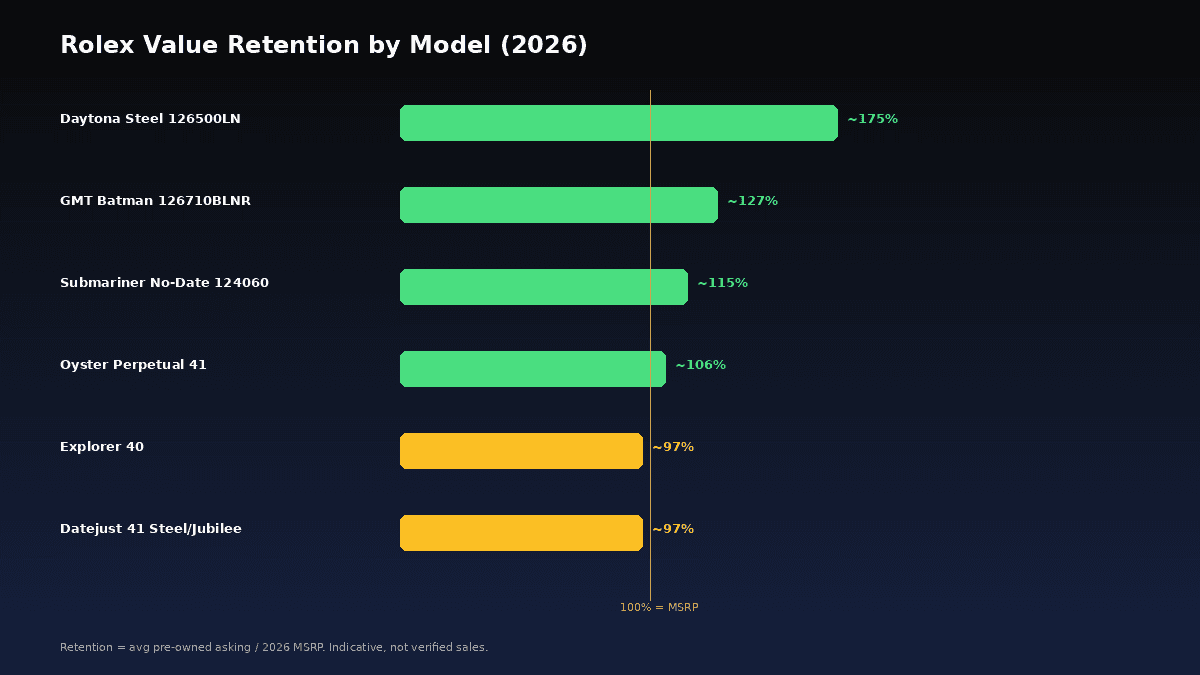
| Model | 2026 MSRP | Pre-Owned (approx.) | Retention |
|---|---|---|---|
| Oyster Perpetual 41 | $6,150 | $6,500 | ~106% |
| Explorer 40 | $7,350 | $7,100 | ~97% |
| Submariner No-Date 124060 | ~$10,050 | $11,000–$12,000 | ~110–119% |
| GMT-Master II Batman 126710BLNR | ~$11,800 | $14,000–$16,000 | ~119–136% |
| Daytona Steel 126500LN | ~$16,900 | $28,000–$32,000 | ~166–189% |
| Datejust 41 (Steel/Jubilee) | $9,650 | $9,400 | ~97% |
This retention changes the calculation for buyers. A Rolex that costs $10,000 and retains $9,500 of its value after five years has an effective cost of ownership of just $500, plus servicing. Compare that with a $5,000 fashion watch that might be worth $500 at resale: the Rolex is actually cheaper to own despite costing twice as much upfront. The detailed resale comparison between Rolex and Omega explores this further.
What a Rolex Actually Costs in 2026
After two rounds of price increases, here is where the current Rolex lineup sits. Steel models saw roughly 4–9% increases in January 2026, driven by tariffs on Swiss imports and a weaker dollar. Gold models took an additional ~5% in June as gold prices surged. The full 2026 release guide covers every new reference introduced this year.
Entry-Level Steel
$5,800 – $9,650
Oyster Perpetual 36 to Datejust 41. Same Superlative Chronometer standard, same 70-hour power reserve as every Rolex.
Steel Sport Models
$10,050 – $16,900
Submariner No-Date to Daytona. The waitlist tier — these models trade above retail on the secondary market.
Two-Tone (Rolesor)
$14,550 – $22,300
Steel and gold combinations. The Submariner Two-Tone and GMT Rolesor live here.
Full Precious Metal
$37,000 – $82,700+
Day-Date, Sky-Dweller, gold Daytona. Hit hardest by the June 2026 increase as gold prices surged.
For the most complete Oyster Perpetual pricing breakdown, including every dial colour and size, see our dedicated guide.
Is a Rolex Worth the Price?
The honest answer is: it depends on what “worth it” means to you. If you evaluate a watch purely on timekeeping accuracy, a $50 Casio keeps better time than any mechanical watch, including a Rolex. If you evaluate it on engineering depth, material quality and long-term value retention, Rolex is one of the strongest propositions in watchmaking.
The seven factors above — vertical integration, 904L steel, certified accuracy, controlled supply, precious metals, brand heritage and resale strength — are all real. They add up to a genuinely expensive product to design, manufacture and support. But the retail price also includes a brand premium that goes beyond cost of goods. Rolex is a charitable trust (the Hans Wilsdorf Foundation) with no shareholders to please, and its pricing reflects a deliberate strategy to maintain exclusivity rather than maximise unit volume.
For most buyers, the practical question is not whether a Rolex is objectively “worth” the sticker price, but whether the total cost of ownership — purchase price minus eventual resale value, plus any servicing — fits their budget and priorities. On that measure, Rolex performs better than nearly any competitor.
Frequently Asked Questions
How much does it cost Rolex to make a single watch?
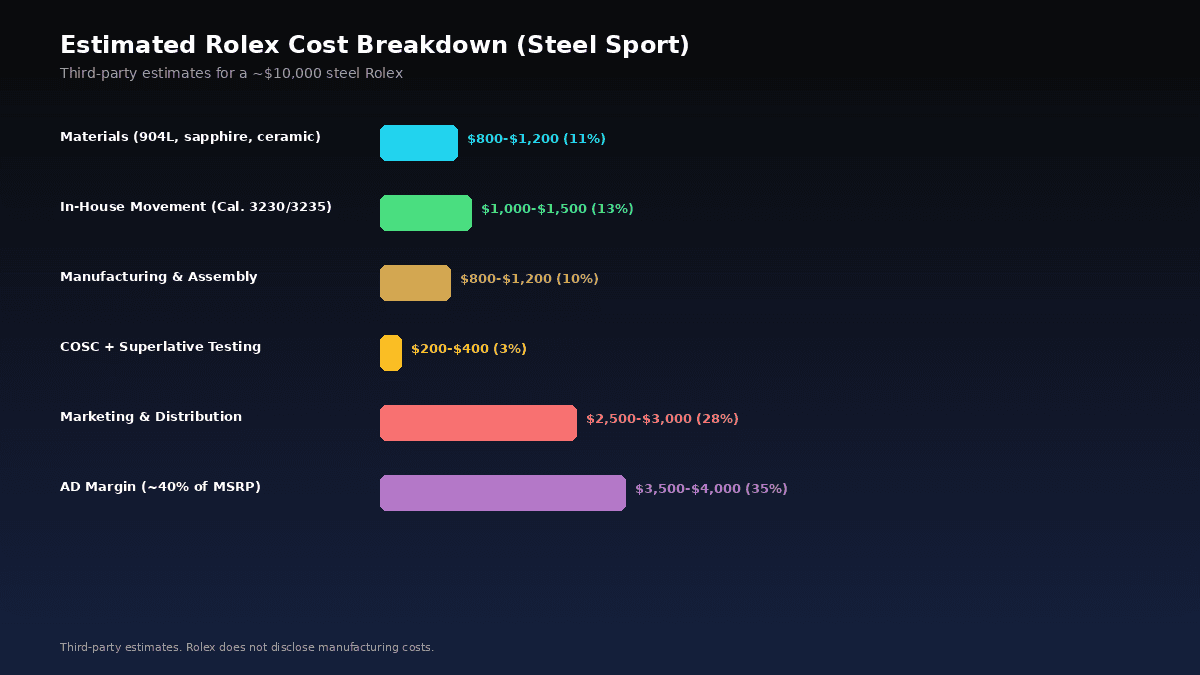
Rolex does not disclose manufacturing costs. Third-party estimates for a steel model range from roughly $1,000 to $4,000, covering materials, labour and factory overhead but excluding R&D, marketing and distribution.
Why does Rolex use 904L steel instead of 316L?
904L (marketed as Oystersteel) contains more nickel, chromium and molybdenum than 316L. It resists chloride corrosion better, takes a higher polish, and holds up in saltwater. The trade-off is that it is harder to machine, which raises production cost and requires specialised tooling.
Are Rolex watches overpriced for what you get?
Rolex retail prices reflect in-house production, premium alloys, certified accuracy, a five-year warranty and strong brand demand. Whether that represents good value depends on the buyer: entry-level steel models retain 89–106% of retail on the secondary market, which few luxury goods achieve.
Why are Rolex watches so popular?
Rolex combines instant brand recognition, proven durability, strong resale value and over a century of marketing around exploration, sport and achievement. That combination keeps demand well above production volume.
How much did Rolex prices increase in 2026?
Rolex raised US retail prices by roughly 7% on average in January 2026, with steel models up 4–9%. A second increase in June 2026 added about 5% to gold models only. Tariffs, gold prices and currency shifts were cited as drivers.
Do Rolex watches hold their value?
Most Rolex steel sport models hold 90–110% of their retail price on the secondary market. Entry-level models like the Oyster Perpetual and Explorer retain 89–106%. Precious-metal models can depreciate more initially but tend to stabilise over time.
Related Articles
The Bottom Line
Rolex watches are expensive because they are expensive to make — proprietary steel, in-house movements, dual-certified accuracy and vertical integration across four Swiss factories all carry real cost. But they are also expensive because Rolex deliberately produces fewer watches than the world wants, sustaining both retail pricing and secondary-market premiums. The result is a product whose high sticker price is partially offset by unusually strong value retention, making the true cost of ownership lower than the purchase price suggests.
Curious About a Rolex?
Grailr uses a photo to suggest a watch identity and an indicative price estimate, with active eBay listings where available. Check the exact reference and condition independently; a photo scan cannot authenticate a watch.
Scan a Watch NowSources and price context
- Rolex Watchmaking — Rolex’s own description of its in-house manufacturing processes, foundry operations and quality controls.
- 316L vs 904L Stainless Steel in Watches — Detailed alloy composition comparison and machinability trade-offs for watch-grade steel.
These primary sources support the specific specification and process points noted above. Prices and resale percentages elsewhere in this guide are indicative editorial figures, not a verified transaction dataset or guaranteed returns. Confirm the exact reference, region, condition and current quote before buying; asking prices are not completed-sale prices.