Buying guide
King Seiko Buying Guide: KSK Size, Movement and Value
Compare King Seiko KSK references, case sizes and movements. Learn how to assess condition, bracelet fit and a used seller’s asking price before buying.
By Grailr Watch Intelligence · · 12 min read
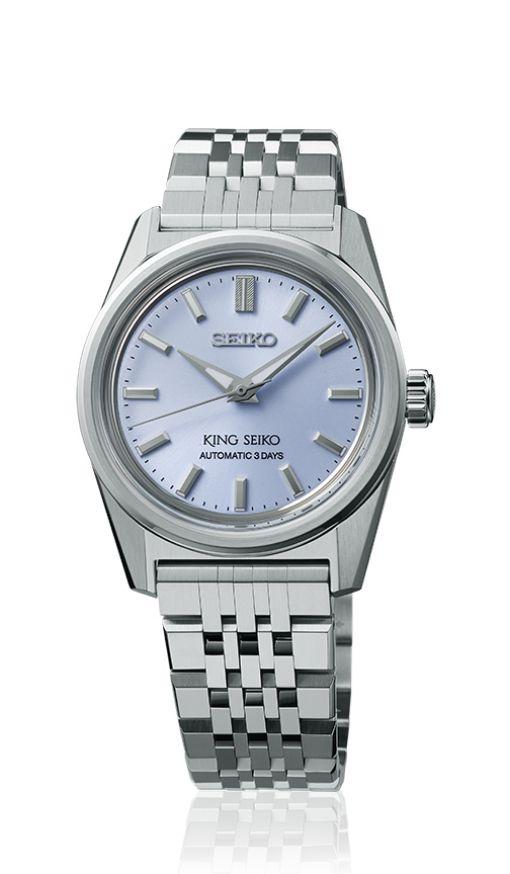
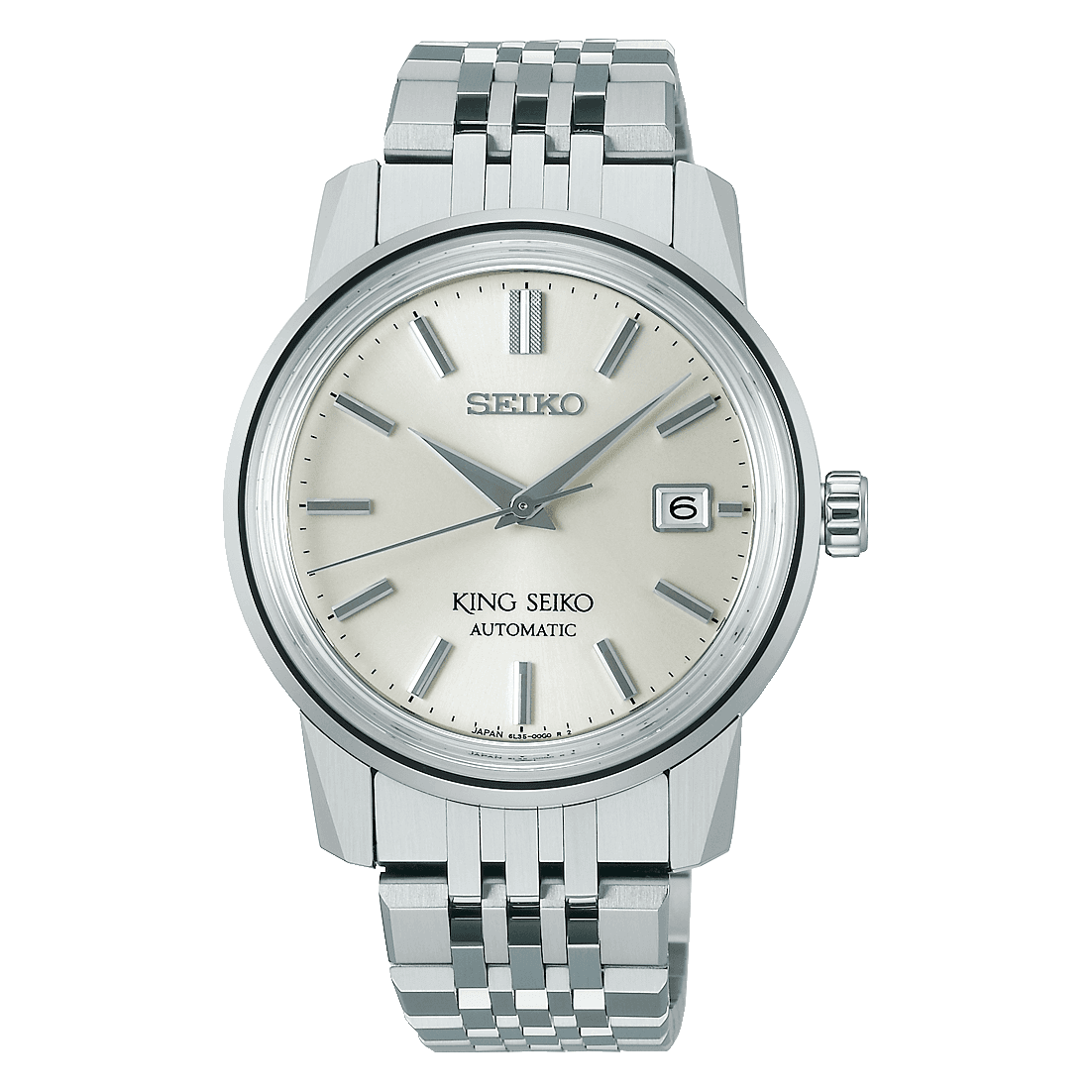
King Seiko can be an appealing purchase until you open several listings and discover that similar-looking watches have very different specifications. A smaller case does not necessarily mean a thinner watch. A more expensive movement does not necessarily run longer between wears. And a low asking price can stop looking attractive when the bracelet is too short or the service history is unclear.
This King Seiko buying guide focuses on two modern KSK references: the blue-dial SPB457J1 and silver-dial SJE089J1. It is a desk-researched comparison of documented specifications and buying checks, not a claim that we have worn or tested either watch. Use it to build a shortlist and to ask a seller questions that change the decision.
King Seiko KSK: start with the full reference
A listing headed simply “King Seiko automatic” is not enough to compare offers. Record the complete reference, dial colour, bracelet or strap, included accessories and seller location. Keep the seller’s photographs with that record. If a listing includes a shortened code, ask for the paperwork or other evidence connecting it to the watch being sold.
The KSK name refers to a design lineage within the modern King Seiko collection. It does not make every model interchangeable. Vintage pieces, other modern King Seiko families and different KSK generations need their own comparisons. This article deliberately stays with two steel-bracelet examples rather than creating a single price ladder for everything carrying the name.
Seiko’s KSK collection overview is useful for separating the 6R and 6L families. Use manufacturer photographs to understand the intended configuration; use the seller’s photographs to assess the particular offer. An official picture in an advertisement tells you little about scratches, missing links or replacement parts on the actual watch.
| Specification | SPB457J1 | SJE089J1 |
|---|---|---|
| Dial in this comparison | Light blue, no date | Silver, date at three |
| Movement | Automatic 6R51 | Automatic 6L35 |
| Case diameter | 36.1mm | 38.6mm |
| Case thickness | 11.6mm | 10.7mm |
| Case length / lug-to-lug | 43.0mm | 45.8mm |
| Lug width | 19mm | 19mm |
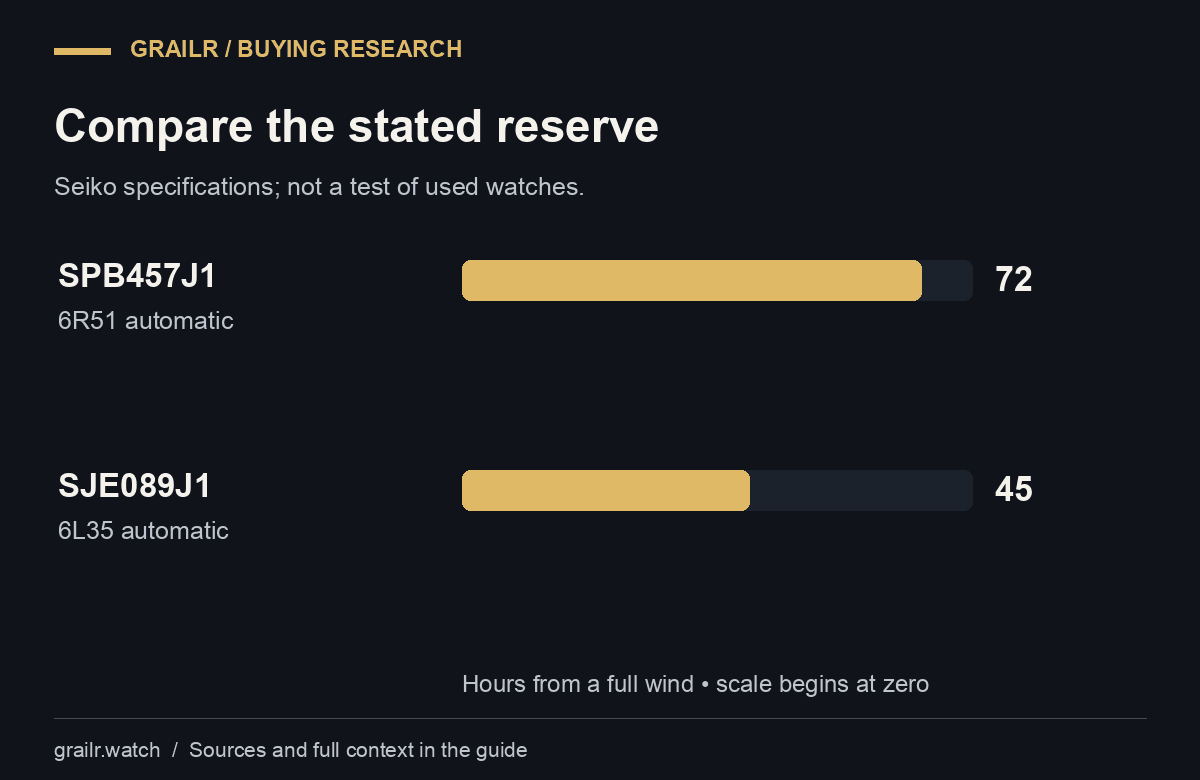
| Stated reserve | 72 hours | Approximately 45 hours |
| Published daily accuracy range | −15/+25 seconds | −10/+15 seconds |
The table uses the official UK SPB457J1 listing and Seiko’s SJE089J1 specification, checked on 20 November 2026. Specifications describe the model, not measured performance of a used example. If a seller quotes different dimensions, ask which source and reference they used.
Choosing the size that works on your wrist
The useful comparison is footprint against height. The SPB457J1 occupies less space across the wrist, while the SJE089J1 is the thinner of these two cases. Neither difference tells you everything about comfort. The bracelet’s first links, clasp position and your wrist shape can matter more than the number that appears most prominently in a listing.
Try a watch with the bracelet adjusted, or ask a dealer to explain the available adjustment before paying. A loose bracelet sliding onto your hand gives a poor impression of how the case normally sits. Check the watch with your arm relaxed, while bending your wrist and under a sleeve you actually wear. A mirror at an ordinary viewing distance is more useful than judging only a close phone photograph.
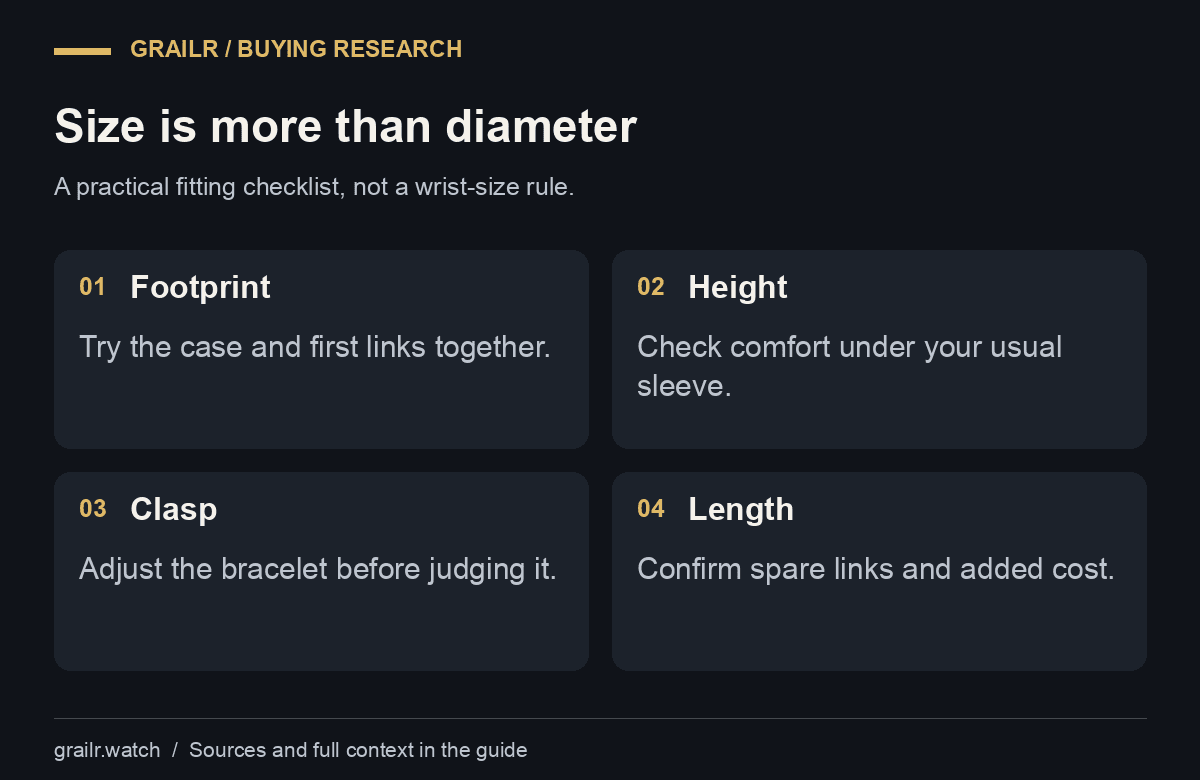
For an online purchase, request a straight-on photograph, a side view and a measurement of the bracelet as supplied. Ask how many spare links are included. Do not assume a stated maximum wrist size includes missing links or a future strap purchase. If the watch is already marginal for your wrist, confirm the cost and availability of the correct links before treating it as a bargain.
Both compared references have a published 19mm lug width, but that alone does not establish that bracelets, end links or clasps can be exchanged. Confirm compatibility with the brand or an appropriate watchmaker. A replacement strap can be an enjoyable choice; it should be a choice you budgeted for, not a surprise required to make the watch wearable.
King Seiko movements: reserve is only one part of value
Our automatic and quartz ownership guide explains the broader routines. If you rotate watches, reserve affects how often you reset the time. If you wear one watch every day, you may care more about its overall feel, rate consistency and ease of use. Decide which routine sounds like yours before interpreting a specification as an automatic upgrade. Paying more for a feature you will not notice is different from paying more for one you will enjoy daily.
The two reserve figures are shown below so that the trade-off is easy to see. They are manufacturer specifications from a full wind, not a forecast of how long a watch with an unknown winding or service history will keep running. A brief seller video showing a moving seconds hand cannot demonstrate the full reserve.
Keep rate accuracy separate from reserve. A wider published daily range is not a promise that your own watch will operate at its worst limit; a narrower range does not certify the condition of a watch on a marketplace. Ask what the seller has measured, over what period and under what conditions. If timing data is supplied, treat it as one piece of evidence for a watchmaker to interpret.
For a used purchase, useful questions include whether winding feels normal, whether the hands set cleanly and whether the watch has had repairs. For the dated model, follow the correct manual when setting the calendar. Avoid diagnosing a movement from a seller’s adjective such as “excellent.” Request the service invoice when maintenance is part of the reason for the asking price.
Inspect the case and bracelet before judging the price
Start with consistent photographs rather than a list of condition grades. Request views of all four lugs, both case sides, the crystal, crown, caseback and clasp. Diffuse light can reveal different marks from a bright reflective photograph. A seller who provides both makes it easier to understand what you are buying without relying entirely on one flattering angle.
The KSK’s defined case surfaces make the quality of those photographs particularly useful. Ask whether the watch has been polished, who performed the work and whether any parts were replaced. A polished watch is not automatically a poor purchase, but the work should be disclosed and reflected in how you compare it with other examples. Do not turn an ambiguous photograph into a confident verdict about originality.
| Area | Ask for | Why it changes the decision |
|---|---|---|
| Case | Clear lug and side photographs; polishing disclosure | Shows the surfaces you will actually receive |
| Bracelet | Supplied length, spare links and clasp photographs | Helps establish fit and possible extra costs |
| Movement | Service invoices and a description of running behaviour | Separates documented work from a vague assurance |
| Documents | Matching reference details and dated purchase evidence | Clarifies what the seller means by a complete set |
| Transaction | Written return terms, delivery and payment arrangements | Lets you evaluate the offer as a whole |
Check the wording of “full set.” It may mean a box and booklet, or it may include dated warranty documentation, tags and spare links. Write down what matters to you and ask the seller to list what is included. A box does not establish the identity of the watch, and paperwork does not replace inspection, but missing accessories can still affect the offer’s usefulness to you.
If water use matters, ask about recent water-resistance testing. Seiko’s care guidance explains that water resistance can deteriorate with ageing gaskets or damage. A factory specification and the present condition of an older watch are separate questions. Budget for appropriate checks rather than assuming the specification remains established indefinitely.
What is a fair King Seiko price? Build a comparable set
There is no single fair price for “a King Seiko.” Start with the same reference and configuration, then narrow the comparison by condition, accessories, service evidence and seller terms. Compare offers in the same currency and market where possible. Keep dealer asking prices separate from private offers and do not describe either as completed-sale evidence unless you actually have a documented sale.
The UK boutique displayed £1,720 for SPB457J1 and marked it out of stock when checked on 20 November 2026. That is a dated UK retail reference point, not an available purchase offer or a used-market valuation. We are not converting it into a supposed US street price. Availability, local taxes and a specific seller’s conditions require a fresh check when you are ready to buy.
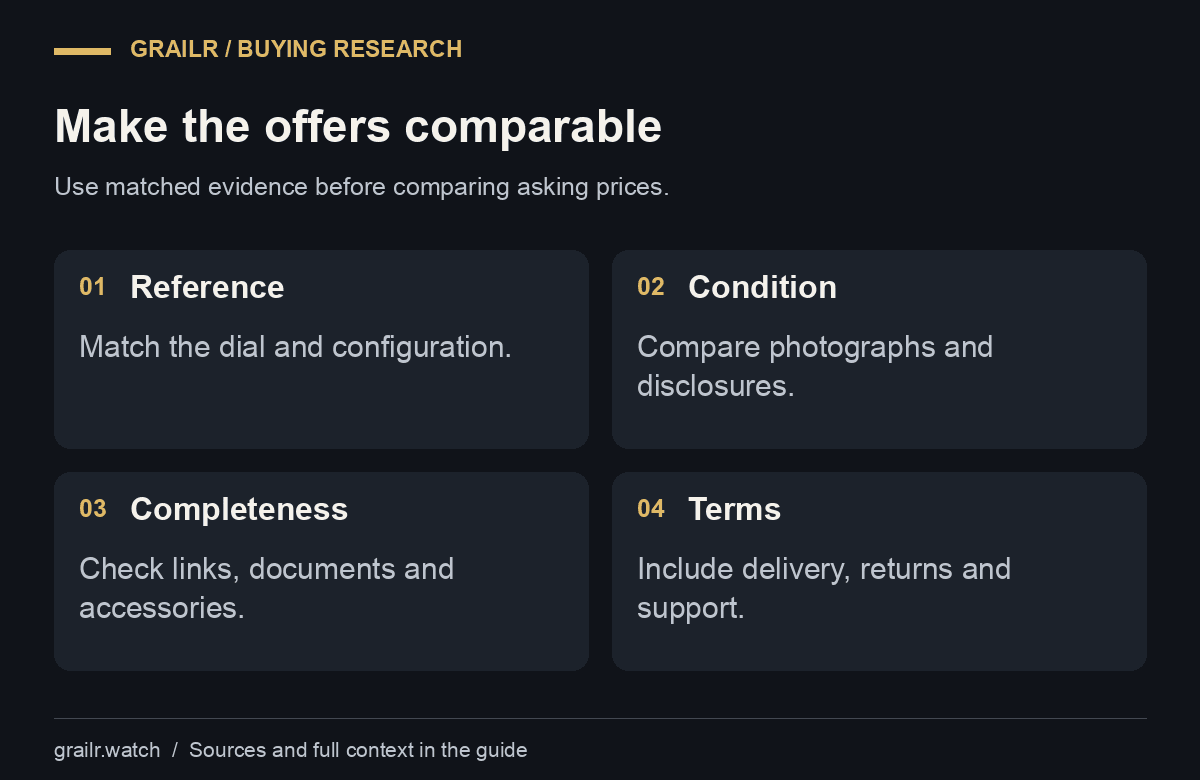
Collect several relevant offers and note why each is comparable. If only one matches, keep that uncertainty visible. A cheap result for a different movement or dial may be useful context, but it is not a replacement for a matched comparison. Likewise, a listing that remains unsold at a high price shows what someone is asking, not what buyers are willing to pay.
Write a total-cost line for each serious candidate: asking price, delivery, applicable tax or import charges, known bracelet needs and quoted work. Leave unquoted repairs as unknown rather than filling in an optimistic guess. Our watch condition guide and used-watch price checklist explain how to keep those assumptions separate from the headline number.
Compare two offers without inventing a resale forecast
Imagine two offers for the same reference. Offer A asks $1,200, with $50 delivery and $150 of confirmed work. Offer B asks $1,350 with delivery included and no identified immediate work. Those are invented arithmetic examples, not current King Seiko prices or service quotations. Before tax and any undiscovered issues, the first subtotal is $1,400 and the second is $1,350.
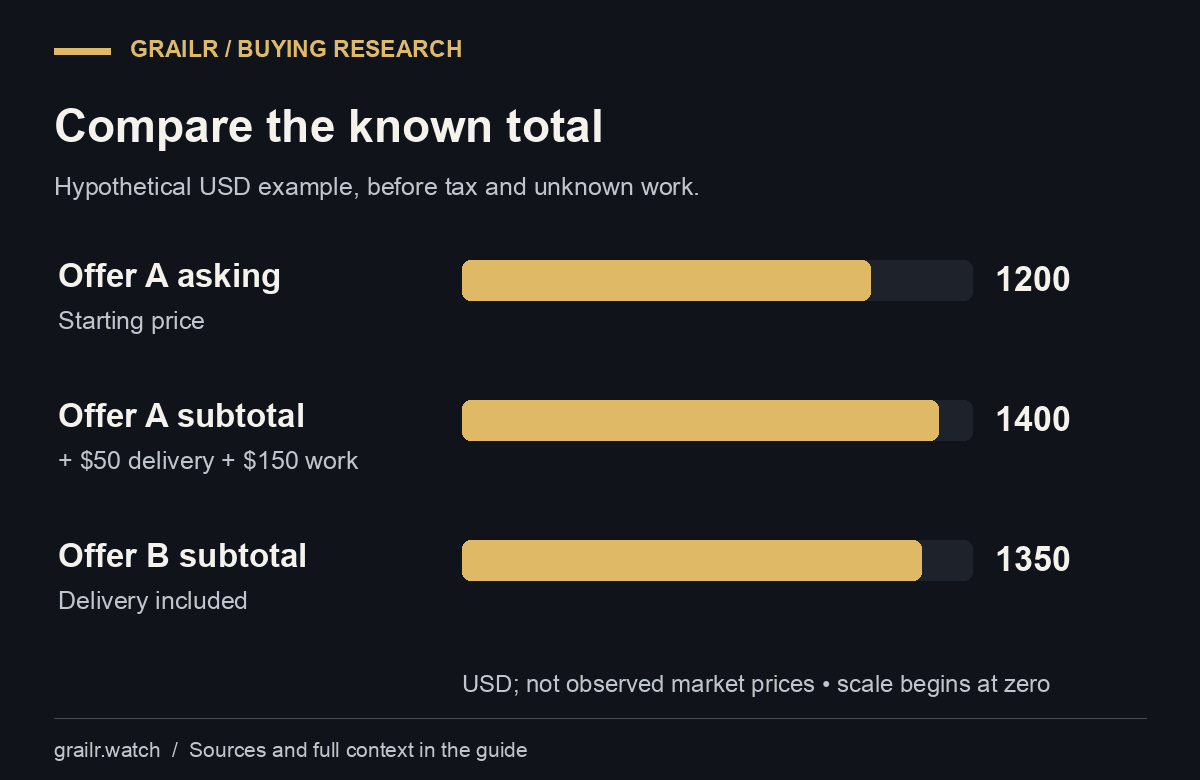
The comparison does not establish that B is the better watch. It shows why the sticker price is an incomplete answer. B could have weaker return terms, unclear ownership documentation or a condition issue that has not yet been investigated. Keep those questions beside the subtotal rather than compressing everything into a score that hides the uncertainty.
This is also where a subscription research tool can be useful across several candidates. Save a clear photograph, explore the suggested identification and indicative value, then record the asking price and known costs in your Grailr web report. Verify the suggested reference against the evidence. The tool gives your research a starting point and a place to return to; it does not inspect the movement inside the watch.
Decide whether to buy, ask another question or walk away
Choose the compact blue model if its appearance and fit are what you prefer and its operating routine suits you. Choose the silver model if you prefer its proportions, date display and overall configuration. Those are editorial buying judgments, not a hierarchy in which every buyer should want the same specification. Try to answer “Would I enjoy this particular watch?” before “Can I call this a deal?”
For a remote transaction, read the actual seller’s terms and the platform’s current protection rules. Chrono24’s Buyer Protection information, for example, distinguishes transaction arrangements; do not assume the same protections apply to every dealer, private purchase or payment made outside the platform. Preserve the listing and written answers that formed your buying decision.
A useful final checklist has three outcomes. Buy when the watch, total cost and terms make sense. Ask another question when one missing fact could change the answer. Walk away when important information remains unavailable or the seller pressures you to ignore it. There will usually be another watch to research; a deadline imposed by a listing is not evidence that its price is right.
- Confirm the reference and configuration against the actual watch.
- Establish fit, supplied bracelet length and any extra parts required.
- Separate documented maintenance from promised condition.
- Compare the total outlay with genuinely similar offers.
- Agree the inspection, payment and return process before committing.
Frequently asked questions
Is King Seiko the same as Grand Seiko?
No. They are different collections or brands, and their names are not a substitute for comparing exact references. This guide covers two modern King Seiko KSK watches; it does not assign them the specifications or finishing of a Grand Seiko.
Which of these King Seiko watches is smaller?
SPB457J1 has the smaller diameter and case length. SJE089J1 is thinner. Try the complete watch with its bracelet adjusted, because those measurements describe different aspects of fit.
Does the longer reserve mean better accuracy?
No. Reserve describes the stated running time from a full wind. Accuracy concerns how closely a watch keeps time. Consider both separately, along with the condition and documented performance of the actual watch.
Are the listed prices current resale values?
No. The dated UK retail observation and the explicitly hypothetical budget serve different purposes. Neither is a completed-sale valuation. For a buying decision, collect current, matched offers and record their condition and terms.
Should I buy a King Seiko without its box?
It can still suit you if the identity, condition, seller and price are acceptable. Confirm exactly what is missing and compare with similarly equipped watches. A box neither proves authenticity nor resolves missing service evidence.
How can Grailr help before I buy?
A subscription lets you use a watch photo for identification assistance and an indicative value estimate, then revisit saved reports. The web report also supports asking-price and known-cost comparisons. Confirm suggested references and arrange physical checks where needed.
Sources and research method
This is a desk-researched buying guide, not a hands-on test. Manufacturer specifications were checked on 20 November 2026. Price snapshots identify their currency and source; worked examples are hypothetical. Our recommendations are editorial judgments about fit, evidence and buying costs.