Luxury Chronograph Watches: The Definitive Guide
Omega Speedmaster, Rolex Daytona, Zenith Chronomaster, Breitling Navitimer, TAG Heuer Carrera, and Tudor Black Bay Chrono — compared with real pricing and expert picks.
Price context: this guide includes indicative prices from its original publication period. They have not all been refreshed to current quotes. Use the linked primary sources for specifications and policies, and verify prices independently.
- Luxury chronograph prices range from ~$4,000 (TAG Heuer Carrera) to $28,000+ (Rolex Daytona pre-owned)
- The Omega Speedmaster Moonwatch (~$7,800 retail) offers the strongest heritage-to-price ratio
- In-house chronograph movements (Zenith El Primero, Rolex 4130, Omega 3861) command premiums over modular designs
- Pre-owned luxury chronographs typically retain 70–95% of retail value, with the Daytona exceeding 180%
What Makes a Chronograph “Luxury”?
A chronograph is a watch with a built-in stopwatch. Press the top pusher to start timing, press again to stop, and the bottom pusher resets to zero. It sounds simple, but that complication adds 100–300 parts to the movement — and separates a $500 quartz chrono from a $15,000 mechanical one.
The defining feature of a luxury chronograph is the in-house movement. Brands like Omega, Rolex, Zenith, Breitling, and TAG Heuer develop their own chronograph calibers — a multi-year, multi-million-dollar investment that only a handful of manufacturers can sustain. An in-house chrono movement is the mechanical equivalent of building your own engine. It costs more, but it means the brand controls every aspect of performance and service.
Inside these movements, two mechanisms matter most. The column wheel is the gold standard for engaging the chronograph — it delivers a crisp, precise pusher feel compared to the cheaper cam-actuated system. And the vertical clutch (used in the Rolex 4130 and Zenith El Primero) connects the chronograph to the gear train without the stutter you sometimes see in horizontal-clutch designs when the seconds hand jumps at start. Every watch in this guide uses a column-wheel mechanism.
Then there’s finishing. At this price point, expect ceramic bezels that resist scratching for decades, sapphire crystals with anti-reflective coating on both sides, and case materials ranging from surgical-grade steel to Omega’s proprietary Sedna gold. Bracelet finishing includes alternating brushed and polished surfaces, micro-adjustable clasps, and tolerances measured in hundredths of a millimeter.
The 6 Best Luxury Chronographs in 2026
1. Omega Speedmaster Moonwatch 3861 (~$7,800)
The Moonwatch needs no introduction. Flight-qualified by NASA in 1965, worn on the lunar surface in 1969, and still in production with the Co-Axial Master Chronometer caliber 3861. At 42mm in steel with a 50-hour power reserve, it’s the most historically significant chronograph ever made — and one of the most affordable luxury chronographs relative to its heritage.
You get two crystal options: the classic Hesalite (acrylic, as worn on the Moon) or the sapphire sandwich with a display caseback showing the decorated movement. The Hesalite version runs about $200 less and delivers the authentic vintage look. Pre-owned Speedmasters in excellent condition start around $5,500 — extraordinary value for a watch with this pedigree.
The main limitation is water resistance: 50 meters is fine for splashes and rain but not for swimming. If you need a chronograph you can take diving, look at the Daytona (100m) or Tudor Black Bay Chrono (200m).
2. Rolex Daytona 126500LN ($15,100 MSRP)
The Cosmograph Daytona is the chronograph that broke the secondary market. At $15,100 MSRP, it’s already the most expensive watch in this guide at retail — but good luck finding one. Pre-owned steel Daytonas currently trade between $28,000 and $32,000, making it the only entry here that’s also a genuine market phenomenon.
The in-house Cal. 4130 delivers a 72-hour power reserve — the longest of any Rolex movement — with a vertical clutch and column wheel for chronograph precision. The Cerachrom ceramic bezel with engraved tachymeter scale is virtually scratch-proof. At 40mm with 100m water resistance, it wears like a sport watch and looks like an investment.
The honest assessment: the Daytona is a phenomenal watch, but most of its pre-owned price reflects market demand rather than pure horological value. If you’re buying for the watch itself, the Speedmaster gives you 90% of the experience at a fraction of the cost.
3. Zenith Chronomaster Sport (~$8,500–$10,500)
Zenith has a legitimate claim to history: the El Primero, launched in 1969, was one of the first automatic chronograph movements. The modern Chronomaster Sport houses the El Primero 3600, beating at 36,000 vibrations per hour — 25% faster than most Swiss movements. That high beat rate enables genuine 1/10th-of-a-second chronograph precision, visible on the rainbow-colored sub-dial at 9 o’clock.
At 41mm with 100m water resistance, the Chronomaster Sport is sized and specced for daily wear. The open-dial variants let you see the escapement through the dial — mesmerizing in person. Pre-owned examples start around $6,000, making this one of the strongest value propositions in luxury chronographs.
4. Breitling Navitimer B01 (~$5,500–$7,000)
The Navitimer is the pilot’s chronograph. Its defining feature is the circular slide-rule bezel — a fully functional analog computer that can calculate fuel consumption, rate of climb, and unit conversions. It’s been in continuous production since 1952 and remains the official watch of AOPA (Aircraft Owners and Pilots Association).
The in-house B01 chronograph movement delivers a 70-hour power reserve with COSC-certified accuracy. Available in 41mm, 43mm, and 46mm, the Navitimer accommodates every wrist size. The only real weakness is 30m water resistance — barely splash-proof by modern standards. Pre-owned Navitimer B01 models start around $4,500.
5. TAG Heuer Carrera Chronograph (~$4,000–$5,000)
The best entry point to luxury chronographs. The Carrera houses the Heuer 02 — TAG Heuer’s in-house chronograph caliber with an 80-hour power reserve, the longest in this entire comparison. That means you can take it off Friday evening and pick it up Monday morning still running.
Available in 39mm, 41mm, and 44mm with 100m water resistance. The modular case design allows TAG Heuer to offer a dizzying range of dial and bezel configurations. Pre-owned Carrera chronographs start around $3,000 — serious in-house chronograph performance at a price that makes the Swiss competition look overpriced.
6. Tudor Black Bay Chrono (~$5,375)
Tudor, Rolex’s sister brand, delivers the Black Bay Chrono with the MT5813 — a movement developed in collaboration with Breitling based on the B01 architecture. You get a 70-hour power reserve, column-wheel chronograph, and 200m water resistance — the best water resistance of any chronograph in this guide. The classic panda and reverse-panda dials are genuinely beautiful, and pre-owned examples at $4,000–$4,500 represent outstanding value. The 41mm case wears comfortably and the steel bracelet quality punches above its price.
Head-to-Head Comparison
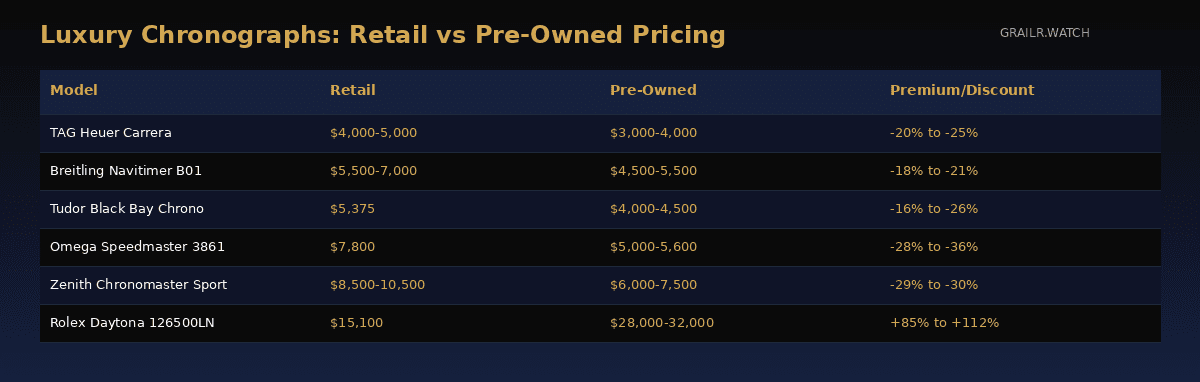
| Model | Retail | Pre-Owned | Movement | Power | Size | WR |
|---|---|---|---|---|---|---|
| Speedmaster Moonwatch | $7,800 | $5,500 | Cal. 3861 | 50h | 42mm | 50m |
| Rolex Daytona | $15,100 | $28,000+ | Cal. 4130 | 72h | 40mm | 100m |
| Chronomaster Sport | $8,500 | $6,000 | El Primero 3600 | 60h | 41mm | 100m |
| Navitimer B01 | $5,500 | $4,500 | B01 | 70h | 41mm | 30m |
| Carrera Chrono | $4,000 | $3,000 | Heuer 02 | 80h | 41mm | 100m |
| Black Bay Chrono | $5,375 | $4,000 | MT5813 | 70h | 41mm | 200m |
Movement Deep Dive
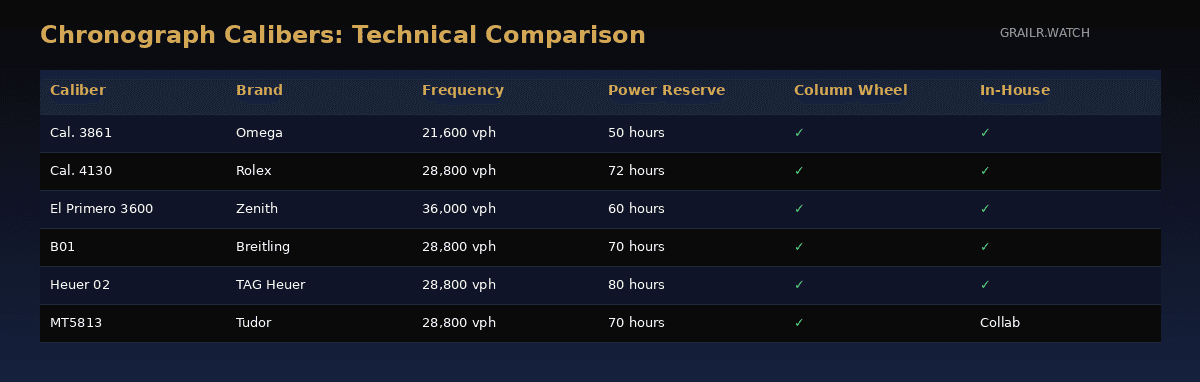
| Caliber | Brand | Frequency | Power Reserve | Column Wheel | In-House |
|---|---|---|---|---|---|
| Cal. 3861 | Omega | 21,600 vph | 50h | Yes | Yes |
| Cal. 4130 | Rolex | 28,800 vph | 72h | Yes | Yes |
| El Primero 3600 | Zenith | 36,000 vph | 60h | Yes | Yes |
| B01 | Breitling | 28,800 vph | 70h | Yes | Yes |
| Heuer 02 | TAG Heuer | 28,800 vph | 80h | Yes | Yes |
| MT5813 | Tudor / Breitling | 28,800 vph | 70h | Yes | Collab |
Which Luxury Chronographs Hold Value?
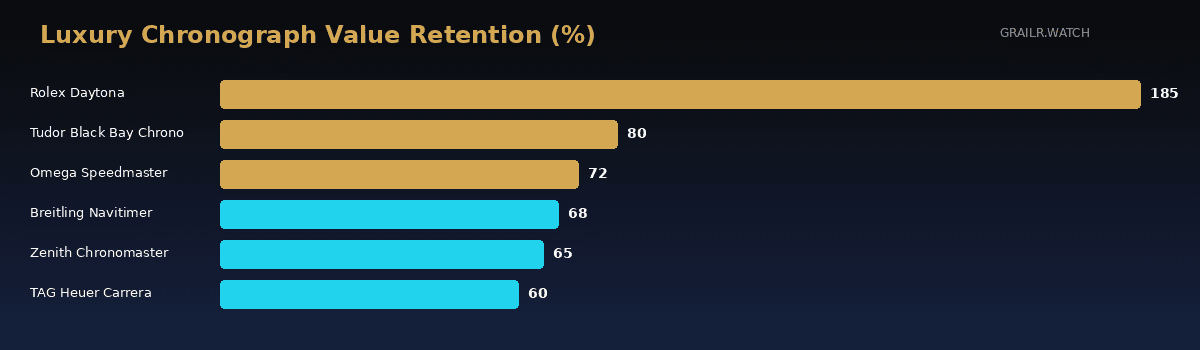
Value retention varies dramatically across luxury chronographs. The Rolex Daytona is in a category of its own, trading at roughly 180% of MSRP on the secondary market. This isn’t normal — it’s a market anomaly driven by scarcity and brand cachet. Most luxury chronographs depreciate, and buying one as a pure investment is risky.
That said, certain models hold value remarkably well. The Tudor Black Bay Chrono retains 75–85% of retail, outperforming many watches at twice its price. The Omega Speedmaster Moonwatch holds 70–80%, supported by consistent collector demand and the NASA connection. The Zenith Chronomaster has improved to 60–75% as the brand’s revival gains momentum. TAG Heuer and Breitling sit in the 55–75% range — solid for a luxury purchase, but you should buy them because you want to wear them, not because you expect a return.
Strong Retention
- Rolex Daytona — 180%+
- Tudor Black Bay Chrono — 75–85%
- Omega Speedmaster — 70–80%
Moderate Retention
- Zenith Chronomaster — 60–75%
- Breitling Navitimer — 60–75%
- TAG Heuer Carrera — 55–65%
How to Choose Your Luxury Chronograph
Set Your Budget First
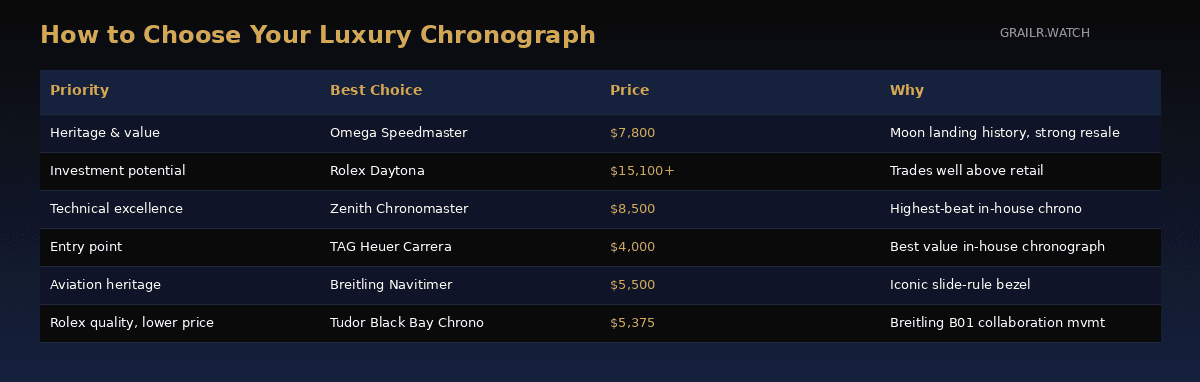
Under $5,000 pre-owned? The TAG Heuer Carrera and Tudor Black Bay Chrono are your best options. $5,000–$8,000? The Speedmaster, Navitimer, and Chronomaster Sport all compete. Above that, only the Daytona remains — and it’s a different financial proposition entirely.
Match the Case to Your Wrist
Chronographs wear larger than time-only watches because the sub-dials and pushers add visual weight. The Daytona at 40mm wears like a 42mm dress watch. If your wrist is under 7 inches, stick to 39–41mm cases. Try before you buy — the pusher height and crown guard shape affect comfort significantly.
Consider Water Resistance
If you swim or dive, the Tudor Black Bay Chrono (200m) and Daytona (100m) are your safest bets. The Navitimer’s 30m rating is barely splash-proof, and the Speedmaster’s 50m means careful hand-washing only. Most luxury chronographs aren’t designed for water sports.
Scan Before You Buy
Use Grailr’s scanner to photograph any listing and suggest the model, check fair market pricing, and get a suggested identification. Compare the result against the seller documentation and an independent inspection before committing.
Frequently Asked Questions
What is the best luxury chronograph watch?
The Omega Speedmaster Moonwatch is widely considered the best overall luxury chronograph for its combination of NASA heritage, in-house Co-Axial movement, and reasonable pricing at around $7,800 retail. The Rolex Daytona is the top market performer but costs significantly more on the secondary market.
Are luxury chronographs a good investment?
Some hold value well. The Rolex Daytona trades at 180%+ of retail, and the Omega Speedmaster retains 70-80%. However, most chronographs depreciate 25-45% from retail. Buying pre-owned is usually smarter than buying new if resale value matters to you.
What is the difference between a chronograph and a regular watch?
A chronograph includes a built-in stopwatch function with start, stop, and reset pushers alongside standard timekeeping. This adds sub-dials for elapsed seconds and minutes (sometimes hours) and typically includes a tachymeter scale for speed calculations.
Why are chronograph watches so expensive?
Luxury chronographs require 100-300 additional parts compared to time-only watches. In-house chronograph movements take years to develop and demand higher assembly precision. Column-wheel mechanisms, vertical clutches, and high-beat escapements add further cost and complexity.
Is the Omega Speedmaster or Rolex Daytona better?
Both are exceptional. The Speedmaster offers stronger heritage (NASA/Moon) and better value at $7,800 retail vs the Daytona's $15,100 MSRP ($28,000+ pre-owned). The Daytona has better water resistance (100m vs 50m), longer power reserve (72h vs 50h), and unmatched resale value. Choose the Speedmaster for heritage and value, the Daytona for investment.
What is the best entry-level luxury chronograph?
The TAG Heuer Carrera at $4,000-5,000 retail is the best entry point. It features the in-house Heuer 02 movement with an 80-hour power reserve — the longest in this comparison. Pre-owned examples start around $3,000, delivering genuine luxury chronograph performance at a competitive price.
Related Articles
The Bottom Line
A luxury chronograph is one of the most mechanically impressive watches you can own. For most buyers, the Omega Speedmaster Moonwatch offers the best combination of heritage, movement quality, and value at $7,800 retail. If your budget is tighter, the TAG Heuer Carrera delivers genuine in-house chronograph performance from $4,000. And if resale value matters most, the Rolex Daytona is unmatched — though you’ll pay a steep premium for that security. Whatever you choose, understand the complication, try it on, and buy the one that makes your heart beat as fast as the movement inside.
Sources and price context
- Omega Speedmaster Moonwatch Professional specifications — Official product page listing the Co-Axial Master Chronometer 3861 caliber, 50-hour power reserve, and Hesalite/sapphire crystal options.
- Tudor Black Bay Chrono S&G specifications — Official product page detailing the MT5813 manufacture caliber, 200m water resistance, and 70-hour power reserve.
These primary sources support the specific specification and movement points noted above. Prices and resale percentages elsewhere in this guide are indicative editorial figures, not a verified transaction dataset or guaranteed returns. Confirm the exact reference, region, condition and current quote before buying; asking prices are not completed-sale prices.