Moon Phase Watches: How They Work and What to Buy
The moonphase complication explained — from the 59-tooth mechanism to ultra-precision modules, with real pricing across every budget.
Price context: this guide includes indicative prices from its original publication period. They have not all been refreshed to current quotes. Use the linked primary sources for specifications and policies, and verify prices independently.
- A standard moonphase uses a 59-tooth disk and drifts by one day every ~2.5 years; precision modules extend that to 122 years
- Entry-level moonphase watches start around $1,200 (Frederique Constant) with strong mid-range options from $2,500 (Longines)
- The Jaeger-LeCoultre Master Ultra Thin Moon ($10,000–$15,000) is the benchmark for moonphase design and finishing
- Moonphase complications from established brands retain 60–85% of retail on the secondary market
How a Moonphase Complication Works
The moon takes 29.53059 days to complete one full cycle from new moon to new moon. A moonphase complication tracks this cycle mechanically, displaying the current phase of the moon through a shaped aperture on the dial. It is one of the oldest watch complications — astronomical clocks in medieval cathedrals included lunar displays centuries before wristwatches existed.
The standard mechanism is elegant in its simplicity. A flat disk sits beneath the dial, printed or engraved with two identical images of the moon against a starfield. The disk has 59 teeth around its edge. A small finger, driven by a pin on the hour wheel, advances the disk by one tooth every 24 hours. Since the disk carries two moons across 59 teeth, each moon is visible for 29.5 days before the second one rotates into view — closely matching the actual lunar cycle of 29.53059 days.
The aperture cut into the dial is shaped with two arcs. As the disk rotates, the visible portion of the moon grows from a thin crescent (waxing) to a full circle, then shrinks back down (waning). The result is an analog display of the moon’s phase that you can read at a glance — no digital screens, no batteries, just a gear train counting days.
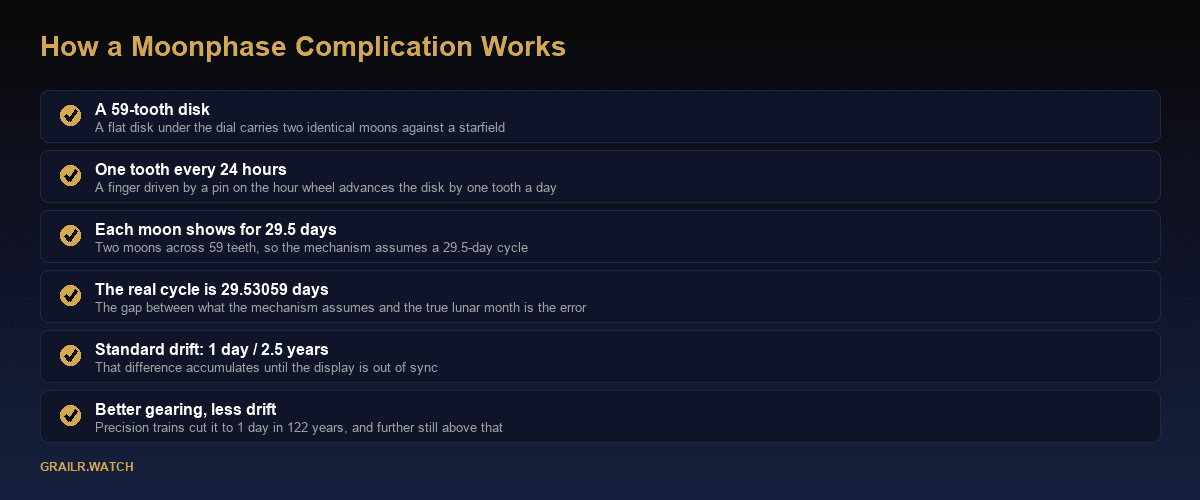
The gap between 29.5 days (what the mechanism assumes) and 29.53059 days (the real lunar cycle) is what determines accuracy. That small difference accumulates over time, eventually putting the display out of sync. How quickly depends on the quality of the mechanism, which is why accuracy tiers matter when you’re comparing watches.
Moonphase Accuracy: From Basic to Ultra-Precision
Not all moonphase displays are created equal. The accuracy of the complication depends entirely on the gearing ratio used to approximate the lunar cycle. There are three broad tiers, and the price difference between them is significant.
Standard (59-tooth): The most common design. It assumes a lunar month of exactly 29.5 days, creating an error of 0.03059 days per cycle. This adds up to roughly one full day of drift every 2 years and 7 months. You’ll need to advance the moonphase display by one day periodically, which is a minor inconvenience — most owners simply adjust it when they notice the display no longer matches the sky.
Precision (135-tooth or equivalent): Brands like Jaeger-LeCoultre and Patek Philippe use more complex gear trains that reduce the error dramatically. The industry benchmark is one day of drift in 122 years — effectively a lifetime of ownership without correction. Patek’s calibre 215 PS LU in the Calatrava Ref. 7121 hits this mark precisely.
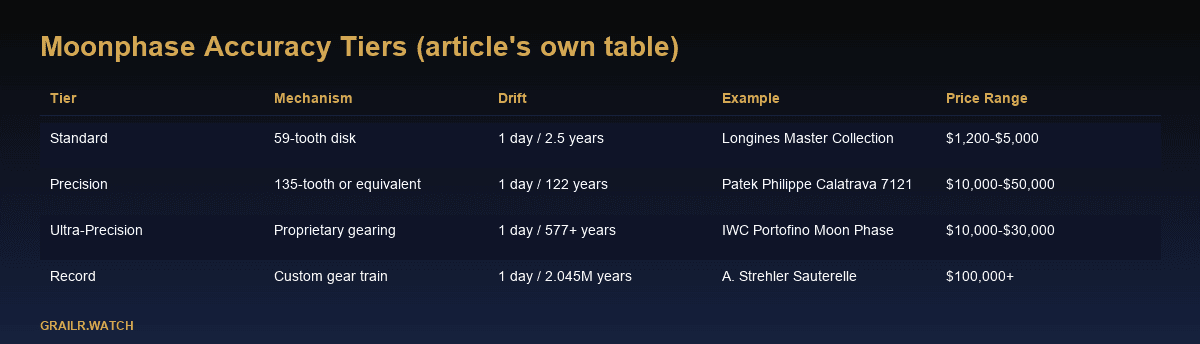
Ultra-precision: A handful of manufacturers push accuracy into truly astronomical territory. IWC’s Portofino Hand-Wound Moon Phase needs correction only once every 577.5 years. H. Moser & Cie’s Endeavour Perpetual Moon extends that to 1,027 years. And the current record holder — Andreas Strehler’s Sauterelle à Lune Perpétuelle — is accurate to one day in approximately 2.045 million years.
| Tier | Mechanism | Drift | Example | Price Range |
|---|---|---|---|---|
| Standard | 59-tooth disk | 1 day / 2.5 years | Longines Master Collection | $1,200–$5,000 |
| Precision | 135-tooth or equivalent | 1 day / 122 years | Patek Philippe Calatrava 7121 | $10,000–$50,000 |
| Ultra-Precision | Proprietary gearing | 1 day / 577+ years | IWC Portofino Moon Phase | $10,000–$30,000 |
| Record | Custom gear train | 1 day / 2.045M years | A. Strehler Sauterelle | $100,000+ |
The Best Moonphase Watches by Price
Under $3,000: Accessible Moonphase
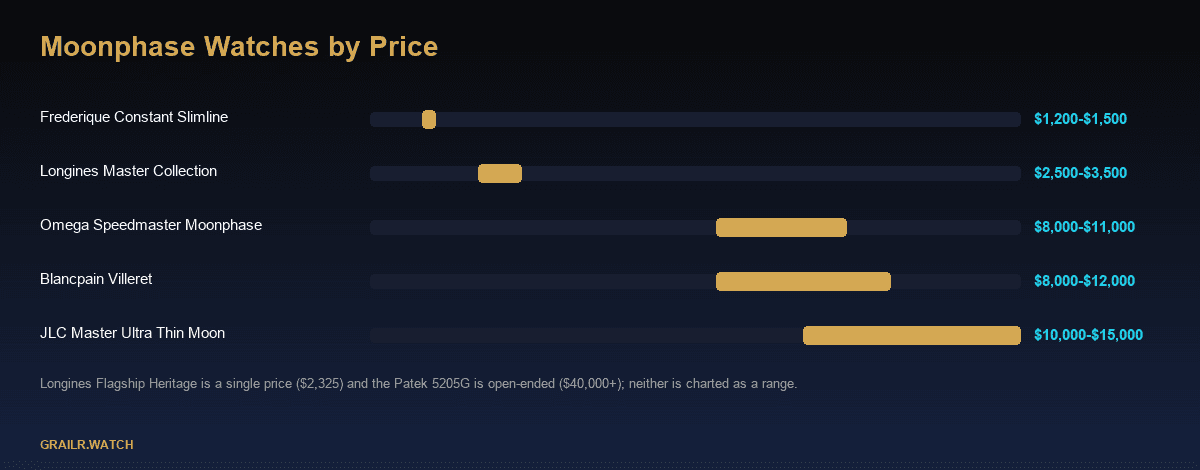
Frederique Constant Slimline Moonphase ($1,200–$1,500): The best entry point into moonphase watches. The 42mm steel case houses an FC-705 automatic movement with a moonphase display at 6 o’clock. The dial is clean and legible, and the finishing punches above its price. Available in silver, blue or dark-grey dial variants. This is the watch that proves you don’t need to spend five figures for a moonphase complication.
Longines Master Collection Moonphase ($2,500–$3,500): A significant step up in movement quality. The L899 automatic calibre (based on the ETA A31.L81) offers 72 hours of power reserve with a moonphase and date display. Available in 40mm and 42mm with a range of dial colors. The bracelet finishing and case proportions reflect Longines’s position as the best value in the Swatch Group’s upper tier. For a dressier option, the Flagship Heritage Moonphase starts at $2,325 in 40.5mm with a thinner profile.
$3,000–$10,000: The Sweet Spot
Omega Speedmaster Moonphase ($8,000–$11,000): Omega’s Co-Axial Master Chronometer calibre 9904 combines a chronograph with a moonphase display at 6 o’clock. The 44.25mm case is on the larger side, but the Speedmaster DNA makes it one of the most recognizable moonphase watches you can buy. The Seamaster range offers different aesthetics, but the Speedmaster Moonphase stands alone for chronograph-moonphase integration.
Blancpain Villeret Quantième Phase de Lune ($8,000–$12,000): Blancpain arguably makes the most beautiful moonphase display in the industry. The double-arched aperture and hand-painted moon with a face are distinctive, and the 6654 calibre is a fully integrated manufacture movement. At 40mm in steel, the proportions are refined without being small.
$10,000+: Prestige Moonphase
Jaeger-LeCoultre Master Ultra Thin Moon ($10,000–$15,000): The watch most collectors point to when they think “moonphase.” At 39mm and just 10.04mm thick, it wears like a dress watch that happens to track the moon. The Cal. 925/1 automatic movement is visible through the caseback, and the blue enamel dial variant is one of the most striking watches at any price. This is our top pick for a dedicated moonphase purchase.
Patek Philippe Grand Complications ($40,000+): Patek’s moonphase references represent the pinnacle. The Calatrava Ref. 7121, perpetual calendar models in the 5320 and 5327 families, and the annual calendar 5205 all feature precision moonphase displays accurate to one day in 122 years. These are watches that hold and often appreciate in value — Patek moonphase references are among the strongest performers on the secondary market.
Full Specification and Pricing Comparison
The table below compares the key moonphase watches across price tiers. Prices reflect approximate retail or typical pre-owned asking prices as of late 2026. Use Grailr’s appraisal tool to check current market values for specific references.
| Watch | Size | Movement | Power Reserve | Approx. Price |
|---|---|---|---|---|
| Frederique Constant Slimline | 42mm | FC-705 auto | 42h | $1,200–$1,500 |
| Longines Flagship Heritage | 40.5mm | L899 auto | 72h | $2,325 |
| Longines Master Collection | 40mm/42mm | L899 auto | 72h | $2,500–$3,500 |
| Omega Speedmaster Moonphase | 44.25mm | Cal. 9904 auto | 60h | $8,000–$11,000 |
| Blancpain Villeret | 40mm | Cal. 6654 auto | 72h | $8,000–$12,000 |
| JLC Master Ultra Thin Moon | 39mm | Cal. 925/1 auto | 70h | $10,000–$15,000 |
| Patek Philippe 5205G | 40mm | Cal. 324 S QA LU auto | 45h | $40,000+ |
Moonphase vs Other Complications
Among the classical watch complications, the moonphase occupies a unique position. It is the only common complication that tracks an astronomical body rather than measuring human time. A chronograph measures elapsed seconds. A perpetual calendar tracks the Gregorian calendar with its irregular months and leap years. A moonphase connects the watch to the sky.
That distinction matters for two reasons. First, it means the moonphase is mechanically simpler than most other complications. A perpetual calendar requires hundreds of additional parts; a basic moonphase adds fewer than a dozen. This keeps the movement thinner and the watch more wearable, which is why the JLC Master Ultra Thin Moon can stay under 10.1mm thick while packing an automatic movement with a moonphase display.
Second, the moonphase has an emotional appeal that other complications lack. A chronograph is a tool. A perpetual calendar is an engineering exercise. A moonphase is a window into something larger than timekeeping — it reminds you that the watch on your wrist is connected to the same cycle that moves tides and has guided navigation for thousands of years.
Practically, the complication is also low-maintenance. Unlike a chronograph (which introduces wear when used frequently) or a minute repeater (which requires careful handling), a moonphase display runs passively. The only intervention needed is the occasional one-day correction every few years, or resetting it if the watch stops and you let the power reserve run out.
Resale Value of Moonphase Watches
Moonphase watches from established Swiss brands hold their value reasonably well on the secondary market. The complication adds perceived value and collector interest, which supports stronger retention than equivalent time-only or time-and-date models from the same brand.
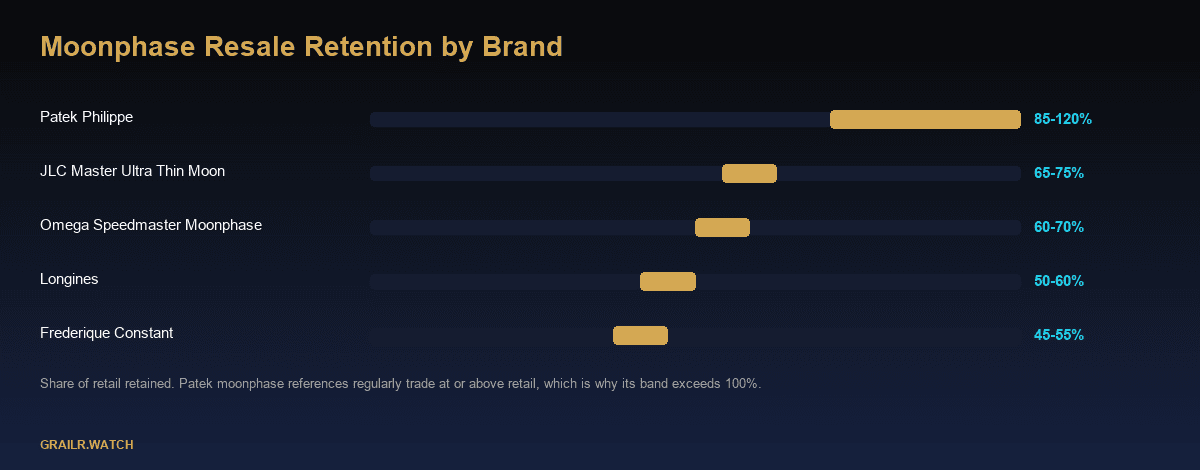
Strongest Retention
Patek Philippe — 85–120%
Sought-after Patek moonphase references regularly trade at or above retail. Perpetual calendar models with moonphase (5320, 5327) are among the strongest long-term performers in all of horology.
Strong Mid-Range
JLC & Omega — 60–75%
The JLC Master Ultra Thin Moon holds around 65–75% of retail. Omega Speedmaster Moonphase models retain approximately 60–70%, supported by the brand’s broad collector base.
Accessible Tier
Longines & FC — 45–60%
Longines moonphase models retain roughly 50–60% of retail. Frederique Constant tends to settle around 45–55%. Both offer strong value as entry points but should not be considered investments.
Scan Before You Buy
Grailr — Free
Use Grailr’s scanner to photograph any listing and check whether the asking price aligns with current market data before committing.
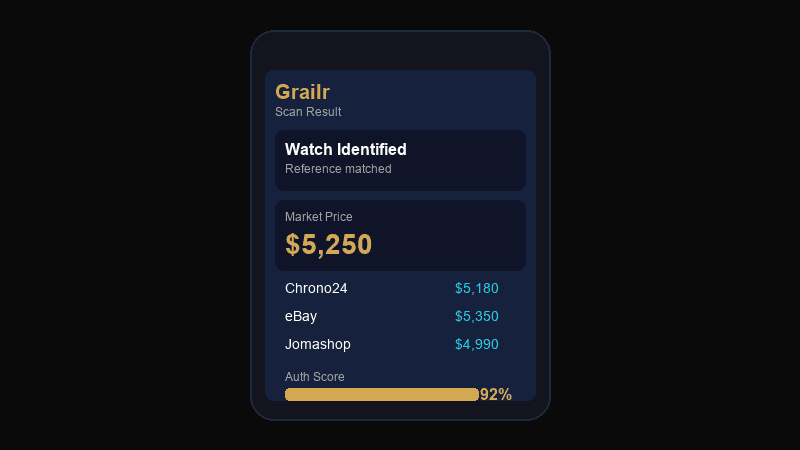
Check Any Watch Price in Seconds
Grailr scans your watch photo and pulls live pricing from Chrono24, eBay, and Jomashop.
- AI identifies brand, model & reference number
- Live market prices from 3+ sources
- Authentication confidence score
What to Check When Buying a Moonphase Watch
1. Verify the Moonphase Display Is Functional
On a pre-owned watch, ask the seller to set the moonphase to the current lunar date so you can verify it advances correctly. A moonphase that skips or sticks may indicate worn teeth on the driving finger or the disk, which requires servicing. Use Grailr’s identifier to confirm the reference before agreeing to a price.
2. Know the Accuracy Tier
Ask whether the movement uses a standard 59-tooth mechanism or a precision module. This information is in the manufacturer’s technical specification — not all sellers know it, but the reference number tells you. A precision moonphase adds value and reduces long-term maintenance.
3. Check the Dial for Moisture Damage
Moonphase disks are often painted or lacquered. Moisture ingress can damage the finish on the disk long before it shows on the main dial. Examine the moonphase aperture closely for discoloration, spots or a hazy appearance. If buying online, request macro photos of the moonphase display specifically.
4. Scan Before You Pay
Use Grailr’s scanner to photograph any listing and check whether the asking price aligns with current market data. For watches above $5,000, also request an authentication check and ask the seller for service history documentation.
5. Consider Service Costs
A full service on a moonphase complication costs more than a time-only watch. Expect $400–$800 for a Frederique Constant or Longines, $800–$1,500 for Omega or JLC, and $2,000+ for Patek Philippe. Factor this into the total cost of ownership, especially if buying a pre-owned example without recent service documentation.
Frequently Asked Questions
How does a moon phase watch work?
A moon phase watch uses a disk with 59 teeth that advances one tooth per day, driven by a finger connected to the hour wheel. The disk carries two identical moon images and rotates beneath an aperture cut to frame one moon at a time, tracking the 29.5-day lunar cycle.
How accurate is a standard moon phase watch?
A standard 59-tooth moon phase mechanism drifts by one full day approximately every 2 years and 7 months. Precision moonphase modules correct this to one day in 122 years, and ultra-precision designs from brands like IWC and H. Moser extend accuracy to centuries or millennia.
What is the best moon phase watch under $3,000?
The Longines Master Collection Moonphase at around $2,500 to $3,500 offers a Swiss automatic movement with a moonphase complication in a well-finished package. The Frederique Constant Slimline Moonphase at roughly $1,200 to $1,500 is the strongest option under $2,000.
Do moon phase watches hold their value?
Moon phase watches from established brands like Jaeger-LeCoultre, Omega and Patek Philippe generally retain 60 to 85 percent of retail on the secondary market. High-complication Patek Philippe moonphase references can appreciate significantly over time.
How often do you need to adjust a moon phase watch?
With a standard 59-tooth mechanism, you will need to correct the moon phase display by one day roughly every 2 years and 7 months. Precision modules need correction only once every 122 years. If the watch stops, you will need to reset the moonphase to the current lunar date.
What is the difference between a moon phase and a perpetual calendar?
A moon phase displays the current phase of the moon through an aperture on the dial. A perpetual calendar tracks the day, date, month and leap year cycle automatically. Many perpetual calendars include a moonphase sub-dial, but a moonphase watch does not necessarily include a perpetual calendar.
Related Articles
The Bottom Line
The moonphase is one of watchmaking’s oldest complications and one of its most emotionally resonant. Whether you start with a $1,200 Frederique Constant or aim for the JLC Master Ultra Thin Moon, the key is matching accuracy tier and size to your actual use. If you plan to wear the watch daily and appreciate mechanical craft, a precision moonphase from JLC or Patek is worth the premium. If you want the complication without the five-figure commitment, the Longines Master Collection is the strongest value in the category. Either way, scan any listing with Grailr before committing to verify the reference and check whether the price is fair.
Sources and price context
- Jaeger-LeCoultre Master Ultra Thin Moon specifications — Lists calibre 925/1, case dimensions and complication details for this reference.
- Gear Patrol: The Best Moonphase Watches — Provides editorial context on moonphase models and pricing across brands.
These primary sources support the specific specification and editorial points noted above. Prices and resale percentages elsewhere in this guide are indicative editorial figures, not a verified transaction dataset or guaranteed returns. Confirm the exact reference, region, condition and current quote before buying; asking prices are not completed-sale prices.