Omega Speedmaster White Dial: Every Model Compared
From the Moonwatch Professional to the Milano Cortina 2026 — every white dial Speedmaster reference, compared by movement, price and collectibility.
Price context: this guide includes indicative prices from its original publication period. They have not all been refreshed to current quotes. Use the linked primary sources for specifications and policies, and verify prices independently.

- White dial Speedmasters are produced in significantly lower numbers than their black dial counterparts, making them harder to source at authorized dealers
- Current white dial options span from the $4,200 pre-owned Speedmaster 38 to the $8,100 sapphire sandwich Moonwatch
- The Moonwatch Professional white (Ref. 310.30.42.50.04.001) uses the same Cal. 3861 Master Chronometer movement as the black dial icon
- The Milano Cortina 2026 edition adds a blue ceramic tachymeter bezel and Olympic branding to the 38mm platform
- Lower production volumes help white dial variants retain value slightly better than equivalent black dial references on the secondary market
Why White Dial Speedmasters Matter
The Omega Speedmaster is one of the most recognized chronographs in watchmaking, but for most of its history the conversation has centered on the black dial. NASA qualified a black-dial Speedmaster for spaceflight. The Moonwatch that sits in every authorized dealer’s case is black. The “Moonwatch” a new collector pictures when they hear the name is almost certainly black. That imbalance means white dial variants occupy a genuinely different position in the lineup — they share the same engineering and heritage but are produced in far smaller quantities, creating a combination of familiarity and scarcity that appeals to buyers who want something less common without leaving Omega’s flagship chronograph platform.
Aesthetically, a white dial changes the character of a Speedmaster in ways that go beyond color. On a black dial, the subdials and hands recede into a monochromatic field that reads as a single, unified instrument face. On a white dial, every element separates: the subdials gain definition against a lighter background, the tachymeter scale becomes more legible at a glance, and the overall impression shifts from tool-watch severity toward something more versatile and contemporary. A white dial Speedmaster pairs as naturally with a linen shirt as it does with a flight suit, which broadens its wearing occasions without pretending it is a dress watch.
From a collecting standpoint, lower production creates a secondary-market advantage. Pre-owned white dial Speedmasters tend to hold value slightly better than their black dial equivalents — not dramatically, but enough to matter to a buyer weighing two otherwise identical references. That premium is indicative, not guaranteed, and it depends on condition, papers, and which specific reference you are comparing, but the pattern has been consistent enough across recent years to be worth noting. For a broader look at how the Speedmaster family stacks up on the secondary market, see our complete Omega Speedmaster guide.
Every White Dial Speedmaster Reference
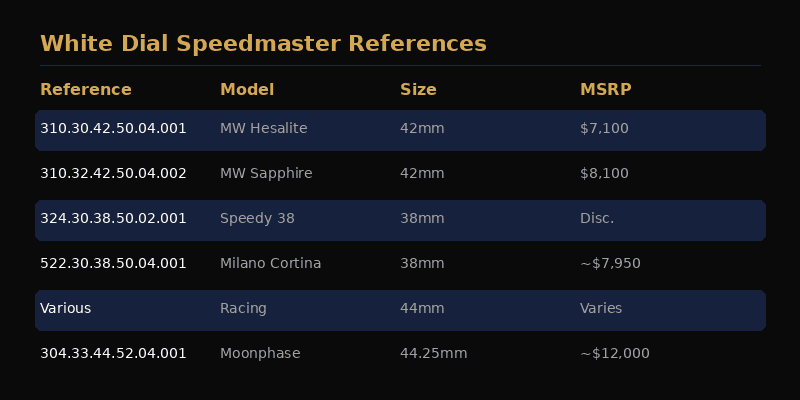
Omega has offered a white dial across several Speedmaster sub-lines, each serving a different buyer. The table below lays out every current and recent-production white dial reference in the Speedmaster family, with case size, movement, and indicative pricing. Verify current prices independently before buying — these are editorial estimates from available market data at publication, not guaranteed quotes.
| Reference | Model | Size | Movement | MSRP | Pre-Owned |
|---|---|---|---|---|---|
| 310.30.42.50.04.001 | Moonwatch Hesalite | 42mm | Cal. 3861 | $7,100 | ~$6,800 |
| 310.32.42.50.04.002 | Moonwatch Sapphire | 42mm | Cal. 3861 | $8,100 | ~$7,500 |
| 324.30.38.50.02.001 | Speedmaster 38 | 38mm | Cal. 3330 | Disc. | ~$4,200 |
| 522.30.38.50.04.001 | Milano Cortina 2026 | 38mm | Cal. 3330 | ~$7,950 | TBD |
| Various | Speedmaster Racing | 44mm | Cal. 3330/9900 | Varies | $4,500–$6,000 |
| 304.33.44.52.04.001 | Moonphase | 44.25mm | Cal. 9904 | ~$12,000 | ~$9,500 |
“Disc.” indicates a model that is discontinued but readily available pre-owned. The Racing line has carried white dials across multiple generations with varying references, so specific pricing depends on the exact reference and era. For a broader comparison that includes the black dial counterparts and the Silver Snoopy Award edition, see our Snoopy Speedmaster guide.
The Moonwatch Professional: Hesalite vs Sapphire
The two most important white dial Speedmasters in the current catalog share a case, a movement, and an aesthetic — and differ in one detail that accounts for a $1,000 price gap. The Hesalite model (Ref. 310.30.42.50.04.001) uses Omega’s traditional acrylic crystal, the same material that covered the Speedmaster dials worn on the Moon. It scratches more easily than sapphire but can be polished with a paste compound, produces a warmer optical quality that many collectors prefer for legibility in bright light, and keeps the price at $7,100.
The sapphire sandwich model (Ref. 310.32.42.50.04.002) replaces both the front crystal and the caseback with sapphire, exposing the decorated Cal. 3861 movement through a display back. That visibility is a genuine differentiator — the 3861’s rhodium-plated finish, Geneva waves, and branded rotor are worth seeing rather than hiding behind steel — but it comes at $8,100 and makes the watch fractionally thicker. Both versions use the same manual-wind, Master Chronometer-certified 3861 with a 50-hour power reserve and 5 Hz beat rate, so the functional performance is identical.
Which should you buy? If you value heritage authenticity, lighter weight on the wrist, and a lower entry price, the Hesalite is the purist’s choice. If you want scratch resistance on the front crystal and the pleasure of seeing the movement at work, the sapphire sandwich justifies its premium. Neither is objectively better; they serve different priorities. On the secondary market, pre-owned Hesalite white dials trade around $6,800, which represents a tighter spread to retail than many Omega references manage — a function of lower supply meeting steady demand.
Check Any Watch Price in Seconds
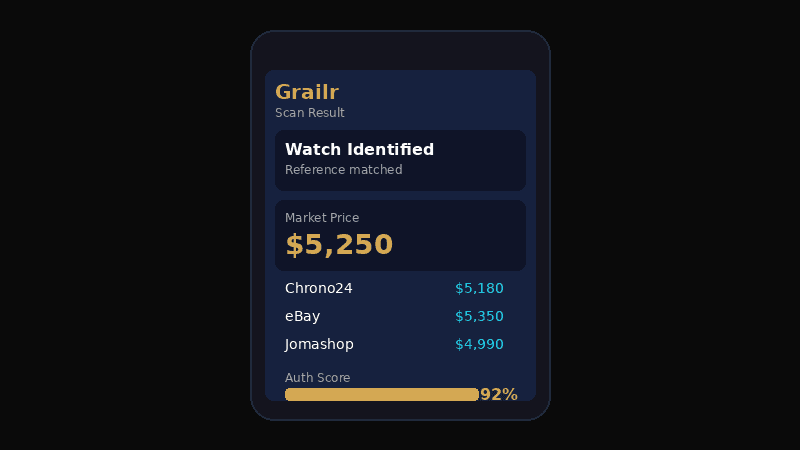
Grailr uses your photo to suggest a watch identification and an indicative price estimate. Active eBay listings, when available, offer asking-price comparisons.
- Grailr suggests brand, model & reference number
- Active eBay asking-price comparisons
- Identification confidence score
The Milano Cortina 2026 Edition
Omega’s Olympic partnership has produced some of the brand’s most collectible special editions, and the Speedmaster 38 Milano Cortina 2026 (Ref. 522.30.38.50.04.001) follows that tradition. Built on the 38mm Speedmaster platform, it pairs a white dial with a blue ceramic tachymeter bezel that references the Milano Cortina 2026 Winter Olympics color palette. The combination of white and blue gives it a distinctly different visual character from any other Speedmaster in the current lineup — brighter, more athletic, and more identifiably tied to a specific moment in Omega’s institutional history.
Inside is the Cal. 3330, the same column-wheel automatic chronograph that powered the standard Speedmaster 38 before its discontinuation. It is not a Master Chronometer-certified movement, which puts it a tier below the 3861 in the Moonwatch, but it is a proven, well-regarded caliber with a 52-hour power reserve and automatic winding. At roughly $7,950, it costs more than the Hesalite Moonwatch white despite using a smaller case and a less advanced movement — a premium that reflects the Olympic branding, the ceramic bezel, and the anticipated production window rather than raw horological specification.
Olympic edition Speedmasters have historically performed well on the secondary market once their production window closes, though the degree of appreciation varies widely depending on the specific Games and the edition’s desirability relative to other Olympic releases. Treat any resale expectation as speculative rather than proven, particularly for an edition that has not yet reached the secondary market in volume. The Milano Cortina 2026 is worth buying because you want to wear an Olympic Speedmaster with a distinctive white-and-blue colorway, not because you expect a guaranteed return.
Racing and Moonphase White Dials
Speedmaster Racing White Dial
The Speedmaster Racing line has carried white dials across multiple generations, typically in a 44mm case that wears larger and more assertively than the 42mm Moonwatch. Earlier references used the Cal. 3330 column-wheel chronograph; more recent iterations have moved to the Cal. 9900, Omega’s automatic co-axial Master Chronometer chronograph with a 60-hour power reserve. The Racing’s defining visual touches — a minute track on the rehaut, a tachymeter bezel with a more overtly motorsport character, and bolder hand designs — give the white dial a sportier, more contemporary read than the Moonwatch’s flight-instrument formality. Pre-owned Racing white dials run approximately $4,500 to $6,000 depending on the specific reference and movement generation.
Speedmaster Moonphase White Dial
The Speedmaster Moonphase (Ref. 304.33.44.52.04.001) is the most complicated and expensive white dial Speedmaster in regular production. At 44.25mm with the Cal. 9904 — an automatic Master Chronometer chronograph with moonphase complication and 60-hour power reserve — it occupies a different tier from the Moonwatch entirely. The white dial on this reference creates an especially striking contrast with the blue-lipped moonphase subdial, and the overall presentation leans closer to haute horlogerie than tool watch. At roughly $12,000 MSRP and $9,500 pre-owned, it appeals to the collector who wants a Speedmaster that does something no standard Moonwatch can and who prefers the visual lightness of a white dial for a complicated face. For buyers who want Omega’s broader approach to white dial watches, the Moonphase is the most ambitious expression of that direction within the Speedmaster range.
Vintage White Dial Speedmasters Worth Collecting
Omega produced white and silver-toned dial Speedmasters intermittently throughout the late 20th century, well before the current lineup formalized white as a regular offering. These vintage references are considerably rarer than their black dial contemporaries and attract serious collector attention when they appear at auction or through specialist dealers.
The most sought-after vintage white Speedmasters tend to come from the 1990s and early 2000s production, when Omega occasionally offered the Professional with a “panda” configuration — a white main dial with black subdials, or vice versa. These are not the same as the modern white lacquer dials; the older finishes have a different texture and warmth that changes as they age, developing a patina character that varies by example. Pricing on genuine vintage white dial Speedmasters ranges widely, from under $5,000 for a mid-1990s reduced model to well above $15,000 for a desirable Professional-reference panda dial in clean condition with original parts.
A word of caution: the vintage market is where condition, originality, and provenance matter most. Aftermarket dials exist, re-lumed hands are common on older Speedmasters, and the difference between a genuine factory white dial and a service replacement can be thousands of dollars. Have any vintage Speedmaster inspected by someone who specializes in the reference before committing, and confirm whether the dial, hands, and bezel insert are original to the watch rather than service or aftermarket parts. For more on how to evaluate a Speedmaster purchase generally, our Omega Speedmaster buying guide covers the full lineup.
Movement Comparison Across References
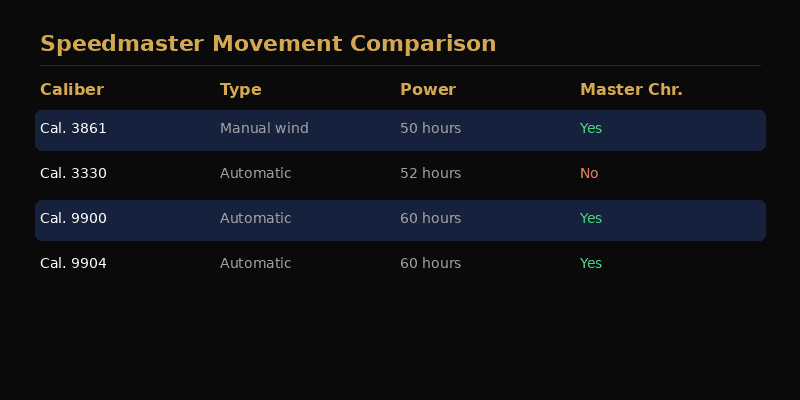
The four calibers that power white dial Speedmasters represent three different tiers of Omega’s movement architecture. Understanding which caliber is inside each reference helps clarify what you are actually getting for the money — the dial color is cosmetic, but the movement is the engineering.
| Caliber | Type | Power Reserve | Frequency | Master Chrono. |
|---|---|---|---|---|
| Cal. 3861 | Manual wind | 50 hours | 5 Hz | Yes |
| Cal. 3330 | Automatic | 52 hours | 4 Hz | No |
| Cal. 9900 | Automatic | 60 hours | 4 Hz | Yes |
| Cal. 9904 | Automatic | 60 hours | 4 Hz | Yes |
The Cal. 3861 is the direct descendant of the caliber that went to the Moon, updated with a co-axial escapement and Master Chronometer certification. It is manual-wind by design, not by limitation — Omega kept manual winding to preserve the Moonwatch’s historical identity and to allow a thinner case profile. The Cal. 3330, found in the Speedmaster 38 and Milano Cortina, is a capable column-wheel automatic but lacks Master Chronometer certification, which means it has not been subjected to METAS’s additional anti-magnetism and accuracy testing. The Cal. 9900 and Cal. 9904 represent Omega’s top-tier automatic chronograph platform, with the 9904 adding the moonphase complication. Both carry Master Chronometer certification and 60-hour power reserves. For a detailed look at how Omega’s movement architecture compares to the broader luxury landscape, see our Omega Seamaster buying guide, which covers the co-axial escapement in depth.
Pricing and Value Retention
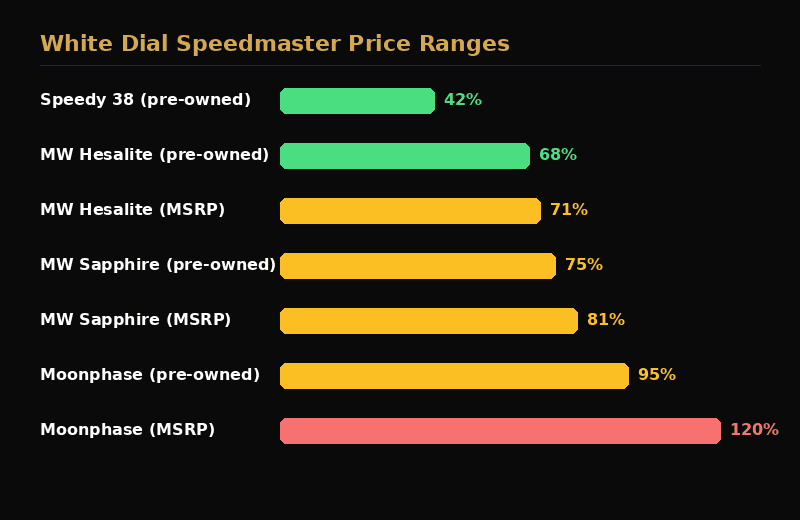
White dial Speedmasters occupy a pricing band roughly in line with their black dial equivalents at retail, but the secondary market tells a slightly different story. Because fewer white dials are produced, pre-owned supply is thinner, and buyers shopping specifically for a white Speedmaster have fewer options to negotiate against. The result is a modest but consistent resale premium over equivalent black dial references — typically a few percentage points of retention, not a dramatic margin, but enough to notice when you are comparing two otherwise identical watches separated only by dial color.
At the entry level, the discontinued Speedmaster 38 white dial (Ref. 324.30.38.50.02.001) trades around $4,200 pre-owned, which is competitive with new mid-range Swiss chronographs and represents the most accessible path into a white dial Speedmaster. The Hesalite Moonwatch white at roughly $6,800 pre-owned against $7,100 MSRP shows a retention rate above 95%, which is strong by any standard and reflects both the reference’s desirability and its limited production relative to the black version.
At the top of the range, the Moonphase white at around $9,500 pre-owned versus $12,000 MSRP retains roughly 79%, which is respectable for a complicated luxury chronograph but noticeably lower than the Moonwatch Professional. That gap is normal: more expensive, more complicated watches tend to depreciate faster in absolute terms because the buyer pool narrows as the price climbs. None of these figures are guarantees, and they reflect indicative market conditions at the time of writing rather than a verified transaction dataset. For context on how Omega pricing compares across the lineup, see the Aqua Terra buying guide for another major Omega reference’s resale data.
How to Choose the Right White Dial Speedmaster
For Heritage and Value
The Moonwatch Professional Hesalite white dial (Ref. 310.30.42.50.04.001) is the pick. It carries the lineage, the Master Chronometer certification, and the strongest retention in the lineup, at $7,100 MSRP. If you want one Speedmaster to wear for decades, this is the reference most likely to age well on both your wrist and your balance sheet.
For Wrist Presence and Complications
The Moonphase (Ref. 304.33.44.52.04.001) offers what no other white dial Speedmaster does: a moonphase complication, the Cal. 9904 automatic movement, and a 44.25mm case that commands attention. At $12,000 MSRP, it is a different category of purchase, but for the buyer who wants a complicated chronograph in white, there is nothing else in the Speedmaster catalog that competes.
For Smaller Wrists or Entry Price
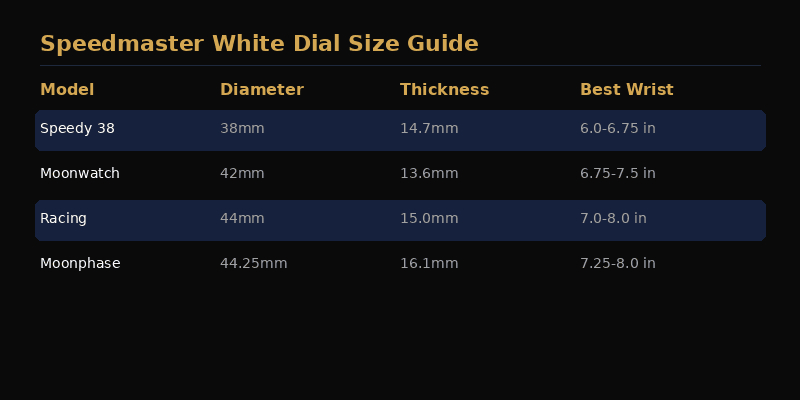
The discontinued Speedmaster 38 white dial remains available pre-owned around $4,200 and wears comfortably on wrists that find the 42mm Moonwatch too large. The Milano Cortina 2026 offers a similar 38mm case with Olympic branding and a ceramic bezel at a significant premium. Both are genuinely smaller watches, not just scaled-down dials, and suit buyers whose wrist circumference sits below 7 inches.
Before You Buy Any of Them
Use Grailr’s free scanner to photograph a listing and get a suggested model identification alongside live pricing from multiple marketplaces. It is a starting point for due diligence — pair it with an independent inspection before you send payment, especially on the secondary market where dial swaps and aftermarket parts can be difficult to spot in photos alone.
Frequently Asked Questions
Does Omega make a white dial Speedmaster?
Yes. Omega currently produces several white dial Speedmasters, including the Moonwatch Professional in both Hesalite and sapphire sandwich configurations, the Speedmaster 38 Co-Axial, and the limited Milano Cortina 2026 edition. The Speedmaster Racing and Moonphase lines have also carried white dial options.
How much is a white dial Omega Speedmaster?
Prices range from roughly $4,200 pre-owned for a Speedmaster 38 Co-Axial white dial to $8,100 retail for the Moonwatch sapphire sandwich. The standard Hesalite Moonwatch white dial lists at $7,100 MSRP, with pre-owned examples around $6,800.
Is the white dial Speedmaster harder to find than the black?
Generally yes. Black dials account for the vast majority of Speedmaster production, so white dial variants are produced in lower quantities. They are not limited editions in most cases, but availability at authorized dealers tends to be more sporadic than for black dial equivalents.
Do white dial Speedmasters hold their value?
White dial Speedmasters tend to hold value slightly better than equivalent black dial references, driven by lower production numbers and collector interest in less common configurations. However, resale percentages vary by reference and condition, and past retention does not guarantee future performance.
What is the difference between the Hesalite and sapphire white Moonwatch?
Both use the same Cal. 3861 manual-wind movement and 42mm steel case. The Hesalite version uses a traditional acrylic crystal at $7,100. The sapphire sandwich version uses sapphire on both front and caseback, exposing the decorated movement, at $8,100.
Is the Milano Cortina 2026 Speedmaster a limited edition?
Omega has positioned the Milano Cortina 2026 edition as an Olympic-themed special release. While Omega has not publicly confirmed a fixed production number for all Olympic editions, these models are typically produced during a defined window tied to the Games and are not part of the permanent catalog.
Related Articles
The Bottom Line
White dial Speedmasters occupy a genuine niche within Omega’s most famous chronograph family — less produced, more versatile in their wearing occasions, and slightly better at holding value on the secondary market. The Moonwatch Professional Hesalite white dial is the strongest all-around recommendation: it carries the heritage, the Master Chronometer movement, and the best retention figures in the lineup at a price that, by luxury chronograph standards, remains competitive. The Milano Cortina 2026 and the Moonphase serve more specialized tastes — Olympic collectibility and horological complication, respectively — while the discontinued Speedmaster 38 remains the easiest entry point for buyers who want the white dial aesthetic at a more accessible price. Whichever reference you choose, verify the exact model, condition, and current market price before committing; the numbers in this guide are indicative starting points, not transaction guarantees.
Found a White Dial Speedmaster You Like?
Grailr uses a photo to suggest a watch identity and an indicative price estimate, with active eBay listings where available. Check the exact reference and condition independently; a photo scan cannot authenticate a watch.
Get an Indicative EstimateSources and price context
- Omega Speedmaster Moonwatch Professional — Official specifications for the Moonwatch Professional lineup, including the white dial Hesalite and sapphire sandwich references.
- Fratello Watches Speedmaster coverage — Independent reviews, historical context, and collector insights on the Speedmaster family including white dial references.
These primary sources support the specifications and history noted above. Prices and resale percentages elsewhere in this guide are indicative editorial figures, not a verified transaction dataset or guaranteed returns. Confirm the exact reference, region, condition and current quote before buying; asking prices are not completed-sale prices.