Rolex Milgauss Buying Guide: Every Reference and Price
The discontinued anti-magnetic Rolex that scientists loved and collectors now chase — every reference from the vintage 1019 to the Z-Blue 116400GV, with real market pricing and specs.
Price context: this guide includes indicative prices from its original publication period. They have not all been refreshed to current quotes. Use the linked primary sources for specifications and policies, and verify prices independently.

- The Milgauss was discontinued in March 2023 after two production runs spanning 1956–1988 and 2007–2023
- The Z-Blue 116400GV now trades at $10,000–$14,000, above its last retail price of $9,300
- Anti-magnetic to 1,000 gauss via the Calibre 3131 with Parachrom Bleu hairspring and internal shield
- Availability has dropped roughly 50% since discontinuation, pushing values up about 10%
A Brief History of the Milgauss
The name comes from the French mille, meaning thousand, and gauss, the unit of magnetic flux density. Rolex launched the original Milgauss in 1956 as a tool watch for scientists working near particle accelerators and MRI machines — environments where magnetic fields could stop a mechanical movement dead. The reference 6541 featured a distinctive honeycomb dial and a rotating bezel, and it was offered to researchers at CERN in Geneva.
A quieter successor, the reference 1019, arrived in 1960 and stayed in the catalogue until 1988. It dropped the rotating bezel for a smooth one and traded the honeycomb dial for cleaner options. Production numbers were never high — scientists were a niche audience — and the 1019 slipped out of the lineup without fanfare.
Then came the revival. In 2007, Rolex surprised Baselworld with the reference 116400, a completely new Milgauss for the modern era. The orange lightning-bolt seconds hand, a nod to the electrical fields the watch was built to resist, became the model’s signature. A year later, the 116400GV added the now-iconic green sapphire crystal — the only coloured crystal Rolex has ever used on a production watch.
In March 2023, Rolex quietly removed the Milgauss from its website. No announcement, no farewell edition — it was simply gone. The Air-King, which had absorbed the Milgauss’s crown-guard design in 2022, now occupies the anti-magnetic space in the Rolex lineup. Whether the Milgauss returns for its 70th anniversary remains pure speculation.
Every Milgauss Reference Compared
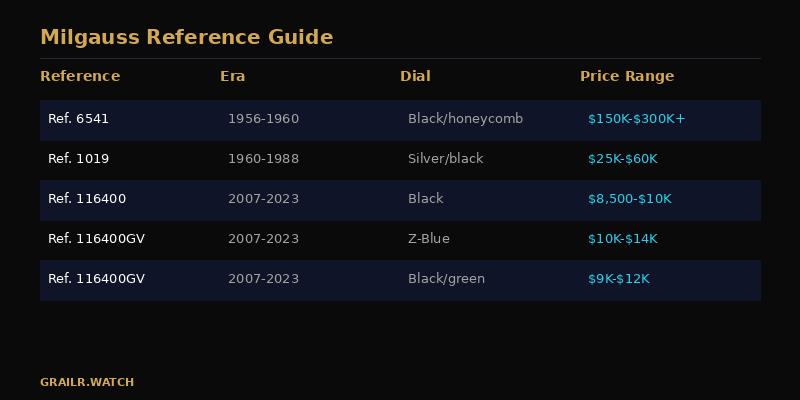
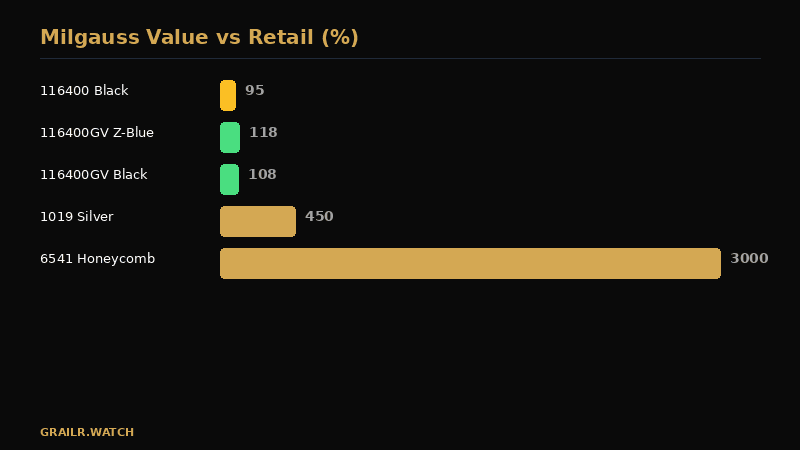
Four main references define the Milgauss lineage. The original 6541 is a museum-grade collector’s piece that rarely appears at auction. The 1019 is the accessible vintage option. The modern 116400 and 116400GV are the watches most buyers will actually consider. Here is how they compare.
| Reference | Years | Size | Calibre | 2026 Market |
|---|---|---|---|---|
| 6541 | 1956–1960 | 38mm | 1080 | $100,000+ |
| 1019 | 1960–1988 | 38mm | 1580 | $25,000–$60,000 |
| 116400 (black) | 2007–2023 | 40mm | 3131 | $8,700–$10,000 |
| 116400GV (Z-Blue) | 2014–2023 | 40mm | 3131 | $10,000–$14,000 |
Prices are indicative asking prices for examples in good to excellent condition. The 6541 rarely trades and prices depend heavily on dial originality and provenance.
Specs and What Makes It Anti-Magnetic
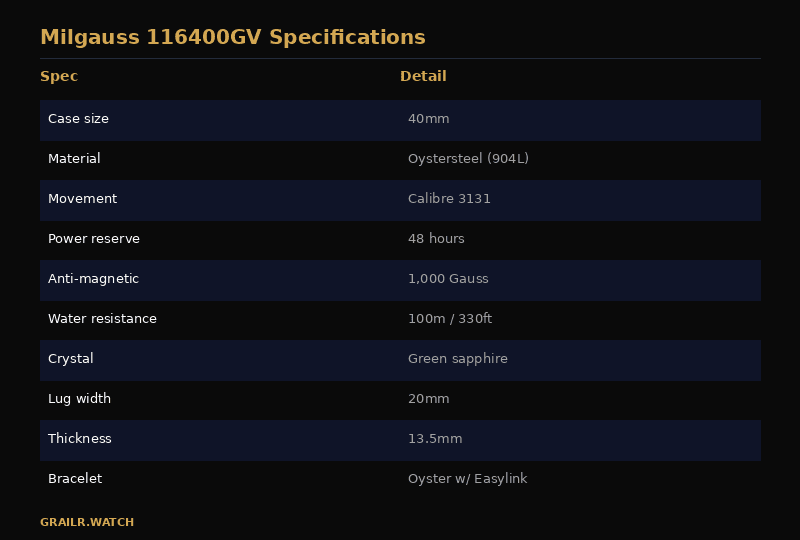
The modern Milgauss (116400 and 116400GV) shares the same 40mm Oystersteel case and Calibre 3131 automatic movement. Where it differs from every other Rolex is inside: a ferromagnetic shield surrounds the movement, diverting magnetic fields around the delicate balance wheel rather than letting them interfere with timekeeping. This is paired with the Parachrom Bleu hairspring, an alloy developed by Rolex that is inherently resistant to magnetic fields and up to ten times more resistant to shocks than a conventional hairspring.
The result is protection against magnetic fields up to 1,000 gauss. For context, a standard mechanical watch can be affected by fields as low as 50–100 gauss, and a smartphone generates about 30–50 gauss at close range. The Milgauss was designed for environments where fields reach into the hundreds — laboratories, power plants, and medical imaging facilities.
The Z-Blue dial on the 116400GV is a zirconium-coated sunburst finish that shifts between deep navy and electric blue depending on the light. Combined with the green-tinted sapphire crystal, the visual effect is unlike anything else in the Rolex catalogue. The orange lightning-bolt seconds hand adds a playful accent that contrasts sharply with the serious engineering underneath.
One trade-off: the internal magnetic shield adds thickness. At 13.5mm, the Milgauss wears noticeably thicker than an Explorer (11.5mm) or Oyster Perpetual (11.7mm). It sits higher on the wrist, and some owners find it top-heavy compared to other 40mm Rolex models. The 48-hour power reserve is also shorter than the 70-hour reserve found in Rolex’s newer calibres — a reminder that the 3131 belongs to the previous generation of movements. For a look at what makes modern Rolex movements special, see our deep dive.
Check Any Watch Price in Seconds
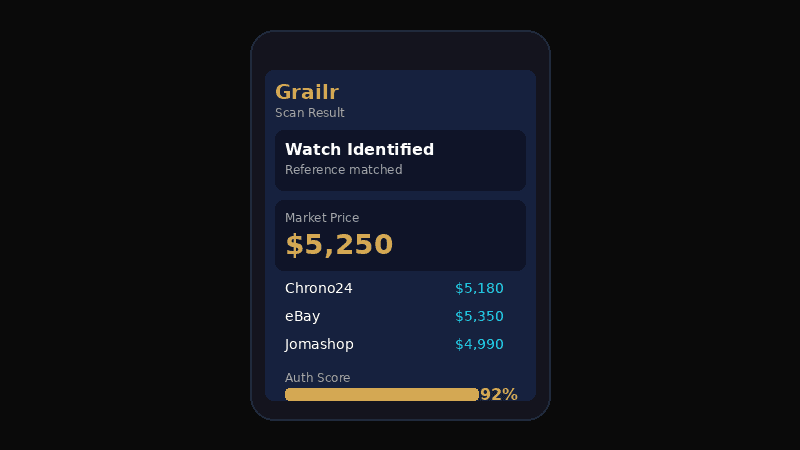
Grailr scans your watch photo and pulls live pricing from Chrono24, eBay, and Jomashop.
- AI identifies brand, model & reference number
- Live market prices from 3+ sources
- Authentication confidence score
2026 Market Pricing and Value Trends
Discontinuation changed the Milgauss market overnight. When Rolex pulled the model in March 2023, availability on the secondary market dropped roughly 50% within the first year. Prices responded accordingly, rising about 10% from pre-discontinuation levels. The Z-Blue 116400GV, which had a final retail price of $9,300, now consistently trades above that figure.
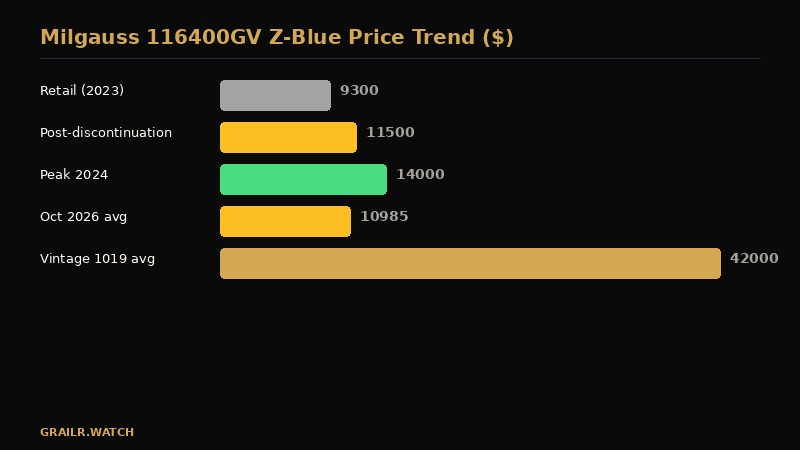
As of October 2026, WatchCharts reports a market price of $10,985 for the 116400GV. Individual transactions range from $10,000 for earlier production years to $14,000 for late-production examples with full box and papers. The black-dial 116400 remains more affordable, with clean examples starting around $8,700 — still above its last retail of roughly $8,200.
The vintage market tells a different story. The reference 1019, once considered a minor collector’s piece, has appreciated steadily. Black-dial examples in good condition trade between $25,000 and $40,000, while rarer silver-dial variants and those with original paperwork push toward $60,000. The original 6541 with its honeycomb dial is a six-figure proposition when it appears at auction, though sales are rare enough that establishing a reliable market price is difficult.
How does the Milgauss compare to other Rolex models as an investment? It sits in a middle ground. It does not have the explosive appreciation of a Daytona or a vintage Submariner, but it has outperformed the Datejust and Air-King on a percentage basis since discontinuation. The key risk is a Rolex revival — if a new Milgauss launches, the vintage-premium narrative weakens.
What to Check Before You Buy
Buying a discontinued Rolex on the secondary market carries risks that buying from an authorized dealer does not. Here is what to verify before sending money.
1. Verify the Green Crystal
The green sapphire crystal on the 116400GV is the single most-faked element. Under natural light, the genuine crystal shows a subtle green tint that shifts with angle. Aftermarket crystals tend to be either too green or too uniform. If the seller cannot demonstrate the crystal under different lighting, proceed with caution.
2. Check the Serial and Papers
Post-2010 Milgauss watches use a random serial number format, so you cannot date the watch by serial alone. The warranty card (green for older examples, Rolex-branded card for later ones) is the reliable production-date reference. Full box and papers add $1,000–$2,000 to the market value.
3. Test the Anti-Magnetic Function
A magnetised Milgauss defeats the point of the watch. Ask the seller to run a magnetism test — a simple compass placed near the case will reveal whether the movement has been magnetised. A watchmaker can demagnetise the movement, but knowing in advance lets you negotiate.
4. Inspect Case Condition
The Milgauss case has sharp lugs that show polishing wear quickly. Over-polished lugs are a common issue on pre-owned examples. Look for even brushing on the case sides and sharp edges on the lugs. A heavily polished case can reduce value by $500–$1,000.
5. Scan Before You Buy
Use Grailr’s free scanner to photograph any listing photo and get an indicative identification and price estimate. It is not proof of authenticity — always have a discontinued model independently inspected — but it is a fast first check against obvious red flags.
Alternatives to the Milgauss
If the Milgauss’s price or availability does not work for you, these models share some of its character. None is a direct replacement, but each captures a different part of what made the Milgauss appealing — whether that is anti-magnetic engineering, a distinctive coloured dial, or a science-world heritage.
| Watch | Anti-Magnetic | Size | Price | Why Consider |
|---|---|---|---|---|
| Rolex Air-King 126900 | Partial (Parachrom) | 40mm | $7,600 retail | Current-production Rolex with Milgauss DNA |
| Omega Aqua Terra >15,000 Gauss | 15,000 gauss | 41mm | $6,300 retail | Superior anti-magnetic rating, Master Chronometer |
| IWC Ingenieur 40 | Soft-iron cage | 40mm | $8,350 retail | Engineer’s heritage, integrated bracelet |
| Grand Seiko SBGX341 | No | 40mm | $3,200 retail | High-accuracy quartz, distinctive dial textures |
| Tudor Black Bay Pro | No | 39mm | $3,925 retail | GMT function, 70h reserve, Rolex sister brand |
The Omega Aqua Terra deserves special mention: its Master Chronometer movement resists 15,000 gauss without needing a bulky internal shield, making it thinner and technically superior to the Milgauss on the anti-magnetic front. For buyers who want the function rather than the Rolex name, it is the stronger choice. If you’re staying in the Rolex family, the Oyster Perpetual is the closest current-production model in spirit — time-only, understated, and built to the same standard.
Frequently Asked Questions
Why was the Rolex Milgauss discontinued?
Rolex quietly dropped the Milgauss from its catalogue in March 2023 without an official explanation. Most analysts believe the Air-King absorbed its anti-magnetic niche while offering a more modern movement and case design.
How much is a Rolex Milgauss worth in 2026?
The Z-Blue 116400GV trades between $10,000 and $14,000 pre-owned in 2026, with WatchCharts reporting a market average of $10,985 as of October 2026. Black dial 116400 examples start around $8,700. Vintage 1019 references range from $25,000 to $60,000.
Is the Rolex Milgauss a good investment?
Since discontinuation, Milgauss availability has dropped roughly 50% and prices have risen about 10%. The Z-Blue 116400GV now trades above its last retail price of $9,300, making it one of the few non-sport Rolex models to appreciate. However, future returns are not guaranteed.
What makes the Milgauss anti-magnetic?
The Calibre 3131 uses a Parachrom Bleu hairspring and an internal ferromagnetic shield made from a special alloy that diverts magnetic fields around the movement. This combination resists magnetic fields up to 1,000 gauss, roughly ten times the standard for most mechanical watches.
Will Rolex bring back the Milgauss?
There is no official confirmation from Rolex. The model turned 70 in 2026, which has fuelled speculation, but Rolex does not pre-announce releases. If a successor appears, it would likely use a newer calibre and may look significantly different from the 116400 generation.
What is the green crystal on the Milgauss?
The 116400GV features a green-tinted sapphire crystal, sometimes called glace verte. It is the only coloured crystal Rolex has fitted to a production watch, and the green hue shifts depending on the angle and light conditions, giving the dial a distinctive character.
Related Articles
The Bottom Line
The Milgauss is the Rolex that scientists chose and collectors rediscovered. Its green crystal, lightning-bolt seconds hand, and anti-magnetic engineering give it a personality no other Rolex can match. Discontinuation has tightened supply and pushed the Z-Blue above its last retail price, but it remains more accessible than the sport-model premiums on a Daytona or GMT-Master. If you value individuality over tradition, the Milgauss is worth the search. Just verify the crystal, check the papers, and understand where it sits in the broader Rolex resale picture before committing.
Found a Milgauss You Like?
Grailr uses a photo to suggest a watch identity and an indicative price estimate, with active eBay listings where available. Check the exact reference and condition independently; a photo scan cannot authenticate a watch.
Scan a Watch NowSources and Price Context
- WatchCharts Rolex Milgauss market data — Reports a pre-owned market price of $10,985 as of October 2026, with historical price tracking.
- Bob’s Watches Milgauss 116400GV listing — Dealer listing with specifications for the Z-Blue green crystal variant.
These primary sources support the specific pricing and specification points noted above. Prices and resale percentages elsewhere in this guide are indicative editorial figures, not a verified transaction dataset or guaranteed returns. Confirm the exact reference, region, condition and current quote before buying; asking prices are not completed-sale prices.