Rolex Advertising: A Century of Strategy
How one brand turned a swimmer’s Channel crossing, a mountain summit and a pit-lane clock into a marketing machine that never needs to offer a discount.
Context: this guide covers Rolex advertising history and marketing strategy. Sponsorship dates and testimonee names come from published Rolex materials and third-party reporting. Industry spend estimates are unverified analyst figures. Verify current partnerships on rolex.com.
- Rolex advertising began with one newspaper ad in 1927 and now spans tennis, golf, motorsport, sailing, cinema and the arts
- The brand calls its ambassadors “testimonees” — individuals chosen for achievement, not celebrity alone
- Rolex never discounts, never licenses its name and rarely changes its visual identity
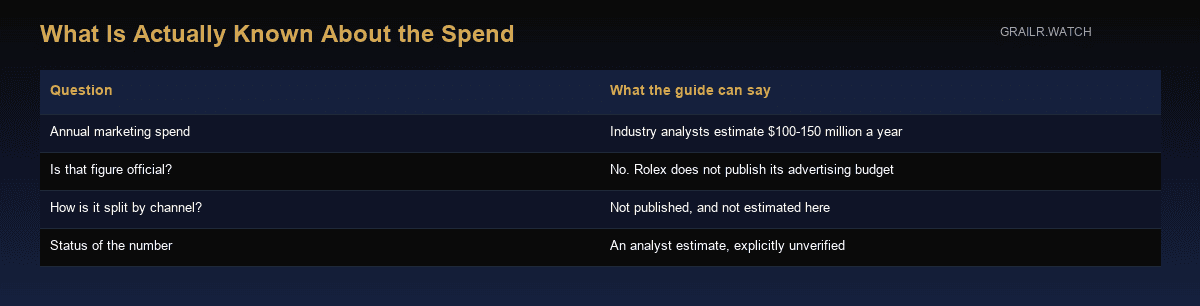
- Industry analysts estimate the annual marketing budget at $100–150 million, though Rolex does not publish the figure
The Origins: 1905–1927
Rolex advertising did not start with a television spot or a billboard. It started with a problem: how do you convince early-twentieth-century buyers that a wristwatch is as reliable as a pocket watch? Hans Wilsdorf, who founded Wilsdorf & Davis in London in 1905, answered that question with certification. In 1910, a Rolex wristwatch received a chronometer certificate from the Bienne rating centre in Switzerland — the first ever awarded to a wrist-worn timepiece. Four years later, in 1914, a Rolex earned Class A certification from the Kew Observatory, a distinction previously reserved for marine chronometers.
These certificates were not advertisements in the traditional sense, but they set the template for every Rolex campaign that followed: pair a product claim with a visible, verifiable test. By 1919, the company had moved its headquarters to Geneva, associating itself with the Swiss watchmaking tradition. In 1926, Rolex introduced the Oyster case, the first commercially successful waterproof watch case, and needed a way to prove it worked.
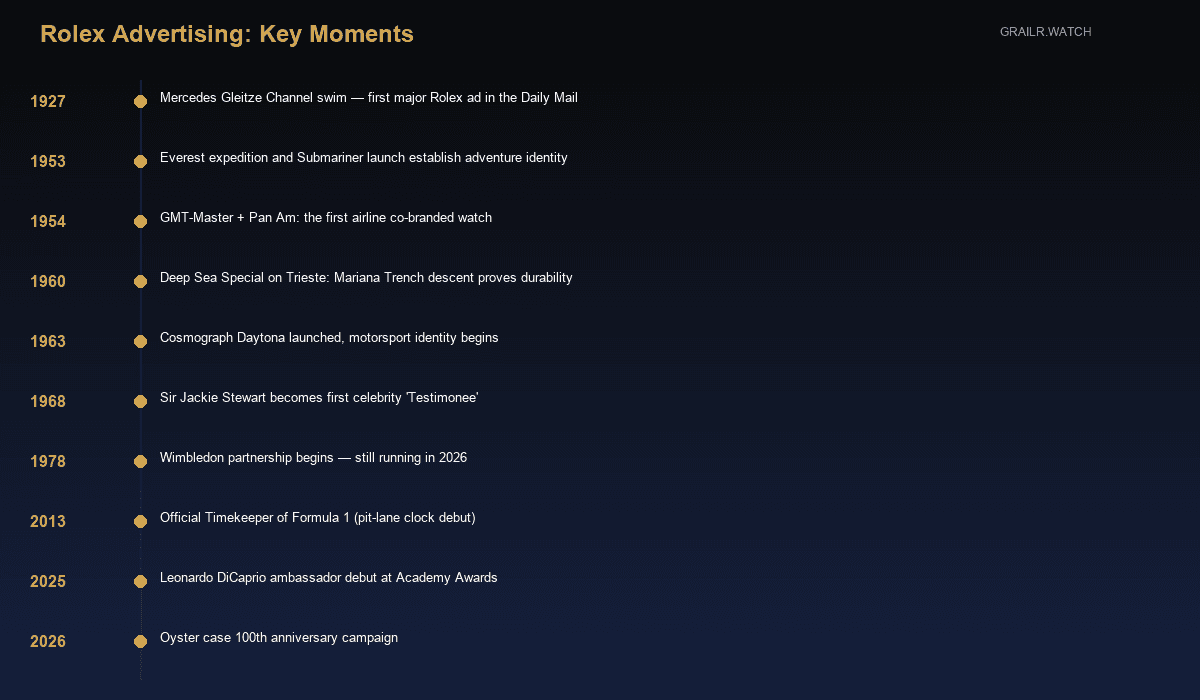
The proof came on 7 October 1927, when English swimmer Mercedes Gleitze attempted to cross the English Channel wearing an Oyster around her neck. The watch survived over ten hours in cold seawater. On 24 November 1927, Rolex took a full-page advertisement in the Daily Mail headlined “The Wonder Watch That Defies the Elements.” It is widely considered the foundation of modern Rolex advertising — a real event, a real person and a product that survived the ordeal.
The Exploration Era: 1930s–1960s
After the Gleitze campaign proved the formula, Rolex advertising spent the next three decades attaching itself to the most extreme environments on Earth. In the 1930s, the brand aligned with explorers, aviators and racing drivers — people whose lives depended on accurate, durable instruments.
The 1950s brought a cascade of model launches that read like an expedition manifest. In 1953, the Oyster Perpetual was linked to the first ascent of Everest — though it is worth noting that Sir Edmund Hillary actually wore a Smiths watch on the summit. Rolex’s association came through the broader expedition sponsorship rather than a single wrist shot. That same year, the Submariner launched as a diver’s instrument rated to 100 metres. In 1954, the GMT-Master debuted as the official watch of Pan American World Airways pilots, giving Rolex advertising a foothold in commercial aviation.
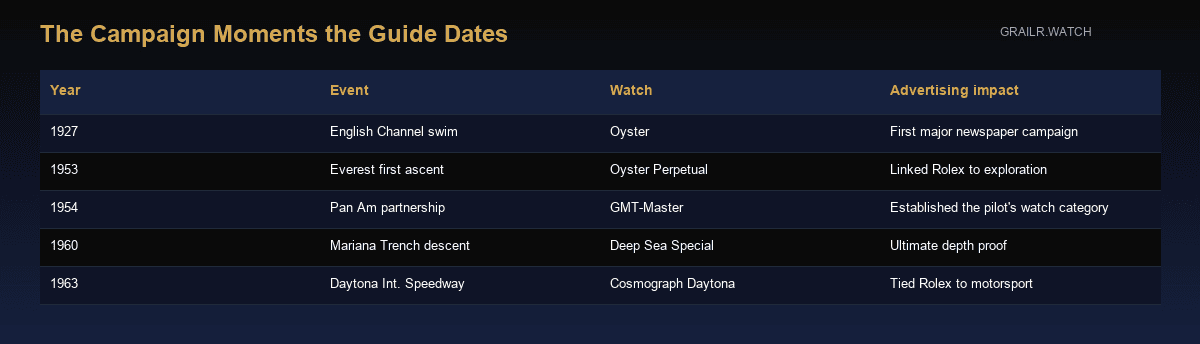
| Year | Event | Watch | Advertising Impact |
|---|---|---|---|
| 1927 | English Channel swim | Oyster | First major newspaper campaign |
| 1953 | Everest first ascent | Oyster Perpetual | Linked Rolex to exploration |
| 1954 | Pan Am partnership | GMT-Master | Established the “pilot’s watch” category |
| 1960 | Mariana Trench descent | Deep Sea Special | Ultimate depth proof |
| 1963 | Daytona International Speedway | Cosmograph Daytona | Tied Rolex to motorsport |
The deepest proof came in 1960 when a Deep Sea Special prototype was strapped to the outside of the Trieste bathyscaphe and descended to the bottom of the Mariana Trench — nearly 11,000 metres. The watch survived. In 1963, André Heiniger took over as managing director and introduced the Cosmograph Daytona, tying the brand permanently to motorsport. By this point, Rolex advertising had a coherent thesis: achievement in extreme conditions proves the product, and the product proves the brand.
Sport Sponsorships and Testimonees
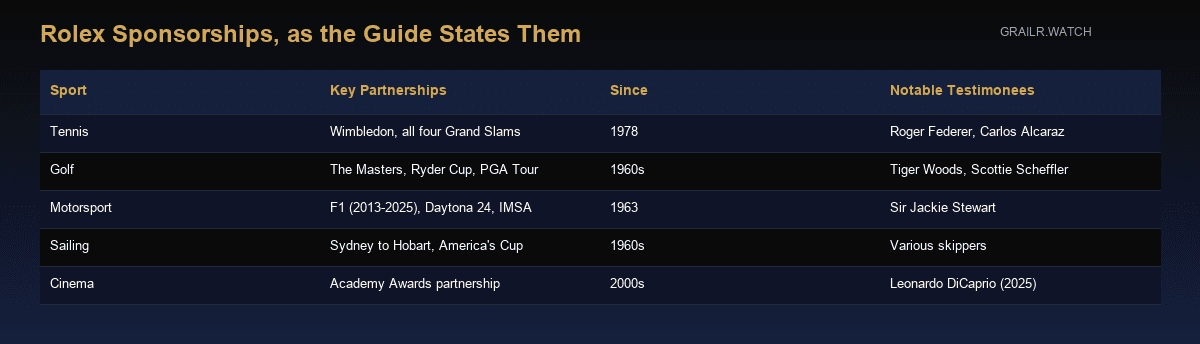
The exploration era established Rolex advertising’s credibility. The sport sponsorship era, beginning in earnest in the 1970s and 1980s, expanded its reach. Rolex became the Official Timekeeper of Wimbledon in 1978 — a partnership now approaching its fiftieth year. The choice of tennis was strategic: unlike team sports, tennis spotlights the individual, and the sport’s traditions of white dress codes, grass courts and royal patronage align with Rolex’s positioning.
Today, Rolex sponsors all four Grand Slam tournaments — Wimbledon, the Australian Open, the French Open and the US Open. In golf, its ties run equally deep: the Masters, the Ryder Cup, the PGA Tour and many of the world’s top players. Rolex’s sailing partnerships include the Sydney to Hobart Yacht Race and involvement with the America’s Cup. Equestrian sport rounds out the sponsorship portfolio.
| Sport | Key Partnerships | Since | Notable Testimonees |
|---|---|---|---|
| Tennis | Wimbledon, all four Grand Slams | 1978 | Roger Federer, Carlos Alcaraz |
| Golf | The Masters, Ryder Cup, PGA Tour | 1960s | Tiger Woods, Scottie Scheffler |
| Motorsport | F1 (2013–~2025), Daytona 24, IMSA | 1963 | Sir Jackie Stewart |
| Sailing | Sydney to Hobart, America’s Cup | 1960s | Various skippers |
| Cinema | Academy Awards partnership | 2000s | Leonardo DiCaprio (2025) |
Rolex deliberately uses the term “testimonee” rather than “ambassador” or “endorser.” The distinction matters: an ambassador represents a brand, but a testimonee, in Rolex’s framing, is someone whose personal achievements speak for the brand without being directed by it. Mercedes Gleitze was the first. Sir Jackie Stewart became a testimonee in 1968 and has remained one for over fifty years — possibly the longest active ambassador relationship in luxury goods. Roger Federer, Tiger Woods and Carlos Alcaraz represent the current generation.
In 2025, Leonardo DiCaprio was announced as a Rolex testimonee. The campaign debuted during the Academy Awards broadcast, connecting Rolex advertising to cinema for the first time at this scale. The move surprised some observers because DiCaprio is known primarily as an actor and environmental advocate rather than an athlete, but it fits Rolex’s broader pivot toward cultural patronage — the brand also sponsors classical music, opera and science initiatives through the Rolex Awards for Enterprise.
The Strategy Behind Rolex Advertising
Rolex advertising works because it follows a small number of principles applied consistently across a century. Understanding these principles helps explain why a brand that never discounts, rarely changes its designs and publishes no annual report still commands more recognition than any other watchmaker on Earth.
Proof Over Promise
Every major Rolex campaign ties a product claim to a visible test. The Oyster survived the Channel. The Deep Sea Special survived the Mariana Trench. The Daytona times races at the speedway that shares its name. This is fundamentally different from aspirational luxury advertising, where the product is associated with a mood or a lifestyle. Rolex advertising says: this watch was there, and it worked.
Scarcity as a Message
Rolex never discounts. Authorized dealers are contractually bound to sell at retail price. This pricing discipline is itself a form of advertising: it tells the market that every Rolex is worth what Rolex says it is worth. When secondary-market prices exceed retail — as they do for the Submariner, Daytona and GMT-Master — the message reinforces itself. The waitlist becomes its own marketing channel.
Visual Consistency
Rolex has used the same green-and-gold colour palette, the same crown logo and roughly the same serif typography for decades. The visual language is so codified that a Rolex advertisement is identifiable at a glance even without the logo. In the 1960s, the brand worked with agencies J. Walter Thompson and Publicis to formalize this identity. By the 1980s, marketing was globally synchronized — the same campaign running in the same style in every market.
Modern Campaigns: 2013–2026
The digital age has changed the channels but not the substance of Rolex advertising. In 2013, Rolex became the Official Timekeeper of Formula 1, placing its logo on the pit-lane clock at every Grand Prix. The partnership began at the Australian Grand Prix and ran for over a decade, reportedly ending around 2025. During that period, the Rolex name appeared on every broadcast, every circuit clock and every timing graphic — passive exposure worth far more than a traditional advertisement, as described in a Formula 1 Q&A with Rolex’s Arnaud Boetsch.
In 2025, Rolex deepened its North American motorsport presence by expanding its role as Official Timepiece of the IMSA Championship, while running the “Reach for the Crown” television campaign tied to the Ryder Cup. The DiCaprio announcement that same year signalled a new front in Rolex advertising: cinema and culture, not just sport.
In 2026, a television spot titled “One Moment Like That: Reach” featured golfer Scottie Scheffler, continuing the golf-centric thread. The year also marks the 100th anniversary of the Oyster case, and Rolex’s teaser campaign reportedly looked more toward the brand’s past than its future — an unusual move for a company that typically lets its products speak for themselves.
Digital and Social Media
Rolex adopted digital platforms slowly and selectively. Its website focuses on product specification and authorized-dealer location rather than editorial content. Social media accounts exist but post infrequently compared to competitors. The restrained digital presence is itself a strategy: Rolex advertising has always prioritized controlled environments — sponsored events, print publications, boutique design — where the brand controls the context. That philosophy extends online. The brand does not chase viral moments. It waits for the moment to come to it, then places a clock next to it.
What Rolex Advertising Teaches About Brand Building
Rolex is not the only luxury brand with a strong advertising presence, but it may be the most consistent. The same principles that drove the 1927 Daily Mail advertisement — proof, association with achievement, visual discipline — are visible in every 2026 campaign. Competitors like Omega (which sponsors the Olympic Games and James Bond), TAG Heuer (which pushed into Formula E and esports) and Hublot (which embraced football and street-art collaborations) have taken different paths. Rolex’s path is narrower, slower and arguably more effective per dollar spent.
For watch buyers, understanding Rolex advertising matters because the marketing is part of what you are paying for. When a Day-Date is called “the President’s watch,” that is not a product specification — it is a half-century advertising campaign that turned a nickname into a category. When a Daytona trades at three times retail, the premium is not just for the movement; it is for the racing heritage that Rolex advertising built around it, compounded over sixty years.
Frequently Asked Questions
How much does Rolex spend on advertising?
Industry analysts estimate Rolex spends $100–150 million per year on marketing. Rolex does not publish its advertising budget, so the exact figure is unverified. The spend is split between event sponsorships, television spots, print campaigns and boutique design.
Does Rolex advertise on television?
Yes. Rolex runs television spots tied to major sporting events such as Wimbledon, the Masters, the Ryder Cup and the Rolex 24 at Daytona. In 2025, a campaign featuring Leonardo DiCaprio debuted during the Academy Awards broadcast.
What is a Rolex testimonee?
Rolex uses the term testimonee rather than ambassador. Testimonees are individuals whose achievements align with the brand’s values of precision, endurance and excellence. Examples include Roger Federer, Tiger Woods, Carlos Alcaraz and Leonardo DiCaprio.
When did Rolex start sponsoring Wimbledon?
Rolex became the Official Timekeeper of The Championships, Wimbledon in 1978. The partnership is still active in 2026 and extends to the Australian Open, French Open and US Open.
Why does Rolex never offer discounts?
Rolex controls its pricing through authorized dealers and never permits discounts. This consistent pricing reinforces the perception that Rolex watches hold their value, which in turn supports the brand’s advertising message of permanence and quality.
What was the first Rolex advertisement?
The most cited early Rolex advertisement is a full-page ad in the Daily Mail on 24 November 1927, which highlighted Mercedes Gleitze’s English Channel swim while wearing an Oyster. Earlier trade advertisements existed, but the Gleitze ad is considered the foundation of modern Rolex advertising.
Related Articles
The Bottom Line
Rolex advertising is not a department or a campaign — it is the product of a century of deliberate choices. From Mercedes Gleitze in the English Channel to Scottie Scheffler on the eighteenth green, the brand has told the same story in different settings: a Rolex was there, and it worked. That consistency is both the strategy and the message. If you’re buying a Rolex, you’re buying into that story whether you think about it or not — and understanding the advertising helps you separate the craft from the mystique.
Sources and context
- Rolex Partners — Behind the Crown — Official list of Rolex sport and cultural partnerships.
- Formula 1 Q&A with Arnaud Boetsch — Interview with Rolex’s Director of Communication about the F1 timekeeping partnership.
- SJX: Shaping the Rolex Identity — In-depth editorial analysis of a century of Rolex marketing and strategic positioning.
These primary and editorial sources support the historical timeline, partnership dates and strategic analysis above. Industry spend estimates are unverified analyst figures, not Rolex disclosures. Confirm current testimonees, partnerships and campaigns on rolex.com.